On this page
- The cross-sell principle: improve an existing decision
- Qualify the client before proposing the add-on
- A three-level offer ladder
- The implementation workflow and approval limits
- Criteria for comparing an intent or identification layer
- Current MarketPulse input and complementary workflows
- Compare the main cross-sell approaches
- Pricing and contribution-margin model
- Put expansion triggers in the original proposal
- Metrics that show revenue quality and profitability
- Margin, scope, data-use, and trust risks
- Design the renewal story during onboarding
- Turn the add-on into recurring buyer-intent service
- Frequently asked questions
- Copyable client add-on test record
Direct answer: Add intent research to an existing client workflow only when a bounded test shows useful review work, an approved action owner and sustainable delivery costs. Start with one actual decision and preserve its baseline, permissions, feedback and missing outcomes. A larger research audience alone does not justify expanding a retainer.
In practice, cross-selling intent data and lead generation succeeds when the new signal improves an existing client decision and the agency prices the ongoing operating work.
Who this is for. This guide is for agency owners, growth leads, paid-media directors, lead-generation teams, and GTM consultants expanding an existing client retainer. It is most useful when the agency already owns campaign, outbound, or pipeline delivery and wants a lower-friction expansion path than selling a completely new service to a cold account.
Current MarketPulse offer: intent-data plans start at $500/mo. See the product, demo, and current plans. Updated October 3, 2026.
The cross-sell principle: improve an existing decision
Do not lead with “we now sell intent data.” Identify a decision already inside the retainer:
- which accounts enter an outbound queue;
- which site visitors receive seller attention;
- which market deserves a paid audience;
- which existing opportunities get research support;
- which accounts receive personalized content; or
- which leads get faster routing.
Then explain what new evidence changes that decision. Firmographic fit says an account could buy. Topic or website activity may suggest that it deserves review now. Identity and enrichment make an action possible where coverage is available. The sales or marketing outcome validates whether the signal was useful.
This makes the add-on easy to understand: the agency is not replacing lead generation. It is prioritizing and improving the work already being delivered.
Qualify the client before proposing the add-on
A strong cross-sell candidate has:
- a specific B2B market and offer;
- enough addressable account or website activity;
- a reachable buying committee;
- clean ownership in the CRM or campaign workflow;
- an activation channel that the agency can operate;
- a response SLA;
- willingness to measure negative as well as positive results; and
- enough client value to support recurring delivery cost.
Disqualify or delay clients with vague ICPs, low traffic and low market activity, sensitive or prohibited contexts, no follow-up capacity, weak permissions, chronic invoice disputes, or expectations of guaranteed meetings.
The existing relationship is an advantage only if the client trusts the agency. Do not spend that trust by presenting probabilistic signals as confirmed buyers.
A three-level offer ladder
1. Signal report add-on
Deliver a branded report for agreed topics, market, fit filters, and cadence. Include source/freshness notes, qualification reasons, coverage limitations, and recommended next steps. This package is useful when the client wants evidence before activation.
Review current MarketPulse topics and plans, starting at $500/mo. Test actual ICP fit, available fields and review effort. Verify current guarantee conditions before testing; a short evaluation does not establish incremental pipeline or revenue.
2. Activated intent add-on
Add identity or company context, enrichment, qualification, routing, audience preparation, or human-reviewed outreach. Define the included channel, record or usage band, SLA, and client approvals. Charge separately for media, email infrastructure, or other variable channel costs.
3. Managed intent growth program
Add ongoing topic governance, threshold changes, workflow QA, account research, activation, outcome reporting, and a monthly strategy review. This is the most defensible recurring service because the agency maintains the operating system rather than sending data.
Avoid unlimited promises in any tier. A new geography, ICP, site, channel, integration, or custom dashboard can materially change cost and risk.
The implementation workflow and approval limits
1. Freeze the current baseline
Record existing lead sources, volume, qualification rate, seller acceptance, time to action, meeting/opportunity outcomes, direct delivery hours, and client fee. Without a baseline, the agency cannot tell whether the add-on improves anything.
2. Choose one signal hypothesis
Select a small topic set, website behavior, or account event tied to a defined offer. Write what the signal means and does not mean. Avoid combining every source in the first iteration.
3. Define fit, identity, freshness, and suppression
Require the record to pass agreed company, role, geography, account-status, recency, contactability, and suppression rules. Keep person and account evidence distinct.
4. Choose one activation play
Examples include an account-research task, a CRM alert, an ad-audience specification, a message draft for approval, or follow-up to an existing relationship. Do not reveal sensitive behavioral detail in the message.
5. Set approval boundaries
Require human approval for external communication, audience spend, bulk export, use of sensitive data, deletion, or irreversible CRM changes. Define who can change topics, thresholds, usage, and scope.
AIMEE can organize supplied context through configured tools. Named owners approve actual exports, messages and destination writes. Confirm permissions, execution acknowledgements and recovery before automating work.
6. Run a shadow or bounded pilot
Review what would have been routed before taking external action. Check topic ambiguity, coverage, matchability, client fit, duplicates, suppressions, and workload. If the output is weak, refine or stop instead of widening the promise.
7. Report the whole funnel
Show raw signals, usable matches, qualified records, accepted actions, completed actions, positive outcomes, opportunities, revenue, and negative evidence separately. The monthly report should tell the client what decisions changed.
8. Review margin and rules together
A rule that improves quality may reduce volume and support a higher-value service. A loose rule can increase volume, manual review, complaints, and delivery cost. Review utilization, exceptions, and direct hours alongside outcomes.
Criteria for comparing an intent or identification layer
Use identical criteria for every option:
- Signal fit: off-site topics, website behavior, first-party activity, account intelligence, or other relevant evidence.
- Identity and qualification: company/person context, enrichment, fit filters, freshness, contactability, and suppression.
- Activation: CRM, audiences, outbound, research, workflow instructions, and outcome write-back.
- Agency economics: actual subscription scope, permitted client work, implementation, allocated usage and direct labor. Custom branding and billing require separate verification.
- Client experience: actual report, access, transparency and support obligations; verify custom delivery separately.
- Implementation and governance: integrations, operations, privacy, security, change management, and measurement.
- Best fit and limitation: where the option strengthens the existing retainer and what can make it uneconomic or unsuitable.
BrandWell publishes this guide to its own product and agency workflow options. Compare the actual research gap, permissions, delivery effort and measured outcomes rather than treating this as an independent provider ranking.
Current MarketPulse input and complementary workflows
MarketPulse topic research
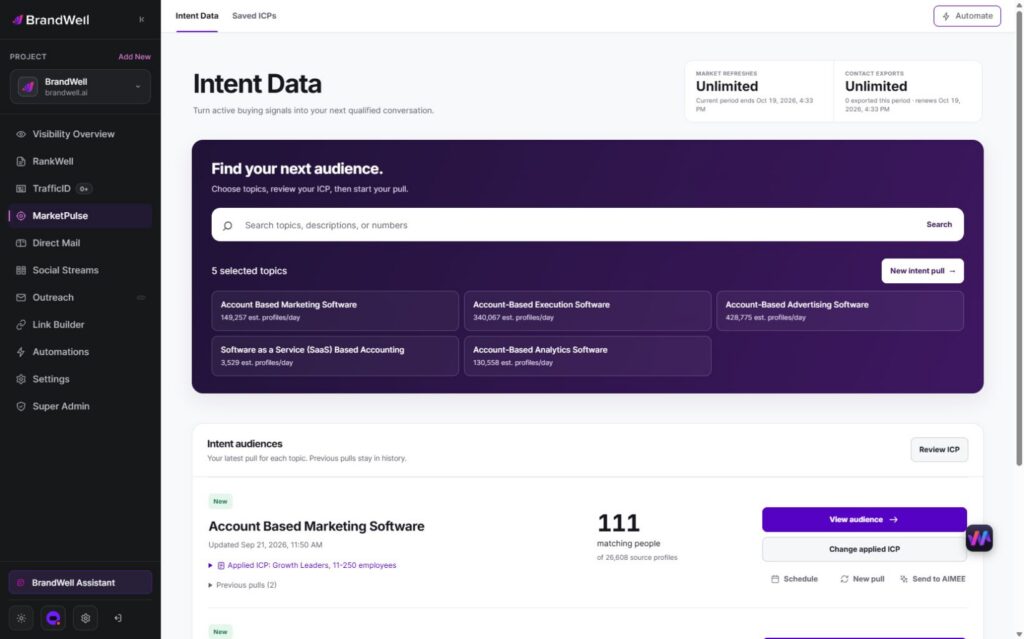
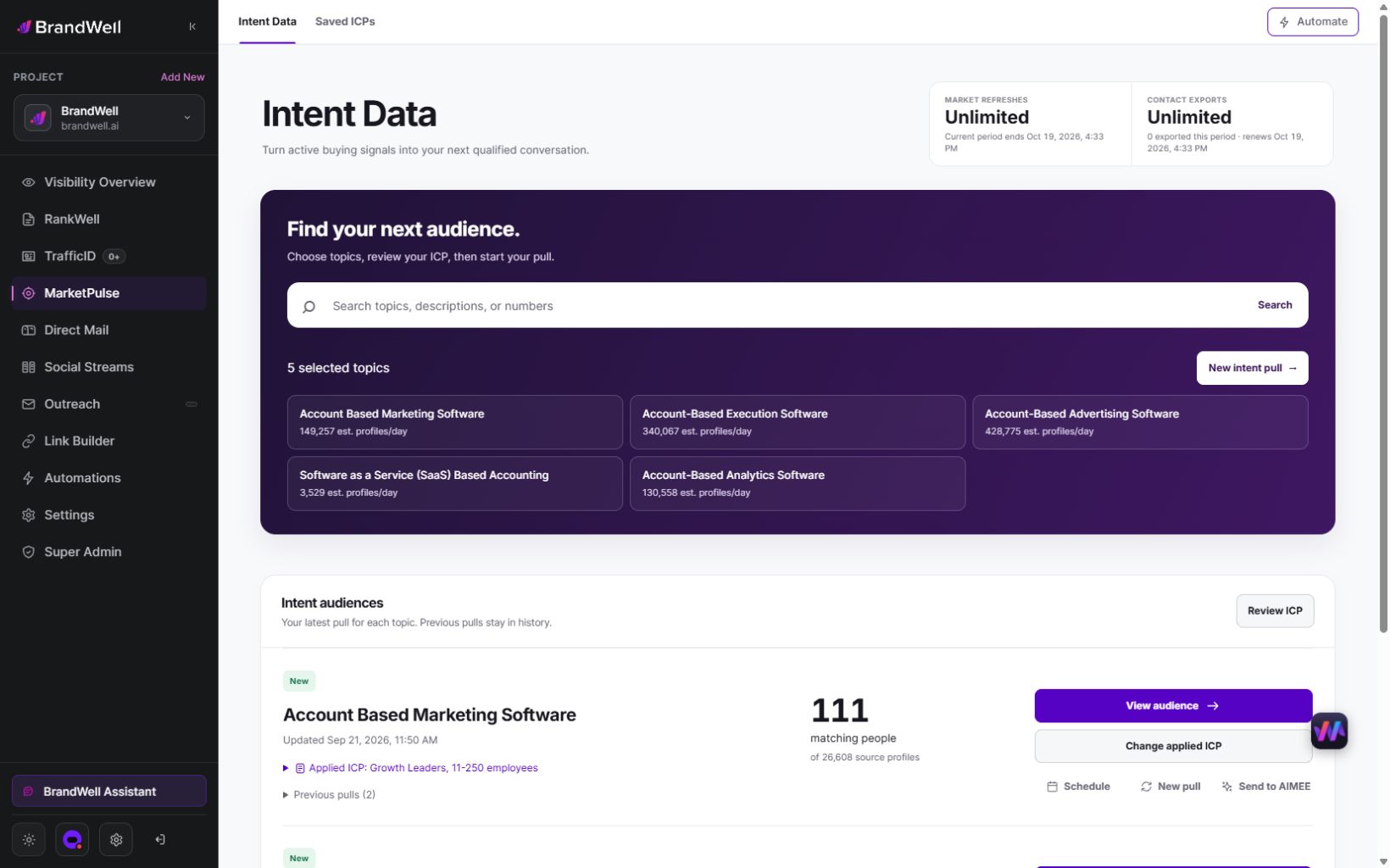
MarketPulse research is starting at $500/mo. Review relevant topics, a saved ICP and available match details before preparing an approved next action.
| Plan | Topics and refreshes | Monthly exports |
|---|---|---|
| Starter | 1 topic, weekly | 25,000 contacts |
| Growth | 3 topics, daily | 100,000 contacts |
| Scale | 10 topics, daily | Unlimited contacts |
Swipe the table to see all columns.
A pull retrieves available data from the previous 24 hours for one topic. Daily use across all included topics provides 90 Growth pulls or 300 Scale pulls in a 30-day month. Weekly Starter pulls vary by calendar month. Available audience size and contact fields vary, and audiences may overlap. Refreshes stop at the plan limit without overage charges.
- Find and qualify: search the topic catalog, save your ICP, and review the people and companies that match.
- Act on the research: export qualified contacts or prepare an Outreach or Direct Mail workflow. Connected products, channel usage, and fulfillment may cost extra.
- Get help from AIMEE: Growth and Scale include AIMEE for the initial user to research accounts and prepare the next step through connected tools.
Agencies and other service businesses can build client deliverables around their available Intent Scans and exports. Keep each client’s scope, permissions, and service fees clear. A subscription is not a promise of a white-label platform or exclusive access to a market.
Explore MarketPulse and watch the demo or compare plans starting at $500/mo. Any early-access discount is a separate, time-limited offer shown to an eligible recipient.
Compare the main cross-sell approaches
Manual research add-on: low platform cost and high control, but labor scales poorly and findings can be inconsistent. Best for a small number of high-value accounts.
Signal-only data add-on: relatively simple to procure, but the agency must supply identity, qualification, activation, reporting, and governance. Margin can look high until fulfillment labor is counted.
Custom branded delivery: separately implemented reports or interfaces can support a repeatable service. Verify client separation, actual rights, support and costs; do not infer those capabilities from a research subscription.
Client-owned implementation: verify the actual internal operating capacity, entitlements and integration work. Define the agency role and costs separately from the client’s subscription.
Status quo: keeping the existing retainer unchanged is rational when signal coverage, client readiness, or economics are poor. Not every account should be expanded.
Pricing and contribution-margin model
Define the client-month unit, actual add-on fee, incurred variable delivery costs and allocation of shared costs. Distinguish scoped contribution from company net profit and document excluded overhead.
Scoped contribution dollars = add-on revenue – allocated platform cost – incurred data/channel costs – direct delivery labor – client-specific tools. Count costs once and keep unused contingency separate.
Contribution margin rate = contribution margin dollars ÷ add-on revenue.
Include:
- platform and module allocation;
- topics, client accounts, traffic, matches, enrichments, exports, or workflow usage;
- implementation and integration;
- analyst and QA time;
- client meetings and reporting;
- outreach or media operations;
- support, rework, and exceptions;
- risk capacity for overages; and
- discounts or referral economics.
Create conservative, expected, and high-usage scenarios. Set approval alerts before an overage changes margin. Do not prescribe one universal agency margin target; allocation and delivery models differ.
Put expansion triggers in the original proposal
Define when the add-on should grow, pause, or contract. Expansion can follow sustained usable-signal volume, available seller capacity, healthy contribution margin, reliable response SLA, and an approved new market or channel. Pause when complaints rise, owners stop acting, identity quality falls, or the client cannot provide outcome data. Contract the scope when paid capacity remains unused. These triggers keep the monthly review commercial and operational: the agency expands because evidence and capacity support it, not because a dashboard can produce more rows.
Metrics that show revenue quality and profitability
Track four layers:
- Service adoption: proposal acceptance, attach rate, pilot-to-paid conversion, and time to launch.
- Signal utility: coverage, matchability, fit, contactability, accepted records, and activation speed.
- Pipeline quality: replies, meetings, qualified opportunities, opportunity value, progression, and win/loss reasons.
- Agency economics: actual subscription scope, permitted client work, implementation, allocated usage and direct labor. Custom branding and billing require separate verification.
Use a baseline or matched comparison. A client with improving demand may have grown without the add-on; a client with a weak sales process can squander good signals. Report influence separately from causation.
Margin, scope, data-use, and trust risks
- Raw-list positioning: creates a one-time commodity and encourages volume expectations.
- Unbounded delivery: new topics, markets, identities, and channels quietly become standard.
- Low utilization: the agency pays for capacity it cannot allocate.
- High utilization without controls: overages or manual exceptions erase margin.
- False precision: probabilistic signals are presented as confirmed buyers.
- Creepy activation: messages reveal observed research behavior.
- Channel violations: outreach or ads ignore law, platform policy, or suppression.
- Weak attribution: normal demand receives intent-program credit.
- Vendor-rights mismatch: external-client use, export, or resale is assumed.
- Automation without approval: an agent sends, spends, exports, or edits records beyond its authority.
Verify the actual jurisdiction, recipient, channel, source, purpose, destination rules and opt-out requirements before activation. Assign approval and suppression ownership for the implemented workflow. Resolve missing permissions before use.
Design the renewal story during onboarding
The renewal should not depend on one dramatic deal. Agree at launch on the operating evidence the client will receive: topic coverage, usable-signal yield, action speed, sales acceptance, campaign learning, opportunity outcomes, data-quality issues, and changes made. Keep a decision log showing which topics were added or removed, which threshold changed, and what the client learned. At renewal, compare the maintained program with the cost and weakness of the prior workflow. If the service did not produce enough utility, recommend a narrower package, a different activation path, or cancellation. That honesty protects long-term agency trust and prevents a low-value add-on from consuming delivery capacity.
Turn the add-on into recurring buyer-intent service
The recurring version should include:
- market and topic governance;
- identity, fit, freshness, and suppression rules;
- separately verified client access and custom delivery responsibilities;
- a defined usage band;
- one or more approved activation plays;
- workflow instructions and approval boundaries;
- weekly launch QA and monthly operations review;
- branded signal-to-outcome reporting;
- margin and capacity review;
- quarterly scope and data-use review; and
- expansion paths for topics, markets, visitor identification, enrichment, paid audiences, or outreach.
Review current MarketPulse topics and plans, starting at $500/mo. Test actual ICP fit, available fields and review effort. Verify current guarantee conditions before testing; a short evaluation does not establish incremental pipeline or revenue.
Frequently asked questions
How should an agency cross-sell intent data without hurting margin?
Add one governed signal-to-action use case to an existing workflow, define usage and labor, price from contribution margin, and expand only after the client and agency can operate it profitably.
What rules and review cadence are required?
Define source, fit, identity, freshness, suppression, routing, approvals, usage, actual service commitments and feedback. An illustrative cadence is weekly launch review and monthly scope and margin review; adjust it to actual risks and obligations.
Which calculators and templates are most useful?
Use a contribution-margin model, capacity ledger, topic brief, qualification rule, workflow map, RACI, pilot scorecard, data-use checklist, monthly outcome report, and change-order form.
How do the main options compare?
Manual research needs a scoped labor budget. Topic research requires qualification and an action owner. Own-site identification supplies different context. Custom branded delivery needs its own implementation and rights. Keep the existing service when readiness or economics do not justify an add-on.
What pricing assumptions matter most?
Platform allocation, included capacity, usage, direct labor, integrations, campaign costs, meetings, support, overages, and client-specific exceptions matter more than the headline subscription alone.
Which metrics show profitable growth?
Track attach rate, recurring revenue, contribution margin, utilization, direct hours, retention, expansion, usable-signal yield, speed, qualified opportunities, and revenue with attribution limits.
Which clients are the best fit?
Defined B2B ICPs, sufficient activity, reachable buyers, responsive owners, good CRM discipline, existing activation, and meaningful customer value indicate fit. Low readiness or sensitive use disqualifies.
Which signals and identity checks matter most?
Relevant and recent topic or website evidence, source provenance, company/person level, fit, contactability, suppression, action eligibility, and downstream outcomes should all be visible.
What risks affect trust and margin?
Overclaiming, unlimited scope, poor utilization, overages, false matches, creepy messages, unapproved automation, weak attribution, unclear data rights, and hidden delivery labor are the biggest risks.
How should the service change when it becomes recurring?
Move from a report or list to maintained topic governance, qualification, activation, QA, reporting, capacity management, and scheduled optimization. The recurring value is the managed operating loop.
Copyable client add-on test record
Decision: [Existing client decision and owner.] Input: [Topic research, own-site context or supplied first-party evidence.] Baseline: [Mature cohort, actions and costs.] Gates: [Fit, purpose, permissions and capacity.] Action: [Approved task and destination acknowledgement.] Result: [Completed feedback and unresolved outcomes.] Economics: [Fee, incurred cost, exclusions and separate contingency.] Decision: [Hold, continue, repair or expand.]
Keep different research inputs separate
Use MarketPulse for topic research and review available matches against a saved ICP. TrafficID supplies separate own-site visitor context. Additional stakeholders are not automatically the people observed visiting. Neither input establishes buying authority, permission to contact or a buyer-confirmed opportunity.
Update the operating cost assumptions
The GAO cost-estimating guide includes assumptions, sensitivity analysis and updates from actual costs. It does not provide an agency-margin target.
Added revenue is not added profit
A fictional $2,000 monthly agency add-on incurs $500 allocated platform cost, $800 labor, $200 support and $100 tools: $1,600 total. Scoped contribution is $400, or 20%, before excluded overhead and taxes. An unspent $300 reserve belongs in the budget separately. Another $600 of actual delivery work makes the contribution negative $200 unless scope or price changes.
Missing feedback is not a negative response
A fictional 40-account cohort produces 30 approved actions and 24 feedback records, including four unique qualified opportunities. Six actions have unresolved outcomes. Report four of 24 observed feedback records and four of 30 approved actions; keep the six unknowns visible. An attributed association is not causal lift.
Do not expand beyond action capacity
A fictional weekly review identifies 60 eligible tasks, but named owners can complete only 20 within the evidence lifetime. Hold or narrow the remaining work and record expiry. Buying more research capacity does not resolve the operating bottleneck.
Review current research: explore MarketPulse and current plans.
Reviewed and updated October 3, 2026.

Written by