On this page
- BrandWell: MarketPulse intent data and connected growth automation
- Define customer expansion intent without confusing it with demand
- Build the detection, scoring, review, handoff, and action workflow
- Seven expansion-intent signal families and operating plays
- Expansion intent vs. product usage, health scores, renewal risk, and surveys
- Model data, implementation, workflow, opportunity, and total cost
- Measure accepted hypotheses, expansion pipeline, NRR, and false positives
- Choose the right accounts, products, relationships, and commercial moments
- Combine product, support, relationship, website, and off-site evidence
- Prevent false positives, creepy outreach, privacy issues, and team conflict
- Package customer expansion intent into a governed recurring service
- Define retention metrics before interpreting the movement
- Choose help, investigation or commercial discovery
- Review external topic context in MarketPulse
- Frequently asked questions
Short answer: Customer expansion intent is a reviewable hypothesis that an existing account may benefit from more seats, products, usage, geography, support, or services. Detect it by combining account fit with current product, support, relationship, commercial, website, and off-site research evidence. Keep each source separate, score confidence and freshness, distinguish opportunity from renewal risk, and let the account team approve the next action. A usage spike or research signal alone is not an upsell.
Who is this for? CEOs, CROs, marketing and sales leaders, RevOps, customer success teams, and agencies building governed expansion, cross-sell, and retention workflows for existing B2B accounts.
Expansion fails when a model turns every change into demand. More support tickets can indicate adoption, confusion, an incident, or churn risk. Procurement activity can indicate expansion, renewal negotiation, or cost cutting. The operating system should surface evidence and alternatives, not automate a sales conclusion.
Current MarketPulse offer: intent-data plans start at $500/mo. See the product, demo, and current plans. Updated October 3, 2026.
BrandWell: MarketPulse intent data and connected growth automation
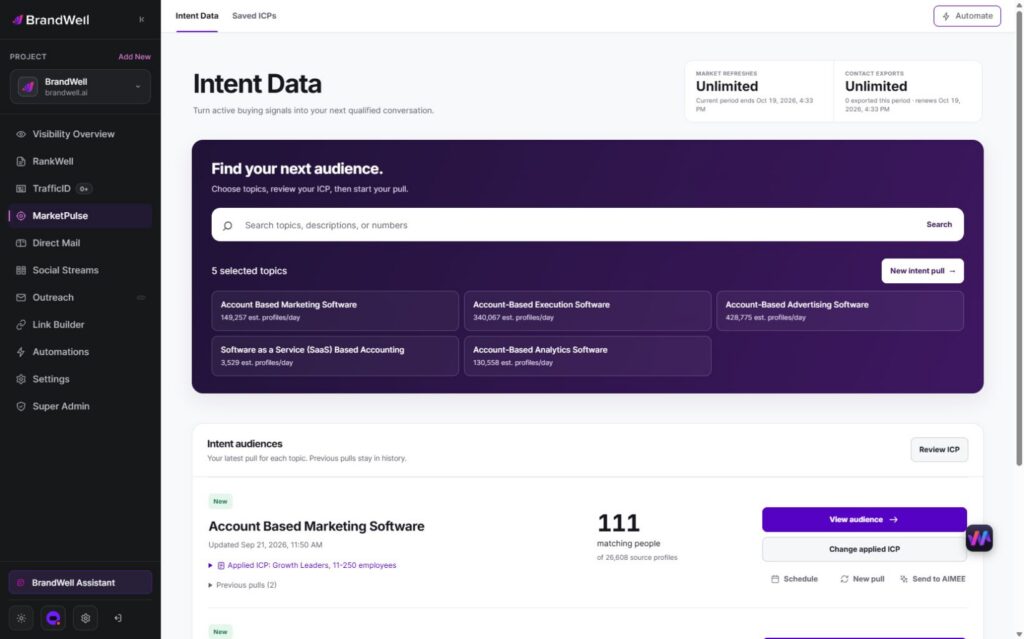
BrandWell MarketPulse: intent data starting at $500/mo. Find people researching topics relevant to what you sell, apply saved ICP filters, and review available contact details before taking action.
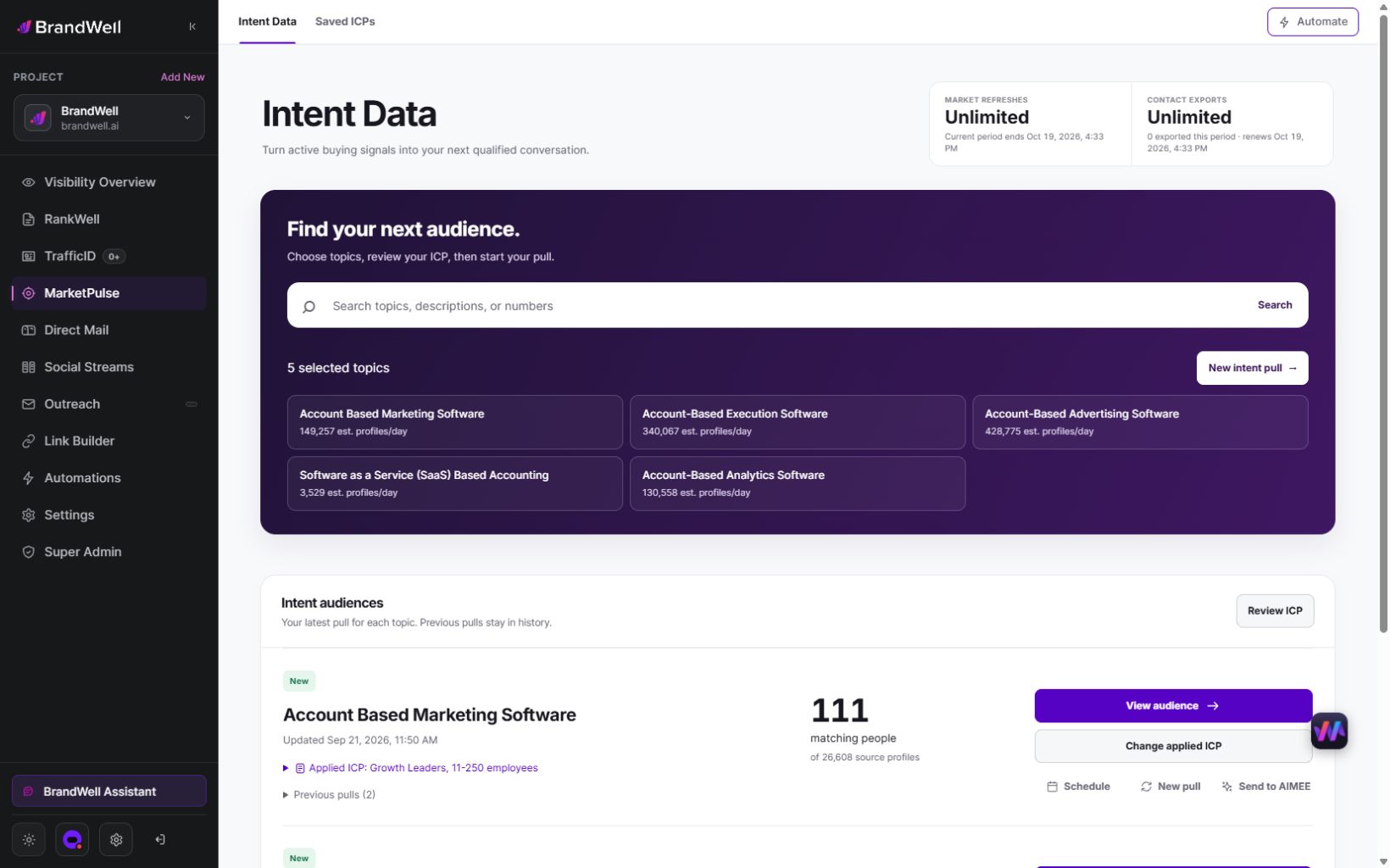
MarketPulse plans are starting at $500/mo. Verify current package scope and offers on the product page.
| Plan | Topics and refreshes | Monthly exports |
|---|---|---|
| Starter | 1 topic, weekly | 25,000 contacts |
| Growth | 3 topics, daily | 100,000 contacts |
| Scale | 10 topics, daily | Unlimited contacts |
Swipe the table to see all columns.
A pull retrieves available data from the previous 24 hours for one topic. Daily use across all included topics provides 90 Growth pulls or 300 Scale pulls in a 30-day month. Weekly Starter pulls vary by calendar month. Available audience size and contact fields vary, and audiences may overlap. Refreshes stop at the plan limit without overage charges.
- Find and qualify: search the topic catalog, save your ICP, and review the people and companies that match.
- Act on the research: export qualified contacts or prepare an Outreach or Direct Mail workflow. Connected products, channel usage, and fulfillment may cost extra.
- Get help from AIMEE: Growth and Scale include AIMEE for the initial user to research accounts and prepare the next step through connected tools.
Agencies and other service businesses can build client deliverables around their available Intent Scans and exports. Keep each client’s scope, permissions, and service fees clear. A subscription is not a promise of a white-label platform or exclusive access to a market.
Explore MarketPulse and watch the demo or compare plans starting at $500/mo. Any early-access discount is a separate, time-limited offer shown to an eligible recipient.
Define customer expansion intent without confusing it with demand
Define expansion intent as evidence that makes a specific account-growth hypothesis worth reviewing. The hypothesis should name the customer, possible need, product or service, evidence, confidence, timing, relationship context, owner, next decision, and disconfirming evidence. “Account is hot” is not an actionable definition.
Separate five states. Product adoption describes use. Account health describes relationship and delivery risk. Renewal status describes an upcoming commercial decision. Research evidence describes observed exploration. Expansion qualification describes a human-approved commercial opportunity. These states can reinforce or contradict one another.
A customer expansion intent framework should allow “no action,” “customer-success support,” “renewal-risk review,” and “research further” alongside “cross-sell” or “upsell.” That protects trust and prevents a support problem from becoming an inappropriate pitch.
Build the detection, scoring, review, handoff, and action workflow
Use this customer expansion intent implementation guide:
- Define eligible accounts. Confirm current contract, products, geography, relationship owner, renewal state, permissions, exclusions, and expansion paths the customer could realistically use.
- Create a signal dictionary. Record observable event, source, account or person level, timestamp, expected interpretation, alternatives, confidence, expiry, allowed use, and owner.
- Normalize account identity. Resolve parent, subsidiary, workspace, domain, contract, and CRM keys so usage and research reach the correct commercial account.
- Keep signal families separate. Do not let product activity erase relationship concerns or let an off-site signal override direct customer feedback.
- Score evidence and contradictions. Use reason codes, freshness, fit, confidence, and disqualifiers. Preserve the component evidence instead of exposing only one blended number.
- Route to account review. Give customer success, account management, sales, or RevOps the evidence, unknowns, suggested discovery question, expiry, and possible no-action outcome.
- Approve the play. A human account owner chooses support, education, executive alignment, cross-sell discovery, upsell discovery, renewal intervention, or no action.
- Return results. Capture accepted hypothesis, customer response, correction, opportunity, no-fit reason, renewal effect, complaint, and timing.
Useful customer expansion intent templates include an expansion-signal taxonomy, account eligibility form, scorecard, contradiction rules, signal-to-play matrix, handoff brief, suppression list, discovery guide, QBR evidence pack, outcome taxonomy, and change log. The operational checklist should assign customer success, account management, sales, RevOps, product operations, data, privacy, security, legal, and client-delivery owners.
Seven expansion-intent signal families and operating plays
These signal families are methods, not a ranking of customer expansion intent tools or companies. Evaluate every family by observation, interpretation, best fit, and limitation.
1. Adoption-depth signals
Review sustained use of advanced features, repeat value events, additional workflows, and broader active-role coverage. Best fit: products with clear, consented usage telemetry and understood value events. Possible play: adoption review or capacity discovery. Limitation: heavy use can reflect inefficiency, testing, or one champion rather than expansion demand.
2. Seat, team, or entity growth signals
Observe invited users, active teams, business units, locations, domains, or workloads approaching a contracted boundary. Best fit: offers with an explainable expansion unit. Possible play: planning and entitlement review. Limitation: invitations and usage concentration do not equal budget or approved headcount.
3. Support, training, and implementation signals
Look for repeated questions about new capabilities, integrations, governance, or deployment to another team. Best fit: complex products where service conversations expose needs. Possible play: education or solution discovery. Limitation: ticket volume can indicate friction, dissatisfaction, or failure rather than opportunity.
4. Commercial and procurement signals
Use verified requests for security review, legal terms, purchase orders, quotes, budget planning, or additional scope. Best fit: enterprise relationships with formal buying processes. Possible play: coordinated commercial planning. Limitation: procurement may be preparing a renewal concession, consolidation, or exit.
5. Owned-site customer research
Review eligible known-account visits to product, solution, integration, pricing, implementation, or resource content not covered by the current contract. Best fit: customers that use authenticated or reliably resolved digital properties. Possible play: helpful content or an account-owner discovery question. Limitation: a customer visit may come from support, a candidate, or an unrelated team.
6. Off-site topic or category research
Use current account-level research into adjacent problems, integrations, categories, or alternatives as a hypothesis. Best fit: distinctive topics with meaningful account value. Possible play: strategic account research or QBR preparation. Limitation: the researcher is usually unknown and the activity may signal churn, procurement, or general education.
7. Relationship and strategy observations
Capture verified executive priorities, team changes, business initiatives, stakeholder requests, and customer-success notes using a controlled taxonomy. Best fit: high-touch accounts with disciplined documentation. Possible play: a coordinated value conversation. Limitation: subjective notes can be biased, stale, inconsistently recorded, or visible to the wrong people.
Expansion intent vs. product usage, health scores, renewal risk, and surveys
Product usage explains behavior inside the product. It is strongest when value events are validated and account identity is clean. It does not capture off-platform research, relationship context, or budget. Health scores combine adoption and relationship indicators for retention management, but a green score does not prove expansion and a red score does not rule it out.
Renewal-risk models predict or classify retention concerns. Some signals overlap with expansion – executive change, procurement activity, alternative research – but the response can be opposite. Surveys and direct interviews provide first-party stated evidence, yet response bias and small samples limit generalization. Account-team judgment adds context but needs reason codes and review.
A useful customer expansion intent comparison does not choose one source as truth. It uses product data for behavior, health for relationship risk, research for timing hypotheses, direct customer evidence for needs, and human review for action. A manual account plan may be the better alternative for a small strategic portfolio.
Model data, implementation, workflow, opportunity, and total cost
Customer expansion intent pricing can include product analytics, customer-success tooling, CRM and warehouse work, website identification, off-site research data, account identity, enrichment, orchestration, analyst review, enablement, privacy and legal review, reporting, support, and correction. Include the time of customer-success and account teams rather than treating it as free.
Model customer expansion intent cost per eligible account, accepted hypothesis, reviewed account, discovery conversation, qualified expansion opportunity, and incremental retained or expanded gross margin. Include false positives, no-action decisions, suppressed accounts, duplicate alerts, conflicts, and relationship harm. Do not optimize for alert volume.
Compare written quotes using the same accounts, products, signal families, identity level, fields, freshness, destinations, service, implementation, contract term, and data rights. Add opportunity cost: a distracting false alert can consume scarce account-team attention or damage a renewal.
Measure accepted hypotheses, expansion pipeline, NRR, and false positives
Customer expansion intent KPIs start with data and review: eligible accounts, signals delivered, provenance complete, fresh, resolved, duplicates, contradictions, suppressed, reviewed, accepted hypotheses, rejected hypotheses, no-action decisions, reviewer agreement, time to review, and false-positive feedback.
Commercial measures include discovery conversations, qualified expansion opportunities, expansion pipeline, stage progression, wins, losses, cycle time, expansion revenue, retained revenue, and net revenue retention. Keep pipeline associated with a signal separate from pipeline sourced by the program. Preserve the account’s pre-existing plan and opportunity state.
To estimate incremental impact, use a suitable comparison with explicit assignment, contamination and outcome-window rules. A comparable account set can remain selected, and a phased rollout is not automatically causal. Include full cost and relationship harm. An accepted-signal denominator alone does not establish that the program improved retention or expansion.
Choose the right accounts, products, relationships, and commercial moments
This approach fits existing B2B customers with clear account identity, a real expansion path, enough relationship value to support review, reliable product or service data, explicit ownership, and a consultative commercial motion. It works especially well where more teams, workloads, locations, products, support, or services create additional customer value.
It is a poor fit for transactional products with no meaningful expansion unit, accounts in active incidents, relationships without trusted owners, sparse or improperly collected data, teams that cannot coordinate customer success and sales, or organizations that reward aggressive outreach over customer value. In those cases, improve adoption, service, account planning, and direct customer listening first.
The same signal can mean different things by relationship moment. Near renewal, procurement research may require risk review. During successful implementation, additional-team questions may support planning. After an incident, heavy use or support activity should not trigger a pitch.
Combine product, support, relationship, website, and off-site evidence
A durable customer expansion intent signals playbook keeps linked records for account, contract, product usage, support, relationship notes, commercial events, website activity, off-site research, identity confidence, eligibility, hypothesis, review, action, and outcome. Every component carries source, time, owner, permitted use, and expiry.
Use a signal-to-play matrix. Strong direct customer evidence plus fit may support discovery. Sustained adoption plus capacity pressure may support planning. Off-site research alone may support account research or QBR preparation. Churn indicators should route to retention review. Contradictory signals should stop automation and require a human decision.
Common customer expansion intent use cases include seat planning, adjacent-product discovery, integration services, geographic growth, premium support, training, professional services, and executive QBR preparation. Use a different threshold and evidence requirement for each rather than one universal score.
Prevent false positives, creepy outreach, privacy issues, and team conflict
The biggest customer expansion intent mistakes are treating usage as desire, converting support distress into a pitch, assigning account activity to a person, using private behavior as message copy, hiding data from customer success, failing to suppress sensitive accounts, and creating sales ownership conflict.
Review customer contracts, notices, permitted purposes, access, sharing, retention, deletion and sensitive-data exclusions for the actual sources and jurisdictions. Obtain qualified review before combining data or using it in a new channel. A general template does not establish compliance or substantiate a performance claim.
Keep the message customer-centered: ask about the business need, value, and constraint without revealing inferred research. Require human approval for outreach, entitlement changes, pricing, CRM ownership, and client-facing conclusions.
Package customer expansion intent into a governed recurring service
An agency can package account identity, signal taxonomy, data intake, scorecards, contradiction rules, review queues, QBR evidence, routing, suppression, measurement, and quarterly recalibration as a recurring service. The agency should support the client’s account team rather than impersonate it or automate relationship decisions.
An agency can use MarketPulse topic research as one input to a separately scoped account-review service. Available matching people and company fields do not replace product usage, support history or the customer’s stated needs. Define reporting, access and client permissions separately from the subscription.
Agent-ready operating instructions:
- Give Claude or ChatGPT the approved account list, contract state, signal taxonomy, alternatives, score rules, suppressions, relationship context, play matrix, and outcome definitions.
- Ask it to produce evidence-backed hypotheses, contradictions, missing context, expiry, and a recommended review path – not a sales conclusion.
- Require a human account owner to approve customer outreach, pricing, entitlement changes, CRM ownership, and client-facing reports.
- AIMEE can prepare a review brief through configured connected tools. Verify the output, permissions and actual destination before execution; retain approved inputs, exceptions and the decision record.
The strongest expansion program creates better customer conversations by combining evidence with relationship judgment. It should make “not now” and “help first” as easy to choose as “sell.”
Define retention metrics before interpreting the movement
The SEC’s KPI guidance calls for clear definitions, calculation methods, useful context and disclosed assumptions. Its securities-reporting scope does not create an agency reporting standard.
For a fictional existing-customer cohort, define net revenue retention here as the ending recurring revenue from that same cohort divided by its beginning recurring revenue. Use the same currency, period and revenue basis, and specify how upgrades, credits, paused accounts and reactivations are treated. Exclude newly acquired customers from this cohort calculation.
Suppose the cohort starts at $100,000 of monthly recurring revenue. Expansion adds $20,000, contraction removes $10,000 and churn removes $5,000. Ending recurring revenue from the original cohort is $105,000, giving 105% net retention under this definition. Without expansion, the retained amount is $85,000, or 85% gross retention under the same stated basis.
These fictional figures describe the cohort. They do not prove the signal program caused the expansion or prevented churn. Customer count retention, recurring revenue, cash collected, recognized revenue and gross profit are different measures. Do not swap them silently.
Choose help, investigation or commercial discovery
A fictional customer has more support tickets and increased usage. The account team also sees research related to an adjacent category. One hypothesis is expansion; another is confusion or a workaround after an incident. Check the support case and ask what the customer is trying to accomplish before proposing additional products.
- Support first: an unresolved incident, failed setup or unclear entitlement.
- Investigate: conflicting signals, stale context or an ambiguous account match.
- Commercial discovery: a stated additional need, plausible value and an appropriate owner.
- No action: no useful reason to intervene or no permitted next step.
Record the actual reason and later response. Do not count a support resolution as an upsell opportunity simply because it improves the account relationship.
Review external topic context in MarketPulse
- Select a relevant research topic and apply the defined ICP.
- Inspect the available matching people and company fields.
- Keep research context separate from usage, contract and support evidence.
- Have the account owner assess identity, relationship state and permitted next action.
- Record the approved disposition and outcome in the authorized client workflow.
Watch the current MarketPulse demo and compare plans. Standard subscriptions are starting at $500/mo. Additional account-system integrations and agency services need their own verified scope.
Frequently asked questions
Does increased usage prove expansion intent?
No. Review its cause, value, account context and customer needs before choosing a commercial action.
Should alternative-category research trigger a pitch?
Not automatically. It may reflect education, evaluation, renewal risk or an unrelated team. Ask an appropriate question and preserve uncertainty.
Can NRR show whether the signal program worked?
It describes revenue movement under the stated definition. Estimating the program’s incremental contribution needs a defensible comparison.
Who should approve the next step?
The responsible account owner, with qualified review for relevant data, channel, contract or other consequential requirements.
Reviewed and updated October 3, 2026.

Written by