On this page
- Use intent to choose the account, not to claim certainty
- Run the intent-to-mail workflow with explicit gates
- Six intent-based direct mail plays and failure modes
- Compare intent-led, manual, and digital-only approaches
- Model total cost before setting a per-piece budget
- Measure direct mail with a holdout and account timeline
- Identify best-fit and poor-fit use cases
- Combine fit, intent, identity, address, and economics
- Control privacy, security, and recipient-experience risk
- Package an agency intent-to-mail service
- Calculate response and lift separately
- Use the current BrandWell postcard workflow
- Start with a MarketPulse topic review
This proposed account-level playbook uses selective, reviewed mail rather than an indiscriminate list. Define ICP fit, relevant recent evidence, an appropriate recipient and address, a useful offer and coordinated follow-up. Inspect observed and inferred evidence separately: an account signal does not prove a named person requested mail.
Who is this for? VPs of Sales, SDR, RevOps, growth and ABM leaders, and agency owners with a defined target-account market, meaningful deal economics, reliable business-address operations, and CRM outcomes. It is not for teams planning surprise packages to personal residences or indiscriminate high-volume mail.
Current MarketPulse offer: intent-data plans start at $500/mo. See the product, demo, and current plans. Updated October 1, 2026.
Use intent to choose the account, not to claim certainty
An intent-based direct mail strategy should answer five questions before anything is printed:
- Does the account fit the commercial and geographic criteria?
- Is the observed activity recent, relevant, and corroborated?
- Is the identity resolved at the right level for the proposed mailpiece?
- Is the business address accurate and is the use permitted?
- Is there an offer and human follow-up plan appropriate to that evidence?
Keep account and person evidence separate. A topic signal or company-level website association can prioritize research, but it does not establish which employee researched the topic. Inspect the actual observation and matching method, source date, available fields and unresolved records. A known CRM contact is different from a newly appended individual.
The purpose of direct mail for intent accounts is to allocate a costly, tangible channel to a small eligible cohort and learn whether it creates incremental qualified conversations. It is not a claim that the recipient is “in market.”
Run the intent-to-mail workflow with explicit gates
Use this implementation guide and operational checklist:
- Define the outcome and unit. Choose an account-level outcome such as a qualified conversation, opportunity-stage meeting, event attendance, or expansion discussion.
- Create the eligible account pool. Apply ICP, territory, customer status, opportunity conflicts, suppression, sensitive-use, and jurisdiction rules.
- Score evidence. Combine recent topic activity, first-party behavior, CRM engagement, events, and public business context. Require corroboration for higher-cost pieces.
- Resolve the recipient appropriately. Prefer a known relevant business contact or a role-addressed account mailer. Preserve match type and confidence; do not infer that a person generated account-level activity.
- Validate the address. Standardize, check deliverability, remove duplicates, and define how moves, returns, and undeliverable items are handled. The Postal Service says it does not sell address lists, but provides tools to help check, standardize, and update addresses in its business-mail guidance.
- Choose a proportional offer. Match production value to evidence strength and expected account economics. Useful content is safer than a high-value gift when identity or policy is uncertain.
- Create a holdout before fulfillment. Randomly withhold an eligible portion where volume permits; keep assignment stable and document exclusions.
- Send through an approved process. Use a fulfillment SLA, proof approval, inventory controls, address security, and shipment or return logging.
- Coordinate human follow-up. Give the owner a delivery window and business-relevant message. Never reveal private behavioral detail.
- Record outcomes and purge. Write delivery, response, qualification, opportunity, revenue, return, complaint, and suppression back to the system; delete unnecessary address data on schedule.
The team typically includes demand generation or ABM, RevOps, sales leadership, creative, fulfillment operations, procurement, analytics, privacy or legal counsel, and security. Integrations may connect intent and identity data, CRM, address validation, fulfillment, suppression, tracking, and outcome reporting.
Six intent-based direct mail plays and failure modes
Evaluate each play on the same criteria: signal threshold, recipient confidence, address quality, offer relevance, unit economics, follow-up, and measurable outcome.
1. Role-addressed insight brief
Send a concise, branded industry or topic report to the relevant function at a verified business location when the account is high fit but person-level identity is uncertain. Follow with account-level advertising or researched outreach.
Failure mode: A general role addressee may never reach a decision-maker. The piece must still be useful without personalizing around unverified behavior.
2. Known-contact problem-solving kit
Send a modest guide, checklist, or diagnostic to an eligible known contact whose prior relationship and current account signals support the topic. Give the seller a value-led follow-up prompt.
Failure mode: A known contact may have changed roles or preferences. Prior contact does not automatically authorize every new purpose, channel, or gift.
3. Event or meeting accelerator
Use mail to support a declared event registration, scheduled meeting, or opportunity stage. The package can prepare stakeholders, summarize an agenda, or provide a working session artifact.
Failure mode: Sending before attendance or ownership is confirmed creates waste, and expensive gifts can create procurement, ethics, or company-policy problems.
4. Buying-group education pack
Send a role-neutral implementation or risk-reduction asset to an account location while digital media reaches several functions. Coordinate content themes without claiming to know who researched what.
Failure mode: Large or distributed companies may route mail poorly, and one location may not represent the buying group. Narrow audience scale can also weaken measurement.
5. Triggered executive note with human approval
Combine a public business trigger with a recent permitted intent signal, then let the account owner approve a short, non-creepy note and relevant proof asset.
Failure mode: Public events can be misread and intent may be stale or probabilistic. Automated handwritten-style personalization can feel deceptive if no human actually reviewed it.
6. Opportunity-stage objection resolver
At the seller’s request, mail a tangible security, implementation, ROI-method, or stakeholder-alignment asset designed for a known deal question. Treat it as sales enablement, not anonymous acquisition.
Failure mode: Uncoordinated mail can contradict the deal strategy, disclose an opportunity internally, or reach a stakeholder whom the seller did not approve.
These are better “tools” than a vendor roster: an intent-to-mail scorecard, address and permission gate, offer matrix, fulfillment SLA, holdout assignment, follow-up template, and return/suppression log. If comparing intent-based direct mail software, platforms, companies, services, or vendor alternatives later, score all of them against these operational requirements and verify current capabilities and written pricing; do not let a logo list replace the playbook.
Compare intent-led, manual, and digital-only approaches
Manual direct mail based on seller judgment works for a very small named-account list and high-value opportunities. It offers context and control but is hard to standardize. Non-intent direct mail supports broad awareness or geographic coverage, yet spends equally on accounts with different fit and timing. Digital-only activation is faster, cheaper per touch, and easier to change, but it may blend into crowded channels.
Intent-based direct mail adds a prioritization layer and can reserve higher unit cost for stronger evidence. It also adds data rights, address quality, fulfillment, coordination, and attribution complexity. Use it when the eligible cohort is small enough to review, the potential account value can justify the full cost, and the physical artifact has a clear job.
A 2023 study published in the Journal of the Academy of Marketing Science analyzed a beauty retailer and an apparel retailer, with a randomized field experiment at the beauty retailer. Channel response varied by customer segment. These retail findings are not B2B response benchmarks or proof that intent-triggered mail creates lift in your market.
Model total cost before setting a per-piece budget
Direct mail for intent accounts pricing includes intent and identity data, address sourcing and validation, creative, print, packaging, postage, fulfillment, inventory, tracking, seller research, follow-up, CRM integration, returns, security, legal review, and agency management. Gifts introduce approval, tax, procurement, ethics, and acceptance-policy questions.
Create low-, middle-, and high-complexity scenarios with:
- eligible accounts after fit and policy gates;
- verified business addresses and approved recipients;
- production and fulfillment cost per mailed account;
- follow-up labor and media support;
- expected delivery and return assumptions based on a test;
- qualified conversations and accepted opportunities needed to cover full program cost.
Do not use a generic response-rate benchmark as a forecast. Compute the break-even qualified-opportunity rate from your own gross contribution, close rate, and total campaign cost. Start with a small cohort and stop or redesign when address failures, negative feedback, or weak downstream quality exceed the agreed threshold.
Measure direct mail with a holdout and account timeline
Direct mail for intent accounts KPIs should span operations, response, and revenue:
- eligible-to-approved rate;
- address validation and duplicate suppression;
- production SLA, delivered or returned status, and cost per delivered account;
- QR, short-link, reply, meeting, or seller-response events where appropriate;
- qualified conversations and accepted opportunities;
- pipeline, revenue, and full cost per accepted opportunity;
- complaint, gift rejection, and suppression rate;
- incremental difference between mailed and eligible holdout accounts.
Use unique but privacy-conscious response paths, CRM campaign membership, and a stable account ID. Delivery is not engagement, and engagement is not qualification. Compare mailed and holdout accounts using the same eligibility rules and observation window. Report influenced pipeline separately from incremental lift.
Avoid universal benchmarks. Address type, account size, offer, package, industry, role, seller follow-up, and existing relationship all change performance. Use internal benchmarks by play, tier, and client.
Identify best-fit and poor-fit use cases
Best-fit programs have high account value, a finite target market, research-heavy buying, strong sales follow-up, accurate business-address data, and an offer with physical utility. Examples include executive workshops, event follow-up, opportunity-stage enablement, reactivation of known accounts, and targeted industry-report delivery.
Poor-fit cases include low-margin transactions, weak ICP, unverified home addresses, consumer or sensitive targeting, no consent or rights analysis, unclear gift policies, international complexity the team cannot support, or insufficient volume for either learning or meaningful account selection. Delay if CRM account ownership and suppression cannot be trusted.
For agencies, client fit also requires written approval for data sources, recipient types, address handling, creative, gifts, fulfillment partners, follow-up, and incident response.
Combine fit, intent, identity, address, and economics
Use a transparent intent-to-mail scorecard:
- Fit gate: account meets ICP, territory, customer, and conflict rules.
- Intent gate: recent relevant evidence clears a minimum threshold and is corroborated for higher-cost plays.
- Identity gate: recipient is known and relevant, or the mailpiece is role/account-addressed; match confidence is stored.
- Address gate: business address is standardized, complete, current, deduplicated, and permitted for use. USPS business-to-business list-maintenance guidance emphasizes accurate, complete, uniformly formatted business-address information.
- Offer gate: value and tone are proportional; gifts and sensitive content require extra approval.
- Economics gate: full unit cost fits account potential and the test has a stop rule.
- Action gate: owner, follow-up window, suppression, and human approval exist.
Real-time intent signals should not force real-time fulfillment. A review delay that validates the account, recipient, address, and offer is a feature, not friction.
Control privacy, security, and recipient-experience risk
The biggest mistakes are mailing a personal residence without an approved basis, exposing inferred behavior in copy, sending expensive gifts to unverified people, keeping address files indefinitely, ignoring returns and opt-outs, or letting a fulfillment partner become an unmanaged data leak.
CPPA’s data-broker resources are an official California reference. Have the relevant owner review applicability. NIST’s Privacy Framework is a voluntary privacy-risk reference, not a provider certification.
Apply data minimization, business-address preference, field-level purpose, access control, encryption, secure transfer, vendor due diligence, retention and deletion, return-to-sender handling, suppression propagation, gift-policy checks, proof approval, audit logs, and incident response. Consequential sends and follow-up always require authorized human approval. Before operational use, complete product, pricing, privacy, security, compliance, legal, and platform-policy review.
Package an agency intent-to-mail service
An agency can offer a recurring service with modules for signal monitoring, account scoring, address QA, creative and offer planning, controlled fulfillment, seller follow-up, and monthly pipeline reporting. Scope should state recipient types, data sources, eligible plays, unit-cost bands, fulfillment SLA, returns, suppression, approvals, and how incremental measurement will work. The agency should never promise a fixed number of “in-market buyers.”
Review a relevant MarketPulse topic and ICP, preserve its source and distinguish research from a request for contact. Use AIMEE through configured tools to draft a bounded brief with references and unknowns; a named owner reviews the action.
The six plays above include general business-address mail, physical kits and gifts. They are agency-designed channel options, not a list of native BrandWell fulfillment capabilities. The current BrandWell Direct Mail offer is a separate eligible-home-address postcard workflow; check its actual scope before promising an office mailer or physical kit.
Calculate response and lift separately
In a fictional randomized pilot, 100 eligible accounts receive the reviewed mailpiece and 100 remain in a holdout. During the same window, eight mailed accounts and five holdout accounts have a held qualified conversation: 8% and 5%, a three-percentage-point observed difference. This small invented result does not establish a reliable lift estimate; report uncertainty, assignment, contamination and follow-up consistency.
If the mailed cohort costs $2,000 in total, cost per held conversation is $250 using the eight observed conversations. Dividing by the three-account difference would produce $666.67 per observed excess conversation, but that is not a validated incremental acquisition cost or proof of profitability.
Use the current BrandWell postcard workflow
BrandWell Direct Mail uses eligible home-address postcards, with suppression and repeat rules, production-proof review, QR response tracking and conversion matchback. Verify the permitted audience and actual campaign configuration. Matchback associates conversions with recipients; it does not by itself establish causal lift.
The general business-location plays in this guide need their own suitable fulfillment process. Do not substitute a home address or send an unreviewed gift because a business address is missing.
Start with a MarketPulse topic review
MarketPulse standard plans are starting at $500/mo for one topic with weekly refreshes. Growth includes three topics with daily pulls; Scale includes ten topics with daily pulls. Fields, audience sizes and overlap vary. Mail production and fulfillment are separate costs.
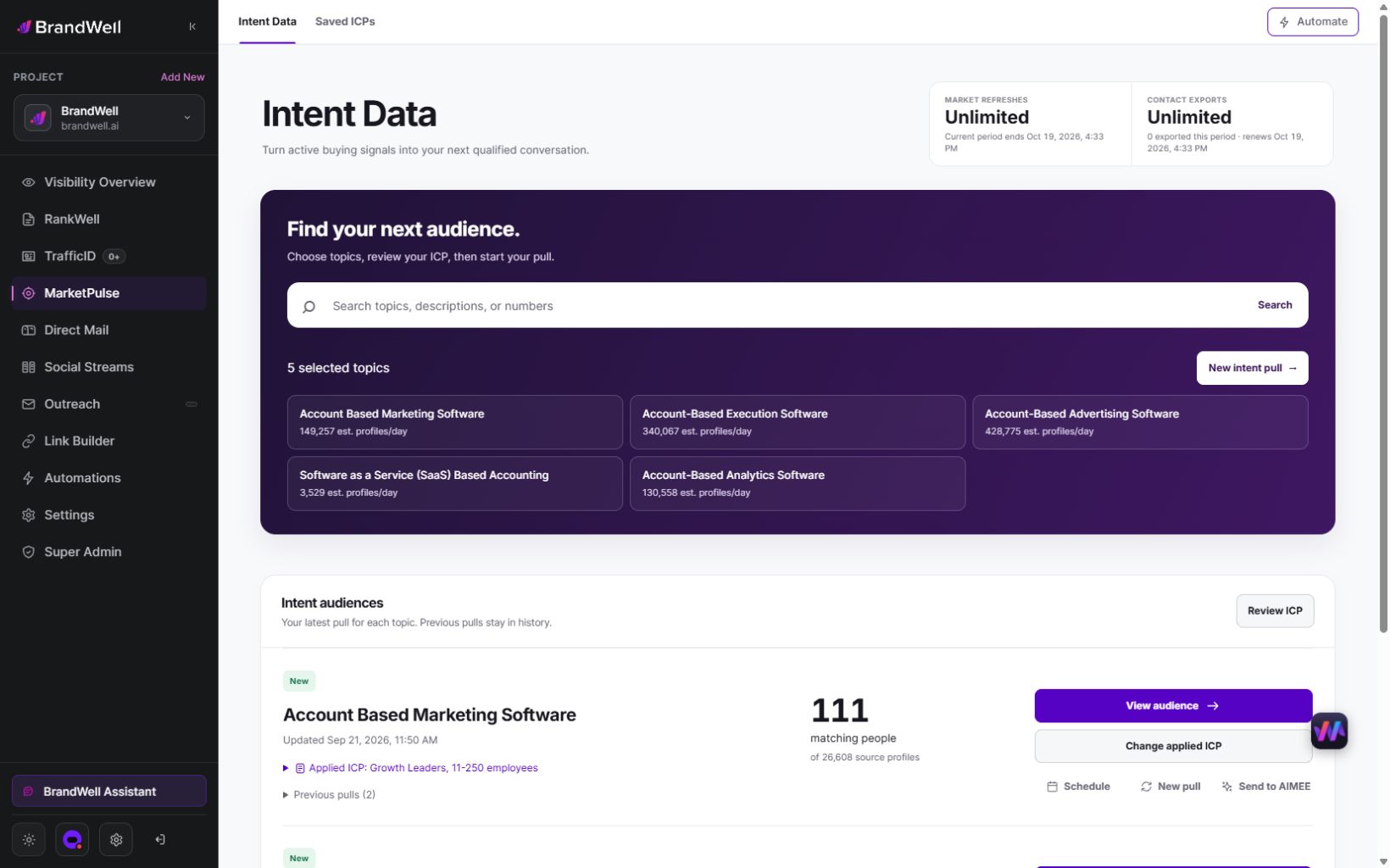
Inspect one relevant topic and ICP, then review audience eligibility and the proposed mailpiece before configuring a campaign. Watch the demo and review current plans.
Reviewed and updated October 3, 2026.

Written by