


On this page
- Current TrafficID visitor workflow
- Check actual site and analytics readiness
- Separate source from buyer interpretation
- Use seven evidence checks
- Choose seven review states
- Assign workflow owners
- Compare attribution and buyer evidence
- Count instrumentation and response costs
- Measure actual qualified outcomes
- Prevent source and identity errors
- Scope a separate analytics service
- Copyable direct-traffic review record
- Frequently asked direct-traffic questions
Direct traffic is an attribution classification, not proof of buyer intent. Diagnose missing source information separately from account fit, page activity, recency and actual buyer evidence. A visit does not establish identity, budget, authority or permission to contact someone.
Current MarketPulse offer: intent-data plans start at $500/mo. See the product, demo, and current plans. Updated October 3, 2026.
Current TrafficID visitor workflow
TrafficID addresses identifiable visitors to your own authorized site. Its views keep observed visitors, submitted form identities and added company stakeholders distinct. It does not identify every visitor or make an added stakeholder the person who visited.
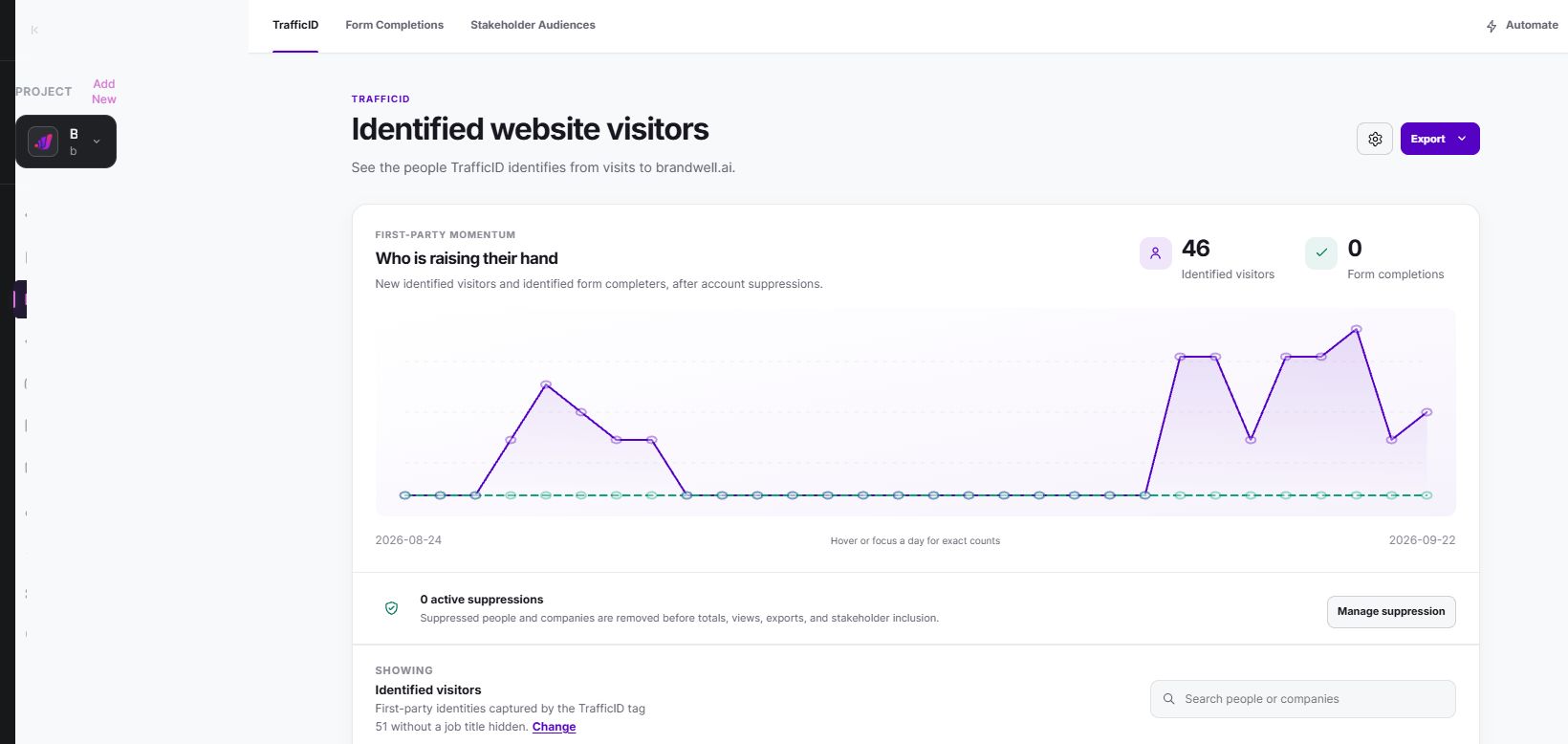
Review current TrafficID plans, eligible identified-visitor volume and the selected fixed or dynamic billing mode before budgeting. TrafficID and MarketPulse have separate product scope. Verify current allowances and included tools on the product page.
MarketPulse is separate external topic research starting at $500/mo. Topic audiences do not establish a visit to the client’s site. Agency setup, analysis, reporting, custom portals and integrations need separate scope and fees.
Check actual site and analytics readiness
This guide is for B2B growth, analytics, content, communications, demand generation, RevOps, and agency teams trying to decide what unattributed owned-site activity means. Check whether your site has meaningful evaluation journeys, enough traffic to see patterns, a reliable page and event taxonomy, and downstream opportunity data.
Do not declare every direct session dark social, AI traffic or a buying project. Google explains direct / none as traffic without a clear referral source. Missing tags, redirects, offline links, typed URLs and blockers can affect attribution.
The right first question is not “Who is this buyer?” It is “Why did attribution fail or remain unavailable, what did the session contain, and what is the least invasive useful response?”
Separate source from buyer interpretation
A direct-traffic intent framework needs two independent tracks.
Attribution track: inspect actual campaign tags, redirects, cross-domain setup, offline links, consent states and referrer handling. Preserve the test case and resulting source classification. A repair can improve future measurement; it does not establish the missing historical source.
Decision-evidence track: Examine landing page, page sequence, event quality, repeated behavior, recency, account fit, lifecycle status, and separately sourced identity confidence. Decide whether to monitor, diagnose, create an account review, route a known contact to an owner, or report an aggregate pattern.
Do not let source diagnosis and buyer interpretation answer each other’s questions. Account matching does not reconstruct a referral source. An analytics identifier does not automatically establish a verified named person. Preserve the actual identification basis and unresolved cases.
Use seven evidence checks
Score each dimension separately and retain the reason codes:
- Implementation confidence: Are tags, UTMs, auto-tagging, redirects, domains, and integrations working as designed?
- Page intent: Was the landing page informational, evaluative, transactional, support-related, or irrelevant?
- Session sequence: Did the visit include pricing, integration, security, comparison, contact, or another meaningful path?
- Repetition and recency: Is this one isolated session or a recent pattern in a consistent identity space?
- Account fit: Does the associated organization, if any, match the ICP and current customer or partner exclusions?
- Identity confidence: Is the evidence anonymous, device-based, account-level, authenticated first-party, or externally resolved?
- Corroboration: Do independent campaign, CRM, content, off-site topic, or opportunity signals agree – or conflict?
A score can help sort reviews, but it cannot turn uncertainty into fact. Keep “unknown source,” “account match,” “known contact,” and “purchase intent” as different fields. When evidence conflicts, send the record to analysis or no action rather than hiding the conflict inside an average.
Choose seven review states
These direct-traffic intent use cases share the same decision criteria: evidence gate, applicable fit, proportionate action, limitation, and measurement.
State 1: A single unknown direct visit
Decision: Observe, diagnose, or ignore one unattributed session?
Evidence gate: A valid analytics event with no clear source, no reliable identity, and no corroborating evidence.
Best fit and action: Use it for baseline reporting and tagging QA. Record the landing page and inspect implementation; do not create a named lead or outreach task.
Limitation and measurement: It could be typed navigation, a bookmark, an untagged link, a redirect, an offline document, a blocker, or another gap. Measure direct share by landing-page group, defects found, and repeat-session rate.
State 2: An identified account visit
Decision: Does a documented account match justify review?
Evidence gate: A transparent account-resolution method, confidence label, page context, fit, recency, and exclusions.
Best fit and action: Add a reason-coded account item to an ABM review queue. Keep the action at account level unless a separate permitted identity basis exists.
Limitation and measurement: Account resolution can be wrong and does not identify which employee visited or where the visit originated. Track verified match rate, accepted alerts, false-positive reasons, and qualified opportunities.
State 3: Repeat direct visits
Decision: Does repetition increase timing relevance?
Evidence gate: A consistent device, account, or first-party identity space; recent repeated behavior; and relevant page context.
Best fit and action: Raise review priority and compare the sequence with other evidence.
Limitation and measurement: Repeats may come from employees, customers, support users, or tracking artifacts. Measure frequency, engaged sequences, accepted reviews, and opportunity movement.
State 4: A high-intent page visit
Decision: Does the page and sequence justify an account-level review?
Evidence gate: A maintained page taxonomy, working events, meaningful session sequence, fit, and freshness.
Best fit and action: Create a review for relevant pricing, integration, security, comparison, or contact journeys when context and fit pass the threshold.
Limitation and measurement: A pricing or security page can attract competitors, customers, applicants, or accidental visits. Measure qualified-page engagement, accepted alerts, false-positive reasons, and stage progression.
State 5: A known-contact return
Decision: What helpful next step fits an existing, permitted relationship?
Evidence gate: A first-party identifier, transparent collection, permitted purpose, suppression status, and lifecycle owner.
Best fit and action: Route context to the existing owner with a recommended human-reviewed action.
Limitation and measurement: Knowing the contact still does not restore the missing traffic source or prove purchase intent. Measure owner action, lifecycle progression, objections, and downstream value.
State 6: Cross-channel corroboration
Decision: Does a stack of independent evidence justify higher priority?
Evidence gate: Explicit observation units and timestamps for site behavior, fit, campaign, topic, CRM, or opportunity evidence.
Best fit and action: Show the evidence and conflicts to a reviewer instead of collapsing everything into an opaque score.
Limitation and measurement: Signals may share the same tracking cause and are not automatically independent or causal. Track corroboration, accepted action, qualified pipeline, and experimental outcomes where feasible.
State 7: Aggregate reporting
Decision: Is direct traffic revealing a tagging problem or a demand pattern worth investigating?
Evidence gate: Stable event taxonomy, landing-page groups, campaign-tagging QA, and privacy-safe aggregation.
Best fit and action: Report trends, likely causes, unresolved attribution, and a short list of tagging or channel experiments.
Limitation and measurement: Aggregate growth cannot be assigned to search, AI, community, PR, or another source without additional evidence. Measure tagging coverage, direct share, engaged sessions, qualified conversions, and experiment results.
Assign workflow owners
A practical implementation uses a controlled review loop:
- Analytics owner: audit UTMs, auto-tagging, redirects, cross-domain behavior, integrations, exclusions, and event validity.
- Content or web owner: classify pages by informational, evaluation, transaction, support, careers, and irrelevant intent.
- RevOps owner: preserve user, session, and event scope; join only approved fit and lifecycle fields; deduplicate accounts.
- Privacy or policy owner: document identity basis, notice, consent where required, retention, access, suppression, and permitted actions.
- Demand or sales owner: review evidence tiers and choose monitor, research, contact, advertise, or no action.
- Measurement owner: capture dispositions, qualified stages, revenue outcomes, latency, and tagging fixes.
The review record should contain source classification, landing page, page sequence, timestamp, repetition window, identity level, account fit, corroborating evidence, recommended action, owner, approval status, and outcome. It should also support “unknown,” “conflicting evidence,” and “do not act.”
Verify actual tag states and implementation behavior. Consent tooling is not a legal conclusion; resolve applicable purpose, jurisdiction, channel, retention and approval requirements separately.
Compare attribution and buyer evidence
Clicks answer whether a measurable interaction occurred. Session attribution describes how a visit was classified. Last-touch models assign credit according to a rule. Direct-traffic intent analysis asks whether unattributed owned-site behavior, after diagnosis, has enough context to inform a proportionate next decision.
Use click and campaign reporting for channel execution and tagging QA. Use page and session evidence to understand the visit itself. Use account fit and lifecycle data to decide whether the organization matters. Use CRM outcomes to learn whether reviews produce value.
None of these observational views proves incrementality alone. If a program is large enough, compare a holdout, phased rollout, or controlled treatment. Research on experimental incrementality shows why observational attribution can disagree with causal estimates, though a small B2B sample may remain inconclusive.
Manual review is a valid alternative when volume is low. A company with few high-value accounts may learn more from careful session and account research than from an automated alert stream. Repair obvious attribution defects before buying more identity or intent data.
Count instrumentation and response costs
Total cost includes:
- analytics and tag audit;
- page and event taxonomy;
- consent and preference implementation;
- optional account or identity resolution;
- fit and lifecycle enrichment;
- integration and review queue;
- analyst and seller labor;
- approved activation;
- outcome capture and experiment design;
- access, retention, correction, and deletion controls.
Start with a repair-before-buy rule. If redirects strip UTMs or key events fire incorrectly, more data will create a more expensive misinterpretation. Compare cost per valid classified session, accepted account review, qualified opportunity, and usable learning – not cost per direct visit.
There is no universal traffic threshold or ROI benchmark. The business case depends on site volume, share of evaluation journeys, match quality, deal economics, response capacity, and the number of outcomes available for calibration.
Measure actual qualified outcomes
Use a layered scorecard:
Instrumentation: tag coverage, valid events, referral exclusions, redirect failures, cross-domain continuity, and unresolved direct share.
Evidence: distribution across anonymous, account, repeat, high-intent page, known-contact, corroborated, and aggregate states; freshness; match confidence; false-positive reasons.
Operations: reviews completed, accepted actions, latency, suppressions, routing failures, and corrections.
Business: qualified meetings, accepted opportunities, stage movement, gross profit, and time to outcome with a stated attribution rule and denominator.
Analytics reports can change as processing completes, identity settings differ, or privacy thresholds apply. Store the decision-time evidence and later outcome rather than assuming today’s report will preserve every detail. Label missing or uncertain attribution instead of forcing a channel answer.
Prevent source and identity errors
The biggest mistakes are acting before diagnosis, treating an account match as a person, retaining sensitive data without need, exposing surveillance-style detail in outreach, and automating consequences without a reviewer.
Keep necessary fields, role-based access, approved purpose, retention, correction, deletion and suppression routes. Verify actual storage, recipients and action approvals. A research label is not permission to contact or upload an audience.
Do not claim that a resolved identity generated the visit. Do not describe direct traffic as a specific dark channel without corroboration. Do not let an agent contact a person, change spend, modify CRM records, or delete data without an approved policy and human decision.
Scope a separate analytics service
A recurring agency service can include tagging QA, cause analysis, page taxonomy, evidence-tier reporting, human-reviewed account recommendations, downstream measurement, and quarterly rule tuning. The useful deliverable is not a list of mysterious “hot visitors.” It is a transparent explanation of what happened, what remains unknown, what action is proportionate, and what the client learned.
TrafficID supports review of identifiable own-site activity, submitted forms and company context. Identification is partial; additional company stakeholders are not necessarily visitors. MarketPulse separately supplies off-site topic research. Neither product reconstructs a missing referral source or establishes a buyer project. Custom agency reports, client interfaces and integrations require separately verified implementation, rights, scope and fees.
Start with TrafficID for the owned-site workflow. Review an actual observed visitor or submitted form, its source label and available page context. Preserve the distinction between observed visitors and additional company stakeholders. AIMEE can prepare research through configured tools; the owner approves actual actions.
AIMEE can organize supplied context through configured connected tools. Keep proposed actions separate from actual approvals, writes and destination acknowledgements. Confirm the implementation and permissions before execution.
Treat every intent, identity, account match, and recommendation as probabilistic evidence. Before activation, assign named human owners for editorial claims, product configuration, pricing, privacy, security, compliance, legal review, and platform policy. Agents can prepare options; people approve consequential decisions and document exceptions.
Keep analytics source diagnosis, identity review, sales qualification and agency delivery as separate responsibilities. Measure actual qualified outcomes and operating costs rather than treating direct-session volume as proof of demand.
Copyable direct-traffic review record
Scope: [Session, observed visitor or account unit and dates.] Source test: [Actual link, tags, redirects and resulting classification.] Identity: [Observed visitor, submitted form or additional stakeholder; unresolved matches.] Fit: [Relevant context and missing buyer evidence.] Action: [Purpose, owner, approval, destination and acknowledgement.] Outcome: [Actual disposition, unique opportunity and missing feedback.] Decision: [Comparable cohort, full costs, repair or stop rule.]
Worked example: a tagging change is not a demand change
Assume a fictional first period has 1,000 sessions, with 300 classified direct, or 30%. After a tagging repair, a separate period has 1,000 sessions with 200 direct, or 20%. The direct share fell by ten percentage points. That does not prove demand fell, that another channel caused more buyers, or that the missing sources of the earlier sessions are now known. Compare actual source tests, population changes and qualified outcomes. These are invented counts, not BrandWell results.
Keep session and account denominators separate
Suppose the first period’s 300 direct sessions are associated with 150 deduplicated account records under a documented method. Fifty records meet fit checks, 20 enter the review queue and eight receive seller acceptance. Acceptance is 40% of reviewed records or 5.3% of all 150 records. It is not a verified 40% conversion rate among visitors. Account records, sessions, identifiable visitors and people are different units; seller acceptance is not a qualified opportunity or purchase.
Include the response work
A fictional operating test costs $99 for the standard entry TrafficID plan, $300 for instrumentation and $400 for review, totaling $799 in defined costs. With eight accepted account records, descriptive cost is $99.88 per accepted record. Setup, acquisition, general overhead, tax and financing may add costs. A separate fictional $1,200 agency fee against those $799 costs leaves $401, or 33.4%; another $500 in repairs makes the remainder negative $99. These invented service inputs are not BrandWell agency-service fees or typical margins.
Prepare the actual TrafficID handoff
Check the authorized Company’s tracking-tag state. Review an actual observed visitor or submitted form and its available visit context. Keep enriched company stakeholders in a distinct category. Check suppressions and purpose before export. AIMEE can prepare company research through configured tools; named owners approve actual messages, Outreach enrollment, postcard workflows and CRM writes. Custom attribution joins or client interfaces require separately verified implementation and scope.
Frequently asked direct-traffic questions
Is direct traffic proof of buyer intent?
No. Diagnose attribution separately from buyer evidence.
Can a tagging repair recover every earlier referral source?
No. Keep historical uncertainty visible.
Does TrafficID identify every visitor?
No. Identification depends on available matching data and site conditions.
Are additional company stakeholders observed visitors?
No. Keep the actual source categories distinct.
Review the owned-site product: explore TrafficID and current plans.
Reviewed and updated October 3, 2026.

Written by

