On this page
- Current MarketPulse research workflow
- Check actual audience and outcome evidence
- Define five evidence hypotheses
- Test eight message and handoff plays
- Compare rule and delivery behavior
- Measure comparable outcomes
- Budget useful outcomes and review work
- Scope a separate segmentation service
- Catch five classification failures
- Audience handoff checklist
- Copyable audience test record
- Frequently asked audience questions
Do not split early-stage and late-stage intent audiences with a single vendor label. Build an evidence ladder from topic specificity, recency, repeated research, firmographic fit, identity confidence, first-party engagement, and buying-committee context. Then change the message, offer, budget, exclusions, and human handoff as the evidence gets stronger.
Use broad problem research and specific evaluation activity as distinct evidence hypotheses. Test useful education or a scoped assessment against actual context and needs. Neither hypothesis establishes buyer authority, budget, consent or a purchase decision.
Preserve the actual platform segment definition, source, recency, identity state and observed behavior. A platform classification does not establish the company’s buying stage, actual authority, budget, permission or a purchase.
Current MarketPulse offer: intent-data plans start at $500/mo. See the product, demo, and current plans. Updated October 3, 2026.
Current MarketPulse research workflow
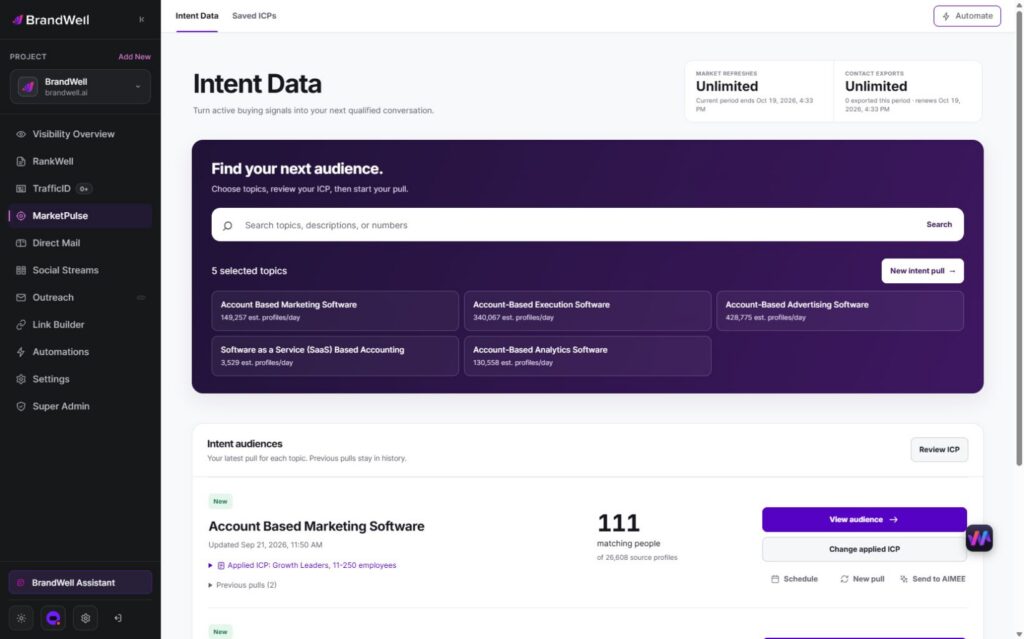
BrandWell MarketPulse: intent data starting at $500/mo. Find people researching topics relevant to what you sell, apply saved ICP filters, and review available contact details before taking action.
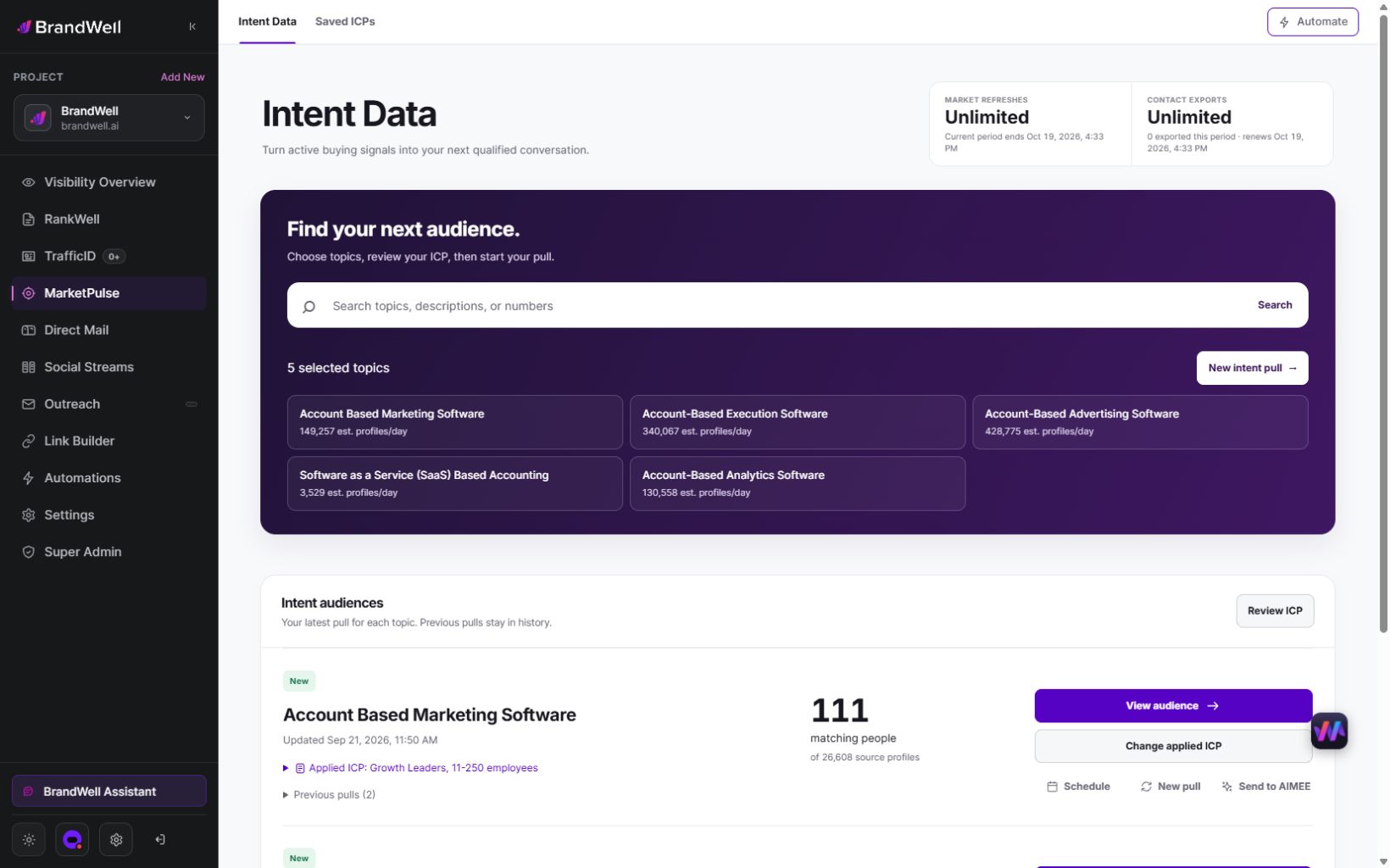
MarketPulse plans are starting at $500/mo. Verify current package scope and offers on the product page.
| Plan | Topics and refreshes | Monthly exports |
|---|---|---|
| Starter | 1 topic, weekly | 25,000 contacts |
| Growth | 3 topics, daily | 100,000 contacts |
| Scale | 10 topics, daily | Unlimited contacts |
Swipe the table to see all columns.
A pull retrieves available data from the previous 24 hours for one topic. Daily use across all included topics provides 90 Growth pulls or 300 Scale pulls in a 30-day month. Weekly Starter pulls vary by calendar month. Available audience size and contact fields vary, and audiences may overlap. Refreshes stop at the plan limit without overage charges.
- Find and qualify: search the topic catalog, save your ICP, and review the people and companies that match.
- Act on the research: export qualified contacts or prepare an Outreach or Direct Mail workflow. Connected products, channel usage, and fulfillment may cost extra.
- Get help from AIMEE: Growth and Scale include AIMEE for the initial user to research accounts and prepare the next step through connected tools.
Agencies and other service businesses can build client deliverables around their available Intent Scans and exports. Keep each client’s scope, permissions, and service fees clear. A subscription is not a promise of a white-label platform or exclusive access to a market.
Explore MarketPulse and watch the demo or compare plans starting at $500/mo. Any early-access discount is a separate, time-limited offer shown to an eligible recipient.
Check actual audience and outcome evidence
This framework is for agency owners, paid-media directors, demand-generation teams, and RevOps leaders running considered B2B purchases. Check whether the team has multiple signal sources, a clear ICP, distinct offers for different information needs, CRM outcomes, and enough volume to compare cohorts.
It is a poor fit when every signal is bundled into one audience, identity resolution is untested, customers and open opportunities are not suppressed, or the sales team cannot return disposition data. In that environment, adding another stage score creates false precision rather than better activation.
Define five evidence hypotheses
Use the ladder to decide the next useful intervention. Do not use it to claim you know what an individual will do.
1. Category curiosity
This includes broad contextual activity, an affinity-like interest, or a single interaction with general category content. It can identify an audience for education, but it is weak evidence of an active project.
A possible bounded action is to test a helpful problem frame, research summary, or diagnostic asset. The wrong action is to route the signal straight to an aggressive sales sequence.
2. Problem research
Keep repeated or recent problem activity distinct from broad interest; test its actual usefulness. Add fit checks: industry, size, geography, technology, operating model, and any exclusion that makes the account unsuitable.
At this level, the useful goal is progression. Measure whether accounts consume deeper content, return, add another relevant role, or engage with a first-party resource.
3. Solution research
Specific activity around a solution category, use case, integration, or implementation approach can justify a narrower audience and a more concrete decision aid. The offer might be a framework, calculator, comparison criteria, or working session.
Keep the distinction between an account and a person. An account-level topic surge does not prove that the matched contact performed the research.
4. Vendor evaluation
Pricing, demo, product, implementation, security, comparison, or return-visit behavior on first-party properties may indicate evaluation. Confirm that the account fits and that the event is fresh enough to matter.
The next step can be direct, but it should still be proportionate. A comparison guide or assessment may be more useful than immediately asking for a contract conversation.
5. Buying-committee convergence
Keep recent solution research, candidate roles, first-party evaluation, fit and account history as separate evidence. Require actual buyer confirmation before asserting participants or a stage. Human-reviewed action still needs purpose, channel, eligibility and approval checks.
It does not remove privacy, consent, platform-policy, or data-quality requirements. Record the evidence used, confidence, exclusions, and the person who approved the action.
Test eight message and handoff plays
1. Early-stage category education
Use a clear explanation of the problem, the cost of leaving it unresolved, and a practical way to assess it. Optimize for qualified reach, depth of engagement, and progression – not demo volume.
Limitation: Education can generate attention without a near-term project. Keep budget and frequency proportionate to the evidence.
2. Early-stage research and proof
Offer a methodology, benchmark with transparent sourcing, checklist, or calculator that helps the audience make a better decision. Avoid an invented statistic or a report that is only a disguised pitch.
Limitation: A downloaded asset is not automatically a late-stage signal. Look for additional evidence before escalation.
3. Early-stage nurture and observation
Verify actual targeting restrictions, reporting configuration and audience overlap in the implemented campaign. A report on an audience does not itself create a clean experimental control. Keep observed delivery separate from intended membership.
Limitation: Observation reports overlap with existing targeting. They do not create a clean experimental control by themselves.
4. Early-stage account expansion
At a fitting account, reach additional relevant functions with role-appropriate education. Keep account-level frequency and suppression controls so “expansion” does not become repeated exposure to every available contact.
Limitation: Role data and identity matches can be wrong or stale. Require confidence and permitted-use checks.
5. Late-stage comparison support
Give evaluators symmetrical criteria: fit, implementation, integrations, evidence, limitations, total cost, governance, and next steps. Make the resource useful even if the reader does not choose your product.
Limitation: Comparison activity can reflect research by a consultant, student, competitor, or existing customer. Confirm fit and context.
6. Late-stage assessment or demo offer
When recency, specificity, fit, and first-party behavior converge, offer a scoped assessment, tailored report, demo, or pilot. State what the prospect receives and which inputs are required.
Limitation: A direct offer is not permission for persistent outreach. Respect channel policy, preferences, and suppression.
7. Late-stage human sales assist
Send the accountable seller a short evidence packet: account, stage hypothesis, signal source, recency, fit, identity confidence, prior touches, exclusions, and the recommended next action. The seller should decide whether and how to act.
Limitation: Do not expose sensitive browsing details or present a probabilistic signal as surveillance-derived certainty.
8. Late-stage suppression and ownership handoff
Suppress customers, disqualified accounts, active opportunities owned by another motion, completed requests, and accounts under a legal or privacy restriction. Assign one owner for the next step and a time for reclassification.
Limitation: Suppression lists decay. Test whether each destination actually receives and honors the update.
Compare rule and delivery behavior
Manual CRM or warehouse rules provide the most explainable stage definition. They work well when volume is manageable and the team needs strict control. Their weaknesses are maintenance effort, stale fields, and slow feedback.
Check the actual platform audience definition and delivery. A supplied segment does not establish the company’s stage model or actual buyer readiness.
CDP or warehouse activation can combine first-party behavior, fit, signal recency, identity, and CRM state. Compare actual consistency across destinations and verify reliable identifiers, versioned rules, and monitoring.
Verify whether the implemented expansion setting permits delivery outside the supplied audience. Preserve actual delivery and overlap before comparing cohorts; do not assume every platform or campaign type behaves the same way.
Use the lightest approach that preserves the decision. A manual method may be better for a small, high-value account set; automation may be useful for scale when the team can measure incrementality and tolerate less interpretability.
Measure comparable outcomes
For earlier-stage audiences, report qualified reach, content depth, repeat engagement, growth in known relevant roles, progression to a stronger signal, and cost per progressed account. For later-stage audiences, add assessments, meetings accepted, opportunities, velocity, pipeline, revenue when mature, and sales disposition.
Keep common guardrails across both groups: match confidence, audience eligibility, frequency, opt-outs, complaints, rejected leads, missing outcomes, and total cost. Show counts and rates so a small, high-performing cohort does not look more certain than it is.
Use a holdout or staged comparison when feasible. If automated expansion, overlapping campaigns, or sales activity contaminates the groups, disclose it. Never call a descriptive difference incremental lift without a design that supports the claim.
Budget useful outcomes and review work
Buying-stage segmentation costs more than an audience subscription. Model the platform, intent and identity data, topics or keywords, usage, seats, enrichment, implementation, warehouse or CDP work, destination integrations, media, creative and offer production, analyst time, sales review, governance, and contract term.
Compare cost per stage-qualified account and cost per accepted opportunity. Separate working media from platform and data fees. A cheaper audience that creates more false positives, sales rejection, and manual cleanup can be the more expensive program.
Use current, scope-matched written quotes. There is no reliable universal budget because volume, countries, identity requirements, topics, integration depth, and service level change the cost.
Scope a separate segmentation service
MarketPulse supplies topic research and available match details. AIMEE can organize supplied context through configured tools. An agency stage-segmentation service, branded report, custom interface or destination synchronization requires separately verified implementation, rights, scope and fees. A research subscription does not establish buyer stages or managed campaign delivery.
Review an available MarketPulse topic, saved ICP and actual preceding-24-hour matches for the approved research purpose. Keep uncertain company context visible. AIMEE can organize supplied context through configured tools; named owners approve actual exports, messages, audience uploads and CRM writes.
AIMEE can prepare a review brief through configured connected tools. Keep proposed actions separate from actual approvals and destination acknowledgements. Confirm the implementation and permissions before execution.
Before operational use, complete product, pricing, privacy, security, compliance, legal, and platform-policy review.
Catch five classification failures
1. Treating “in market” as “ready to buy”
A platform category is estimated evidence. Require fit, recency, identity, and first-party context before using a late-stage action.
2. Sending one message to every signal
Broad researchers need different information from active evaluators. Match the offer to the unresolved decision.
3. Ignoring delivery outside the audience
Automated expansion can blur the stage test. Record hard constraints, soft signals, and actual delivery.
4. Skipping customers, opportunities, and privacy restrictions
Missing exclusions wastes spend and creates conflict. Synchronize and test suppression in every destination.
5. Allowing a score to trigger autonomous sales action
Agents can organize evidence. A human should review the account context, permitted use, message, and channel before action.
Audience handoff checklist
For every segment, record:
- Signal source, topic, specificity, frequency, recency, and expiry.
- Account or person unit, identity method, match confidence, and known conflicts.
- ICP fit and exclusion reasons.
- First-party activity and buying-committee context.
- Stage hypothesis and the evidence required to upgrade or downgrade it.
- Audience rule, channel, message, offer, frequency, and budget.
- Primary outcome, guardrails, baseline or holdout, and minimum usable volume.
- Customer, opportunity, preference, and privacy suppressions.
- Human owner, approval, reclassification cadence, and client reporting fields.
Keep the stage hypothesis separate from actual buyer evidence. Test useful actions and preserve corrections, failed assumptions and missing outcomes.
Copyable audience test record
Hypothesis: [Actual information need and evidence, with uncertainty.] Unit: [Person, account, click or other defined unit.] Eligibility: [Actual purpose, channel, exclusions and approvals.] Delivery: [Rules, expansion, overlap and observed exposure.] Test: [Assignment, baseline, outcome definition and equal window.] Feedback: [Buyer confirmation, missing cases and corrections.] Cost: [Media, software, creative, review and operating work.]
Google Ads custom-experiment guidance explains testing campaign changes. Verify actual supported settings, assignment and delivery; a platform experiment does not automatically establish buyer stage or causal revenue.
Worked example: different populations are not a message test
Assume a fictional broad-research campaign receives 200 clicks and ten qualified enquiries, or 5%. A specific-evaluation campaign receives 100 clicks and eight qualified enquiries, or 8%. At $1,200 and $800 in media spend, media-only cost per qualified enquiry is $120 and $100 respectively. Different audiences, contexts and delivery prevent treating that descriptive rate gap as the causal effect of a message or a stage label.
For a separate test on the same eligible population, suppose assignment produces 1,000 units per version with equal follow-up: 20 qualified enquiries for A and 30 for B. Rates are 2% and 3%, a one-percentage-point gap or 50% relative difference. Preserve uncertainty, exclusions, overlap and actual assignment; arithmetic alone does not establish a reliable effect. An enquiry still is not a buyer-confirmed stage, opportunity, sale or cash receipt.
Include costs outside working media
If the specific-evaluation campaign also costs $400 in creative and $300 in review work, its defined cost is $1,500, or $187.50 per qualified enquiry rather than $100. A separate fictional $2,000 agency fee against $1,500 in service costs leaves $500, or 25%. Another $600 in corrections makes the remainder negative $100. Setup, acquisition, general overhead, tax and financing are excluded and can further change the result. These invented inputs are not BrandWell agency-service prices or typical margins.
Prepare the supported research input
Review an available MarketPulse topic, saved ICP and actual preceding-24-hour matches for the approved research purpose. Verify company context and preserve uncertainty. TrafficID is separately scoped own-site visitor work. AIMEE can organize supplied context through configured tools. Owners approve exports, messages, Outreach enrollment, audience uploads and CRM writes. Stage models, custom audience joins, campaign delivery and client reporting require separately verified implementation, rights, scope and fees.
Frequently asked audience questions
Does a topic label establish buyer stage?
No. Preserve actual evidence and uncertainty.
Can different audiences prove a message’s causal effect?
No. Verify comparison design and assumptions.
Is a 2% to 3% change three percentage points?
No. It is one percentage point, or 50% relative.
Does media-only cost include the whole workflow?
No. Count actual creative, review and operating costs.
Review the research product: explore MarketPulse and current plans.
Reviewed and updated October 3, 2026.

Written by