On this page
- Editing and proofreading are different passes
- Pass 1: confirm the reader and the answer
- Pass 2: verify claims and product details
- Pass 3: repair structure and repetition
- Pass 4: edit for clarity and voice
- Pass 5: proofread and review the page assets
- Pass 6: inspect the published result
- Example: an editing acceptance record
- Budget for review rather than promising instant editing
- Edit in the current BrandWell workflow
- Frequently asked questions
Edit a blog post by checking its purpose, evidence and structure before polishing individual sentences. Finish by reviewing metadata, images, links and the actual published page. A spelling pass alone cannot establish that the article answers the reader’s question or describes your product correctly.
Use a repeatable process, but scale the review to the content. A simple update and a research-heavy guide may need different expertise and time. Neither should be published merely because the draft sounds fluent.
Editing and proofreading are different passes
The UNC Writing Center’s guide distinguishes editing the substance and organization from proofreading surface errors. Resolve the article’s meaning and evidence before spending the final pass on spelling and punctuation.
The following six-pass workflow is an original checklist for business blog publishing. Assign the relevant reviewer rather than expecting one automated check to approve everything.
Pass 1: confirm the reader and the answer
Write the question the article should answer and read the introduction against it. Does the reader receive a clear starting answer? Do the later sections provide the explanation or steps they need?
- Remove sections outside the brief’s scope.
- Define important terms before relying on them.
- Check that the proposed next step fits the reader’s task.
- Keep an original contribution, such as a worked example or a documented process.
A payroll migration guide should help the reader prepare for migration. A long digression into general business productivity can obscure that purpose even when every sentence is grammatically correct.
Pass 2: verify claims and product details
Identify statistics, instructions, dates, prices and feature statements. Check each against the appropriate primary source or approved internal documentation. Record missing evidence and resolve it before publishing.
Keep a study’s population, date and limitations attached to its claim. A hypothetical calculation should be labeled as such. Remove invented customer results, unverified first-person experiences and features that belong to an old version of the product.
Review quoted and paraphrased passages with their sources. Attribution and permission are separate questions, so check both where relevant.
Pass 3: repair structure and repetition
Read just the headings to see whether they form a sensible outline. Give each section a distinct job. Combine repeated explanations, move prerequisites before steps and remove conclusions that only repeat the introduction.
Use numbered lists for ordered steps and bullets for parallel items. Keep enough context that a reader can understand a list without guessing what its labels mean. Do not expand an article simply to hit a word count.
Pass 4: edit for clarity and voice
Replace vague promises with specific explanations. Check pronouns, terminology, transitions and sentence length. A short sentence can be helpful, but it is not a universal search-ranking rule.
For example, replace “Our powerful solution revolutionizes onboarding” with a statement that describes the actual action, such as “The checklist names the records and approvals your implementation team needs before kickoff.” This is an original wording example, not a claim about a specific product feature.
Read difficult passages aloud or ask a reviewer unfamiliar with the draft to explain them back. Choose the technique that helps you identify ambiguity rather than imposing one writing routine on every person.
Pass 5: proofread and review the page assets
- Check spelling, punctuation, grammar and consistent names.
- Verify the title and description match the article’s actual promise.
- Follow important links and check their destinations.
- Review image rights, quality, captions and alternative text.
- Confirm the featured image works as the social sharing image.
- Check the author information and update note.
Evaluate suggestions from automated tools in context. A recommendation to rewrite a sentence is a prompt for editorial judgment, not a requirement to change a correct explanation.
Pass 6: inspect the published result
Open the public page and inspect it at a narrow width. Check tables, screenshots, navigation, headings and calls to action. Follow the primary next-step link and confirm that a form or destination works as intended.
Do not assume the editor preview is identical to the live page. Publishing can change formatting, crop images or expose a missing embed. Fix visible defects and inspect again.
Example: an editing acceptance record
A fictional payroll software team reviews a preparation guide and records these findings:
- Purpose: the introduction answers which records to gather.
- Evidence: one deadline is unsupported and is removed pending confirmation.
- Structure: prerequisites are moved before the implementation steps.
- Clarity: the person responsible for approvals is named.
- Assets: a stale screenshot is replaced and the linked documentation is checked.
- Live page: a wide table is repaired for mobile and the next-step link is tested.
This is an original example of a review record, not a customer case. It captures decisions another editor can verify, including which issue remains unresolved.
Budget for review rather than promising instant editing
In a hypothetical workflow, a draft takes 30 minutes to generate, 60 minutes to fact-check, 45 minutes to edit and 15 minutes to publish and inspect: 150 minutes total. Reporting only the first 30 minutes would omit most of the work needed for acceptance.
Track total time, accepted output and rework. If the same error appears repeatedly, improve the source material or brief rather than repeatedly polishing it at the end.
Edit in the current BrandWell workflow
Use Visibility for keyword research and opportunity discovery. In RankWell, review the brief, draft, source material, media and search preview. Keep factual approval separate from a score or recommendation.
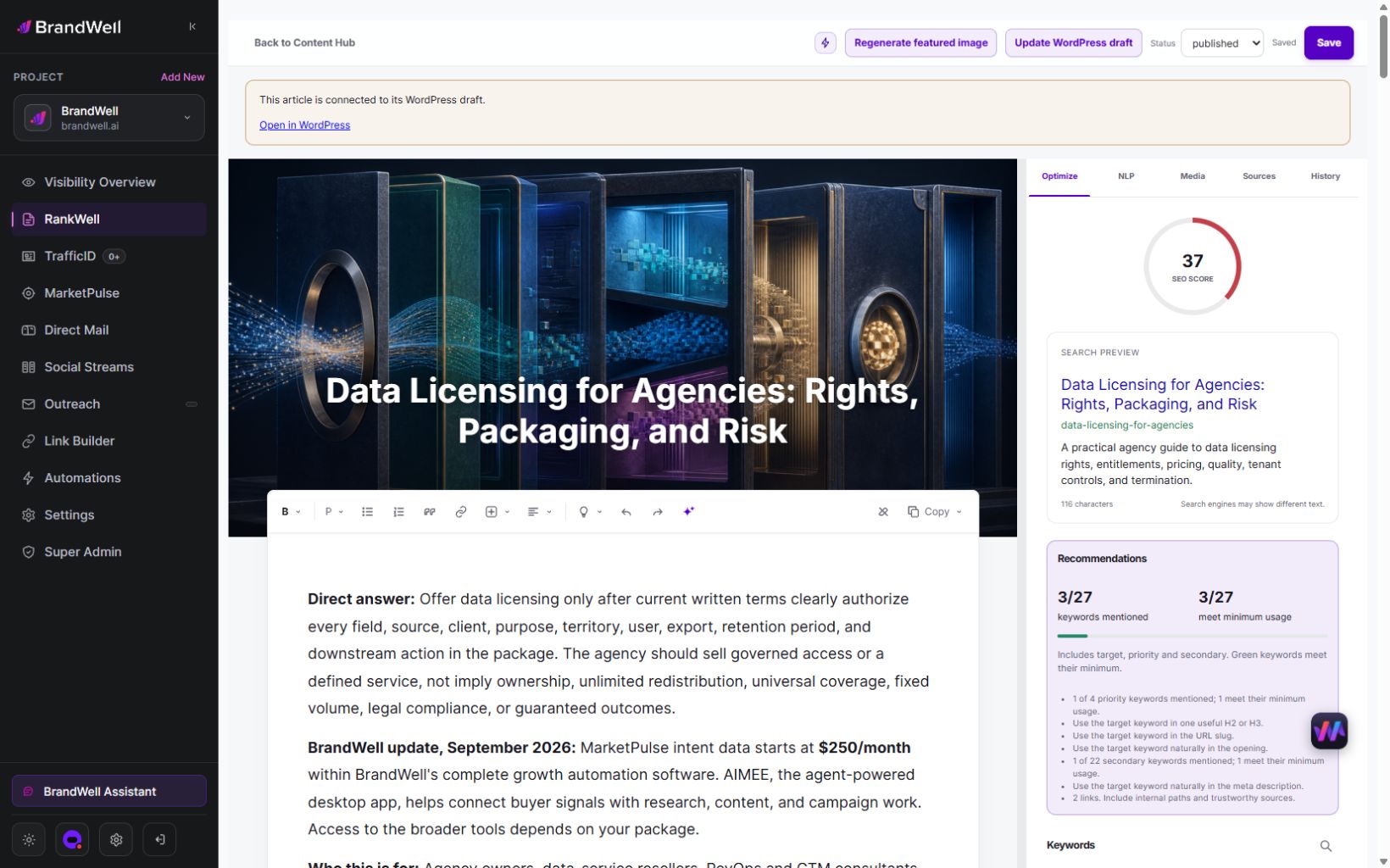
Publish through your configured connection or move approved content into the site’s editor. Record the reviewer, published URL and next review date so the article remains maintainable.
Frequently asked questions
Should I edit while writing?
Use a process that works for you. Separate major revision from the final proofreading pass so you do not spend time polishing text that will be removed.
Does a high bounce rate prove my post is poorly edited?
No. Interpret the metric with the reader’s task, measurement setup and intended outcome. Inspect the page before diagnosing its content.
Can an AI draft skip editorial review?
No draft should be approved solely because of how it was produced. Review its evidence, wording, product details and live presentation.
Explore RankWell to organize a drafting and editing workflow with clear acceptance checks.
Reviewed and updated October 3, 2026.

Written by
Julia McCoy has contributed articles to BrandWell on content marketing, writing, and search engine optimization. This archive retains her original bylines; individual articles may be updated by the BrandWell editorial team.