On this page
- Define the intended reviewers
- Show evidence and uncertainty
- Build a versioned explanation card
- Use current research within scope
- Compare rules and generated narratives
- Budget explanation work
- Measure appropriate reliance
- Match detail to the reviewer
- Separate fit, identity and outcomes
- Protect permitted access and corrections
- Scope separate client deliverables
- Test the explanation workflow
- Copyable explanation review
- Frequently asked explanation questions
A score can be mathematically consistent and operationally useless. If a seller sees an account at 87 but cannot see whether the change came from fresh research, repeated web activity, a fit adjustment, or an identity merge, the number invites either blind trust or complete rejection. Neither response is calibrated.
Explainability for intent scoring means translating evidence and model behavior into a decision record a human can inspect. It does not require revealing every proprietary detail. It requires clarity about what was observed, how strongly it contributed, what remains uncertain, and what action the evidence reasonably supports.
Explain an intent score with the actual source events, observation unit, timing, fit, uncertainty, rule or model version, suppression and proposed action. Keep evidence separate from inferred factors and purchase probability. Give the reviewer a way to challenge unsupported, stale or conflicting inputs.
Current MarketPulse offer: intent-data plans start at $500/mo. See the product, demo, and current plans. Updated October 3, 2026.
Define the intended reviewers
RevOps, sales, data, privacy, and agency teams that already have an intent score but need people to understand, trust, contest, and use it. This guide focuses on the human-readable evidence layer, not on constructing or benchmarking the predictive model itself.
Use this explanation layer to calibrate human decisions, and substantiate product access, score evidence, commercial structure, privacy boundaries, retention, and correction rights before deployment.
Show evidence and uncertainty
Start with an event timeline and contribution view. Show the recent behaviors, source category, topic, time, account or person match, confidence, fit context, and whether the event is independent or deduplicated. Then show why the score changed and what threshold or rule produced the current recommendation.
An explanation should answer ‘why now,’ ‘why this account,’ ‘how sure are we,’ and ‘what should I do.’ It should also show disconfirming or stale evidence. Hiding uncertainty makes the display look simpler but prevents a seller or client from judging whether the proposed action is proportionate.
- Write the human judgment the explanation step must produce, not merely the task someone performs.
- Name the explanation owner, score approver, score evidence, cutoff, exception route, and reviewing client dependency.
- Use a bounded pilot and revise the operating rule from observed exceptions.
Build a versioned explanation card
The minimum card contains score and band, change since the prior period, top positive and negative contributors, supporting events with provenance, freshness, identity-confidence status, fit summary, missing or conflicting evidence, recommended action, suppression status, and a challenge link. Record the model or rule version behind it.
Use plain-language explanations tied to observable facts. ‘Three independent topic events in seven days from a matched account’ is more useful than ‘high latent propensity.’ If a factor is inferred, label it. If weights cannot be exposed, show ranked influence and direction without pretending that order is a precise causal account.
- Freeze the approved input and record its version.
- Run deterministic validation before subjective review.
- Route ambiguous or high-impact cases to a named human explanation owner.
- Record the seller action, approval, score evidence, and downstream result.
- Feed repeated exceptions into process improvement rather than hiding rework.
Use current research within scope
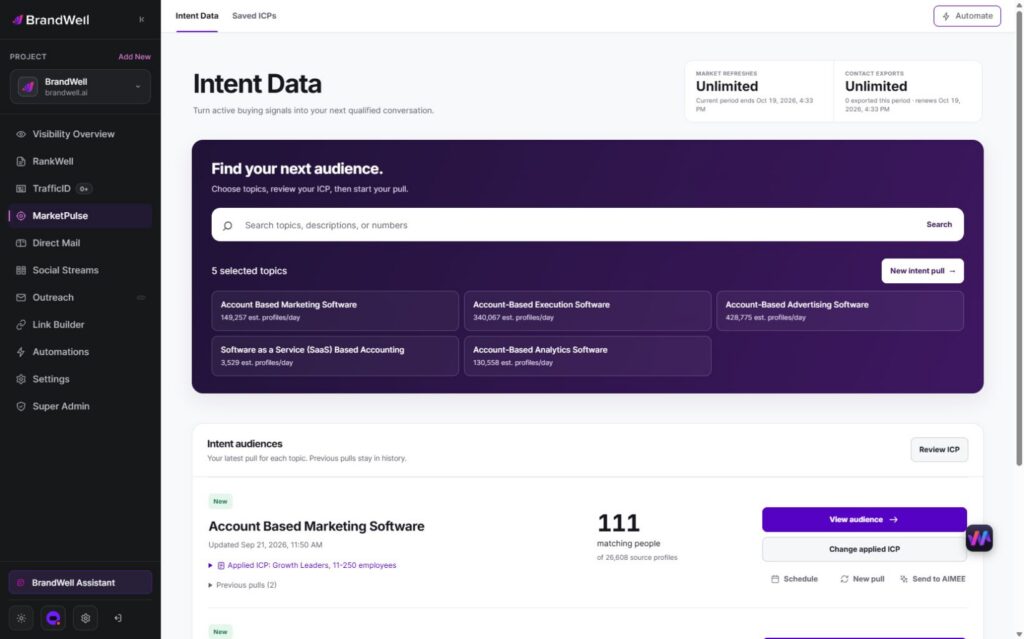
Use current MarketPulse research as one input to a separately implemented explanation record. Verify source, time, actual identity boundary, fit, uncertainty, permitted display and correction before proposing action. Do not assume native predictive scoring, event lineage or a client explanation portal.
BrandWell: MarketPulse intent data and connected growth automation
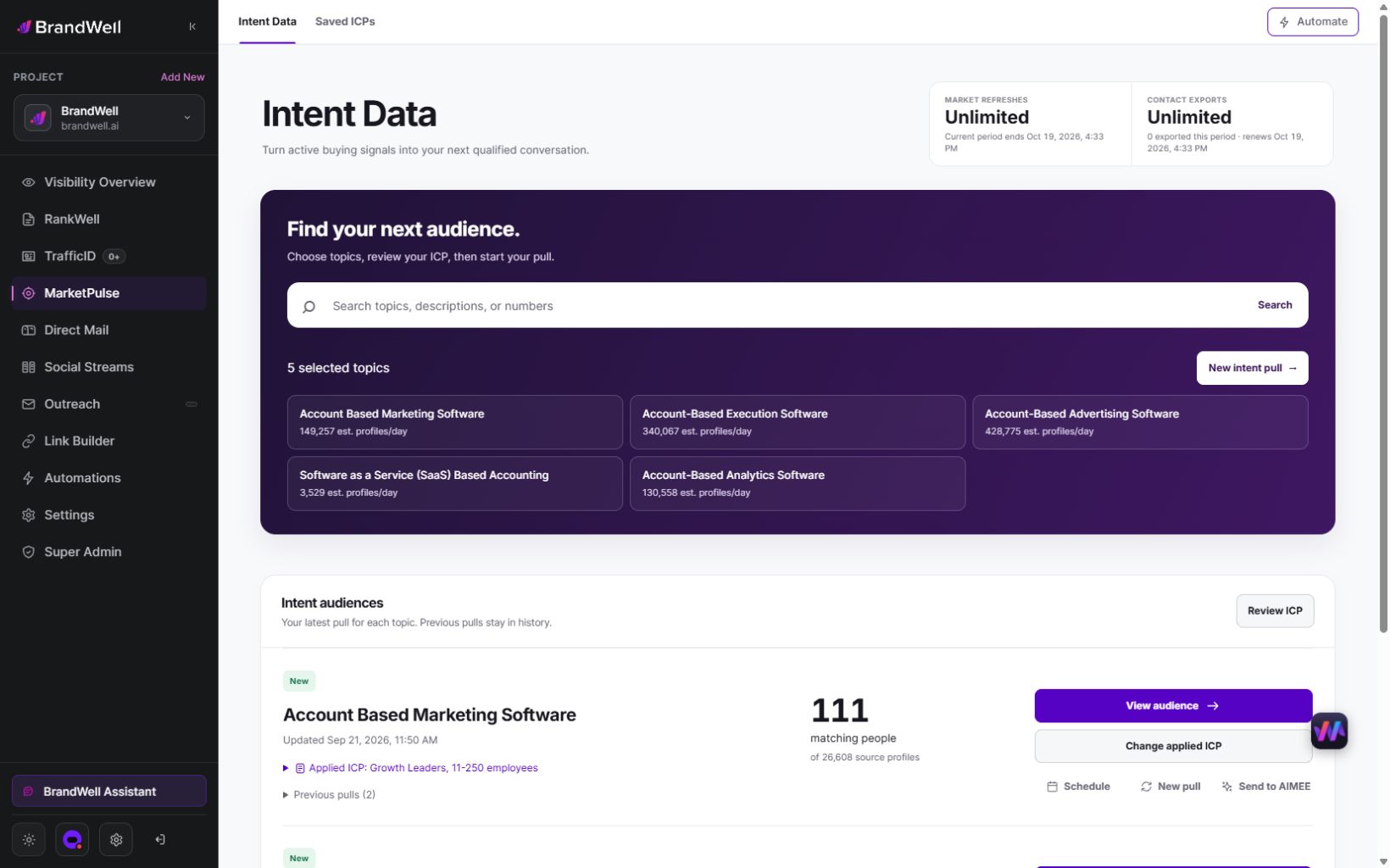
BrandWell MarketPulse: intent data starting at $500/mo. Find people researching topics relevant to what you sell, apply saved ICP filters, and review available contact details before taking action.
| Plan | Topics and refreshes | Monthly exports |
|---|---|---|
| Starter | 1 topic, weekly | 25,000 contacts |
| Growth | 3 topics, daily | 100,000 contacts |
| Scale | 10 topics, daily | Unlimited contacts |
Swipe the table to see all columns.
A pull retrieves available data from the previous 24 hours for one topic. Daily use across all included topics provides 90 Growth pulls or 300 Scale pulls in a 30-day month. Weekly Starter pulls vary by calendar month. Available audience size and contact fields vary, and audiences may overlap. Refreshes stop at the plan limit without overage charges.
- Find and qualify: search the topic catalog, save your ICP, and review the people and companies that match.
- Act on the research: export qualified contacts or prepare an Outreach or Direct Mail workflow. Connected products, channel usage, and fulfillment may cost extra.
- Get help from AIMEE: Growth and Scale include AIMEE for the initial user to research accounts and prepare the next step through connected tools.
Agencies and other service businesses can build client deliverables around their available Intent Scans and exports. Keep each client’s scope, permissions, and service fees clear. A subscription is not a promise of a white-label platform or exclusive access to a market.
Explore MarketPulse and watch the demo or compare plans starting at $500/mo. Any early-access discount is a separate, time-limited offer shown to an eligible recipient.
Compare rules and generated narratives
Rules-based explanations can quote the satisfied conditions and are easy to reproduce, but long rule stacks become brittle. Factor-based views show direction and relative contribution, though users may mistake them for causal proof. Generated narratives can translate evidence, but they must be grounded in the actual record and reviewed for unsupported additions.
Choose a layered design: concise reason code for the seller, expandable evidence for operations, and technical lineage for data reviewers. The narrative should never outrun the structured facts. When an explanation cannot reconcile conflicts, it should say so and route the case for review rather than inventing confidence.
Budget explanation work
The operating cost includes data lineage, reason-code design, event retention, version control, explanation assembly, user testing, challenge review, correction, client training, and reporting. Complexity grows with source count, score versions, audiences, languages, privacy requirements, and the number of activation destinations.
MarketPulse research is starting at $500/mo. Verify current topic coverage, refreshes, exports and included tools on the product page. Custom scoring, client presentation, retention and challenge workflows need separately verified implementation and rights.
Measure appropriate reliance
Measure whether users can identify the evidence, choose an appropriate action, recognize uncertainty, and challenge a bad result. Track explanation-open rate, action acceptance, action reversal, challenge rate, confirmed corrections, time to decision, seller disagreement, and behavior by confidence band.
Trust should be calibrated, not maximized. A good explanation increases reliance on strong evidence and encourages caution with weak evidence. Compare decisions with and without explanations in controlled pilots, examine errors rather than clicks alone, and avoid claiming revenue attribution from explanation engagement.
- Define the denominator and time window before collecting a KPI.
- Separate human judgment flow score evidence from commercial score attribution.
- Scrutinize misses, reversals, and unresolved cases – not just successful actions.
- Keep trust metric definitions stable enough to compare periods and clients.
Match detail to the reviewer
A seller needs the reason, urgency, contact or account context, and safe next step. A manager needs consistency, coverage, and coaching patterns. RevOps needs thresholds, routing, version history, and feedback. A client leader needs aggregated rationale and outcomes. Data and privacy reviewers need lineage, confidence, retention, and challenge records.
Do not solve the audience problem with one enormous panel. Use progressive disclosure and role-appropriate detail while keeping the underlying explanation consistent. Clients should be able to compare periods without the agency changing definitions merely to produce a better-looking narrative.
Separate fit, identity and outcomes
An account can be a strong fit with weak current intent, or show strong recent activity with uncertain identity. Display fit, observed intent, freshness, identity confidence, corroboration, and outcome feedback as separate dimensions before combining them. This prevents a single composite number from hiding the reason for action.
Keep the actual identity method, observation unit, source uncertainty and fit separate from purchase conclusions. Label inference, preserve conflicts and route correction or suppression requests. A readable explanation does not make an unsupported input reliable.
Protect permitted access and corrections
Explain only what the viewer is permitted to see. Avoid exposing unnecessary personal data or proprietary source detail to make a score feel credible. Document purpose, access, retention, correction, deletion, and escalation. The explanation layer should inherit client separation and suppression controls from the underlying data operation.
Give sellers and clients a structured challenge path: wrong identity, stale event, irrelevant topic, duplicate evidence, incorrect fit, unsafe action, or other reason. Preserve the original explanation, reviewer decision, correction, and model version. Challenges are quality data, not insubordination.
- Document purpose, permissions, retention, suppression, deletion, and correction.
- Require approval before material targeting, score data-use, spend, or external-message changes.
- Preserve provenance and a reversible explanation record of transformations and decisions.
- Escalate uncertainty rather than converting it into an unsupported certainty claim.
Scope separate client deliverables
An agency can deliver an explanation register, challenged-score queue, correction log, seller enablement, client summary, and monthly pattern review. The recurring value is a more accountable decision process: which evidence was used, where people disagreed, what changed, and how future actions should be adjusted.
AIMEE can prepare a review brief through configured connected tools. Keep proposed actions separate from actual approvals and destination acknowledgements. Confirm the implementation and permissions before execution.
Review an available MarketPulse topic, saved ICP and actual preceding-24-hour matches for the approved research purpose. Keep uncertain company context visible. AIMEE can organize supplied context through configured tools; named owners approve actual exports, messages, audience uploads and CRM writes.
Test the explanation workflow
- Choose representative strong, weak, stale, conflicting, and corrected scores for the first review set.
- Expose the event timeline, source category, freshness, match confidence, fit, and score movement.
- Separate observable facts, inferred factors, model contribution, and recommended seller behavior.
- Give sales a concise reason while preserving deeper lineage for RevOps and data reviewers.
- Ground generated narratives in structured evidence and reject unsupported additions.
- Provide challenge categories for wrong identity, stale events, duplicates, fit, topics, and unsafe actions.
- Retain the original explanation, reviewer response, correction, and model or rule version.
- Test whether explanations improve appropriate reliance rather than maximizing trust or clicks.
- Limit displayed personal and proprietary information to each viewer’s permitted purpose.
- Review challenge patterns monthly and update presentation, training, or upstream controls accordingly.
The explanation test is whether a seller and client can independently identify why the score changed, what remains uncertain, and which action is proportionate. If they must trust a private interpretation, the number is still opaque despite a polished presentation.
Copyable explanation review
Unit: [Actual account, event or candidate contact.] Input: [Observed source, topic, time and uncertainty.] Rule: [Actual version, factor definition and contribution.] Conflict: [Missing, stale, duplicate or disconfirming evidence.] Action: [Permitted purpose, owner, suppression and approval.] Challenge: [Original output, reviewer correction and unresolved state.] Evaluation: [Appropriate decision, unique outcome, labor and exclusions.]
Readable reasoning and faithful reasoning are separate
NIST’s explainability principles address evidence, understandable explanations, fidelity to the system’s process and knowledge limits. These are review prompts, not certification of BrandWell or proof of buyer readiness.
If an actual rule uses topic appearance and company fit, a narrative must not invent approved budget, decision authority or a planned purchase date. Ask whether the reviewer can trace each statement to the supplied record. A fluent story is not additional evidence.
Points are not purchase probability
A fictional rule starts at 20 points, adds 30 for fit and 25 for recent research, then subtracts 15 for conflicting context: 60 points. That arithmetic does not mean a 60% probability of purchase. Such a probability claim needs a defined outcome, time horizon and suitable calibration evidence. Keep an ordinal band or rule score labeled as such.
Model changes can move the score without new behavior
The same fictional record scores 60 under version 1 and 75 under version 2 because the fit weight changes. The 15-point increase is a rule change, not new research or a buyer becoming more ready. Preserve versions, unchanged inputs and the explanation of the difference.
Review appropriate reliance, not clicks alone
In a fictional 100-case test, 70 cases have a defensible proposed action and 30 require a hold. A reviewer chooses the appropriate action in 60 of the 70 and appropriately holds 20 of the 30. Correct decisions total 80%, while inappropriate actions occur in 10 of 30 hold cases, or 33.3%. A high explanation-open rate would not repair those errors. These case labels and results need an actual reference review; they are not measured BrandWell performance.
Challenge resolution has multiple states
Twenty fictional challenges include eight confirmed corrections, seven reviewed with no correction and five unresolved. Eight corrections are 40% of all challenges or 53.3% of the 15 resolved challenges. Do not present either as an overall match-error rate; challenges are a selected population.
Include the labor behind the explanation
A fictional monthly workflow costs $500 research, $400 configuration, $500 QA and $300 challenge review: $1,700. Forty accepted decision records make the defined cost $42.50 each. An extra $300 correction cost makes it $50 each. Overhead, tax and financing are excluded; zero accepted records make the ratio undefined. These invented values are not BrandWell prices or benchmarks.
Frequently asked explanation questions
Does a score of 87 mean an 87% purchase chance?
No. Verify the actual score definition and any separately supported probability claim.
Can a generated narrative add likely buyer facts?
Keep it grounded in actual inputs and label inference; do not invent budget or authority.
Does opening an explanation prove it helped?
No. Review appropriate decisions, errors, challenges and outcomes.
Does MarketPulse include a custom scoring portal?
Use supported research as an input and verify separate implementation, rights and fees.
Review current research: explore MarketPulse and current plans.
Reviewed and updated October 3, 2026.

Written by