



On this page
- Separate a seed from a final target
- Start with your products and customer tasks
- Review questions your team already receives
- Use Search Console to find existing visibility
- Inspect public questions and search results
- Expand the list in BrandWell
- Turn the research into page decisions
- Prioritize relevance before arbitrary thresholds
- Frequently asked questions
Seed keywords are starting terms you use to explore a topic and discover more specific search opportunities. They are inputs to research, not automatically the phrases every article should target.
Begin with what your business does and the problems customers describe. Expand those ideas, inspect the evidence, and decide which existing or new page can satisfy each useful task.
Separate a seed from a final target
For a payroll software company, “payroll” may be a seed. Research could lead to “payroll migration checklist,” “payroll software for multiple locations,” or “how to correct a payroll error.” Those searches call for different information.
A seed can be broad or specific enough to keep the research focused. There is no required word count. Nor must every seed become a pillar page: some produce no relevant opportunity after review.
Start with your products and customer tasks
List the product categories, services, use cases, and recurring problems your team actually understands. Include the language customers use, not only your internal feature names.
- Product: payroll software
- Task: migrate payroll
- Problem: reconcile payroll discrepancies
- Audience: payroll for multi-location businesses
- Decision: compare payroll implementation requirements
These are original examples, not measured keyword-volume claims. Their value is that each gives the researcher a concrete direction to investigate.
Review questions your team already receives
Sales conversations, support requests, onboarding questions, and site-search logs can expose language missing from your initial list. Use appropriate access and remove private customer details from the working brief.
Record the question and its context. A support question from an existing customer may need a help article rather than a prospect-facing sales page. Do not force every question into the same format.
Use Search Console to find existing visibility
Review query and page data for the relevant part of your website. Terms with impressions can suggest subjects Google already associates with your content, including gaps where the page does not answer the query well.
Keep the date range, country, device, and search type consistent. Google’s metric definitions help explain what impressions, clicks, and position mean. Impressions for your property are not the same as total market search volume.
Save the source of each idea. “Customer question” and “query with measured impressions” are different kinds of evidence, and both can be useful.
Inspect public questions and search results
Look at relevant public discussions and the types of results shown for a candidate topic. Are people looking for a definition, a comparison, a tool, or instructions? Use that observation to refine the seed.
Suggestions and related questions are discovery clues, not proof of volume or a guaranteed content plan. Do not copy another publisher’s structure and assume that reproducing it establishes originality.
Expand the list in BrandWell
Use BrandWell’s keyword research workflow to investigate the seed and related opportunities, then bring the selected task into RankWell for content planning. Review available metrics rather than treating a score as a publishing instruction.
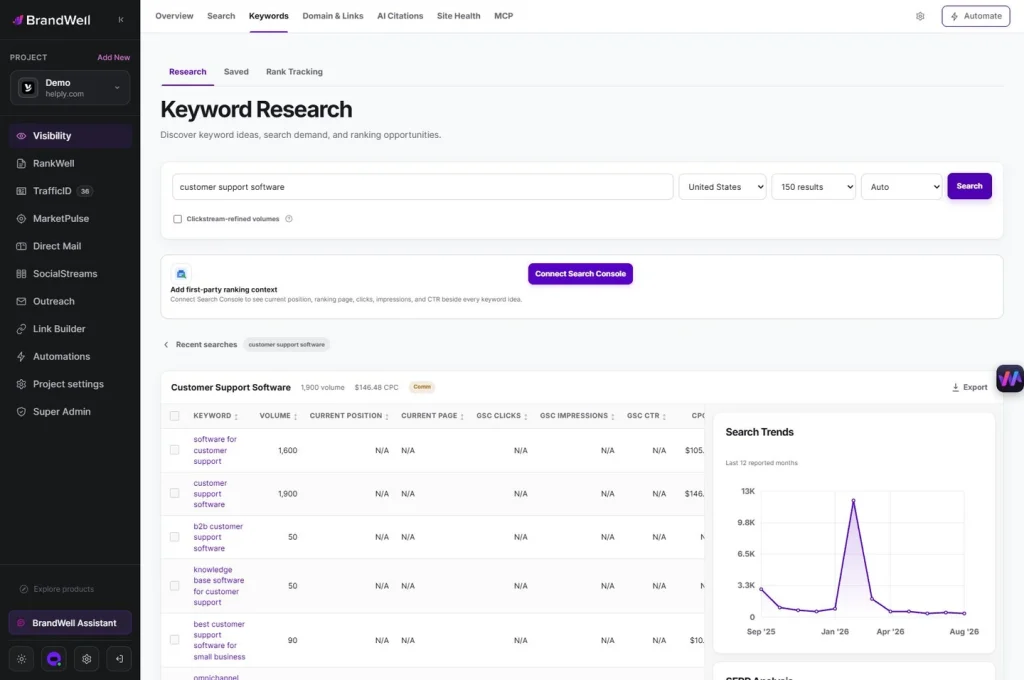
Missing volume or difficulty data means the metric is unavailable, not that the query has no searches or no competition. Likewise, there is no universal difficulty score below which every business can rank.
Turn the research into page decisions
For each promising idea, record the likely reader, task, existing destination, evidence, and next action. Choose whether to improve a page, create a distinct resource, merge redundant coverage, or set the idea aside.
For example, a migration checklist and an implementation responsibilities guide may belong together if they answer the same practical task. A pricing page serves a different purpose. Keyword similarity alone should not decide the architecture.
Use keyword clusters to organize related searches without creating a separate page for every wording variation.
Prioritize relevance before arbitrary thresholds
A niche query can be valuable when it matches a costly customer problem and your expertise. A large estimated audience can be unhelpful if your product cannot serve it.
Compare the evidence you can contribute, the effort to produce and maintain the page, and the appropriate next step for the reader. Avoid rules such as “only target at least 100 searches” or “always stay below difficulty 40.”
Start with a manageable set and review what happens after publication. The purpose of research is a better decision, not the largest possible spreadsheet.
Frequently asked questions
How many seed keywords should I collect?
Enough to represent the relevant products, problems, and audiences you can realistically research. There is no universal minimum or maximum.
Does a seed need high search volume?
No. It is a starting point. Evaluate the specific opportunities discovered from it and the quality of the evidence available.
Are long phrases always easy to rank for?
No. Length alone does not establish competition, relevance, or conversion potential.
Reviewed and updated October 2, 2026.

Written by
Julia McCoy has contributed articles to BrandWell on content marketing, writing, and search engine optimization. This archive retains her original bylines; individual articles may be updated by the BrandWell editorial team.

