On this page
- Current TrafficID own-site workflow
- Define website observations and uncertainty
- Use eight instrumentation and review steps
- Evaluate seven operating resources
- Separate forms, analytics and behavior
- Count actual collection and review costs
- Measure decisions and buyer outcomes
- Check site and team prerequisites
- Preserve five signal dimensions
- Version scoring and collection rules
- Scope separate website-evidence services
- Copyable first-party signal review
- Frequently asked website-signal questions
First-party website signals are observations on a business-controlled site, not proof of purchase intent. Define and validate events, separate forms from passive visits and appended stakeholders, preserve actual collection state, and check identity support before proposing action. Review events, fit, age, exclusions and owner feedback rather than treating every pageview as a buyer.
Who is this for? B2B marketing, sales, RevOps, analytics, and agency teams that want to turn activity on a company-controlled website into timely action without overstating what the activity means.
Review current TrafficID plans, eligible identified-visitor volume and the selected fixed or dynamic billing mode before budgeting. TrafficID and MarketPulse have separate product scope. Verify current allowances and included tools on the product page.
Current TrafficID own-site workflow
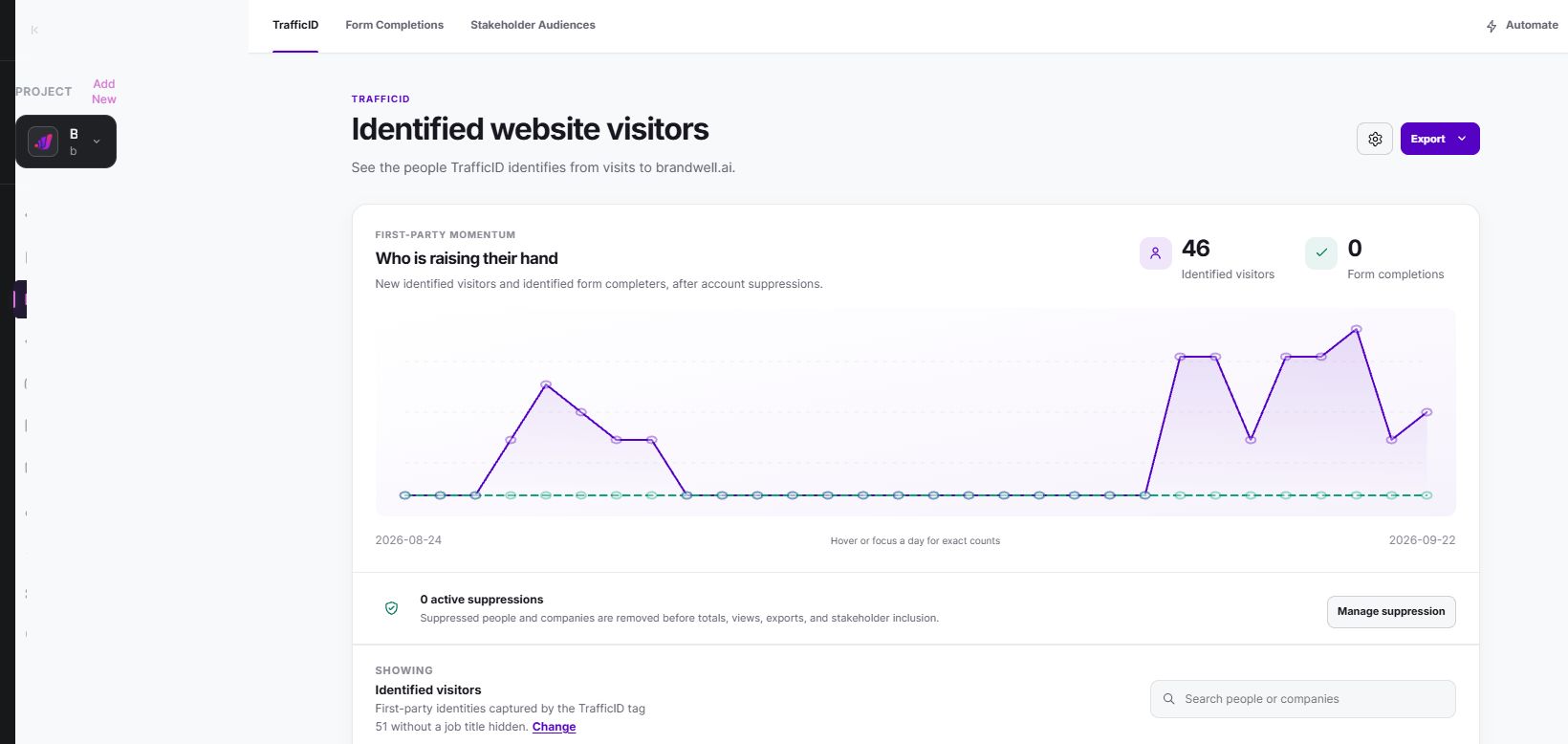
TrafficID addresses identifiable visitors to your own authorized site. Its views keep observed visitors, submitted form identities and added company stakeholders distinct. It does not identify every visitor or make an added stakeholder the person who visited.
Review current TrafficID plans, eligible identified-visitor volume and the selected fixed or dynamic billing mode before budgeting. TrafficID and MarketPulse have separate product scope. Verify current allowances and included tools on the product page.
MarketPulse is separate external topic research starting at $500/mo. Topic audiences do not establish a visit to the client’s site. Agency setup, analysis, reporting, custom portals and integrations need separate scope and fees.
Define website observations and uncertainty
First-party website intent begins with behavior collected on a property the business controls. That can include visits to solution, integration, comparison, pricing, security, implementation, or customer-story pages; repeat sessions; meaningful tool use; event registrations; form submissions; and authenticated product or portal activity. Ownership of the site gives the business better context, but it does not make every observation unambiguous.
A single pageview can come from a customer, competitor, job candidate, student, bot, partner, or accidental visitor. Treat it as weak evidence until other context increases its usefulness. A practical signal hierarchy places explicit hand raises and authenticated actions above high-consideration sequences, repeated relevant visits, and isolated content consumption. Add negative evidence such as careers-page behavior, support use, existing-customer status, bot patterns, and suppression.
The operational question is not “Did this visitor intend to buy?” It is “Does this observed behavior, combined with fit, recency, frequency, identity confidence, and permitted-use rules, justify a specific next action?” That wording keeps the first-party website intent strategy useful and honest.
Use eight instrumentation and review steps
- Define business events. Give every event an owner, purpose, parameter schema, expected source, and alternative explanation. Use stable names rather than ad hoc URL rules.
- Set consent and collection states. Decide which tags and storage/access technologies may run under each consent state. Consent mode is a technical way to communicate state; it is not a consent-management platform, lawful basis, or compliance guarantee.
- Validate instrumentation. Test actual event names, parameters, timestamps, consent states and duplicates on representative site paths. A visible event proves a collection observation under that test, not valid production traffic, identity correctness or buyer intent. Record expected and actual behavior.
- Filter non-human and irrelevant traffic. Exclude known bots, internal traffic, monitoring, duplicate events, support users, and pages unrelated to the buying decision.
- Assign an identity state. Keep anonymous session, probable account, matched person at a stated confidence level, and known first-party contact distinct. Do not force a name onto uncertain traffic.
- Score evidence. Combine fit, behavior strength, sequence, recency, frequency, confidence, and negative evidence. Store the rule version so past decisions remain explainable.
- Route an eligible next action. Sales review, account research, nurture, ad audience review, suppression, reject, and hold are all valid outcomes. Consequential contact or ad activation needs human and policy approval.
- Close the loop. Track acceptance, action, outcome, false-positive reasons, decay, and overrides. Recalibrate rules from downstream evidence rather than raw traffic volume.
Evaluate seven operating resources
Evaluate these seven resources against actual interpretability, instrumentation behavior, implementation costs, identity support, source rights and error recovery. They are operating templates, not a claim that every feature is native to one subscription.
1. Event taxonomy worksheet
List each event, parameters, business meaning, expected frequency, owner, exclusions, retention, and intended action. Limitation: a taxonomy becomes stale when site structure and offers change; assign a maintenance owner.
2. Instrumentation QA plan
Test event firing, parameter values, duplicate behavior, cross-domain paths, consent states, and timestamp handling before using events in scoring. Limitation: a successful test session does not prove production traffic is clean; monitor continuously.
3. Consent-state ledger
Record actual collection state, notice, purpose, region, downstream eligibility and change history. Verify the configured collection behavior under each state. A technical consent signal is not a consent-management system, lawful basis or general compliance guarantee.
4. Bot and relevance filter
Use traffic-source, behavior, network, user-agent, velocity, and known internal patterns to quarantine suspicious events. Add business exclusions for support, careers, investor, and existing-client activity. Limitation: filtering is probabilistic; aggressive rules can remove real buyers.
5. Identity-confidence gate
State the observed inputs, match method, confidence tier, known-contact status, and rejection path. Limitation: a resolved identity is still not proof that the named person performed every observed action.
6. Behavior scoring worksheet
Give stronger weight to sequences and high-consideration events, decay old activity, cap repeated low-value actions, and subtract negative evidence. Limitation: weights are hypotheses, not objective truth; validate and monitor drift.
7. Activation and feedback log
Connect the signal snapshot to decision, owner, action, SLA, approval, suppression, and outcome. Limitation: an outcome after activation is not automatically caused by the signal; use a holdout where feasible.
Separate forms, analytics and behavior
Each approach answers a different question:
- Form fills and explicit hand raises capture a person who volunteered information for a defined purpose. They provide an explicit inquiry for the stated purpose, but many research journeys never produce a form.
- Aggregate analytics show channel, content, and journey patterns without requiring person-level action. They are useful for site and campaign decisions, but they cannot prioritize a specific account.
- Pageview counts are simple and useful for content diagnostics. Alone, they are too ambiguous for a personalized sales action.
- First-party website intent combines selected behavior, context, sequence, recency, fit, identity state, and governance. It can support a reviewed prioritization rule while adding integration, privacy, maintenance, and false-positive risk.
Use the simplest source that answers the decision. A high-volume self-serve site may get more value from aggregate journey analysis. A considered B2B sale with limited seller capacity may benefit from account-level prioritization. An explicit form response should not be buried under a more elaborate intent score.
Count actual collection and review costs
First-party website intent cost is spread across measurement rather than one license. Budget for analytics and tag implementation, consent-management and privacy work, identity or account matching, data storage, CRM and automation integration, scoring logic, seller enablement, monitoring, and ongoing QA.
Separate setup from operations. Setup includes the event taxonomy, data contract, consent-state design, integration, baseline, and acceptance test. Recurring work includes drift monitoring, bot review, score recalibration, routing exceptions, reporting, and site-change QA. Usage-based identity or enrichment fees should be modeled separately from fixed software costs.
For a total-cost comparison, measure internal hours as well as vendor fees. A cheap pixel that generates alert fatigue can cost more in seller time than a governed workflow. Conversely, a complex identity layer may be unnecessary when account-level analytics or form activity already answers the question.
Measure decisions and buyer outcomes
Do not judge the program by detected visits alone. Track the full chain:
- valid event rate after bot, duplicate, consent, and relevance filtering;
- match distribution by anonymous, account, matched-person, and known-contact state;
- accepted, held, rejected, and suppressed signal rates with reasons;
- time from event to decision and from decision to approved action;
- seller or marketer acceptance and override rates;
- reply, meeting, qualified opportunity, stage progression, and contribution margin;
- incremental difference versus a comparable holdout where scale permits.
Keep correlation, attribution, and incrementality distinct. “Opportunities with high scores were worth more” is descriptive. “This workflow caused more qualified opportunities than the status quo” needs a credible counterfactual. Define denominators, windows, joins, and late-stage updates so first-party website intent ROI is auditable rather than a sum of influenced pipeline.
Check site and team prerequisites
Check actual meaningful events, relevant traffic, reliable CRM states, owner capacity and a useful review decision. Verify client data roles, collection, access, suppression and reporting. Neither a B2B label nor installing a pixel establishes readiness.
Start manually when traffic is low, events are unstable, or sellers have not agreed on acceptance criteria. Evaluate aggregate analytics when the decision does not require identity. Evaluate explicit lead capture where a requested response answers the decision. Avoid person-level activation in sensitive contexts or where provenance, notice, permission, or identity confidence cannot support it.
A site is not ready simply because it can install a pixel. Operational readiness means the team can explain why each event matters, what alternative explanations exist, who receives it, what action is permitted, and how errors are corrected.
Preserve five signal dimensions
A useful first-party website intent framework keeps five dimensions visible:
- Fit: Does the account match the defined customer profile and current commercial constraints?
- Behavior: Which meaningful events and sequences occurred, and what else could explain them?
- Recency and frequency: Is activity recent enough to act on, and is repetition informative rather than duplication?
- Identity confidence: Is the state anonymous, probable account, matched person, or known first-party contact?
- Eligibility and outcome: Which actions are allowed, and what happened after the decision?
Do not collapse these into an unexplained magic score. If a score is used, expose its inputs and rule version, monitor performance by segment, and allow human override. “Real-time” delivery cannot repair weak meaning or uncertain identity; a fresh false positive is still a false positive.
Version scoring and collection rules
Verify actual region, tool, collection purpose, notice, storage/access behavior, consent or control requirements, data recipients and retention before implementation. Site ownership, a pageview or a pixel does not establish unrestricted permission. Hold unresolved collection or activation requirements.
Common operational mistakes include scoring every page, failing to remove bots, treating repeated events as independent evidence, resolving a person with no confidence tier, sending sensitive browsing detail to sales, retaining events indefinitely, and never recalibrating after the site changes. Maintain deletion and suppression paths across every downstream system.
Review false positives and misses with reason codes. If the score changes, version it; do not rewrite historical decisions. If consent or permitted-use state changes, stop ineligible activation rather than relying on an old audience export.
Scope separate website-evidence services
A durable agency package can include event strategy, measurement QA, identity-state design, scoring, routing, exception handling, monthly signal-quality review, client reporting, and a quarterly recalibration. Define the service boundary: the client owns its website, consent choices, CRM truth, channel permissions, and final outreach or ad decisions.
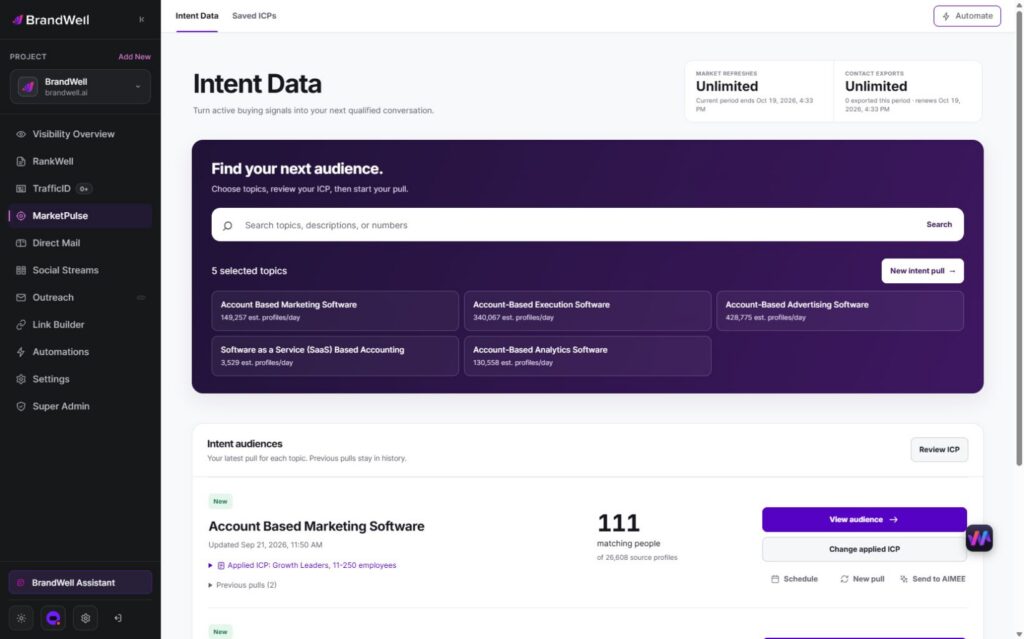
TrafficID supports own-site visitor review with available identity and company context. MarketPulse separately supplies off-site topic research. AIMEE can organize supplied context through configured tools. An agency operating service, branded weekly report, CRM synchronization or custom client interface needs separately verified implementation, rights, scope and fees. The research subscription does not establish those delivery capabilities.
AIMEE can prepare a review brief through configured connected tools. Keep proposed actions separate from actual approvals and destination acknowledgements. Confirm the implementation and permissions before execution.
BrandWell is a poor fit when a client expects a data layer to replace consent management, analytics engineering, legal review, CRM hygiene, or a stable sales process. The service wins by making website evidence more useful and accountable – not by pretending every visitor is ready to buy.
Copyable first-party signal review
Event: [Actual name, source, page, observed time and schema.] Collection: [Notice, state, purpose and excluded events.] Unit: [Event, session, identified visitor, form or appended stakeholder.] Context: [Public company fit, alternative explanations and uncertainty.] Rule: [Version, age, frequency, exclusions and override.] Action: [Owner, permitted channel, approval and acknowledgement.] Outcome: [Buyer evidence, unresolved feedback, costs and comparison.]
Verify event collection before scoring it
Google Analytics DebugView documentation describes inspecting collected events and parameters after enabling debug mode. Use an authorized test device to compare expected and actual events. A visible test event does not validate production coverage, matching correctness or purchase intent. Preserve the actual collection state and expected exclusions.
Duplicate events are not repeated independent interest
In a fictional test, one pricing-page load creates three analytics events because two tags and a retry fire. That is one observed page load, not three independent visits or three buying signals. Preserve raw diagnostic events, identify the duplicate cause and correct the implementation. Do not merely lower a score while leaving the instrumentation fault in place.
Forms, identified visitors and stakeholders use different units
Suppose a fictional week shows 100 identified visitors and 30 form-submitters, with 20 people present in both groups under the stated identity rule. Their union is 110 unique people, not 130. Five extra stakeholder contacts per represented account are not additional observed visitors or form-submitters. Reconcile actual identity support, timing and exclusions; the example does not establish a universal TrafficID overlap or match rate.
A score describes a rule, not a purchase probability
A fictional rule assigns two points to a pricing-page sequence, one point to a repeat session and subtracts two for a support-only pattern. A three-point account meets that locally chosen review threshold. It does not have a 75% or any other stated probability of buying without separate validation. Preserve inputs, rule version, alternatives and actual outcomes.
Missing collection is not proof of missing interest
In a fictional controlled test, ten authorized test sessions are expected, but eight appear in the instrumentation report. Diagnose collection state, blockers, tag timing, source filters and errors before describing the two missing sessions. They are not automatically bots, visitors with no intent or rejected identities. Test collection and identity as different stages.
Budget the implemented workflow
A fictional test costs $99 TrafficID starting subscription, $300 installation/QA and $400 review, totaling $799. One hundred accepted records imply $7.99 each; 20 acknowledged actions imply $39.95 each. These are distinct units and invented operating costs, not BrandWell service prices or conversion results. Media, acquisition, general overhead, tax and financing are excluded. Custom scoring, event taxonomy, CRM routing and client reports require separately verified implementation.
Use the current TrafficID workspace
Review actual installation status, identifiable own-site visits and submitted forms. Inspect available person, role, company and page context, and keep appended stakeholder contacts separately labeled. Apply actual people/company exclusions before preparing an export or follow-up. AIMEE can organize supplied context through configured tools. Owners approve recipients, exports, messages, audience uploads, postcard budgets and CRM writes. Identification is partial; variable fields and a site visit do not establish permission or a purchase.
Frequently asked website-signal questions
Are three duplicate events three visits?
No. Reconcile actual event firing and the observation unit.
Are added stakeholders observed visitors?
No. Keep enrichment context separate from website observations.
Is a threshold score a purchase probability?
No. It is a review rule unless separately validated for a stated outcome.
Does a missing event prove no interest?
No. Investigate actual collection behavior and uncertainty.
Review the own-site product: explore TrafficID and current plans. For off-site topic research, review MarketPulse.
Reviewed and updated October 3, 2026.

Written by