On this page
- Transcript, summary and article: choose the output
- 1. Confirm permission and protect private information
- 2. Prepare and verify the transcript
- 3. Choose a focused article brief
- 4. Draft in the current BrandWell workflow
- 5. Check attribution and meaning
- 6. Publish an article readers can use
- Evaluate the workflow
- Common questions
To generate an article from audio, obtain an authorized recording, prepare and check a transcript, choose the reader’s question, then draft and edit an article around the verified material. Transcription produces a text record; an article adds structure and explanation. AI can support drafting, but it does not remove the need to check speakers, quotations, facts and reuse rights.
Transcript, summary and article: choose the output
- Transcript: a readable record of the spoken material, with speaker identification and relevant audio information.
- Summary: the main points, clearly presented as a condensed version.
- Article: an explanation organized for a particular reader and purpose, with attribution and additional evidence where needed.
An edited article is not a substitute for a complete accessible transcript. W3C’s transcript guidance distinguishes speech and relevant non-speech audio from descriptive transcripts that also explain important visuals. Make the transcript easy to find beside the media.
1. Confirm permission and protect private information
Use recordings you own or have permission to adapt. Check speaker agreements, client approval and any restrictions on publishing quotes. Public availability does not itself establish reuse rights. Remove or redact private customer information before submitting material to a drafting workflow.
Keep a source record with the title, date, speakers, original location and permission notes. Preserve the original recording so editors can resolve uncertain passages.
2. Prepare and verify the transcript
Use the transcription method appropriate to your recording and available tools. Check the current import options, limits and data practices before uploading. Do not assume a particular free quota or supported file type.
Listen to unclear sections. Check names, technical terms, quantities, dates and speaker changes. Mark unresolved passages rather than guessing. Speech recognition can produce plausible mistakes, and accuracy depends on the recording and system.
For a webinar, inspect slides or demonstrations as well as the audio. A speaker’s reference to “this chart” needs context; it does not give a draft enough information to reconstruct the chart.
3. Choose a focused article brief
Define the reader, the question and the useful takeaway. A long interview may support several distinct articles, but do not split it into overlapping pages without a clear purpose.
Fictional planning example: a 20-minute conversation about payroll-software implementation covers approvals, migration and training. An article about preparing the approval checklist can use that section and link readers to the complete conversation. It should not claim to cover the whole implementation process.
List the passages you intend to use and their timestamps. Separate the speaker’s experience from general advice. Add primary research when you need to support a broader factual claim.
4. Draft in the current BrandWell workflow
RankWell supports briefs and drafts within BrandWell. Start with the checked transcript or approved source material and confirm the input options supported by your account. Do not assume direct audio upload or a retired Content at Scale generation screen.
A useful drafting instruction specifies: the reader, article question, approved source passages, claims requiring verification, desired structure and attribution requirements. Tell the drafting process to flag missing information instead of inventing answers.
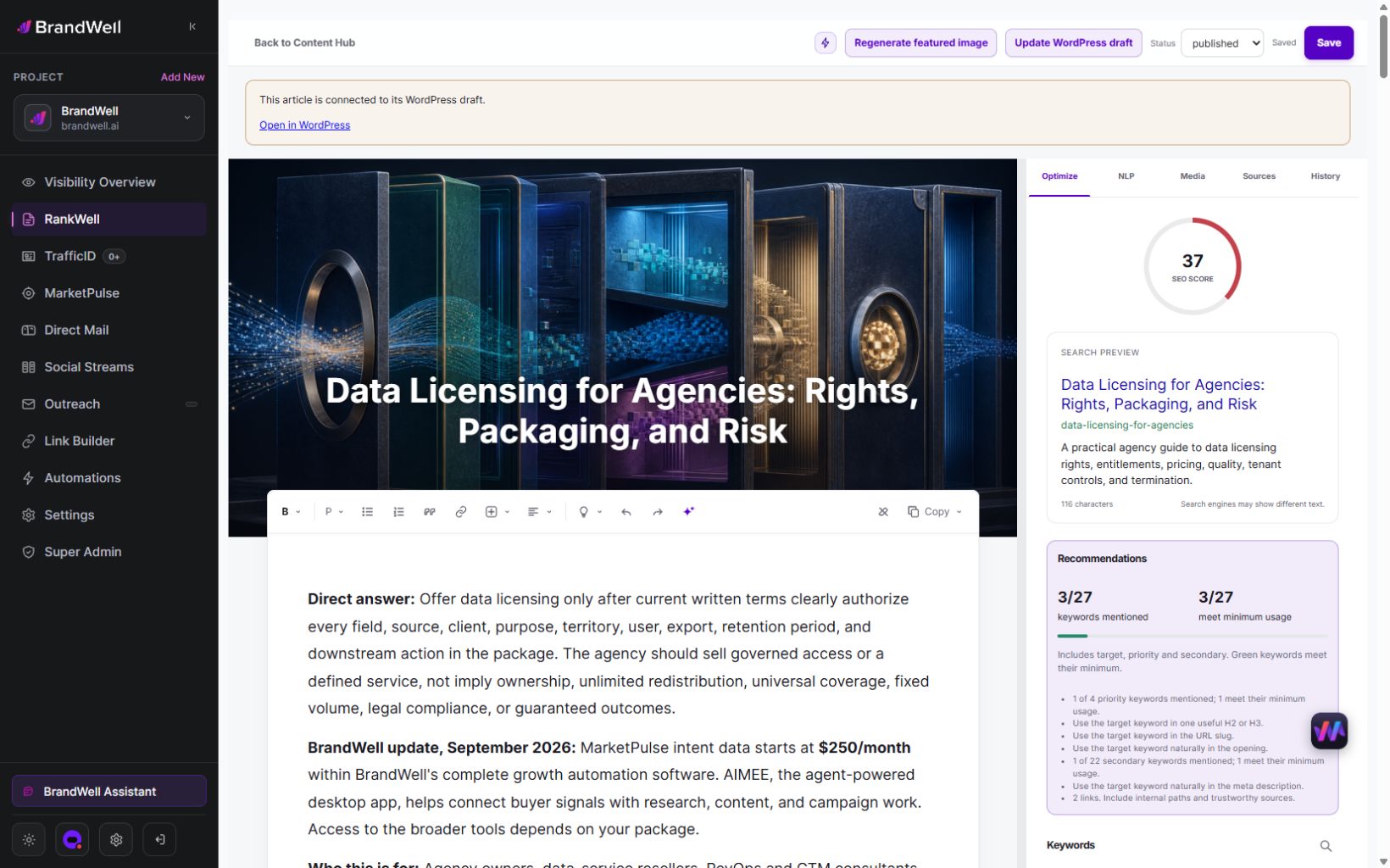
The Content Hub organizes articles, strategy, queue and calendar work. In the editor, review the article, search preview, recommendations, media, sources and history. A generated draft remains subject to editorial and source review.
5. Check attribution and meaning
Compare quotations directly with the recording. Do not silently change a speaker’s wording and present it as an exact quote. If you paraphrase, preserve the meaning and attribute the contribution.
Check that the draft has not turned a tentative observation into a universal result. “This helped our team” does not establish that every business will benefit, and an interviewee’s estimate is not an audited financial figure.
Verify links, product instructions and any statistics independently. If a number cannot be supported, remove it or explain its status. Do not invent a reference to make the article look researched.
6. Publish an article readers can use
Give the page a descriptive title, useful headings and a clear introduction. Include the original recording or a source link where appropriate, the transcript location and relevant speaker context. Use current screenshots only when they clarify a task.
Review mobile spacing, media controls, captions and transcript access. If adapting the article into an email or social post, check the shortened version again so it does not distort the source.
Evaluate the workflow
Record preparation, transcription correction, drafting and review time separately. Compare the finished output with the original purpose. More text is not automatically more useful content or better search performance.
Hypothetical time log: 15 minutes preparing a recording, 25 correcting the transcript, 20 drafting and 30 reviewing totals 90 minutes. This illustrates the work that remains after transcription; it is not a promised turnaround or benchmark.
Common questions
Can I publish an automatic transcript as an article?
You can choose to publish a checked transcript, but label it accurately. A structured article needs its own brief, editing and source checks.
Does converting audio to text guarantee SEO improvement?
No. A useful text page gives readers another way to access the material. Search outcomes depend on relevance, quality, accessibility and other factors.
Can I reuse someone else’s podcast?
Check permission and applicable reuse terms first. Attribution is important, but a source link alone does not authorize republishing a recording or extensive material.
Reviewed and updated October 3, 2026.

Written by
Julia McCoy has contributed articles to BrandWell on content marketing, writing, and search engine optimization. This archive retains her original bylines; individual articles may be updated by the BrandWell editorial team.