Direct answer: Use Google Ads conversion value rules for intent tiers only when the tier can be represented by an eligible Google Ads condition – most plausibly an eligible audience segment – and the adjustment reflects incremental business value not already encoded in the conversion. Do not assign a higher value merely because an account appeared “high intent.” Start with qualified offline outcomes or defensible expected value, test a modest rule, monitor value-based bidding, and keep a rollback path.
Who is this for? B2B Google Ads managers, paid-media agencies, RevOps teams, and demand-generation leaders with reliable conversion tracking, CRM outcomes, sufficient data for value-based bidding, and a governed buyer-intent audience strategy.
Separate conversion value from intent priority
Conversion value answers: how much is this completed business event worth? Intent tier answers: how strongly should this account or audience be prioritized before the outcome? Those concepts can be related, but they are not identical. A high-intent lead may be unqualified; a low-observed-intent lead may become a large customer. If the team multiplies value using the same signal that selected the audience, it can teach the system to reinforce a prior assumption rather than learn from downstream quality.
Google’s official documentation says conversion value rules adjust reported values and can affect value-based Smart Bidding. The eligible conditions include audience, device, and location, with an optional secondary condition. Review Google’s conversion value rules overview and setup guidance for the exact campaign, account, and tracking configuration.
An arbitrary CRM field called “intent tier” is not automatically a rule condition. The team may need to create an eligible first-party audience, meet Customer Match or other segment requirements, document advertiser authority and permitted use, and verify that the segment is available to the selected campaign type. Third-party or off-site evidence is not automatically eligible for upload. If the tier cannot be expressed as an allowed condition, do not force it into a value rule.
The safer hierarchy is: first, improve the conversion goal; second, import qualified or converted outcomes and actual or expected values where appropriate; third, consider a narrowly scoped value rule for information not already reflected in the base value. Google recommends qualified or converted lead goals for enhanced conversions for leads and supports importing a conversion value. See the official enhanced conversions for leads guidance.
Use five design gates before enabling a value rule
Evaluate each gate by decision, required evidence, implementation owner, risk, measurement, and limitation. Do not move to the next gate because a dashboard offers a convenient toggle.
1. Define the qualified business event and base value
Decision: Choose the event that should inform optimization: qualified lead, accepted opportunity, converted lead, sale, expansion, or another observable outcome. Decide whether the base value is actual revenue, expected gross contribution, or a consistently estimated stage value.
Required evidence: Maintain the conversion action, qualification definition, CRM stage, probability or actual value source, currency, deduplication identifier, conversion time, lag, cancellation or adjustment logic, and excluded records. Use the same definition across cohorts.
Implementation owner: RevOps owns the stage and value contract; finance validates economics; paid media configures the conversion action; sales applies the qualification definition; data engineering or operations maintains the import.
Risk: Teams may assign arbitrary values to micro-conversions or use optimistic pipeline amounts. Smart Bidding can then pursue the inflated proxy, producing apparent value without qualified revenue.
Measurement: Track import diagnostics, duplicate and error rates, qualified conversion volume, lag, value distribution, CRM reconciliation, and the ratio of reported value to observed downstream contribution.
Meaningful limitation: Even a well-designed expected value is an estimate. Small cohorts and long cycles can make the average unstable, so revisit it on a controlled cadence.
2. Define intent tiers without claiming certainty
Decision: Specify what distinguishes tiers and whether the distinction predicts incremental downstream value after controlling for fit and stage. Keep fit, engagement, topic evidence, identity confidence, and recency as separate components.
Required evidence: Record source, lineage, account, observed time, evidence window, topic definition, first-party behavior, identity state, ICP fit, exclusions, and current customer or opportunity status. Preserve the component values behind the tier.
Implementation owner: GTM strategy owns the hypothesis; data operations validates source quality and freshness; RevOps maps accounts and contacts; privacy, legal, security, or platform-policy reviewers define acceptable uses.
Risk: Account-level topic evidence can be presented as proof that a named person researched or intends to buy. Tier definitions can also leak current opportunity stage, making the rule double-count information already captured in the base value.
Measurement: Compare qualification, opportunity progression, observed value, and error samples by tier. Examine coverage and selection bias: the provider may observe some markets and account sizes better than others.
Meaningful limitation: A tier can prioritize research but cannot establish causation. If it does not predict additional value beyond fit and existing relationship, it should not modify conversion value.
3. Verify platform eligibility and audience match
Decision: Establish whether the tier can become an eligible, policy-compliant audience condition for the intended account and campaign. Confirm the rule is supported before building an economic model around it.
Required evidence: Document segment source, advertiser relationship, consent or notice as applicable, data rights, formatting, suppression, minimum and resulting audience size, match status, account-level availability, campaign compatibility, and expiration or refresh behavior.
Implementation owner: Audience operations builds and reconciles the segment; the advertiser or client approves the upload; paid media confirms rule and campaign compatibility; risk reviewers approve the data use where needed.
Risk: Licensed data may not be authorized for audience upload. Low match rates can create an unrepresentative subset. A successfully uploaded list is not proof that the source match or person identity is correct.
Measurement: Use a waterfall: source records, eligible records, submitted records, accepted records, matched audience, campaign-eligible audience, exposed population, and qualified outcomes. Preserve rejection reasons.
Meaningful limitation: Platforms do not disclose every matching detail, and audience membership can change. A rule operates on the platform’s eligible condition, not the agency’s full source cohort.
4. Set a conservative value adjustment and experiment
Decision: Choose whether to add or multiply value and by how much. Base the adjustment on observed incremental expected value, not on a label such as warm, hot, or surge.
Required evidence: Use a historical cohort with comparable fit, outcome definitions, lag, and costs. Document base value, tier value, overlap with other rules, sample size, uncertainty, proposed adjustment, primary metric, guardrails, experiment window, and rollback threshold.
Implementation owner: Analytics estimates value; finance reviews the economics; paid media configures the rule; RevOps validates the cohort; an authorized client owner approves bidding consequences.
Risk: A large multiplier can rapidly redirect spend, especially with value-based bidding. Overlapping conditions, sparse conversions, seasonality, and a favorable historical sample can create runaway feedback.
Measurement: Compare eligible audience delivery, conversion volume, qualified conversion value, value per cost, stage progression, spend distribution, and total cost. Monitor whether the rule reduces coverage of other profitable cohorts.
Meaningful limitation: A before-and-after improvement is not necessarily caused by the rule. Use a holdout, campaign split, staged rollout, or another credible comparison when feasible.
5. Monitor bidding, downstream quality, and rollback
Decision: Keep, reduce, expand, or remove the value rule after the planned observation window. Separate technical health, platform optimization, and business outcomes.
Required evidence: Maintain rule status, campaigns affected, bid strategy, spend, reach, conversion and value diagnostics, CRM outcomes, sales acceptance, audience refresh, data-source drift, and the pre-approved rollback procedure.
Implementation owner: Paid media monitors delivery; RevOps monitors qualified outcomes and imports; data operations monitors tier membership; finance reviews contribution; the client approves material scale.
Risk: Teams may leave a rule active after the source changes, or react to short-term volatility by changing the adjustment repeatedly. That prevents a clean read and can destabilize bidding.
Measurement: Track rule-applied conversion value, qualified value, cost, value distribution, audience coverage, opportunity quality, rejected leads, and time-to-correction. Compare with the documented baseline and guardrails.
Meaningful limitation: Removing a rule does not instantly erase learning effects, and long B2B lags delay a final outcome read. Rollback is risk control, not a perfect reset.
Decide when to use one value, dynamic values, separate actions, or rules
One static value per conversion is appropriate when outcomes are reasonably similar and the business lacks trustworthy variation. Simplicity can be safer than false precision. Dynamic conversion values are stronger when the completed event carries an actual or defensible expected value, such as revenue or qualified opportunity contribution. Separate conversion actions help when stages represent genuinely different events and the team needs distinct reporting or primary/secondary treatment.
Conversion value rules are appropriate when an eligible condition changes value in a way not already reflected in the base conversion. They can express audience, device, or location differences supported by the platform. Campaign or audience prioritization without a value rule may be better when the intent tier informs budget, creative, or account research but does not predict a defensible value difference.
Avoid double counting. If a high-intent account is more likely to reach the qualified-lead event and the conversion action already fires only after qualification, an additional multiplier may reward the same quality twice. If imported value already reflects opportunity size and probability, adding a tier factor requires evidence that the tier changes value beyond those inputs.
Build the workflow, data, integrations, and team
The workflow begins in the CRM, not the Google Ads interface. Define the qualified event and value source. Validate conversion capture and identifiers. Create the intent-tier record with provenance and an evidence window. Confirm audience rights and platform eligibility. Build and reconcile the segment. Model the adjustment. Obtain approval. Run a bounded experiment. Join advertising exposure and conversion records to CRM outcomes. Decide and document.
Minimum integrations include Google Ads, tag or conversion infrastructure, Google Ads Data Manager or another currently supported import path, CRM, consent and preference systems, audience source, account and contact normalization, and analytics. Current Google documentation should govern implementation because APIs and supported upload methods change. Do not hard-code a workflow around a deprecated path.
The team needs a paid-search owner, RevOps or CRM owner, data or integration owner, finance reviewer, sales-quality owner, and a privacy, legal, security, or platform escalation path. In an agency setting, the client must confirm advertiser authority, conversion definitions, permissible data use, and material bid changes.
Agent-ready preparation can classify cohorts, check missing fields, calculate proposed values, and draft a change brief. Humans should approve rule creation, bid strategy changes, uploads, and any change that could materially alter spend or personal-data processing.
Use a value map, eligibility checklist, and test sheet
The most useful tools are not another intent score. Use a conversion-goal register, value-source ledger, stage-value calculator, tier-component map, audience-eligibility checklist, match waterfall, rule-overlap matrix, experiment brief, diagnostics log, and rollback sheet. Every calculation should show assumptions and the owner who can change them.
A simple expected-value estimate is: expected contribution = probability of qualified outcome × expected gross contribution at that outcome, adjusted only for costs or probabilities the team can defend. Do not use public benchmark probabilities as client facts. Start with internal cohorts and show a range.
The rule brief should answer: what information is missing from the base value, how the platform will receive the condition, how much the value changes, which campaigns and conversions are affected, what could be double counted, what evidence will be observed, and which threshold triggers rollback.
Model budget, implementation cost, and total cost
There is no separate Google fee merely for creating a rule, but the operating cost can be material. Include audience and intent data, CRM and conversion architecture, tagging, Data Manager or integration work, validation, audience operations, media, analyst time, paid-media management, quality sampling, compliance review, and experiment opportunity cost.
A mature account with reliable qualified-outcome imports may need a bounded implementation project and recurring monitoring. An immature account may need foundational conversion work before any tier test. Price those jobs separately. Hiding CRM remediation inside campaign management creates poor margins and weak accountability.
Calculate total cost per qualified value outcome, not only media return on ad spend. Include the value and cost of seller time if the campaign changes lead volume or quality. Model an adverse case in which audience match is lower, conversion lag is longer, and the proposed multiplier shifts spend without improving pipeline.
Measure pipeline impact rather than rule-applied value alone
Platform metrics include conversions, conversion value, value per cost, spend, reach, rule-applied segments, and bid-strategy diagnostics. Business metrics include validated lead, sales acceptance, qualified lead, opportunity, stage progression, actual contribution, time to value, and disqualification. Data-health metrics include import errors, duplicates, audience match, stale membership, and missing consent or identifiers.
A successful test shows that the rule improved allocation toward qualified business value after total cost, without unacceptable loss of coverage or stability. Report the counterfactual design and uncertainty. If only the reported conversion value rises because the rule multiplied it, nothing has been proven.
Do not call an exposed account incremental pipeline simply because it later converted. Preserve prior opportunity state and sales activity. Use a split, holdout, staggered introduction, or matched eligible cohort where possible. Long sales cycles may require a leading qualified outcome and a later revenue read.
Identify the best-fit B2B use cases
Conversion value rules for intent tiers fit advertisers with sufficient eligible audience scale, clean first-party conversion data, meaningful value variation, qualified offline feedback, and an operating team that can monitor bidding. They are more plausible in finite B2B markets with account lists and differentiated deal economics than in accounts still optimizing to weak form submissions.
They are a poor fit when tiers are opaque, person identity is overclaimed, audience upload rights are unclear, matches are tiny, conversion volume is sparse, or the value difference is already captured by the event. A new account should first establish accurate primary goals, deduplication, CRM feedback, and a stable bidding baseline.
A useful implementation example is a tier that combines approved account fit and recent evidence into a first-party eligible audience, then applies a modest observed-value adjustment to a qualified-lead conversion. A bad example is multiplying every form fill from a third-party “hot” list without validation, consent review, qualified outcomes, or a rollback rule.
Control data-quality, privacy, and bidding risk
The common mistakes are using unsupported tier conditions, uploading data without authority, inflating micro-conversions, double counting quality, applying aggressive multipliers, allowing stale audience membership, ignoring overlap, and changing bid targets during the test. Other failures include losing transaction or order identifiers, inconsistent conversion times, and sending person-level messages based on account-level evidence.
Google’s enhanced conversions for leads documentation describes hashed first-party data, conversion identifiers, values, and consent fields, but technical support does not remove an advertiser’s legal and contractual duties. The ICO’s data-broker guidance likewise emphasizes buyer due diligence and lawful processing. Review the Google implementation guidance and ICO data-broker guidance with the relevant specialists.
Where BrandWell fits the intent-tier input layer
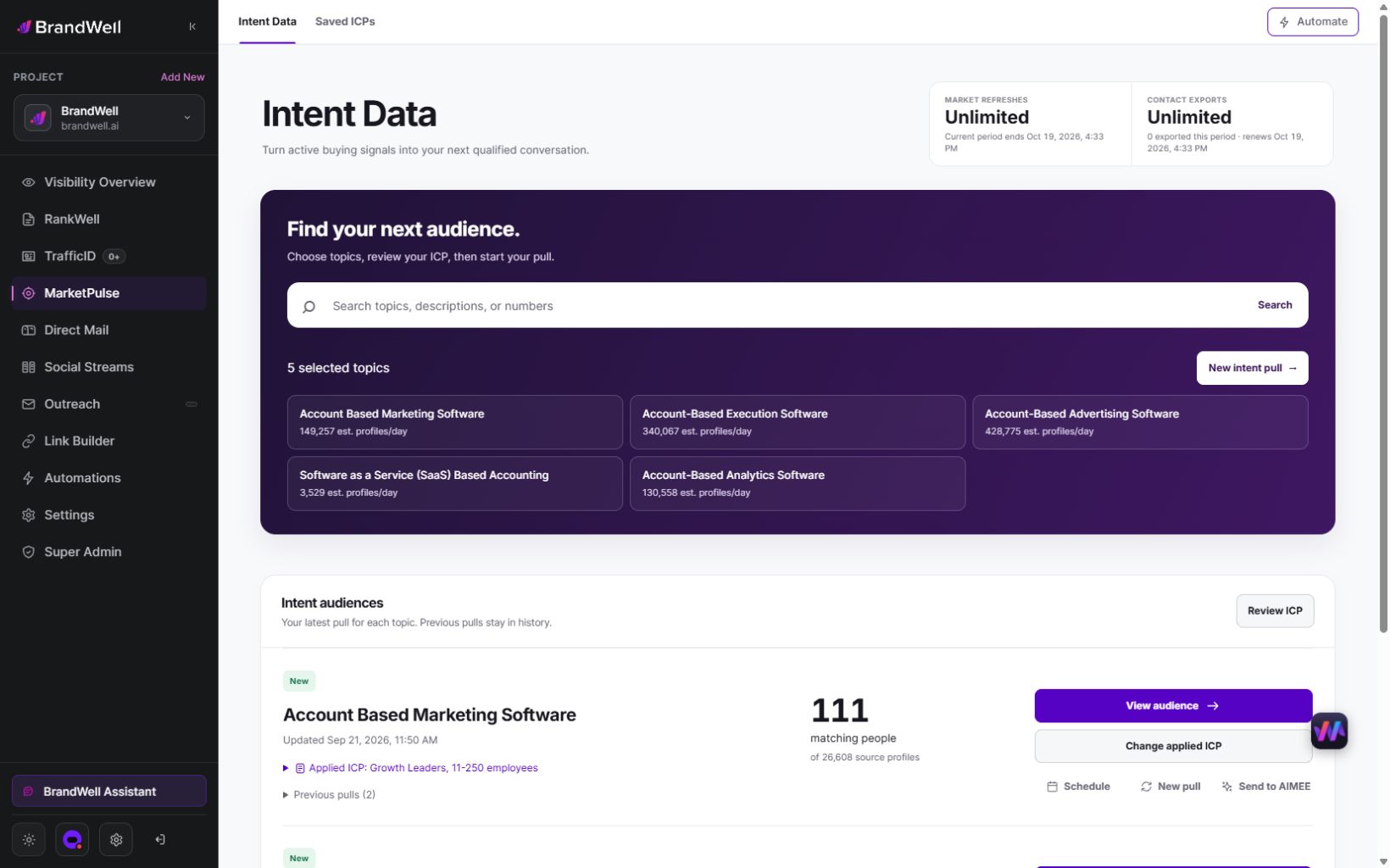
BrandWell’s agency-reseller intent-data product is separate from the legacy SEO writing product. Its role in this workflow is upstream: provide branded topic evidence, account or profile inputs, validation and workflow instructions that an agency can use to create governed hypotheses and client services. BrandWell is not Google’s bidding engine and cannot make an ineligible dataset eligible for a Google Ads value rule.
BrandWell is privately planned at $2,500 to $5,000 per month, depending on topic count, term, operating scope, and topic protection only where written availability exists. Public pricing is quote-based. Topic protection may be available for a defined scope, but it is conditional rather than universal exclusivity.
The intended white-label sales-and-delivery engine lets an agency configure modules, brand reports or portals, set retail pricing, and bill clients while purchasing wholesale. A $70 seven-day reseller pilot can generate branded topic reports and test whether an intent tier produces a defensible audience and value hypothesis before a wider rollout. Confirm every entitlement and data right through product, pricing, privacy, security, and platform review.
BrandWell can provide agent-ready automation workflow instructions for Claude or ChatGPT to prepare the tier map, eligibility preflight, value calculation, and change brief. Moxby is a separate optional browser-first execution path. Humans should approve audience uploads, conversion values, rules, bid changes, and client-facing claims.
Questions advertisers ask about Google Ads conversion value rules for intent tiers
How should Google Ads managers approach Google Ads conversion value rules for intent tiers to create more qualified pipeline and recurring revenue?
Begin with a qualified conversion and defensible base value. Prove that an eligible intent-tier audience predicts incremental value, apply a conservative adjustment, test it with guardrails, and judge the result using qualified pipeline after total cost.
What workflow, data, integrations, and team are required for Google Ads conversion value rules for intent tiers?
Connect intent evidence, audience eligibility, Google Ads, conversion tracking, current offline or enhanced conversion imports, CRM, finance values, and outcome analytics. Assign paid media, RevOps, data, sales-quality, finance, and risk owners.
Which tools, services, templates, or operational resources are most useful for Google Ads conversion value rules for intent tiers?
Use official Google Ads conversion and audience tools, CRM and Data Manager integrations, a governed intent source, validation, and analytics. Pair them with a value map, eligibility checklist, match waterfall, overlap matrix, experiment brief, and rollback sheet.
How should a buyer compare Google Ads conversion value rules for intent tiers with a manual or non-intent approach, and when should each be used?
Use one value when outcomes are similar, dynamic values when the event carries actual value, separate actions for distinct stages, rules for eligible missing value dimensions, and manual audience or budget decisions when intent informs priority but not defensible conversion value.
What budget, pricing model, and total cost should a buyer expect for Google Ads conversion value rules for intent tiers?
Include data, CRM and conversion architecture, tagging, imports, audience operations, media, management, analysis, quality review, and governance. Compare total cost per qualified value outcome and model match, lag, and bidding downside.
How should Google Ads conversion value rules for intent tiers be measured and tied to qualified pipeline or revenue?
Do not treat multiplied reported value as a result. Measure eligible exposure, qualified conversions, sales acceptance, opportunity progression, actual contribution, spend distribution, and total cost against a credible control or baseline.
Which companies, clients, or use cases are the best fit for Google Ads conversion value rules for intent tiers?
Best fits have clean qualified outcomes, sufficient conversion and audience scale, defensible value differences, advertiser authority, and a team that can monitor value-based bidding. Weak measurement and tiny opaque cohorts should be fixed first.
How should Google Ads conversion value rules for intent tiers be combined with fit, identity, freshness, activation, and downstream outcome evidence?
Store each factor independently. Use fit and freshness to define the cohort, identity and permission to determine audience eligibility, activation records to establish exposure, and downstream outcomes to validate or reject the value adjustment.
What are the biggest mistakes, data-quality issues, and privacy risks in Google Ads conversion value rules for intent tiers?
The largest are unsupported uploads, person-level overclaiming, stale tiers, weak primary conversions, double counting, aggressive multipliers, overlapping rules, bad imports, and no rollback. Platform capability is not proof of lawful or contractually permitted use.
How should an agency include Google Ads conversion value rules for intent tiers within a broader recurring client service?
Package conversion architecture, intent evidence, audience operations, rule experiments, diagnostics, qualified-outcome reporting, and quarterly value review. Define advertiser duties, approval limits, source rights, media scope, and stop conditions in the service agreement.
Test the reseller model before full enrollment
Agencies enter the BrandWell reseller pilot by paying $70 for seven days of access. The deliverables include agency-branded topic reports and a complete sales playbook for explaining the service and seeking client commitments before selecting a full plan.
The agency uses that evidence to test demand, assess whether expected commitments offset its costs, and decide whether the service merits a profit-center rollout. There is no guarantee of commitments, cost recovery, or profitability. Review the $70 seven-day reseller pilot.