On this page
- The short answer: Choose response policy for explicit hand raises versus inferred behavior by fit, confidence, and recency.
- 6 decision rules
- Build the workflow: data, evidence, integrations, roles, and approvals
- Compare alternatives and decide where this approach fits
- Model cost, pricing, and total operating effort
- Measure qualified outcomes – not signal volume alone
- Control data quality, privacy, trust, and automation risk
- Package it as an agency service – and where BrandWell fits
- Implementation checklist
- Frequently asked questions
- Make the request understandable at collection
- Keep lane metrics separate
- Review a topic with MarketPulse
Direct answer: Treat an explicit hand-raise and inferred intent as different evidence classes with different response policies. A verified request can enter a service-response lane. Confirmed first-party behavior may support contextual follow-up. Account-level research, visitor resolution, and multi-signal scores should normally trigger review, not automatic outreach. Preserve source, identity level, freshness, permitted use, confidence, and outcome so the team can explain every decision.
Who is this for? B2B data, RevOps, engineering, privacy, security, sales, marketing, and agency-delivery teams deciding how to combine declared and inferred buying signals. This decision guide covers strategy, implementation, tools and templates, pricing and total cost, ROI and KPIs, comparisons, use cases, activation, data quality, mistakes, privacy, and a recurring agency service model.
Current MarketPulse offer: intent-data plans start at $500/mo. See the product, demo, and current plans. Updated October 1, 2026.
The short answer: Choose response policy for explicit hand raises versus inferred behavior by fit, confidence, and recency.
The central error is ranking every signal on one hotness scale. Explicit intent means a person or account has taken a declared action in a known context, such as requesting a demo. Inferred intent is an interpretation of observed evidence, such as topic research associated with a company. Both can be useful; they answer different questions and carry different uncertainty.
Create an evidence hierarchy with five fields before scoring: what happened, at what identity level, how the identity was established, how recent the evidence is, and what use is permitted. Then assign a response policy. The strongest service request may authorize rapid human follow-up. A company topic surge may authorize account research. An uncertain visitor match may remain analytics-only. Missing permission or ambiguous identity should fail closed.
A response-policy matrix is more supportable than a universal score because it preserves meaning. Rows represent evidence classes; columns represent fit, identity, freshness, relationship, suppression, and channel conditions. Each cell ends in serve, review, nurture, analyze, hold, or discard. None should end in autonomous contact solely because an algorithm produced a high number.
6 decision rules
These are operating lanes rather than software rankings. Each is evaluated with the same criteria: best fit and poor-fit case; inputs, workflow, and owner; cost and commercial effect; measurement and evidence; and governance and a meaningful limitation. Keeping the criteria visible prevents teams from comparing a true request with a probabilistic account association as if they were equivalent records.
1. Prioritize explicit requests
Best fit and poor-fit case: Use this lane for a verified form submission, demo request, pricing inquiry, reply, or other declared request from a known party. It deserves the clearest and usually fastest response policy because the action and contact path are explicit. It is a poor fit when the record is a bot, test, duplicate, stale import, ambiguous consent, or a content interaction mislabeled as a sales request.
Inputs, workflow, and owner: Capture the original action, page or offer, timestamp, supplied identity, notice or consent context, account match, requested follow-up, owner, service level, and suppressions. Validate the record, deduplicate it, route it to the appropriate team, and record acceptance. Revenue operations owns routing; the responding team owns service; privacy and security owners govern collection and retention.
Cost and commercial effect: Cost includes forms or event collection, validation, routing, CRM work, response labor, QA, and duplicate handling. The signal itself may be inexpensive, but slow or incorrect routing carries opportunity cost. Agencies should scope response handling separately from the data layer and avoid charging a success fee against revenue they do not fully control.
Measurement and evidence: Measure valid requests, routing acceptance, response latency, duplicate or spam rate, qualified progression, resolution, and client satisfaction under the request type. Keep the denominator of all accepted hand-raises. A high close rate in this lane should not be used as a benchmark for inferred activity because selection and buyer behavior differ.
Governance and meaningful limitation: Even explicit intent has boundaries. A person may request content without authorizing unrelated outreach; a work email does not grant unlimited use. Preserve the collection context, honor preferences, minimize access, and do not enrich beyond the permitted purpose without review. The limitation is scale: true hand-raises are valuable partly because they are scarce and cannot simply be manufactured by relabeling weaker events.
2. Require corroboration for inferred signals
Best fit and poor-fit case: Use this lane when fresh topic or research evidence is associated with a company and the account fits the ICP. It should normally create an account-review or marketing-prioritization task, not immediate named-person outreach. It is a poor fit for low-value accounts, vague topics, thin coverage, or teams that cannot investigate before acting.
Inputs, workflow, and owner: Store source, topic, evidence window, baseline or surge logic, account match, fit reason, confidence, exclusions, and expiration. Normalize the account, test relevance, check existing relationships, and send an evidence card to the chosen owner. Data operations owns ingestion; strategy owns topic meaning; RevOps owns the join; sales or marketing decides the action.
Cost and commercial effect: Budget for topic scope, account matching, normalization, analyst review, enrichment where permitted, activation, and outcome joining. Cost rises with broad topics and high rejection. Agencies can package a bounded topic-report or review queue, but should not promise a count of certain buyers or absorb unlimited research into a fixed fee.
Measurement and evidence: Track signal freshness, relevant-account coverage, fit acceptance, review acceptance, action completion, downstream qualification, false-positive reasons, and cost per accepted decision. Compare against similar fit accounts without the state when feasible. Report association honestly because research activity, brand awareness, rep skill, and market conditions can all affect outcomes.
Governance and meaningful limitation: Inspect the actual observation and account-matching method instead of assuming every source uses a probabilistic model. An account association does not prove a named employee researched the topic or that a project exists. Correlated sources may repeat one event. Retain unknowns, expiration and a no-action state.
3. Apply an ICP fit gate
Best fit and poor-fit case: Use a fit gate before inferred evidence consumes seller or media capacity. It is useful when the addressable market is defined and account value justifies review. It is a poor fit when the ICP is only a slogan or exclusions are not operational.
Inputs, workflow, and owner: Normalize the account, apply positive and negative fit criteria, resolve hierarchy and territory, and retain a reason code. RevOps owns the gate; sales and marketing leadership approve criteria; operators may route ambiguous accounts to review rather than silently upgrading them.
Cost and commercial effect: Costs include data, account resolution, rule maintenance, exception review, and rejected-source waste. The gate protects economics by preventing expensive handling of well-timed but commercially irrelevant accounts.
Measurement and evidence: Measure fit coverage, rejection, override, seller acceptance, qualified progression, and cost within each fit band. Compare inferred evidence only among accounts with reasonably similar fit.
Governance and meaningful limitation: Fit data can be incomplete or proxy sensitive traits. Preserve missing states and review systematic exclusions. The limitation is that excellent fit does not establish current demand, and strong activity does not repair poor fit.
4. Use confidence and recency
Best fit and poor-fit case: Use this lane for analytics, account prioritization, and careful review when a site visit or other event is probabilistically associated with a company or profile. It is a poor fit for definitive person-level claims, sensitive decisions, automatic outreach, or clients that cannot govern personal data and corrections.
Inputs, workflow, and owner: Preserve the raw event, resolution method, match level, confidence state, recency, device or account ambiguity, permitted purpose, suppressions, and release rule. Separate company resolution from contact enrichment and from permission to use a channel. Security and privacy reviewers approve collection; data operations tests match behavior; an authorized owner approves any client-facing or contact action.
Cost and commercial effect: Costs include tagging, identity resolution, consent or notice mechanisms, security work, enrichment, validation, human review, storage, corrections, and vendor changes. High reveal volume can increase handling and risk rather than value. Price governed outputs and accepted workflows, not raw profile counts, and reserve capacity for ambiguity and deletion requests.
Measurement and evidence: Measure coverage, confidence distribution, known-versus-inferred share, sampled error, unmatched and disputed records, destination acceptance, action approval, qualified outcomes, and complaints. Do not validate the system only on matches that became opportunities. Review negative and ambiguous cases so apparent precision is not inflated by selective feedback.
Governance and meaningful limitation: Identity methods differ. A deterministic equality check can still join a shared, stale or wrongly entered identifier; a probabilistic candidate has additional uncertainty. Neither automatically verifies all attached fields or establishes appropriate use. Retain review, correction and client separation.
5. Match channel to evidence
Best fit and poor-fit case: Use this lane for authenticated product activity, a registered event, a known return visit, or another owned interaction whose subject and identity are appropriately established. It can prioritize helpful follow-up or customer success. It is a poor fit when identity is based only on an uncertain match, the event lacks context, or the action does not imply a desire for sales contact.
Inputs, workflow, and owner: Define eligible events, identity requirements, recency, frequency, relationship status, consent or notice, suppression, account owner, and allowed response. Keep service, lifecycle, and sales events distinct. Product or web operations supplies the event; RevOps joins it; the relationship owner reviews context; a human approves outreach or a consequential account change.
Cost and commercial effect: Costs include instrumentation, identity and account resolution, warehouse or CRM integration, event QA, routing, and team handling. Frequent low-value events can create more labor than value, so use deduplication, cooldowns, and capacity limits. An agency should price event design, maintenance, and response workflow – not sell every tracked action as a lead.
Measurement and evidence: Measure event completeness, known-identity rate, destination acceptance, task acceptance, time to appropriate response, suppression errors, qualified outcomes, and helpful versus unwanted contact. Compare different event types separately. Use a holdout where practical, but recognize that active users and known visitors differ from unobserved accounts before the workflow begins.
Governance and meaningful limitation: First-party does not mean risk-free. Shared devices, account changes, mistaken joins, excessive collection, and surprising use can undermine trust. Explain what is known and what remains inferred; restrict fields and retention; support correction. The limitation is interpretive: a page view or feature action describes behavior, not necessarily buying authority, budget, or purchase timing.
6. Feed outcomes back into policy
Best fit and poor-fit case: Use feedback when teams can distinguish review acceptance, contact response, qualification, correction, and no-action outcomes. It is a poor fit if only positive events are returned or policy changes happen without version control.
Inputs, workflow, and owner: Attach signal and policy IDs to the evidence card, record reviewer decision and reason, join downstream outcomes, and propose changes to the response matrix. RevOps owns data quality; functional managers validate dispositions; privacy and commercial owners approve material policy changes.
Cost and commercial effect: Outcome joins, analysis, and policy review add operating cost but can remove weak sources and reduce handling. Agencies should include a bounded optimization cadence rather than unlimited custom model work.
Measurement and evidence: Measure feedback coverage, rejection reasons, false-positive corrections, qualified progression, handling cost, and changes after a policy revision. Keep a baseline and report uncertainty.
Governance and meaningful limitation: Feedback can encode rep bias, coverage bias, or inappropriate personal data. Audit inputs and retain human approval. The limitation is selective observation: accounts the policy did not activate often lack outcomes, so apparent learning is incomplete.
Build the workflow: data, evidence, integrations, roles, and approvals
Begin with a signal registry rather than a scoring model. For every source, record the event, collection context, account or person level, direct or inferred classification, identity method, confidence, freshness, rights, negative evidence, duplicates, destination, owner, and known failure modes. Assign a stable signal ID so corrections and outcomes can be traced back to the rule.
- Validate collection and source authority before ingesting the event.
- Normalize the company and preserve the original evidence without upgrading identity.
- Apply fit, relationship, freshness, suppression, sensitive-category, and capacity gates.
- Select the response lane and create an evidence card that distinguishes facts from inferences.
- Require human approval for outreach, ad activation, personal-data use, or a material client decision.
- Capture acceptance, action, qualification, correction, opt-out, cost, and downstream outcome; revise the source or rule.
Integrations should preserve states rather than flatten them. The warehouse or event system stores source evidence; the identity layer returns a confidence state; CRM holds relationship and ownership; an orchestration layer applies gates; engagement and advertising systems receive only approved fields; reporting joins outcomes. If a destination cannot retain the evidence boundary, send a review task instead of the raw signal.
Compare alternatives and decide where this approach fits
The minimum resource set is a signal registry, evidence hierarchy, response-policy matrix, identity-state dictionary, freshness schedule, suppression policy, evidence-card template, approval matrix, exception queue, outcome taxonomy, and total-cost worksheet. These artifacts make a platform or API assessable. Without them, a technically successful integration can still create opaque and unsupported action.
Evaluate tools on source provenance, identity levels, confidence output, freshness, account hierarchy, deduplication, rights and deletion support, auditability, integrations, destination responses, tenant isolation, monitoring, and cost. A single-source score can be simple, but it may hide what changed. An unchecked visitor match can be fast, but it may be wrong. An opaque API can automate volume while making corrections and client support harder.
Manual review is appropriate while signal meaning and errors are changing. Rules-based orchestration fits deterministic checks after the registry stabilizes. Model-based ranking can help allocate scarce capacity, but it must expose components and remain subordinate to eligibility and human approval. The best architecture is the least complex one that improves a defined decision and can be challenged.
Model cost, pricing, and total operating effort
Explicit requests often have lower interpretation cost but higher response urgency. First-party events require instrumentation and relationship context. Account-level intent adds topic scope and matching. Visitor resolution adds privacy, identity, and correction work. Multi-signal inference adds several sources, orchestration, monitoring, and explainability. Price and budget should reflect those differences rather than one cost per lead.
Calculate source and platform fees, event collection, identity resolution, enrichment, validation, engineering, analyst review, sales or marketing handling, QA, security, privacy, support, and outcome joins. Then divide by accepted decisions and qualified outcomes, not only records received. Include rejected and corrected records in the labor denominator.
For an agency, a responsible package defines enabled evidence lanes, topic and account scope, refresh, identity states, branded delivery, workflow ownership, support, client approvals, and exception limits. The client contract should not promise a volume of certain buyers. A lower-cost feed may fit a mature client’s RevOps team; a managed white-label service may justify more spend when it removes operational work and creates usable decisions.
Measure qualified outcomes – not signal volume alone
At the source layer, measure completeness, freshness, duplication, relevance, and observed error. At the identity layer, measure company-versus-person output, confidence distribution, disputes, and corrections. At the workflow layer, measure eligibility, review acceptance, response time, action, and suppression. At the commercial layer, measure qualified conversations, opportunities, progression, contribution, and retention under explicit definitions.
Compare lanes separately. Hand-raises have selection advantages and should not set the baseline for inferred cohorts. For inferred intent, compare similar-fit accounts with and without accepted evidence or use staggered activation and holdouts where feasible. Note small samples, delayed cycles, data missingness, rep capacity, and offer changes. Report pipeline association unless the design supports causality.
When incremental contribution can be credibly estimated, program net value equals that contribution minus the full program cost. ROI equals net value divided by that cost, provided the cost is positive. Influenced pipeline is neither contribution nor proof of incrementality; do not divide it by the data fee and call the result ROI.
Control data quality, privacy, trust, and automation risk
The largest mistakes are upgrading account evidence to a named person, treating a content action as a demo request, ignoring source age, combining correlated feeds as independent proof, scoring before establishing rights, automating contact from an uncertain match, hiding component evidence, omitting suppressions, and collecting only successful outcomes. Each should be represented as a failed gate or explicit review state.
Use data minimization, purpose limits, role-based access, tenant isolation, encryption, retention, correction, deletion, incident response, and vendor oversight appropriate to the data and jurisdictions. Client-facing language should say what evidence suggests without implying surveillance or certainty. An agency must also document controller, processor, client, and subprocessor responsibilities rather than assuming white label transfers accountability.
Fit is strongest for teams with valuable accounts, clear offers, stable identifiers, reliable CRM ownership, responsible contact practices, and enough action capacity. It is weak when account value cannot support review, the signal is too sparse or vague, data rights are unclear, a client expects names on demand, or outcomes cannot be returned. In those cases, use first-party capture, static ICP work, manual research, or a narrow diagnostic.
Package it as an agency service – and where BrandWell fits
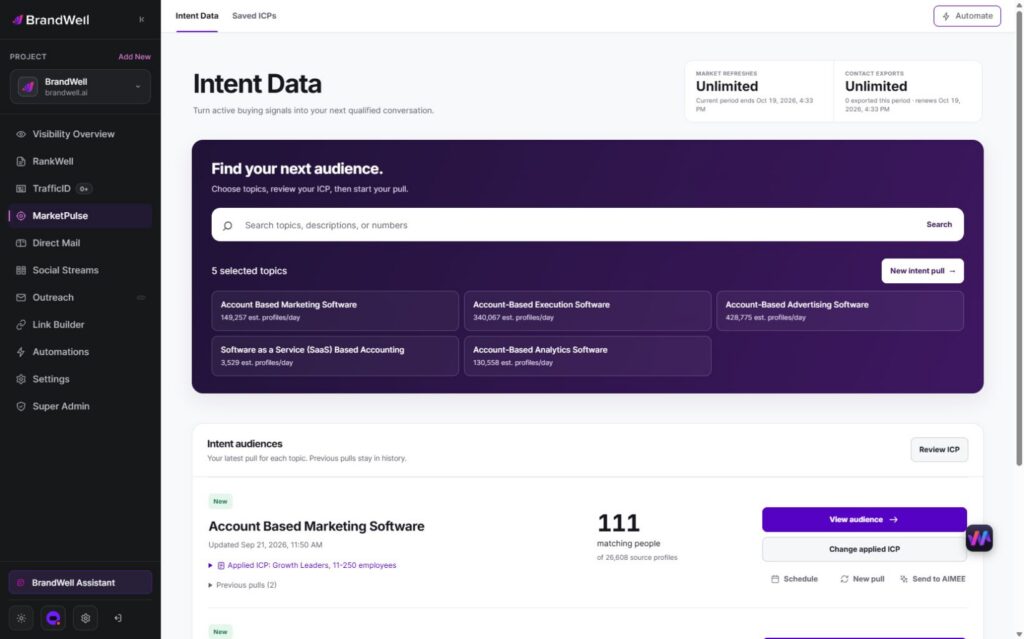
BrandWell MarketPulse is topic-based intent-data software for businesses and agencies. Choose relevant research topics, apply saved ideal-customer-profile filters, review available names, roles, companies and contact details, and export the audience or prepare a connected workflow. Plans start at $500/mo. TrafficID identifies visitors to your own website and is a separate product. A MarketPulse subscription does not by itself promise a white-label portal, custom API implementation, exclusive topics, or managed client delivery.
Use AIMEE through configured tools for a bounded evidence summary with references and unknowns. A named owner verifies the result, response policy and actual permitted action.
Implementation checklist
- Inputs: source event, collection context, identity level, confidence, account fit, relationship, freshness, suppressions, permitted use, capacity, and destination.
- Classification: label explicit request, confirmed first-party behavior, account-level inference, probabilistic identity match, or multi-signal inference without upgrading the evidence.
- Output: facts, inferences, missing fields, response lane, allowed next action, owner, expiration, review reason, and audit ID.
- Fail-closed rules: unclear rights, sensitive inference, stale evidence, disputed identity, unresolved suppression, conflicting owner, or missing approval.
- Human stops: outreach, audience upload, budget or bid change, contact selection, client-facing claim, record merge, or deletion exception.
The agent may summarize and prepare; it may not decide that a person is in market, fabricate source confidence, or execute a material action. Log the input version, rule version, proposed output, reviewer, decision, and correction so the workflow can be audited and improved.
Frequently asked questions
Is a content download an explicit hand-raise?
It is an explicit content action, but not automatically an explicit request for sales contact. Preserve the offer and notice context, distinguish service from marketing follow-up, and choose a response proportionate to what the person actually requested.
When should sales respond to inferred intent?
Usually after fit, freshness, account identity, relationship, contact, suppression, channel, capacity, and human-review checks. The initial action may be account research or advertising rather than direct outreach. Stronger evidence changes priority, not legal or ethical authority.
Can several inferred signals equal an explicit request?
No. Several independent signals may increase confidence that review is worthwhile, but they do not create a declared request. Correlated feeds can also repeat the same underlying evidence, so preserve components and do not manufacture certainty by addition.
How should an agency explain inferred intent to a client?
Show the source level, event or topic, date, matching method, fit and proposed action. Distinguish a declared request from an inference. Even a verified demo request is not proof of budget, authority, purchase timing or an eventual sale.
What should a buyer expect to spend?
Spend depends on evidence lanes, topic and account scope, identity and enrichment, integrations, handling, governance, support, and outcomes. Compare total operating cost per accepted decision rather than list price or raw records. Require current quotes and written scope.
When should the program be paused?
Pause for unclear source rights, identity disputes, suppression or tenant failures, unexplained scores, stale data, repeated false positives, unapproved automation, poor client adoption, missing outcomes, or economics that depend on hidden manual work.
Make the request understandable at collection
W3C’s forms tutorial recommends clear labels, instructions, validation and completion feedback. Retain the form version and what was requested. An accessible submission confirms a task outcome; it does not by itself establish permission for every later channel or purpose.
Keep lane metrics separate
In a fictional period, 20 verified demo requests yield ten held meetings, while 100 inferred account records yield 40 accepted research briefs and eight held meetings. The first lane has a 50% meeting rate per verified request. The second has 40% research acceptance per account and 20% meetings per accepted brief, or 8% per original account.
These invented rates describe different populations and denominators. They are not benchmarks or proof that one response policy causes better performance. Keep rejected records and unresolved outcomes visible, and distinguish no recorded outcome from a verified failure.
Review a topic with MarketPulse
MarketPulse standard plans are starting at $500/mo for one topic with weekly refreshes. Growth includes three topics with daily pulls; Scale includes ten topics with daily pulls. Fields, audience sizes and overlap vary.
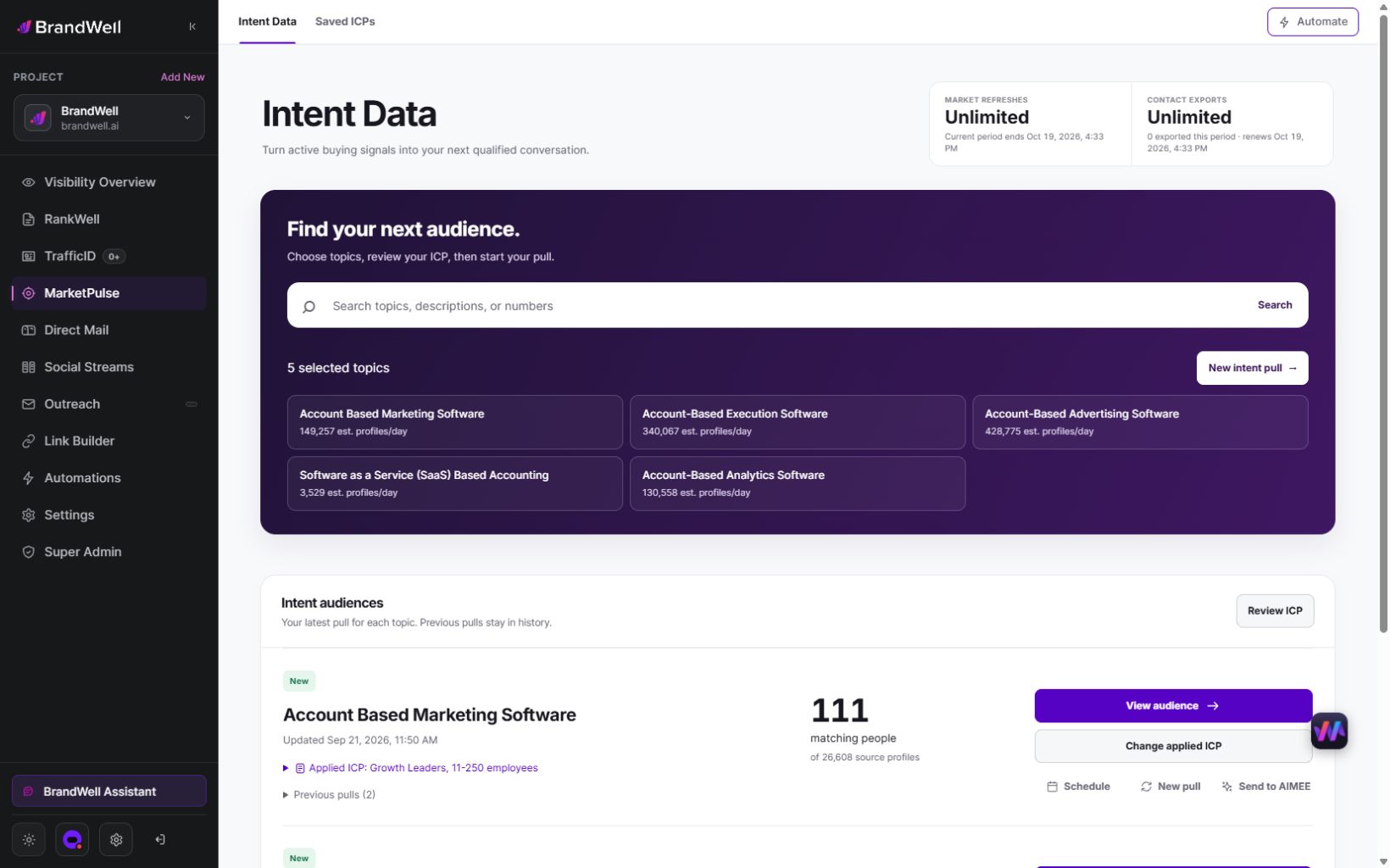
Inspect one topic and ICP, preserve the source and define the reviewed next step. Keep own-site TrafficID activity and submitted requests in their separate evidence lanes. Watch the demo and review current plans.
Reviewed and updated October 3, 2026.

Written by