On this page
- What hiring activity can reveal
- Seven methods for using hiring intent signals responsibly
- A hiring interpretation rubric
- Freshness and decay rules
- Workflow, data, integrations, and team
- Hiring triggers compared with fit, engagement, and broad lists
- Hiring intent signals pricing and total cost
- Measure hiring intent signals ROI
- Best-fit and poor-fit use cases
- Hiring intent signals mistakes, privacy, and bias controls
- How agencies can sell a recurring hiring-signal service
- Hiring intent signals implementation checklist
- Use the posting as context, then test the hypothesis
- A hiring-signal evidence brief
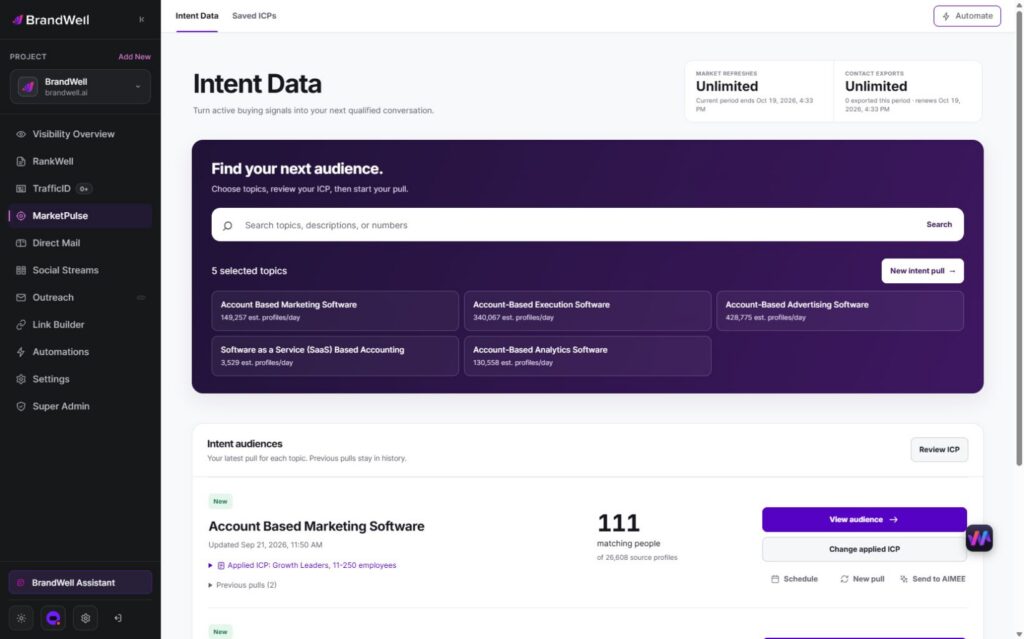
- Use MarketPulse for topic research, not a presumed job feed
Short answer: Hiring activity can reveal what a company is building, where capacity is constrained, and which problems may become urgent. It is not proof that the company is buying. Strong hiring intent signals combine a verified role pattern with ICP fit, problem relevance, recency, in-market research, and an approved route to the people responsible for the initiative.
Who is this for? B2B sales, RevOps, demand-generation, and agency teams that want to use job postings as a measured account-prioritization input rather than a generic reason to email every hiring company.
A single job post is ambiguous. It can represent growth, a backfill, a standing pipeline requisition, a location transfer, a role that has already been filled, or an experiment that will never receive budget. A cluster of roles can be more informative, but it still describes labor demand – not necessarily vendor demand. The practical question is not “Is this company hiring?” It is “Does this hiring pattern create or expose a problem our offer solves, and is there independent evidence that the account is working on it now?”
That distinction preserves the verified observation while labeling the buying hypothesis as an inference. Teams should preserve the source, posting date, role, department, seniority, location, status, pattern, and relevance rationale. They should also record what would disconfirm the hypothesis. A job posting never proves that a named employee is interested, has budget, or authorized contact.
Current MarketPulse offer: intent-data plans start at $500/mo. See the product, demo, and current plans. Updated October 3, 2026.
What hiring activity can reveal
Hiring can indicate planned capacity, a new function, geographic expansion, management change, a technical migration, or investment in a go-to-market motion. The meaning depends on the role pattern. A first security leader is different from a fifth security analyst. A cluster of implementation roles is different from one generic sales requisition. Repeated openings across locations can mean expansion – or simply chronic turnover.
The strongest hiring intent signals examples have a direct problem-to-role connection. A company recruiting its first RevOps leader may be formalizing revenue systems. Multiple data-governance roles may support a data-quality or compliance hypothesis. New marketplace operations roles may signal a launch. Each is still a hypothesis until verified against the job description, current company context, and other evidence.
Search indexes and job boards can retain expired or changed listings. Google’s official JobPosting structured-data guidance explains that expired jobs should be removed or marked with an expired validity date. That is a useful operational reminder: check the employer’s current careers page or authorized source rather than trusting an old result.
Seven methods for using hiring intent signals responsibly
This hiring intent signals implementation guide evaluates each method on the same criteria: source quality, role relevance, pattern strength, freshness, account fit, identity confidence, permitted use, actionability, and outcome feedback.
1. Verify the posting
Confirm the employer, current posting status, role, department, location, source, and dates on the employer’s careers page or an authorized feed. De-duplicate syndicated versions. Preserve changes and closures so a vanished job does not remain a live trigger. Search results and aggregators are discovery paths, not final verification.
Best fit: every hiring-signal workflow, especially those using multiple job sources. Limitation: employer pages can still contain evergreen or delayed listings, and public status cannot prove whether an offer has already been accepted.
2. Map the role to a business need
Read the mandate, reporting line, systems, outcomes, and responsibilities. A first-in-function leader may formalize a program; a migration lead may indicate a defined project; a cluster of implementation roles may expose delivery constraints. Write the problem hypothesis and the evidence that would disconfirm it.
Best fit: offers with a clear problem-to-role connection. Limitation: job descriptions mix current needs, ideal experience, and employer branding, so a named skill or outcome is not proof of an approved purchase.
3. Separate growth from replacement
Classify the post as possible new function, expansion, backfill, vacancy, geographic entry, or evergreen recruiting. Use related postings, organizational context, and public company information to support the label. Route growth and replacement differently: one may signal capacity investment, while the other may signal ownership risk.
Best fit: teams selling into functions where headcount patterns affect urgency or account health. Limitation: the same title can represent expansion, backfill, duplicate publishing, or internal transfer, and public data may not resolve which.
4. Apply ICP fit
Require the account to meet geography, company, business-model, technical, regulatory, and commercial fit before the post adds priority. Normalize hiring volume by company size and normal cadence. Exclude customers, active opportunities, suppressed accounts, and roles unrelated to the offer.
Best fit: companies with defined ideal-customer criteria and enough volume to reject weak accounts. Limitation: rigid ICP rules can miss new segments; review exclusions against actual outcomes rather than freezing them indefinitely.
5. Set a freshness window
Store the employer’s posting or update date, your observation date, and the last time the role was confirmed open. Set expiry by role and play. Leadership, contractor, and high-volume frontline roles should not share one universal window. A closed posting can remain useful historical context without being treated as active demand.
Best fit: programs that can recheck sources before action. Limitation: publication dates, refresh dates, and actual hiring timelines are different; no timestamp alone proves urgency.
6. Require behavioral corroboration
After the role passes relevance and fit, look for fresh research on the underlying problem, competitor category, or implementation questions. Add first-party engagement, an announcement, technology change, or related hiring when available. Keep signal units separate: a company job post, account-level research, and a website visit may involve different people.
Best fit: markets with specific research topics and enough volume to compare cohorts. Limitation: behavioral and identity evidence varies by collection and matching method; inspect whether each item is observed, declared or inferred, and whether it relates to the hiring team.
7. Measure outcomes
Route an evidence brief containing the verified post, classification, fit result, corroboration, missing evidence, suggested action, and expiry. A person approves consequential outreach or activation. Record acceptance, rejection, held meetings, qualified opportunities, revenue, and disqualification reasons, then calibrate the rule against a fit-only baseline.
Best fit: organizations with explicit SLAs and CRM feedback. Limitation: automation can accelerate a bad assumption, while small cohorts, long sales cycles, and seller selection bias can distort early conclusions.
A hiring interpretation rubric
A transparent hiring intent signals framework can use five independent dimensions rather than one mysterious score:
- Role specificity: Does the posting describe a concrete mandate related to the offer?
- Pattern strength: Is it a verified first role, cluster, location expansion, or recurring requisition?
- Organizational placement: Does the role sit with the likely owner, user, or influencer?
- Freshness and persistence: Is the role current, and has the pattern persisted long enough to matter without becoming stale?
- Corroboration: Do company announcements, research signals, engagement, or customer context support the same hypothesis?
Label each dimension as unknown, weak, moderate, or strong and show the underlying evidence. Avoid hard universal thresholds. Calibrate values by segment and outcome because enterprise hiring cadence differs from startup cadence, and one category’s relevant role may be another category’s noise.
Freshness and decay rules
Freshness should describe both the event and the observation. Store when the employer published or updated the role, when your system observed it, and when the employer last confirmed it as open. If the source lacks a reliable date, lower confidence. If a listing disappears, change the state to closed or unverified rather than deleting the history.
Decay also depends on the play. A brand-new leadership role may remain useful for monitoring until the hire is announced. A short-term contractor post may decay quickly. A role cluster may strengthen as additional verified posts appear, then weaken once hiring completes. The workflow should expire suggestions automatically and require re-verification before outreach.
Workflow, data, integrations, and team
The minimum hiring intent signals operational checklist covers: authorized source; stable company identifier; canonical role and department; posting, observation, update, and closure states; location; seniority; job-description evidence; pattern label; ICP result; relevance rationale; corroborating signals; owner; suppression status; approval; and outcome.
Data or research operations owns source normalization and duplicate control. RevOps owns company matching, territory, CRM state, suppression, and measurement. A subject-matter marketer defines problem-to-role mappings and message boundaries. Sales or customer success chooses the action. Privacy, security, compliance, and legal teams review sources, access, retention, automated profiling, and channel use.
Integrations can include an authorized job feed, company enrichment, identity and contact validation, topic-intent data, CRM, marketing automation, and reporting. A hiring intent signals template should travel with the record so an AI system cannot silently replace evidence with a summary.
Hiring triggers compared with fit, engagement, and broad lists
Fit-only targeting is best for defining who could buy, but it lacks timing. Broad lists maximize reachable accounts but create the highest verification burden. First-party engagement is direct activity on your properties, although the visitor may not be a buyer. Hiring signals reveal organizational change and problem context, but not a purchase. Topic research shows problem exploration, at the entity level and confidence supported by the actual method.
A hiring intent signals comparison should therefore ask what question each signal answers. Fit: “Could they buy?” Hiring: “What may be changing?” Research: “What problem may be under consideration?” Identity: “Which role or profile might be relevant, at what confidence?” Outcome: “Did our own market respond?” Layered evidence is more useful than replacing one weak list with another.
Hiring intent signals pricing and total cost
The purchase price of job-posting data is only one component. Hiring intent signals cost also includes role taxonomy maintenance, company resolution, enrichment, contact validation, integrations, analyst review, CRM hygiene, seller time, and governance. If a feed contains duplicated, closed, or poorly matched jobs, the low unit price can hide a high cost per actionable account.
Budget by operating unit: cost per verified posting, relevant role pattern, accepted account, held meeting, and qualified opportunity. Track manual minutes per accepted signal. A software quote should be compared on source provenance, update behavior, historical coverage, export and API limits, identity layer, integrations, security, retention controls, implementation, and contract flexibility – not just records per month.
Measure hiring intent signals ROI
A matched fit-only comparison can show association, not necessarily causal lift. Hiring accounts may already differ in ways the comparison does not capture. Where feasible, use a properly designed randomized allocation to test the action, with comparable conditions and recorded uncertainty. Do not credit a new job post for pipeline already active. Financial return needs defined incremental contribution and full included costs; attributed pipeline is not realized return.
Useful hiring intent signals KPIs include source verification rate, current-posting rate, relevant-pattern rate, sales acceptance, median time to action, held meetings, qualified opportunities, stage progression, wins, disqualification reasons, and opt-out or complaint rates. Calculate the incremental contribution margin from qualified outcomes, then subtract platform, data, labor, and activation cost. Early cohorts are directional, not benchmarks for every market.
Best-fit and poor-fit use cases
This approach fits categories where specific roles create predictable operating needs, average contract value supports review, job-posting volume is sufficient, and the client has a defined ICP. It can support net-new prospecting, customer expansion, churn-risk monitoring, market-entry services, and content planning.
It fits poorly when job posts are scarce, roles have no clear link to the offer, the buyer is an individual rather than an organization, or the team cannot verify whether postings remain open. Avoid using hiring patterns to infer sensitive traits, workforce health, or personal circumstances. Do not target candidates or employees simply because they appear in recruiting data.
Hiring intent signals mistakes, privacy, and bias controls
- Equating one generic post with budget or urgency.
- Ignoring expired, duplicate, evergreen, or third-party recruiter listings.
- Using absolute role counts without normalizing for company size.
- Assuming a skills list proves the installed technology.
- Letting protected characteristics or sensitive proxies enter prioritization.
- Personalizing outreach so specifically that it feels like surveillance.
- Allowing an agent to contact, suppress, or score people without an approval and audit trail.
Review the actual source permissions, intended use, relationship, channel and applicable requirements before activation. Record responsible reviewers, access, retention, deletion, suppressions and complaint handling. Public availability is not permission for every marketing action.
How agencies can sell a recurring hiring-signal service
Package interpretation and activation, not raw job rows. A monthly service can include a client-specific role taxonomy, daily verification, pattern detection, topic-research layering, relevant-role validation, branded evidence reports, approved CRM routing, weekly account review, and monthly cohort calibration. The report should show the source and why an account qualified, plus uncertainty and an expiry date.
Hiring intent signals implementation checklist
- Define the qualified outcome, ICP, role patterns, exclusions, and no-action state.
- Use an authorized source and verify the employer’s current posting.
- Separate first-function, growth, backfill, expansion, and evergreen patterns.
- Record publication, observation, verification, closure, and expiry states.
- Require problem relevance, behavioral corroboration, and human approval.
- Test representative accounts against a fit-only baseline.
- Review downstream outcomes and false-positive reasons before expanding.
Use the posting as context, then test the hypothesis
A job post is not a purchase signal by itself. Hiring intent signals become useful when the role pattern is current, relevant to a defined problem, consistent with the account’s fit, corroborated by research or first-party evidence, and routed with verified identity and human judgment. That is the difference between a noisy alert and a defensible GTM workflow.
A hiring-signal evidence brief
For an author-created example, a company’s current careers page lists a first RevOps role responsible for coordinating systems. The observed fact is the published role and its stated responsibilities. A possible systems-review project is an inference. A funded purchase, a specific tool decision and permission to contact a named employee remain unverified.
Record the source and observation time, current status, exact supporting responsibility, account fit, corroboration, disconfirming evidence, permitted next action, owner and expiry. Related copies of the same posting are not independent corroboration. A skills list does not prove that a tool is installed.
In a fictional review, 20 collected listings yield 12 unique current postings after removing duplicates and expired items: 12 ÷ 20 = 60% retained. Five of the 12 meet the defined role-to-offer rule: 5 ÷ 12 ≈ 41.7%. Three of those five are accepted for further research: 3 ÷ 5 = 60%. These are different denominators, not a buying probability or a MarketPulse benchmark.
Use MarketPulse for topic research, not a presumed job feed
MarketPulse provides topic research, ICP filtering and available contact records. Its standard subscription does not establish native job-posting collection, hiring-status verification, exclusive topics, a branded client portal or a wholesale contract. Keep any separately sourced hiring evidence and agreed agency work explicit.
Standard plans are starting at $500/mo for one topic with weekly refreshes. Growth includes three topics with daily pulls; Scale includes ten topics with daily pulls. Available fields, audience sizes and overlap vary.
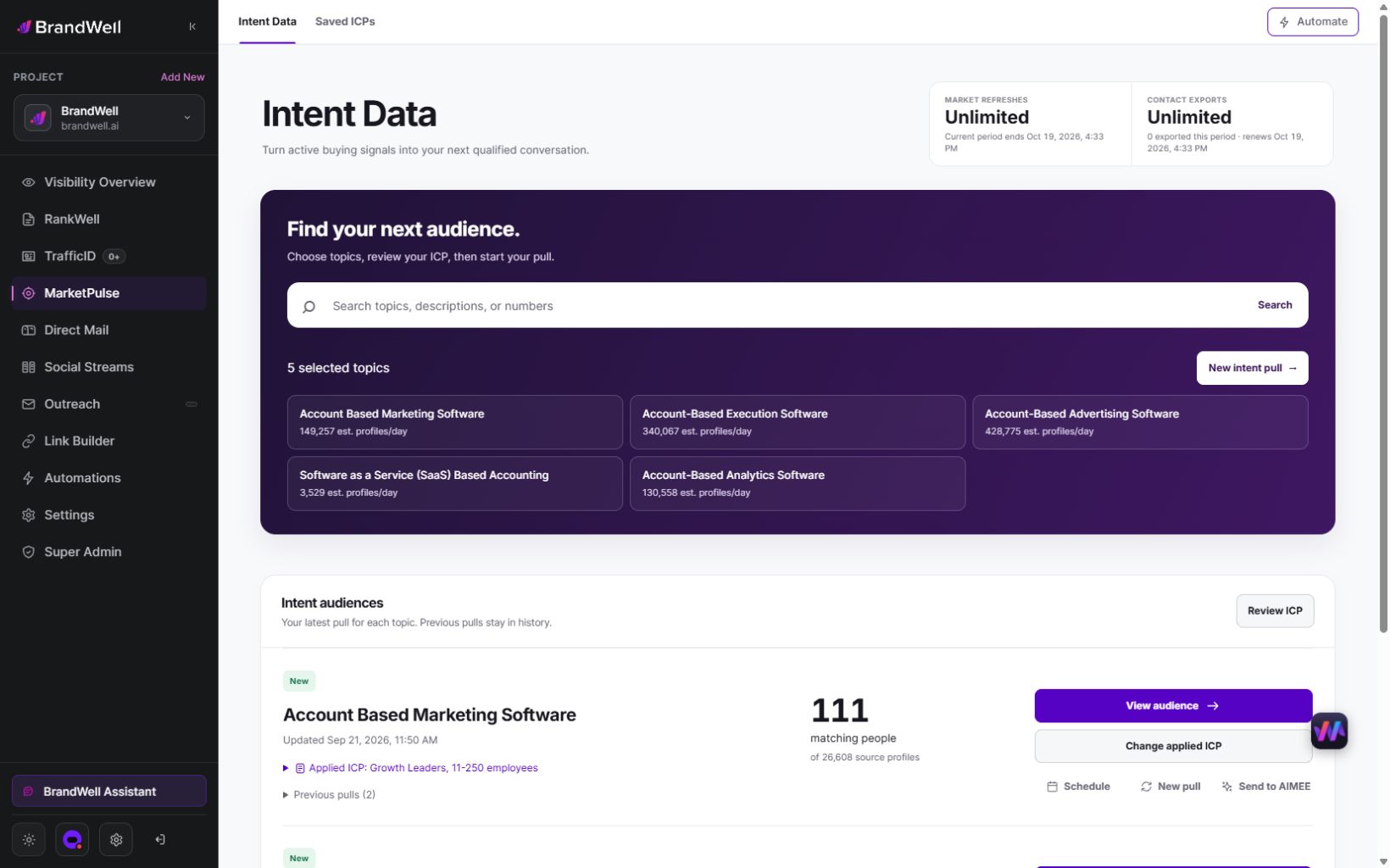
Inspect one relevant topic and ICP, then decide what the evidence supports. AIMEE can help prepare configured work through connected tools; retain source references and review the proposed action. Watch the demo and review current plans.
Reviewed and updated October 3, 2026.

Written by