On this page
- Start with a SaaS-specific pipeline thesis
- Signals that matter for SaaS
- Workflow from signal to pipeline
- Intent-led outbound, ABM, or paid demand generation?
- Budget and total cost
- Measure qualified pipeline and revenue
- Best-fit accounts, roles, and signals
- Data quality, privacy, and compliance
- Agency package for B2B SaaS clients
- SaaS research-topic taxonomy
- Sales and marketing service-level agreement
- Content and evidence by stage
- Ninety-day rollout
- The practical takeaway
- Measure accepted opportunities with clear denominators
- Review a SaaS topic in MarketPulse
Direct answer: A B2B SaaS company generates more qualified pipeline by narrowing its ICP, mapping the buying committee and research topics, combining first-party and third-party signals without confusing them, and routing only verified, timely accounts into the right play. Buyer intent improves prioritization; it does not replace positioning, demand creation, product-market fit, or sales execution.
Who this is for: B2B SaaS growth and revenue teams plus specialist agencies building an intent-led pipeline program. This is an industry-specific operating guide, not a generic lead-generation template.
Current MarketPulse offer: intent-data plans start at $500/mo. See the product, demo, and current plans. Updated October 1, 2026.
Start with a SaaS-specific pipeline thesis
Define the product, contract value, sales motion, buying event, and minimum account conditions. A developer tool sold bottom-up has different signals from finance software requiring security, procurement, and an executive sponsor. Segment new logo, product-led expansion, enterprise upgrade, renewal risk, and partner motions; each needs a different topic set and action.
Build an account universe with explicit positive and negative criteria: industry, employee or revenue band, technology, geography, funding or hiring context, installed alternatives, compliance needs, and ability to implement. Then map roles by buying job: problem owner, daily user, technical evaluator, security/legal, finance, economic buyer, and procurement.
Signals that matter for SaaS
Use a hierarchy. High-context first-party events include pricing, security, integration, migration, implementation, API, and comparison-page activity; authenticated product events can show expansion or risk. Third-party topic research can reveal category, competitor, integration, and problem interest before a site visit. Review-site activity can show comparison behavior. Hiring, technology, funding, leadership, and regulatory events can change fit or timing.
Do not score every content view equally. “What is X?” might indicate education; “X pricing,” “X vs Y,” “migrate from Y,” “security review,” or “implementation timeline” is closer to a buying decision. Require signal clusters or repeated activity for high-cost plays.
Trigger-to-play matrix
- Category research + strong ICP: educational ad or problem-led outbound after validation.
- Competitor comparison + verified role: migration proof, honest tradeoffs, and a rep-reviewed conversation.
- Pricing or security activity: route to account owner; avoid simultaneous SDR automation.
- Integration/API research: involve a technical seller or solutions engineer.
- Multiple stakeholders active: create a buying-committee map and collision plan.
- Customer researching alternatives: alert customer success with context, not an accusatory message.
- Weak fit or ambiguous identity: nurture, research, or suppress.
Workflow from signal to pipeline
- Choose one SaaS product and opportunity type.
- Define ICP, exclusions, committee roles, topics, pages, and event thresholds.
- Ingest each signal with source, time, granularity, confidence, and permitted use.
- Resolve the account, then validate likely people; never promote account intent to person intent.
- Score fit, intent, freshness, identity, and actionability separately.
- Route by play: ads, nurture, SDR research, account-owner alert, customer-success review, or no action.
- Require human approval for outreach, sensitive inference, new audiences, or irreversible CRM changes.
- Write dispositions and opportunity outcomes back to the model.
- Compare results using a stated design; a phased baseline alone does not establish causal lift.
- Retire topics and plays that create activity without qualified pipeline.
Intent-led outbound, ABM, or paid demand generation?
Choose the motion by economics and evidence. Intent-led outbound works when the ICP is narrow, verified contacts exist, the sales team can respond quickly, and deal value supports research. ABM fits larger accounts with multiple stakeholders, longer cycles, and coordinated marketing/sales coverage. Paid demand generation fits broader categories where repeated exposure and scalable education matter.
Most mature SaaS teams combine them: paid media creates and captures demand; account-level intent changes priority; first-party engagement changes stage; sales handles verified opportunities. Keep one control group or phased rollout so every channel does not claim the same pipeline.
Early-stage SaaS companies should resist enterprise tooling when they have too few wins to define fit, too little traffic to identify, or no reliable sales process. Start with a narrow account list, manual research, and disciplined dispositions. Add platforms when ranking and coordination become real bottlenecks.
Budget and total cost
Budget for data, signals, identity, seats, credits, CRM or warehouse integration, media, sales tools, implementation, operations, analytics, review, content and seller capacity. Separate vendor price from total program cost and annual value from monthly billing. Confirm actual capabilities, limits and terms in the current offer.
Measure qualified pipeline and revenue
Define qualified pipeline before launch: accepted opportunity, ICP compliance, minimum value, stage, owner, and evidence. Track eligible accounts, qualified signals, identity acceptance, action rate, response, meetings, accepted opportunities, stage progression, wins, gross profit, and cost. Show denominators and time windows.
A matched observational comparison can show association but does not by itself establish incremental impact. Use an appropriately designed randomized holdout where feasible and record allocation, contamination, timing and sample limitations. Distinguish sourced, influenced and incremental pipeline; the same account appearing in several channels is not several wins.
Inspect quality by segment: company size, product line, region, topic, signal source, role, channel, and freshness. A lower match rate can be acceptable if accepted-opportunity rate rises. Retire high-volume topics that produce students, job seekers, competitors, or irrelevant accounts.
Best-fit accounts, roles, and signals
A proposed fit is a SaaS team with a defined category, measurable site and CRM activity, enough eligible accounts to prioritize and operators who can act. Enterprise or expansion motions may benefit from role context, but test that hypothesis in your segment rather than assuming they benefit most.
For each segment, name a primary problem owner and likely blockers. Validate roles against actual won and lost opportunities, not generic title lists. Use signal freshness appropriate to the action: a sales call might need hours or days, while an account nurture can tolerate a longer window.
Data quality, privacy, and compliance
Common defects include wrong-company IP resolution, stale employment, duplicate accounts, personal/business contact confusion, overbroad topics, model drift, and treating modeled activity as observed fact. Monitor correction and suppression rates. Preserve provenance, confidence, source rights, and the version of every score.
Review privacy notices, lawful basis or consent where applicable, direct-marketing rules, platform policies, contracts, retention, data rights, cross-border transfers, tenant separation, and AI-agent access. Intent is not consent. A signal should never be used to tell a prospect you observed private research unless the organization has verified first-party context and approved the disclosure.
Agency package for B2B SaaS clients
A proposed agency service can include SaaS ICP design, a topic taxonomy, reviewed public research, buying-role mapping, evidence-based routing and recurring measurement. Verify the actual data and configured tools before selling the scope. Do not assume MarketPulse supplies competitor-specific feeds, a native enrichment engine or a branded client portal.
Agent-ready instructions
Use AIMEE through configured tools to draft a bounded brief with sources and unknowns. A named owner verifies the result and actual permitted action; no execution beyond configured tools or automatic outreach entitlement is implied.
SaaS research-topic taxonomy
Organize topics around buyer jobs rather than a giant keyword list. Problem topics describe the operational pain. Category topics describe the solution class. Alternative topics name the current approach or competitor. Decision topics cover pricing, reviews, comparisons, security, compliance, migration, implementation, integration, API, support, and total cost. Trigger topics reflect new regulations, technologies, leadership changes, or hiring that alter urgency.
Map each topic to a product, segment, role, buying stage, confidence, exclusion, and approved play. Broad category terms might support ads or nurture. Competitor-plus-migration clusters might justify researched outbound. Security or DPA topics should route to the account owner or solutions team, not a generic SDR sequence. Review false positives monthly and retire topics whose meaning is ambiguous in your industry.
Sales and marketing service-level agreement
Define who accepts an account, the maximum review time by signal type, required evidence, rejection reasons, and ownership when an opportunity already exists. Marketing should not count a routed record as pipeline. Sales should not reject without a disposition. RevOps audits queue age, duplicates, source defects, and whether reps act consistently across territories.
Create a small set of actions: research, ad audience, nurture, SDR review, account-owner alert, customer-success alert, or suppress. Every action needs an expiry. If a rep cannot review a high-volatility signal within the SLA, downgrade the action instead of delivering a stale “hot lead.”
SaaS buying-committee playbook
For enterprise new logo, begin with the problem owner and technical evaluator, then map security, finance, economic buyer, and procurement as evidence develops. For product-led expansion, combine product usage, workspace growth, support history, and account research; coordinate with customer success before outbound. For churn risk, treat competitor research as a prompt for account review – not an accusation. For renewal, do not let acquisition automation contact active stakeholders without the account owner’s approval.
Content and evidence by stage
Intent activation fails when the destination offers no useful proof. Early-stage accounts need a clear problem framework and fit criteria. Evaluation-stage buyers need symmetric comparisons, implementation steps, screenshots, security facts, and honest limitations. Procurement-stage buyers need current scope, terms, data handling, support, and total-cost assumptions. Keep every claim attributable and updated.
Build assets that compound: comparison pages, integration guides, security documentation, calculators, original benchmarks, and public methodology. These can support organic search, AI answers, sales conversations, and ads, but no asset controls rankings or citations. Track qualified visits and revenue outcomes separately from visibility.
Ninety-day rollout
In days 1–15, choose one product, segment, opportunity type, and measurement baseline. In days 16–30, configure topics, identity rules, routing, suppression, and a small test cohort. In days 31–60, operate weekly, audit quality, and fix adoption. In days 61–90, evaluate matched outcomes, remove weak topics, document costs, and decide whether to expand.
Do not add regions, products, or channels before the first workflow is stable. Scaling an unmeasured queue increases spend and makes causal learning harder. The best next step might be better CRM hygiene, a stronger comparison asset, or faster rep response – not more signals.
Weekly operating review
Review one page: new signal accounts by source, acceptance and rejection reasons, median time to action, duplicate and suppression defects, conversations, accepted opportunities, and cost. Inspect five wins and five failures qualitatively. Decide which topic, threshold, route, or asset changes next, and leave everything else stable. This cadence turns intent from an alert feed into a learning system and prevents a high-volume source from dominating simply because it is easy to count.
The practical takeaway
Qualified SaaS pipeline comes from a narrow market thesis and fast, disciplined activation. Use buyer intent to decide who deserves attention and why; use experiments and CRM outcomes to decide whether the program deserves more budget.
Start by reviewing the MarketPulse demo and plans, starting at $500/mo. Choose a relevant topic and ICP, then evaluate audience fit, available contact fields, and the workflow you will use. The first-purchase 3-day satisfaction guarantee requires no data exports and no more than 2 Intent Scans; review the current guarantee terms before testing. A short evaluation can establish fit, but cannot prove future pipeline or revenue.
Measure accepted opportunities with clear denominators
In a fictional pilot, 200 eligible accounts produce 60 accepted research briefs, 15 held meetings and six accepted opportunities. That is 30% brief acceptance per eligible account, 25% held meetings per accepted brief and 40% accepted opportunities per held meeting. These invented rates are not SaaS benchmarks, buying probabilities or proof of incremental revenue.
Count unique accounts and record the opportunity definition, cohort window, reviewer and missing outcomes. Keep requests for contact separate from inferred research; route active customers and existing opportunities to their accountable owner.
Google Ads’ experiment documentation describes control and treatment traffic for comparing campaign changes. It is a platform-specific reference, not proof that your complete pipeline program has been experimentally validated.
Review a SaaS topic in MarketPulse
MarketPulse standard plans are starting at $500/mo for one topic with weekly refreshes. Growth includes three topics with daily pulls; Scale includes ten topics with daily pulls. Fields, audience sizes and overlap vary.
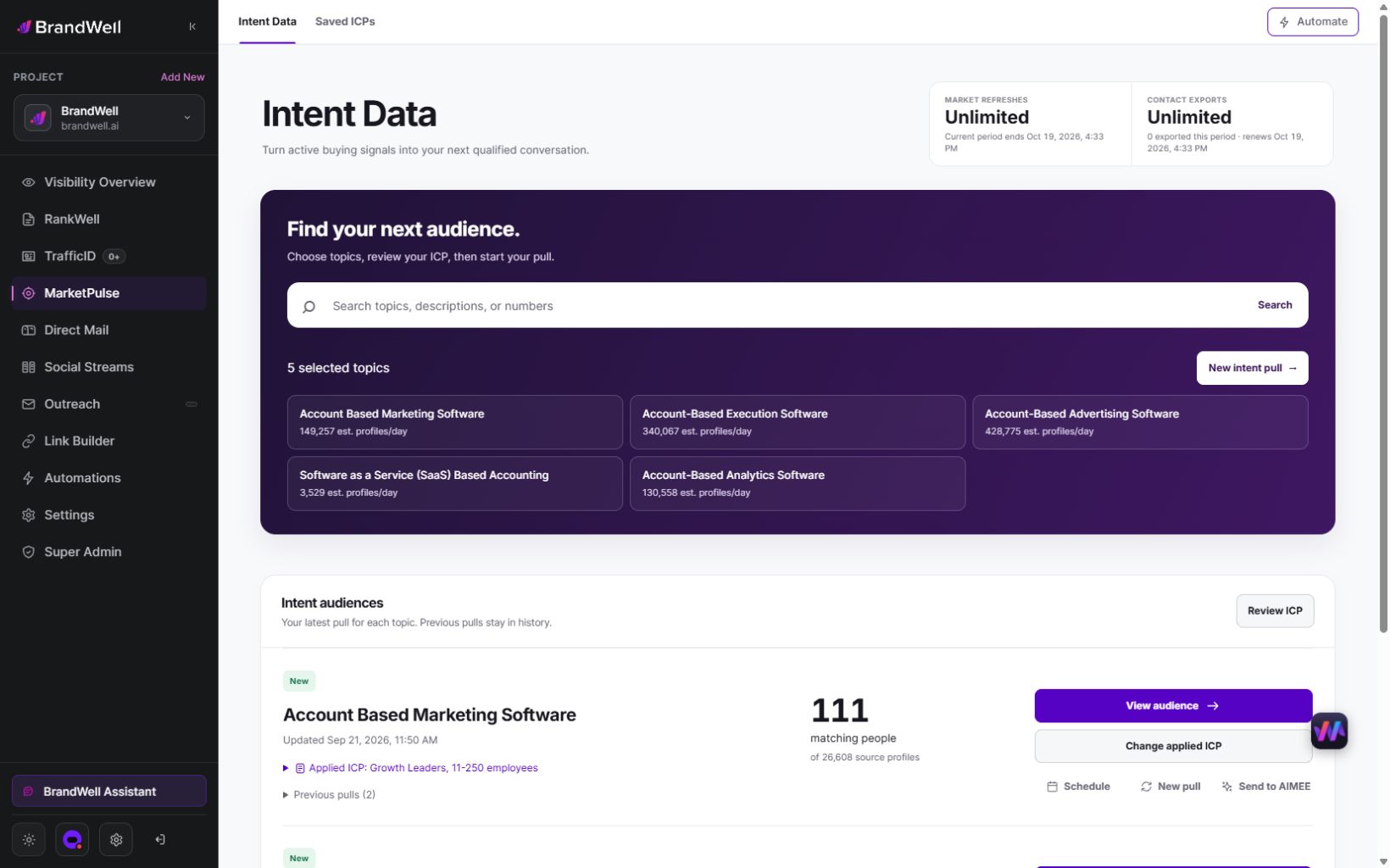
Inspect one relevant topic and ICP, check the available contact fields and define the next reviewed action. Watch the demo and review current plans.
Reviewed and updated October 3, 2026.

Written by