On this page
- 1. Choose the reader’s question and the page’s job
- 2. Research a topic, not a repetition target
- 3. Build the brief before the draft
- 4. Make the answer easy to find and verify
- 5. Review the page’s presentation
- 6. Check discovery and publication
- 7. Measure visibility and business outcomes separately
- Where sharing and links fit
- A repeatable SEO content workflow
Integrate SEO into content by choosing a useful search question before drafting, answering it clearly, supporting important claims, organizing the page and checking that readers and search engines can access it. After publishing, compare search visibility with the actions that matter to your business.
SEO belongs in the brief, writing, editing and measurement process. It is not a final pass where you insert the same phrase into every heading.
1. Choose the reader’s question and the page’s job
Start with a specific audience, problem and next action. A payroll software buyer comparing implementation requirements needs a different page from an employee looking for a payslip explanation.
Read the relevant search results to identify the kind of answer people can already find. Look for missing explanations, practical examples, current facts or decision criteria you can genuinely contribute. Do not reproduce another page’s outline simply because it ranks.
Write the page’s job in one sentence: “Help a payroll manager prepare an implementation checklist and decide whether to request a demo.” That sentence keeps the content useful when the keyword list grows.
2. Research a topic, not a repetition target
Use the Keyword Research area in BrandWell Visibility to explore relevant searches and possible opportunities. Combine that research with customer questions and your existing Search Console data.
- Group searches that can be answered well on the same page.
- Separate questions requiring a different format or audience.
- Check whether an existing article already serves the topic.
- Prioritize relevance and a useful contribution alongside estimated demand.
A longer query is not automatically easy to rank for or more likely to convert. Read the actual results and consider whether your business can answer the question credibly.
3. Build the brief before the draft
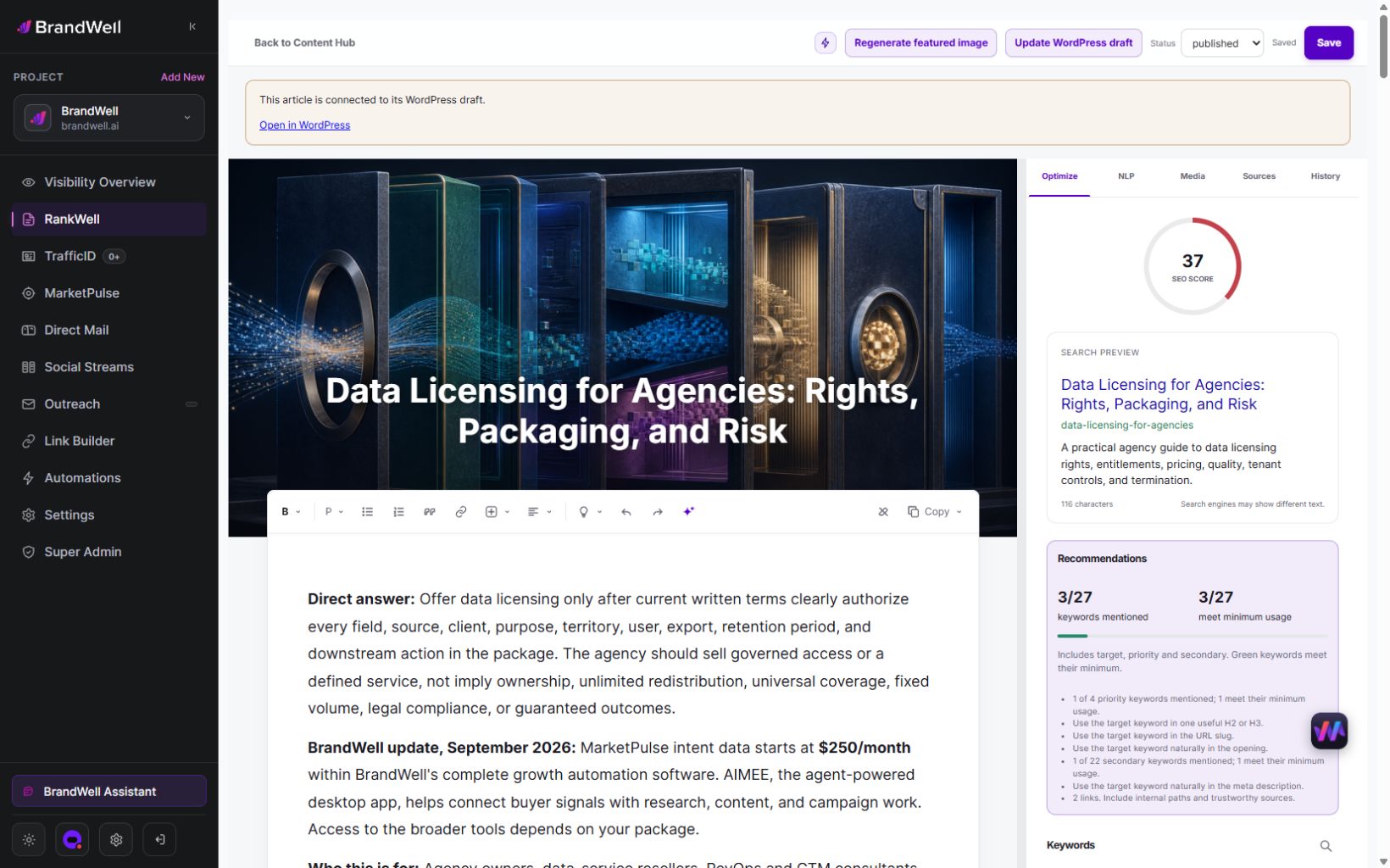
Use RankWell for the content brief, draft and editorial workflow. Give the writer or AI-assisted draft a clear audience, purpose, source list and boundaries.
This original example brief shows the level of detail to include:
- Reader: a payroll manager planning a software change.
- Main answer: the information and decisions required before implementation.
- Evidence: verified documentation and an approved internal process example.
- Sections: data preparation, ownership, testing, launch checks and common mistakes.
- Next action: discuss implementation requirements with the team.
- Claims to avoid: invented customer outcomes or a guaranteed launch timeline.
4. Make the answer easy to find and verify
Answer the main question near the beginning. Use headings for real subquestions and short paragraphs for each step. Add an original example, checklist or comparison when it helps someone act.
Link a material factual claim to the source that supports it. Explain the date, population or limits behind a statistic rather than using a number as decoration. Remove facts that cannot be verified.
Google’s SEO Starter Guide emphasizes useful, organized content, relevant links and language readers understand. It also explains that best practices do not guarantee rankings and that Google’s language systems do not require every exact query variation to appear.
A concise answer and clear evidence can make an article easier to understand and cite. They do not guarantee inclusion in an AI Overview or another AI-generated response.
5. Review the page’s presentation
- Title: accurately describe the answer and distinguish it from nearby articles.
- Description: explain the practical value without promising results.
- Headings: make the structure useful when someone scans the page.
- Images: show a relevant example, provide appropriate alternative text and remove obsolete product screens.
- Links: connect to the source, related explanation or next action with descriptive text.
- Mobile: check paragraphs, screenshots, tables and controls at a small viewport.
Preview the published page as well as the editor. A useful draft can still have a broken image, hidden answer or table that is difficult to read on a phone.
6. Check discovery and publication
Confirm that the intended public URL loads and that important content is visible. Check the page’s canonical and indexing settings rather than assuming publication guarantees discovery.
Google’s Starter Guide recommends Search Console’s URL Inspection tool for checking how Google sees a page. It also explains the role of accessible resources and links in discovery. Investigate technical problems before repeatedly rewriting content to solve an indexing issue.
Publish through your configured workflow after editorial approval. Keep a record of the changes and sources so a later reviewer can understand what was updated.
7. Measure visibility and business outcomes separately
In Search Console, compare impressions, clicks, click-through rate and position for the page over comparable periods. Inspect relevant queries, device and country where the data permits. A sitewide average can hide what happened to the article.
This original hypothetical example illustrates a common mistake: 10,000 impressions and 100 clicks means 1% CTR. Later, 20,000 impressions and 150 clicks means 0.75% CTR. Clicks increased while CTR decreased. That alone does not establish that a new title failed; the query and position mix may have changed.
Track qualified inquiries, demos or purchases separately from search clicks. Record the revision date and account for seasonality, tracking changes and other marketing activity before attributing an outcome to an edit.
Where sharing and links fit
Share a useful article where its intended audience can benefit from it. Treat visits from those channels as distribution results. Do not report social likes as proof of a direct search-ranking improvement.
Make your article worth referencing through clear methods, useful examples and reliable evidence. Avoid promising that promotion or a fixed number of backlinks will produce a specific ranking.
A repeatable SEO content workflow
Research the question in Visibility, prepare the brief and draft in RankWell, verify sources, preview the page, publish the approved work and review performance. Return to the article when evidence, product details or the reader’s needs change. This gives SEO a practical place in the content process without turning the writing into a keyword exercise.
Reviewed and updated October 3, 2026.

Written by
Julia McCoy has contributed articles to BrandWell on content marketing, writing, and search engine optimization. This archive retains her original bylines; individual articles may be updated by the BrandWell editorial team.