On this page
- Separate three kinds of personalization
- Keep a useful default experience
- Check what is actually accessible
- Personalization is not automatically cloaking
- Treat regional pages deliberately
- Avoid unnecessary URL variants
- Protect speed and stability
- Use BrandWell signals with a clear purpose
- Measure conversion and search separately
- Frequently asked questions
Personalization affects SEO through what search engines can access and what visitors experience. Relevant examples or recommendations can make a page more useful, but personalization is not a guaranteed ranking boost. Poor implementation can hide content, create confusing URL variants, or slow the page.
The goal is a dependable public page with useful adaptations, not a different site for every visitor or a special version designed to impress a crawler.
Separate three kinds of personalization
- On-site personalization: your website changes examples, recommendations, or calls to action for a visitor.
- Localized content: the website offers language or regional versions.
- Personalized search results: the search service varies what it displays for a person or context.
These are related but distinct. Changing a website hero does not control how a search service personalizes its results. Translating a product page also requires different planning from remembering someone’s preferred category.
Keep a useful default experience
A first-time visitor should understand the page without a saved cookie, account, enrichment result, or campaign parameter. The default should include the essential explanation, meaningful navigation, and a working next step.
For an original example, a software page might show a payroll example when that industry is reliably known. If the industry is unknown, it should show a clear general example. It should not display an empty heading while waiting for a classification service.
Keep the underlying product facts consistent. An industry-specific introduction can explain relevance, but it should not invent features or change material pricing conditions without a real basis.
Check what is actually accessible
Test the page in a fresh browser state, with personalization unavailable, and on mobile. Inspect the rendered content and use Search Console’s URL inspection tools for the search-facing view.
If an important public explanation appears only after a private session or a complicated interaction, do not assume a crawler will discover it. Keep account-specific information private; provide a separate public explanation where appropriate.
Google’s dynamic rendering guidance describes bot-specific rendering as a workaround rather than a recommended long-term solution. Consider appropriate server rendering, static rendering, or hydration with your development team instead of adding a second rendering system casually.
Personalization is not automatically cloaking
A helpful variation for a real visitor is not the same as deliberately misleading a search engine. Google’s cloaking policy concerns deceptive differences intended to manipulate search visibility and mislead users.
Review the purpose and substance of your variants. A changed example is different from showing crawlers a detailed guide while sending visitors to unrelated sales content. Keep the public purpose coherent across states.
Treat regional pages deliberately
Google warns that locale-adaptive pages may not have every version crawled or indexed. Do not rely only on inferred location to expose important regional content.
Plan explicit language or region URLs when those versions need independent discovery. Provide useful navigation between them and have the technical team review the relevant localization signals. Do not automatically collapse genuinely distinct versions into one canonical page.
Avoid unnecessary URL variants
If a campaign parameter changes attribution but not the main content, review the canonical behavior rather than creating a new indexed page for every campaign. Preserve measurement while keeping a coherent representative URL.
If a variant serves a genuinely different audience task, assess it as a page in its own right. A canonical is not a universal fix for every difference, and creating hundreds of nearly identical industry pages is not a substitute for useful personalization.
Protect speed and stability
Measure the default page and important variants. Watch for a hero that moves after classification, a delayed form, or a script that blocks interaction. A fast empty shell is not a good result if the content arrives much later.
Google’s page experience guidance emphasizes the overall experience. Avoid reducing the project to a single lab score or assuming a speed improvement guarantees a higher rank.
- Reserve space for content that may change.
- Load only the media needed for the selected experience.
- Provide a fallback when a service fails.
- Keep forms and navigation usable without optional enhancements.
- Check that caching never exposes one person’s private content to another.
Use BrandWell signals with a clear purpose
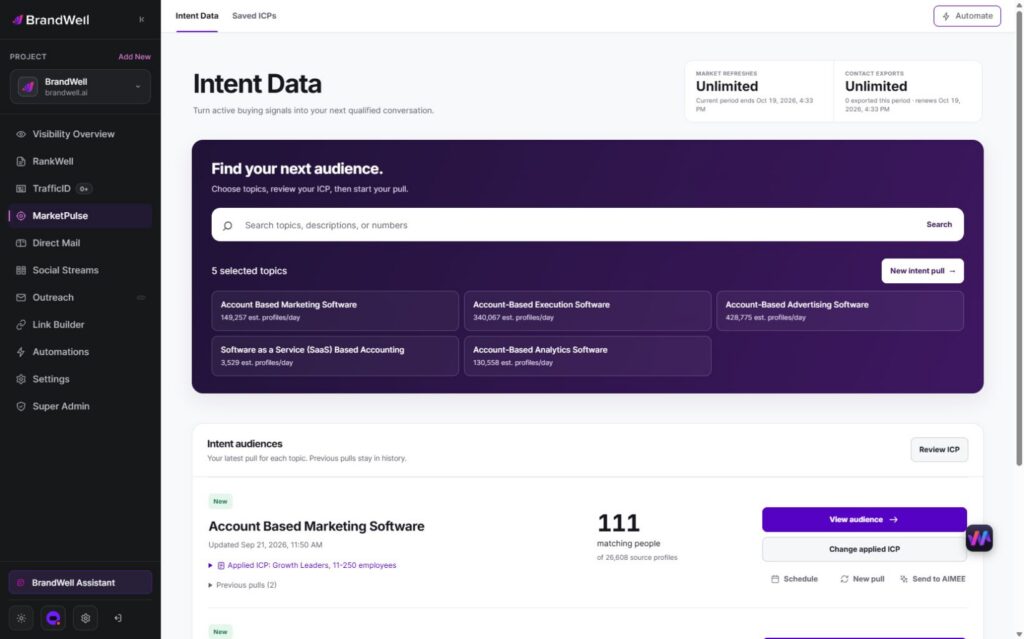
TrafficID and MarketPulse serve different audience workflows. Identified site activity and topic intent are not interchangeable, and neither means you know every visitor’s needs.
Use relevant information to choose a helpful example or follow-up, with the appropriate permissions and a generic fallback. MarketPulse plans are starting at $500/mo; it is an intent-data product, not an SEO ranking feature.
RankWell can support the underlying public content workflow. Review personalized copy against that same factual base so an automated variation does not introduce an unsupported claim.
Measure conversion and search separately
Define the business outcome before testing: qualified form completions, successful purchases, or another meaningful action. Record the exposed audience and variant, and avoid declaring a winner from a few conversions.
Monitor search impressions, clicks, query mix, and indexing separately. Longer time on page may indicate interest or confusion. A lower bounce rate does not, by itself, demonstrate a ranking improvement.
Keep an experiment log of dates, traffic sources, content changes, and technical changes. If several things changed together, report the uncertainty instead of attributing the entire result to personalization.
Frequently asked questions
Should every visitor see identical words?
No. Useful variations are possible, but the page should remain coherent, accessible, accurate, and consistent in its core purpose.
Can personalization guarantee more organic traffic?
No. Evaluate the visitor outcome and technical implementation rather than promising a search gain.
What should happen when the industry is unknown?
Show a complete general experience. Let the visitor choose relevant topics or provide more context rather than displaying an unfinished placeholder.
Reviewed and updated October 2, 2026.

Written by
Julia McCoy has contributed articles to BrandWell on content marketing, writing, and search engine optimization. This archive retains her original bylines; individual articles may be updated by the BrandWell editorial team.