On this page
Local SEO has no guaranteed timeline. Correcting business details is different from earning stronger visibility for competitive searches. Plan the work in stages, measure progress over comparable periods and avoid treating a three- or six-month estimate as a promise of rankings, leads or profit.
The useful question is not simply when you will rank. Ask which searches matter, where customers are searching from, what needs fixing and whether the resulting visits become qualified inquiries.
Why local SEO timelines vary
Google’s local ranking guidance describes relevance, distance and prominence. Complete business information helps Google understand the business; the searcher’s location and how well known the business is also matter. There is no way to request or pay Google for a better local ranking.
You can improve inaccurate information and weak service content. You cannot make every searcher physically close to your location. A ranking check from one device or neighborhood is not a reliable summary of visibility across your whole market.
Your starting point also changes the work: an established profile with a broken website needs a different plan from a new business without a verified profile or useful service pages. Competition, seasonality, technical issues and the speed of implementing corrections can affect the results you observe.
A practical 90-day work plan
The following schedule is an original planning example. It allocates work and review time; it is not a research-backed estimate of when Google will improve your rankings.
Days 1-30: establish the baseline and fix barriers
- Confirm that you control the correct Business Profile and resolve verification or duplicate-profile issues through the appropriate process.
- Check actual business details, category, opening hours, website destination and contact information.
- Inspect important website URLs for indexing barriers, broken links and unusable mobile forms.
- Record Search Console queries, pages, impressions, clicks and CTR for a comparable baseline period.
- Test whether calls and inquiries can be recorded as qualified outcomes without placing personal information into analytics fields.
Separate completed work from observed outcomes. Updating opening hours is a completed correction. A later increase in inquiries is an outcome that may have several causes.
Days 31-60: improve the pages customers need
Prioritize the services that matter commercially. Explain who the service is for, where it is actually available, what the process includes and how to request help. Add real examples, original photos and useful answers that your team can substantiate.
For a service business, a helpful page might explain the service area, response process and what a customer should have ready before calling. Avoid creating nearly identical city pages for places where you have no meaningful service information.
Use clear titles and headings. Write image alt text to describe the image’s purpose, not to repeat a city keyword. Link related services where it helps a visitor decide what to do next.
Days 61-90: inspect results and choose the next change
Compare similar periods and segment important pages or queries. Ask whether the intended searches are producing more impressions, whether snippets earn clicks and whether visitors can successfully contact the team.
If visibility improves but qualified inquiries do not, review the offer, page clarity, mobile experience and response process. If the pages are not indexed, investigate that barrier before publishing more content. If only branded queries improve, do not report it as evidence that you now reach more new customers.
Keep Business Profile and website measurement separate
A Google Maps result, an organic website result and a paid ad are different surfaces. Combine them in a business report only after keeping their underlying metrics distinct.
Business Profile performance provides profile interaction data for verified profiles. Check the definitions: a call-button click is not necessarily a completed or qualified call, and a website click is not a sale. Available metrics depend on the business and profile features.
Search Console helps assess your website’s search exposure and clicks. Review the relevant page and query together, then inspect device and country where useful. A site-wide average position can hide very different results across searches.
What counts as meaningful progress?
- Foundations: accurate profile, working contact routes and important pages accessible to search engines.
- Visibility: exposure for relevant services and locations, separated from searches for your brand name.
- Response: useful website visits and contact attempts, with metric definitions stated.
- Business outcomes: qualified inquiries, booked work and revenue, accounting for the team’s response and sales process.
For example, 20 clicks from 1,000 impressions gives a 2% CTR. Thirty clicks from 1,000 impressions gives 3%. That is an illustrative calculation, not a local SEO benchmark. Check whether the query mix and position changed before attributing the difference to a new title.
Improve content with the current BrandWell workflow
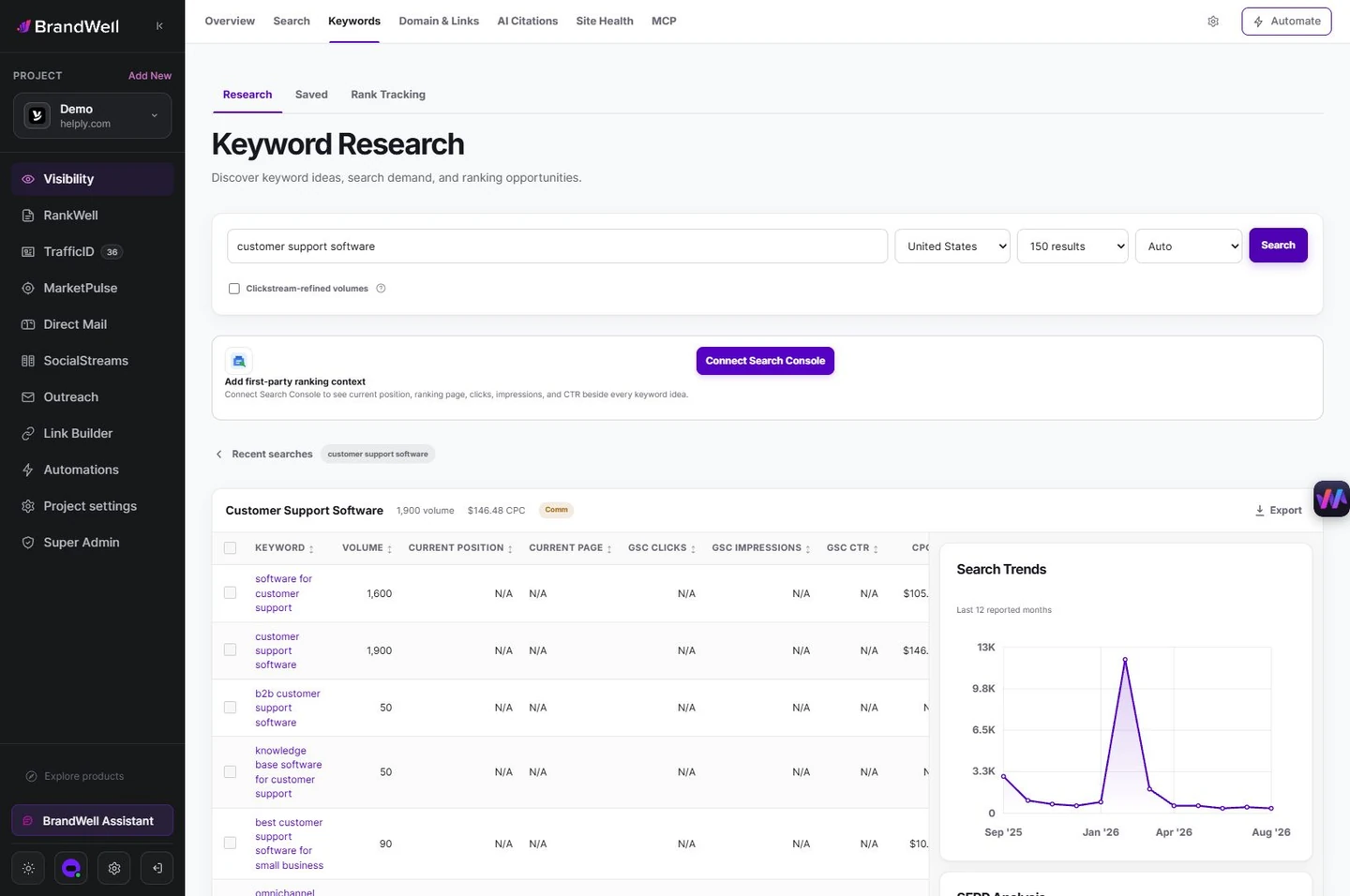
Use Keyword Research in BrandWell Visibility to investigate service questions and possible content opportunities. Compare them with actual Search Console evidence and what customers ask your team.
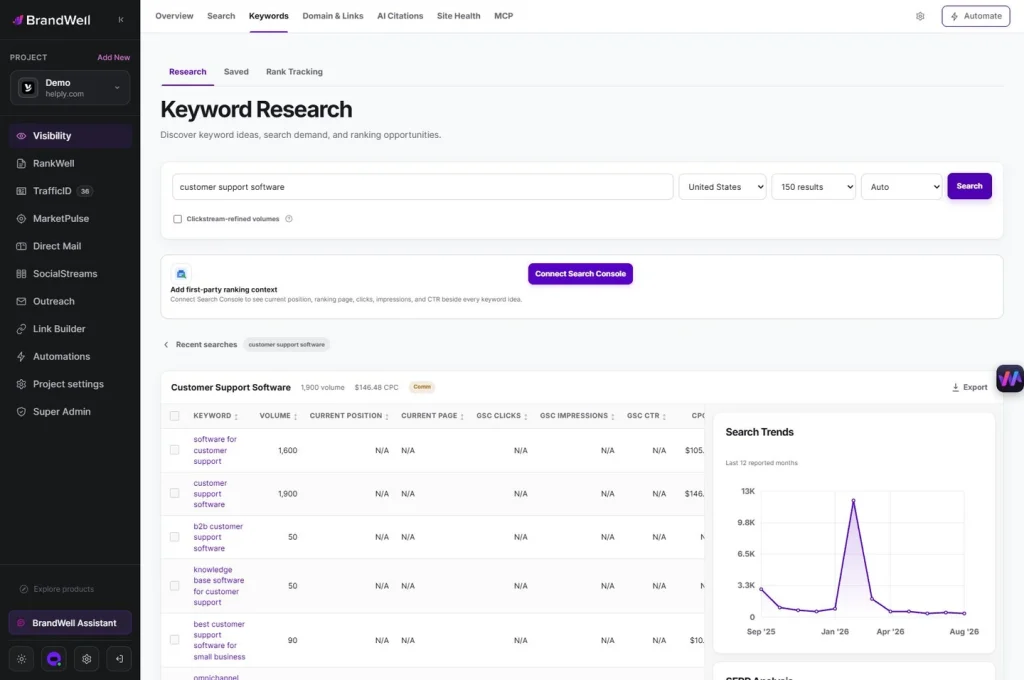
Build a brief in RankWell with the service facts, geographic scope, evidence and customer questions. Review the draft against the real business before publishing. AIMEE can assist through configured tools and workflows, subject to the access and settings you provide.
This helps organize research and production. It does not guarantee rankings, map placement or an AI Overview citation.
What should you avoid?
Avoid guaranteed first-place offers, fake locations, unsupported “best” claims and bulk pages that add no useful local detail. Follow Google’s review policy: do not buy reviews, incentivize reviews or selectively request positive ratings. Request genuine customer feedback and respond professionally.
Google’s guidance on hiring an SEO recommends asking about expected outcomes, measurement and explanations of the work. It warns that nobody can guarantee a number-one Google ranking.
Local business structured data can describe information such as address and hours where appropriate. Follow Google’s LocalBusiness documentation, match the visible business facts and validate the implementation. Markup does not guarantee a search feature or faster ranking.
Frequently asked questions
Can local SEO work in one month?
You can complete useful corrections in that time, but there is no guaranteed one-month ranking or lead outcome. Report the corrections separately from changes in visibility and inquiries.
Should I stop after three months without more leads?
Review what was implemented, indexing, relevant query exposure, conversion tracking and sales response. Decide what to change based on the evidence and budget, rather than assuming every slow result needs more content.
How much does local SEO cost?
Scope determines cost. A profile correction, technical repair, service-page rewrite and ongoing multi-location program are different jobs. Ask for an itemized plan, ownership of the work and measurable review points instead of relying on an unsupported universal price range.
Do more reviews guarantee better rankings?
No. Google identifies review count and positive ratings as factors that can help local ranking, alongside other factors. Genuine reviews can also help customers evaluate the business, but they do not remove distance or relevance constraints.
What should I do this week?
Verify your business information, test the main mobile inquiry route and choose one important service page to improve. Save the baseline before making changes so your next review can distinguish completed work from measured results.
Reviewed and updated October 2, 2026.

Written by
Julia McCoy has contributed articles to BrandWell on content marketing, writing, and search engine optimization. This archive retains her original bylines; individual articles may be updated by the BrandWell editorial team.