On this page
Bing SEO helps Microsoft discover your pages, understand what they offer, and evaluate whether they answer a searcher’s question. Start with accessible pages and useful content, then use Bing Webmaster Tools to diagnose indexing and measure performance.
You do not need a second version of every article stuffed with exact-match keywords. Bing understands related meanings as well as matching terms. The practical job is to make your best answer easy to find, read, and verify.
How Bing ranks pages
Microsoft’s explanation of search ranking identifies relevance, quality and credibility, user engagement, freshness, location and language, and page load time as major parameters. Their importance varies by query.
Relevance includes semantic equivalents, such as synonyms, rather than only exact matches. Bing also evaluates interaction with its search results. That does not mean your analytics bounce-rate percentage is a published ranking formula, or that artificially extending a visit improves a page.
Use these principles to review the actual experience: does the page answer the question, show reliable evidence, load successfully, and help the reader finish the task?
1. Check discovery and indexing before rewriting content
- Add and verify your website in Bing Webmaster Tools.
- Inspect an important URL to check the available crawl and indexing information.
- Confirm that the page returns the intended response and does not accidentally block crawling or request exclusion from indexing.
- Make the page reachable through ordinary internal links.
- Submit a sitemap containing the preferred versions of the pages you want discovered.
Discovery, crawling, indexing, and ranking are separate steps. A submitted URL is not a promise of inclusion or a particular position. If a page cannot be fetched, fix that problem before experimenting with its headline.
2. Notify Bing when pages change
Bing’s URL submission guidance covers notifying the search engine about URLs. IndexNow supports notifications when content is added, changed, or removed. Check whether your existing website setup already handles it before adding another integration.
For an editorial update, keep the original URL when it still represents the same subject. Record what changed and verify the published page. Sending the same unchanged URL repeatedly is not a substitute for improving it.
3. Match the searcher’s task
Search your subject on Bing in the relevant market. Examine the kinds of results shown: product pages, practical guides, local results, videos, or answers. Use that evidence to choose a useful format rather than copying another page.
| Search task | Useful content | Evidence to include |
|---|---|---|
| Understand a service | A direct explanation with examples | Scope, limits, and current product details |
| Complete a task | A tested step-by-step guide | Current screenshots and expected results |
| Compare options | A decision framework | Transparent criteria and tradeoffs |
| Check a statistic | A dated answer | Primary source and metric definition |
Swipe the table to see all columns.
For example, a payroll software guide could explain how to prepare an employee import, including which fields must be checked. A broad introduction about the importance of payroll would not complete that task.
4. Make the page clear and usable
Write a descriptive title and main heading, give the answer early, and organize supporting details into readable sections. Use terms naturally. Describe screenshots with useful captions and alternative text, and keep essential instructions available as text.
Test forms, navigation, tables, and video controls on mobile. A page can fit the screen yet remain difficult to use. Check slow-loading media and avoid embedding unnecessary widgets in a straightforward tutorial.
The Bing Webmaster Guidelines also emphasize accurate content, crawlable links, stable URLs, and clear structure. Avoid keyword stuffing, purchased ranking signals, and large volumes of unchecked generated pages. These practices do not become acceptable because the target is an AI-generated answer rather than a traditional result.
5. Prepare and review the content in BrandWell
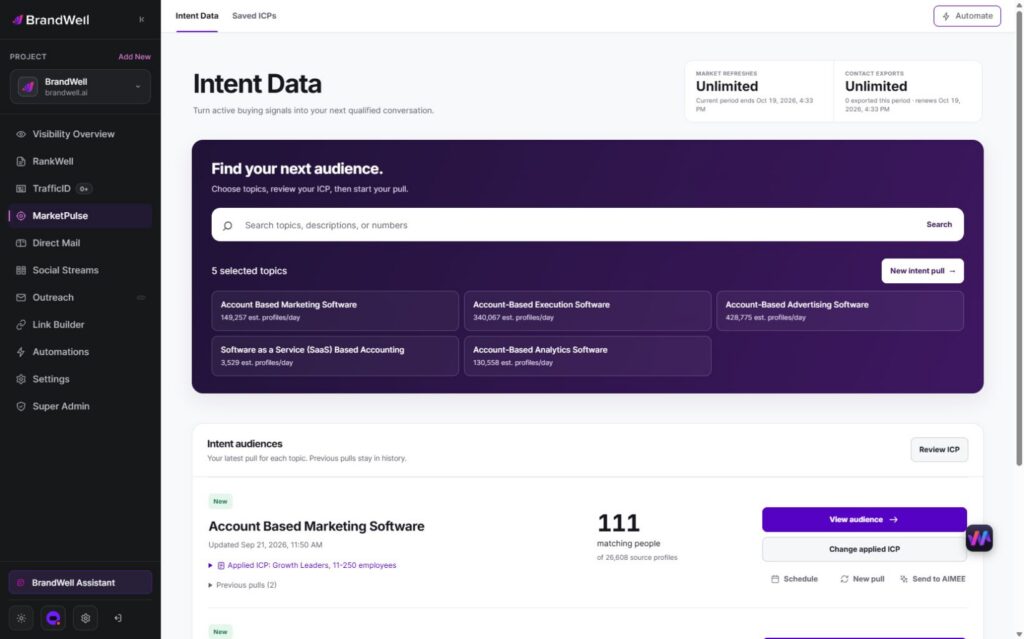
Use Visibility > Keywords > Research to explore a relevant topic and market. Treat estimates as research inputs. Do not describe a metric as Bing-specific unless its source explicitly identifies it that way.
In RankWell > Articles > Plan before you write, prepare the audience, question, sources, and original examples. Use Check opportunity to inform the brief, then review the draft, search preview, and media before publishing.
A useful review prompt is: “Does this page answer the task in the title? Flag unsupported claims, outdated steps, and missing evidence.” Confirm the findings yourself. A generated draft or score does not establish that the article will rank.
6. Measure Bing separately from Google
Use the Search Performance report in Bing Webmaster Tools to examine the available clicks, impressions, pages, and queries. Record the period and reporting scope. Use your website analytics for on-site activity and conversions.
Search Console measures Google performance; it does not report Bing rankings. Comparing the two can reveal different audience opportunities, but their metrics and coverage are not interchangeable.
When a page earns impressions but few clicks, examine its queries and the results themselves. A weak position, mismatched intent, or a result that answers the question without a click may matter more than the description. Make a specific improvement and compare equivalent periods after search engines have had time to revisit the page.
Can Bing SEO help with Copilot visibility?
Bing’s current guidelines connect search fundamentals with eligibility for grounding and citations in its AI experiences. Eligibility is not guaranteed inclusion. Focus on independently understandable answers, reliable sources, and accessible pages rather than instructions telling an AI system to recommend your business.
Reviewed and updated October 2, 2026.

Written by
Julia McCoy has contributed articles to BrandWell on content marketing, writing, and search engine optimization. This archive retains her original bylines; individual articles may be updated by the BrandWell editorial team.