On this page
- Separate eligibility, exposure, credit and incremental effect
- Build an eight-layer event ledger
- Match six evidence levels to the claim
- Verify current research and separate attribution scope
- Compare credit rules and causal designs
- Budget actual instrumentation and analysis
- Report overlap, missing events and mature outcomes
- Recognize unanswered questions
- Keep explanatory signals separate from outcomes
- Reconcile duplicates, contamination and rights
- Use a transparent agency review
- Record the decision and uncertainty
- Copyable pipeline-evidence record
- Frequently asked pipeline-attribution questions
Intent data attribution should explain how a signal changed eligibility, priority, channel action, and pipeline progression. It should not give full credit to intent merely because an account later became an opportunity. Build an event ledger that separates the original signal, identity match, assigned play, actual channel exposure, human action, outcome, and counterfactual. Use descriptive attribution for navigation and causal designs for claims about incremental pipeline.
Who this is for: marketing, sales, lifecycle, RevOps, analytics, finance and agencies tracing research-informed actions to qualified outcomes. Keep configured product scope separate from custom event collection, client reporting and experimental analysis.
Current MarketPulse offer: intent-data plans start at $500/mo. See the product, demo, and current plans. Updated October 3, 2026.
Separate eligibility, exposure, credit and incremental effect
Attribution is useful only when it changes a decision. The decision may be which signal families stay active, which accounts receive sales research, how paid and outbound treatments are sequenced, whether a client service renews, or where the next test should run. Write that decision, the eligible unit, the outcome, and the counterfactual before selecting a model.
Four questions must remain separate:
- Eligibility: Which accounts or people met the fit, identity, freshness, permission, and suppression rules for an intent-informed play?
- Exposure: Which eligible units actually received an ad, email, call, lifecycle message, research step, or seller action?
- Credit: How does a declared model allocate an observed opportunity or pipeline amount among recorded touches?
- Incrementality: How much more pipeline occurred because the intent-informed treatment existed than would likely have occurred without it?
Eligibility and exposure are observable when instrumentation works. Credit is a modeling convention. Incrementality is a counterfactual estimate. A vendor dashboard can help with the first three, but it does not make the fourth true by displaying a percentage.
For account-based motions, make the account the primary analytical unit and preserve people and touches as nested records. This prevents one buying group with several contacts, ad impressions, page visits, emails, and sales tasks from becoming several independent successes.
Build an eight-layer event ledger
A shared ledger is more important than a sophisticated attribution algorithm. Create one row per material event with these fields:
- Entity keys: account, person when allowed, opportunity, client, product, market, and campaign.
- Source evidence: signal provider, signal type, topic or behavior, original timestamp, freshness at decision time, confidence, and raw-record reference.
- Eligibility decision: fit result, identity result, permission state, suppression result, rule version, and reason for inclusion or exclusion.
- Assignment: intended play, treatment or comparison group, planned channel, owner, and assignment timestamp.
- Actual exposure: audience delivery, ad impression, message sent, research task completed, call attempted, lifecycle step, and channel cost.
- Human action: seller acceptance, rejection, research notes, contact choice, reason code, and manual override.
- Outcome: reply, meeting, qualified opportunity, stage movement, won revenue, loss, opt-out, complaint, and finance-reconciled value.
- Quality and governance: missing data, duplicate, contamination, correction, retention class, access role, and deletion state.
Use immutable IDs and versioned definitions. A score can change after a model update; the historical decision needs the score and rule that existed when the action occurred. Store assignment separately from exposure because an account uploaded to an ad audience may receive no impression, while a seller may contact a control account outside the planned workflow.
The minimum operating team includes RevOps for CRM and definitions, marketing operations for audiences and lifecycle, sales operations for tasks and dispositions, analytics for models and experiments, finance for pipeline and revenue values, and privacy or legal owners for permitted use. Agencies also need a client-approved scope, tenant isolation, access control, and a change log.
Match six evidence levels to the claim
Match claim strength to method. Do not let a more elaborate name conceal the same observational weakness.
| Evidence level | Method | What it can support | Principal limitation |
|---|---|---|---|
| Operational | Signal, eligibility, exposure, and disposition counts | Workflow adoption, quality, speed, and unit cost | Does not assign pipeline contribution |
| Descriptive influence | Opportunity linked to one or more prior events | Journey review and touch coverage | High-fit accounts self-select into more activity |
| Rules-based credit | First-touch, last-touch, equal, position, or time-weighted allocation | Consistent planning convention | Result changes when the rule changes |
| Adjusted observation | Regression, matching, weighting, or threshold comparison | Conditional association under stated assumptions | Residual confounding and missing exposure remain |
| Quasi-experimental | Phased rollout, difference-in-differences, discontinuity | Stronger incremental inference when assumptions hold | Parallel trends or threshold behavior may fail |
| Randomized | Account, region, rep, or eligible-unit holdout | Incremental effect of the assigned treatment | Contamination, noncompliance, power, and generalization matter |
Swipe the table to see all columns.
Maintain all levels. Operational data explains why a test failed. Descriptive paths help teams inspect journeys. Causal evidence supports stronger budget or renewal claims. Never delete a weaker but honest result because a stronger result is unavailable.
Verify current research and separate attribution scope
Use current MarketPulse research as an input to a separately implemented evidence ledger. Verify actual event, entity and opportunity keys, permitted joins, assignment, exposure and outcome timing. A subscription does not establish native multi-client attribution, reporting or a causal experiment.
MarketPulse research is starting at $500/mo. Verify current topics, refreshes, exports and included tools on the product page. Custom integration, client reports and attribution analysis require separately verified implementation, rights and fees.
Current MarketPulse research input
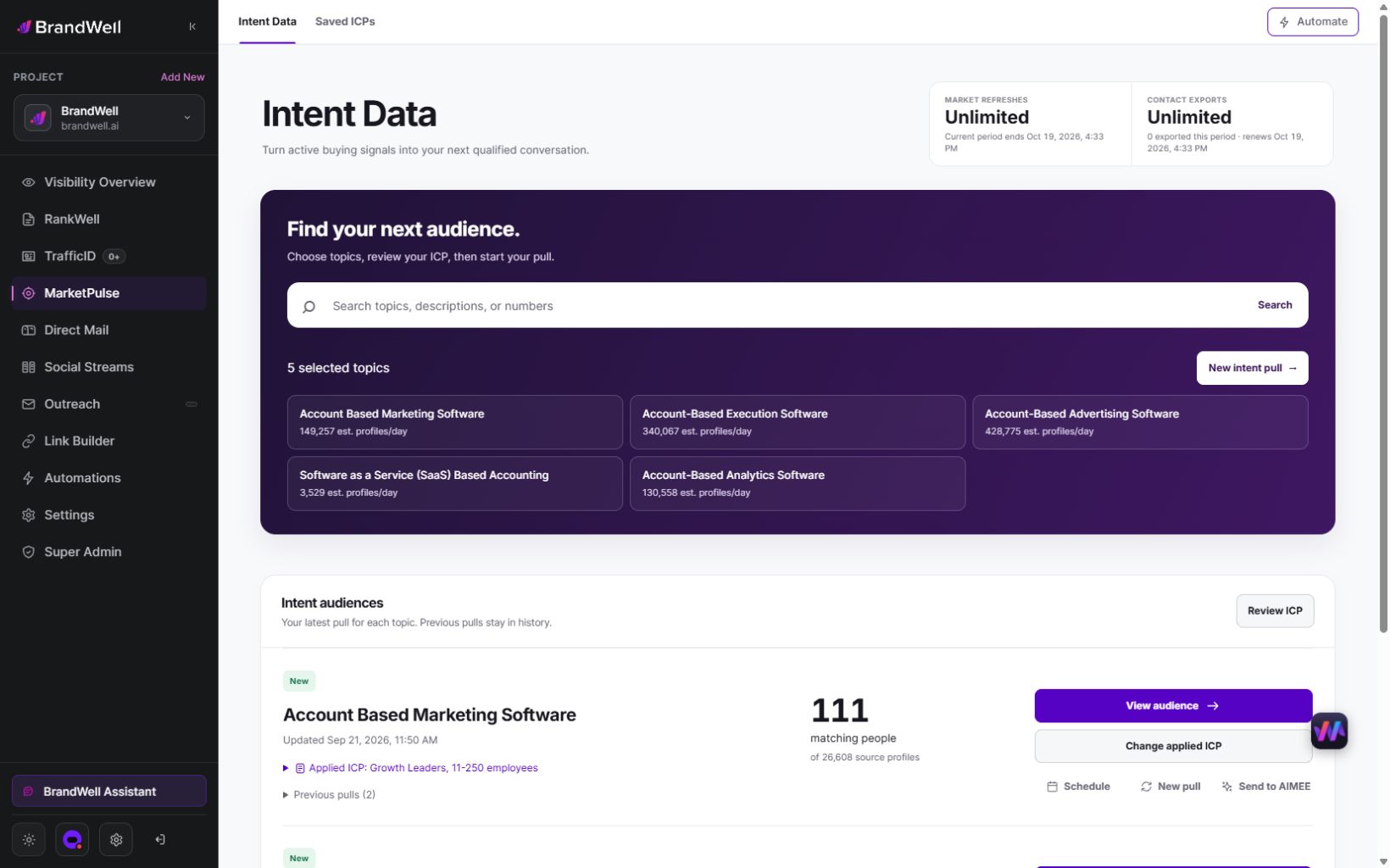
BrandWell MarketPulse: intent data starting at $500/mo. Find people researching topics relevant to what you sell, apply saved ICP filters, and review available contact details before taking action.
| Plan | Topics and refreshes | Monthly exports |
|---|---|---|
| Starter | 1 topic, weekly | 25,000 contacts |
| Growth | 3 topics, daily | 100,000 contacts |
| Scale | 10 topics, daily | Unlimited contacts |
Swipe the table to see all columns.
A pull retrieves available data from the previous 24 hours for one topic. Daily use across all included topics provides 90 Growth pulls or 300 Scale pulls in a 30-day month. Weekly Starter pulls vary by calendar month. Available audience size and contact fields vary, and audiences may overlap. Refreshes stop at the plan limit without overage charges.
- Find and qualify: search the topic catalog, save your ICP, and review the people and companies that match.
- Act on the research: export qualified contacts or prepare an Outreach or Direct Mail workflow. Connected products, channel usage, and fulfillment may cost extra.
- Get help from AIMEE: Growth and Scale include AIMEE for the initial user to research accounts and prepare the next step through connected tools.
Agencies and other service businesses can build client deliverables around their available Intent Scans and exports. Keep each client’s scope, permissions, and service fees clear. A subscription is not a promise of a white-label platform or exclusive access to a market.
Explore MarketPulse and watch the demo or compare plans starting at $500/mo. Any early-access discount is a separate, time-limited offer shown to an eligible recipient.
Compare credit rules and causal designs
First-touch credit favors discovery. Last-touch credit favors the action nearest conversion. Equal or position-based multi-touch spreads credit according to a fixed rule. Time weighting favors recent events. Algorithmic models estimate patterns from observed journeys. Each can support planning if the rule and missing data are disclosed; none automatically identifies causal lift.
For causality, prefer random assignment among eligible accounts where possible. If sellers must see all strong signals, randomize an incremental channel, research step, or timing variation rather than withholding essential service. Phased rollout can compare early and later groups. Difference-in-differences can compare changes if trends were plausibly parallel. Matching or weighting can improve balance but cannot fix unobserved causes.
Run sensitivity across several reasonable credit rules. If a channel appears essential only under the model that awards it the most credit, the finding is fragile. Causal estimates should also report noncompliance and contamination, not just the assigned groups.
Budget actual instrumentation and analysis
Budget for event collection, identity and account resolution, CRM and warehouse work, campaign and channel identifiers, integrations, analyst and RevOps time, experimentation, dashboards, data QA, privacy and security review, agency delivery, and contract administration. Add opportunity cost: engineers instrumenting attribution are not shipping another project, and sellers completing dispositions are not prospecting during that time.
Tool cost is only one line. A less expensive feed with poor identifiers can create expensive reconciliation. An integrated platform can reduce stitching but add unused modules or specialized administration. Normalize options to the same entities, signals, channels, clients, users, history, exports, implementation, support, and term.
Report overlap, missing events and mature outcomes
Use counts and rates for eligible accounts, identity acceptance, signal freshness, assigned plays, actual exposures, seller acceptance, action speed, replies, meetings, qualified opportunities, stage progression, wins, pipeline, contribution value, channel spend, and total operating cost. Add missing-event, duplicate-account, control-crossover, suppression-conflict, opt-out, complaint, and correction rates.
Prespecify client, market, account tier, signal source, topic family, identity-confidence band, freshness band, channel, and sales-motion segments. Report sample sizes and uncertainty. Avoid a single “intent influenced pipeline” number that blends ads, outbound, lifecycle, and sales touches without revealing overlap.
Recognize unanswered questions
Attribution becomes decision-useful when entity resolution is stable, opportunity keys reconcile, exposure is logged, control or comparison units are retained, sales dispositions are usable, and outcomes have had time to mature. It is not decision-grade when most touches are untracked, seller overrides are invisible, the sample is small, definitions change midstream, or every target account receives several treatments at once.
When scale is insufficient, use the ledger to improve workflow and design the next test. Report descriptive influence, unit cost, data quality, and operational adoption without upgrading them to causal pipeline. A transparent “not yet known” result can protect more budget than a confident but misleading allocation.
Keep explanatory signals separate from outcomes
Intent, identity, and activation data explain why an entity entered a workflow and what happened next. They support auditability, segmentation, and mechanism analysis. They are not downstream business outcomes. A strong signal can be wrong, a valid account can be contacted through the wrong channel, and a meeting can occur for reasons unrelated to the signal.
Preserve raw evidence, derived score, decision rule, and actual action separately. Validate revenue against the finance-approved source. Use corrections and seller rejections to improve future eligibility rather than deleting inconvenient cases.
Reconcile duplicates, contamination and rights
Double counting occurs when the same opportunity is credited fully to intent, paid media, outbound, lifecycle, and sales. Assign one account-opportunity key, show overlapping exposures, and separate journey presence from incremental contribution. Selection bias appears when the most active accounts receive treatment. Contamination appears when controls receive ads or seller outreach. Missingness appears when offline or manual actions are absent. Document each and run sensitivity checks.
Map actual source, purpose, identity level, applicable rights, client scope, sharing, access, retention, suppression, correction, deletion and destination. Keep necessary event detail and resolve unclear requirements before use. An account research association does not establish named-person behavior.
Use a transparent agency review
A credible agency report begins with the business decision and shows evidence in layers: signal delivery, usable identity, eligibility, actions, exposure, outcomes, descriptive influence, causal estimate when available, cost, risk, and next recommendation. The agency should retain the original metric dictionary, assignment log, exclusions, and methodology changes. Client dashboards should never silently rewrite prior results.
Review an available MarketPulse topic, saved ICP and actual preceding-24-hour matches for the approved research purpose. Keep uncertain company context visible. AIMEE can organize supplied context through configured tools; named owners approve actual exports, messages, audience uploads and CRM writes.
At renewal, recommend a specific action: expand a signal that produced credible marginal lift, continue a test that remains underpowered, change a contaminated route, narrow an unprofitable segment, or stop a treatment. Preserve the actual evidence and decision rather than requiring a positive attribution percentage.
Record the decision and uncertainty
Intent data attribution is a disciplined chain from evidence to decision, not a contest for full pipeline credit. Maintain the ledger, keep models explicit, use causal tests for causal claims, and show uncertainty and overlap.
Review current MarketPulse research and separately scope any attribution implementation or client report. Start with one eligible population, one incremental treatment, one mature outcome and a documented decision rule; do not imply a native branded attribution operating map.
Copyable pipeline-evidence record
Decision: [Actual research-informed action and question.] Unit: [Client, account and unique opportunity key.] Timing: [Signal, eligibility, assignment, exposure and outcome.] Credit: [Declared allocation model, lookback and value snapshot.] Comparison: [Assignment unit, cohort, mature window and contamination.] Quality: [Missing events, duplicates, revisions and uncertainty.] Result: [Descriptive influence, allocated credit or supported causal estimate; owner and next action.]
Label the credit convention and actual available models
Google Analytics attribution documentation defines credit allocation and lists its available models. First-click, linear, time-decay and position-based models were removed from GA4 in November 2023. Generic worksheet conventions are not claims that those models remain native GA4 options. A report does not validate the incremental effect of your intent workflow by itself.
Overlapping pipeline sets cannot be summed as unique value
A fictional research-associated set contains opportunities worth $60,000; a paid-media-associated set contains $40,000. They share one $20,000 opportunity. Unique union value is $60,000 + $40,000 – $20,000 = $80,000, not $100,000. Keep the unique opportunity key and as-of value. This is descriptive overlap, not incremental pipeline.
Three credited touches do not create three opportunities
One fictional $30,000 opportunity has a research event, an email touch and an ad exposure. An equal-credit convention allocates $10,000 to each touch, totaling $30,000. A journey-presence report may show the opportunity under all three categories, but summing those appearances to $90,000 overstates unique value. Declare which type of report you are showing.
Retain assignment when actual exposure differs
A fictional test assigns 100 accounts to each group. Seventy treatment accounts actually receive the intended action; 20 comparison accounts receive unplanned seller contact. Preserve all original assignments and log noncompliance and contamination. Filtering to acted-on accounts after assignment can select a different population. State the design and assumptions before interpreting any difference.
Opportunity-value revisions are not new opportunities
A fictional opportunity O1 changes from $10,000 to $15,000. At the later snapshot, unique pipeline is $15,000 for O1. It is not $25,000 from adding both snapshots or two opportunities. Retain the revision history, observation date and stage definition.
Keep attribution windows separate from outcome maturity
A fictional model credits eligible touches within 30 days before opportunity creation, while won-revenue observation continues for 90 days after creation. The lookback rule does not make the 90-day outcome mature after 30 days. Report pending outcomes and the actual cutoff.
Use supported research within scope
MarketPulse research is starting at $500/mo. Search a relevant topic, save the approved ICP and inspect actual available matches. AIMEE can organize supplied context through configured tools. Owners approve exports, messages, audience uploads and CRM writes; custom joins, client reports and causal analysis require separately verified implementation, rights and fees.
Frequently asked pipeline-attribution questions
Is influenced pipeline incremental pipeline?
Influence describes a relationship unless the actual comparison design supports a causal effect.
Can overlapping channel totals be summed?
Reconcile unique opportunity keys and overlaps before reporting unique value.
Does an audience upload prove ad exposure?
No. Preserve assignment, delivery and actual exposure separately.
Is a revised opportunity amount another opportunity?
Keep its unique key and report the stated as-of value and revision history.
Review current research: explore MarketPulse and current plans.
Reviewed and updated October 3, 2026.

Written by