On this page
- Start with the decision, not the contact list
- Workflow for coordinated multithreading
- Compare orchestration approaches
- Budget and total cost
- Measure committee coverage without rewarding spam
- Best fit and non-fit
- Data, privacy, and trust risks
- Agency service blueprint
- Role-specific message matrix
- Data model and operating ownership
- Evidence needed before scaling
- The practical takeaway
- Keep role evidence separate from record completeness
- Use a coverage example with explicit denominators
- Review current MarketPulse research
- Frequently asked questions
Direct answer: Coordinate buying-committee outreach around one account plan, not five independent sequences. Define the opportunity, map required roles, attach evidence and confidence to each person, assign one owner per motion, and enforce collision and suppression rules before anyone acts. Intent should change priority and message context; it should not turn a guessed committee into fact.
Who this is for: VPs of Sales, SDR and RevOps leaders, growth teams, and agencies managing complex B2B opportunities. This page covers stakeholder coordination – not generic sequence writing or autonomous browser execution.
Current MarketPulse offer: intent-data plans start at $500/mo. See the product, demo, and current plans. Updated October 3, 2026.
Start with the decision, not the contact list
Buying committees form around a decision: replace a system, reduce a risk, enter a market, or meet a deadline. Map that decision first. A useful committee model then asks who experiences the problem, who evaluates the solution, who owns implementation, who pays, who reviews security or legal terms, and who can block change. Titles are proxies; roles belong to the decision.
Create a minimum viable committee for each opportunity type. A SaaS infrastructure purchase might include a champion, technical evaluator, security reviewer, economic buyer, procurement, and an executive sponsor. A small departmental purchase might need only three roles. More names are not automatically better.
Committee-role map and confidence
For each person record role hypothesis, evidence, confidence, owner, last touch, next allowed channel, and missing information. Use “confirmed” only when first-party interaction, opportunity data, or human research supports it. Use “likely” or “unmapped” for model output. This language prevents a predicted role from becoming CRM folklore.
Workflow for coordinated multithreading
- Define the opportunity type and stage. Committee requirements change between discovery, evaluation, security review, and procurement.
- Combine signals without collapsing them. Preserve first-party engagement, topic research, review-site activity, product usage, CRM activity, and seller notes as separate evidence.
- Resolve the account and people. Validate employment, function, location, and contact source. Mark model-derived people clearly.
- Assign roles and gaps. Map champion, user, technical, economic, legal/security, procurement, and blocker roles appropriate to the decision.
- Set one account owner and channel owners. The account owner sees all planned touches and can pause them.
- Apply collision rules. Block same-day duplicate contacts, contradictory messages, outreach during sensitive negotiations, and automation after a negative response.
- Tailor by role. The champion needs operational value; security needs controls; finance needs assumptions; procurement needs scope and terms. Do not send the same intent-themed note to everyone.
- Review weekly. Correct role hypotheses, close gaps, record stakeholder reactions, and remove people who no longer belong.
A collision-avoidance rule set
Use a shared account calendar. Cap active outbound stakeholders, require a cooling period after a reply, and pause prospecting when an opportunity enters procurement or a complaint occurs. Log ads and nurture at the account level so sales does not misread marketing exposure as independent intent. Escalate to the account owner when two teams claim the same person.
Compare orchestration approaches
A spreadsheet and CRM can be enough for a small number of strategic accounts. Manual mapping offers transparency and forces seller judgment, but it becomes fragile when teams, regions, and channels multiply. A platform helps when identity, signals, buying stages, permissions, and actions must stay synchronized across hundreds or thousands of accounts.
The safest hybrid uses automation to propose roles, surface gaps, and enforce rules while humans confirm stakeholders and messages. Full automation can scale the wrong committee faster. A separate browser agent might assist with approved research or data entry, but it should not independently contact stakeholders or rewrite CRM truth.
Budget and total cost
Budget for data, platform seats, usage, CRM administration, research, operator training and ongoing role review. Define the actual delivery scope and written terms. More contact records do not establish a complete buying committee.
MarketPulse plans are starting at $500/mo. Starter includes 1 topic, weekly refreshes, and 25,000 exportable contacts per month. Growth includes 3 topics, daily refreshes, and 100,000 exportable contacts. Scale includes 10 topics, daily refreshes, and unlimited contact exports. AIMEE for the initial user is included with Growth and Scale. Compare MarketPulse plans and current offers.
Measure committee coverage without rewarding spam
Start with coverage quality: percentage of target opportunities with a confirmed champion, economic buyer, technical role, and risk/procurement path. Add role-confidence distribution, stale-contact rate, missing-role age, duplicate-touch defects, reply conflicts, opt-outs, and seller corrections.
Track stage progression, stalled opportunities, accepted opportunities, cycle time, wins and contribution after relevant costs. A matched-cohort or phased comparison is observational unless its design supports stronger inference. Healthy deals may reveal more stakeholders; correlation does not prove committee mapping caused a win. Where feasible, use a properly designed randomized holdout to estimate impact and report uncertainty.
Avoid “people touched per account” as a success metric. A better metric is meaningful role coverage with no collision and an evidence-backed next step. Inspect losses for absent roles, late security discovery, single-thread dependency, and contradictory outreach.
Best fit and non-fit
Buying-committee orchestration is most useful for multi-stakeholder purchases with meaningful contract value, compliance or technical review, and sales cycles long enough for coordination to matter. It also fits agencies serving complex-account clients if the agency and client share one CRM truth and clear approvals.
It is less useful for low-price self-serve products, transactional purchases, or teams without stable opportunity definitions. If sellers do not write back outcomes, more sophisticated intent will not fix the operating system.
Data, privacy, and trust risks
The biggest risks are false identity resolution, overconfident role inference, uncoordinated outreach, excessive frequency, stale employment data, and using a research signal as proof of consent or purchase intent. Apply data minimization: give each operator only the fields needed for the assigned action. Preserve provenance and correction history.
Do not reveal third-party browsing in outreach. Respect suppressions across every channel and client workspace. Review lawful basis, notices, data rights, contracts, and regional direct-marketing rules with qualified counsel. Document whether the agency, client, and vendors act as controllers, processors, service providers, or other roles for each processing activity; labels in a sales agreement do not replace the real facts.
Agency service blueprint
An agency package can include committee archetype design, topic selection, signal and identity intake, role mapping, weekly gap review, collision controls, branded reports, and pipeline analysis. The agency should specify what is inferred, what is verified, who approves contact, and how corrections propagate. It should never guarantee that every committee member will be found.
Use relevant MarketPulse topic and ICP research as one input to the account plan. AIMEE can prepare configured work through connected tools. Define the agency service, review points, client permissions and deliverables separately.
Agent-ready instructions
Give AIMEE the approved account scope, sources, role hypotheses, suppression rules, owners and review points. Ask for a draft research brief or proposed next action, then verify it against the account record. Do not let an inference overwrite a confirmed role or approved contact preference.
Role-specific message matrix
A coordinated account plan changes the question for each role without changing the underlying facts. The problem owner receives an operational hypothesis and a request to compare current workflow. The daily user receives implementation and usability questions. The technical evaluator receives architecture, integration, reliability, and migration evidence. Security and legal receive controls, data flow, subprocessors, retention, and contract answers. Finance receives assumptions, cash cost, downside, and break-even logic. The economic buyer receives business priority, tradeoffs, and decision timing. Procurement receives exact scope, terms, dependencies, and change control.
Store message intent and evidence at the role level. Do not copy a champion’s confidential detail into a cold message to procurement. Do not imply that one stakeholder endorsed the project unless that endorsement is recorded and approved for sharing. When multiple people reply, the account owner consolidates context and assigns one next step.
Stage-based orchestration
In early discovery, optimize for problem confirmation and missing-role discovery. During evaluation, coordinate technical proof, user requirements, and economic assumptions. Before security or legal review, surface data flows, controls, and non-negotiable requirements rather than waiting for a late blocker. In procurement, stop broad prospecting and manage one controlled decision plan. After close, transfer the role map to implementation and customer success with purpose-limited access.
Every stage change should update permitted actions. An automated sequence built for discovery should pause when the account opens an opportunity, requests security material, rejects contact, or enters negotiation. Create a reason code for each pause so teams can distinguish healthy coordination from a broken workflow.
Data model and operating ownership
Use separate CRM objects or fields for account, opportunity, person, buying role, role confidence, signal, evidence source, activity, owner, and suppression. Do not overwrite a contact title with a buying role. One person can play multiple roles, and a role can be shared across people. Preserve time because committee membership changes.
RevOps owns field definitions and routing. Sales leadership owns account strategy and acceptable coverage. Marketing owns campaign exposure and nurture rules. Security/privacy owns policy controls with operators responsible for implementation. The account executive owns final coordination for an open opportunity. Agencies must define whether they advise, operate, or approve each action; ambiguity invites collisions.
Weekly committee review
Review the highest-value accounts in a fixed order: decision and stage; confirmed roles; likely roles; gaps; recent signals; last touches; negative signals; risk events; next actions; and measurement. Close the meeting by deleting stale tasks, not adding another sequence. Sample several accounts with no opportunity so the team can see whether orchestration is creating useful discovery or only decorating existing deals.
Evidence needed before scaling
Before expanding, evaluate confirmed-role coverage, single-thread dependency, missing-role delays, duplicate outreach and complaints against predefined acceptance criteria. Account for deal size, stage and team differences in comparisons. A short workflow pilot can test execution; it cannot establish future sales performance. Investigate frequent role corrections or ignored recommendations before adding more data.
Committee health checklist
A healthy account record shows the decision, stage, confirmed champion, economic path, technical and risk coverage, open gaps, one owner, recent evidence, next action, and suppression state. It also shows who is intentionally not being contacted. Before scaling, sample records against seller interviews and opportunity notes. If predicted roles disagree with people who actually attend evaluation, update the archetype and preserve the correction for future model review.
Before launch, require every team to demonstrate the pause rule, ownership handoff, and correction path in a test account. Record failures and repeat the exercise after configuration changes.
The practical takeaway
Good orchestration makes the whole account feel like one informed conversation. Start from the buying decision, keep role confidence visible, assign ownership, and measure fewer collisions and earlier risk discovery – not merely more contacts.
Start by reviewing the MarketPulse demo and plans, starting at $500/mo. Choose a relevant topic and ICP, then evaluate audience fit, available contact fields, and the workflow you will use. The first-purchase 3-day satisfaction guarantee requires no data exports and no more than 2 Intent Scans; review the current guarantee terms before testing. A short evaluation can establish fit, but cannot prove future pipeline or revenue.
Keep role evidence separate from record completeness
The UK Government Data Quality Framework distinguishes completeness from accuracy. Filling a role field does not establish that the value is correct.
For a proposed committee review, record the role hypothesis, supporting evidence, date, source and owner. A job title may suggest a function; it does not establish authority for this purchase. Ask the account owner to confirm actual participants and preserve corrections instead of silently replacing the old inference.
Use a coverage example with explicit denominators
In a fictional review of 20 eligible opportunities, 12 have an evidence-confirmed champion and economic decision path. That is 60% coverage on this definition, not 60% of contacts or all possible stakeholders. If eight opportunities have both those roles and the required technical reviewer, full three-role coverage is 40% of the 20 opportunities.
Neither figure is a win rate. Separately log duplicate-touch incidents, suppressed actions, complaints and later outcomes. An increase in populated role fields could reflect research effort or changing opportunities rather than better sales results.
Review current MarketPulse research
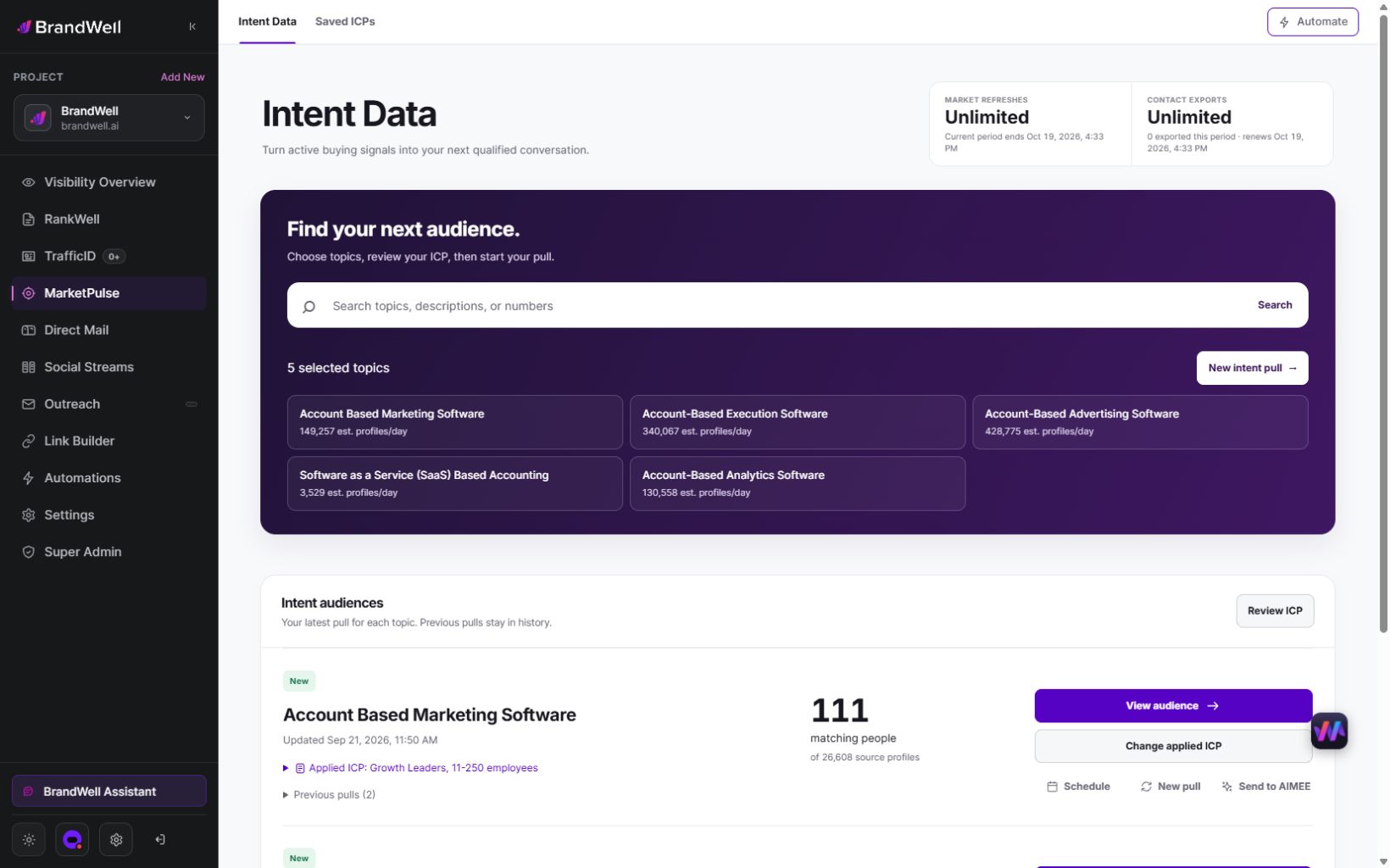
Watch the MarketPulse demo and compare plans starting at $500/mo. Evaluate topic relevance and available contact fields, then verify opportunity roles separately. Audience counts and fields vary, topics can overlap, and data availability does not grant outreach permission.
Frequently asked questions
How should sales coordinate a buying committee?
Use one account plan with role evidence, one coordinating owner, approved next actions and shared pause rules. Tailor questions to the decision each role needs to make.
Does intent data identify every decision maker?
No. Research signals and contact fields can inform investigation, but they do not establish a complete committee, authority, endorsement or permission to contact someone.
How can teams avoid duplicate outreach?
Maintain a shared account activity record, assign owners and check replies, current negotiations and suppression states before each permitted action. Test the pause and handoff rules with authorized test records.
What is a useful committee-coverage metric?
Specify the roles, evidence requirements, eligible opportunities and observation date. Report confirmed coverage separately from inferred roles, contact volume and sales outcomes.
Reviewed and updated October 3, 2026.

Written by