On this page
- What to share and what to keep separate
- 1. Agree on the customer action that matters
- 2. Compare queries around the same task
- 3. Turn paid findings into editorial hypotheses
- 4. Use organic findings to improve paid destinations
- 5. Test messaging without overstating the result
- 6. Measure combined outcomes without double counting
- 7. Coordinate the work in BrandWell
- A practical shared review agenda
- Frequently asked questions
Make SEO and PPC work together by sharing search insights, improving the pages both channels use, and measuring qualified outcomes with consistent definitions. Buying ads does not improve organic rankings. The value of coordination comes from better decisions, not from transferring paid visibility into an SEO ranking signal.
Google explicitly separates advertising investment from organic ranking in its paid and organic reporting guidance. Use that distinction to build a shared workflow without confusing the two channels.
What to share and what to keep separate
SEO and paid search can reveal useful language, reader questions, and landing-page problems. They have different costs, eligibility rules, reporting, and time horizons.
- Share: customer definitions, product facts, conversion definitions, research notes, and page-quality findings.
- Keep distinct: ad spend, organic impressions, paid clicks, attribution settings, and the evidence behind each recommendation.
- Reconcile: duplicate leads, purchases, refunds, and the dates used in performance comparisons.
Neither channel guarantees a return. Organic traffic needs ongoing editorial and technical work; paid traffic needs budget and campaign maintenance. A fast ad launch is not the same thing as immediate profit.
1. Agree on the customer action that matters
Choose a primary outcome, such as an accepted sales opportunity or a completed purchase. Define what qualifies and who verifies it. If one team counts a form submission while another counts a paying customer, their reported conversion rates will answer different questions.
Record the source, event definition, attribution window, timezone, and any deduplication method. Keep intermediate actions, such as a video play or pricing-page visit, useful but separate from revenue.
2. Compare queries around the same task
Review organic queries in Search Console and paid search terms in the advertising account. Group them by what the person is trying to do, rather than assuming identical wording means identical intent.
For an original example, an IT provider might see:
- “IT support contract checklist”: a research task that could suit a detailed guide.
- “managed IT provider in Phoenix”: a service-selection task that may suit a local service page.
- “IT support technician jobs”: employment intent that does not fit the provider’s customer-acquisition campaign.
Use the distinction to decide on a page or an exclusion. Do not move every paid term into a new blog post. Google’s search terms documentation also notes that some low-activity queries are omitted for privacy, so the report is not a complete transcript of all searches.
3. Turn paid findings into editorial hypotheses
If a paid query produces qualified customers, investigate whether a useful organic page should address the same problem. Check the existing site first. An established page might need a clearer answer, a documented example, or a better next step.
Paid conversion performance does not predict an organic ranking. The audience, placement, landing page, and search context can differ. Treat the finding as a reason to investigate the topic, not proof that copying a keyword will reproduce the result.
Write a brief with the reader’s task, current page, missing information, supporting evidence, and desired next action. That is a more useful handoff than a spreadsheet of keywords without context.
4. Use organic findings to improve paid destinations
Organic queries may reveal objections or terminology absent from the landing page. Review whether those questions also matter to paid visitors.
For the IT example, readers might need to understand response coverage, onboarding responsibilities, or what an agreement excludes. Add accurate answers when they help people assess the service. Do not bury the main offer in unrelated material merely to make the page longer.
Check mobile forms, loading behavior, accessibility, and the consistency between the ad promise and the page. Those are concrete improvements regardless of which channel first revealed the problem.
5. Test messaging without overstating the result
A paid test can help compare two messages in a controlled campaign. Keep the offer, audience, and other important settings as consistent as possible, and allow for conversion delay before judging the outcome.
A winning ad headline is not automatically the best organic title. A search title must accurately describe the page and work in its own search context. Preserve the useful customer insight while adapting the wording to the article.
Do not promise that combining channels raises Quality Score or mechanically reduces CPC. Google describes Quality Score as a diagnostic rather than an auction input. Evaluate campaign outcomes directly.
6. Measure combined outcomes without double counting
A person may discover an article organically, return through an ad, and then purchase. Different reports can assign credit differently. Adding every platform’s attributed conversions together can overstate the number of real customers.
Use your customer or order records to reconcile totals. Keep channel reporting for diagnosis, and report a deduplicated business outcome alongside it.
Here is an original hypothetical comparison: a campaign reports 12 attributed purchases and analytics reports eight organic purchases, but the order system shows 17 unique purchases across those journeys. Do not call that 20 customers. Investigate overlap and reporting definitions before drawing a conclusion.
Similarly, an apparent paid conversion might have happened without the ad. If you need to evaluate incremental impact, design an appropriate experiment rather than assuming attribution establishes causation. Avoid switching off a valuable campaign on the basis of a single short comparison.
7. Coordinate the work in BrandWell
Use Visibility’s Keywords and Research area to explore the topic language, then compare that research with first-party campaign and Search Console evidence.
In RankWell, review the existing article opportunity and prepare a sourced brief. Improve the page for its intended reader before treating it as another paid destination.
Use AIMEE to organize approved findings, draft copy alternatives, or prepare the next review task. Keep campaign changes and factual claims under review.
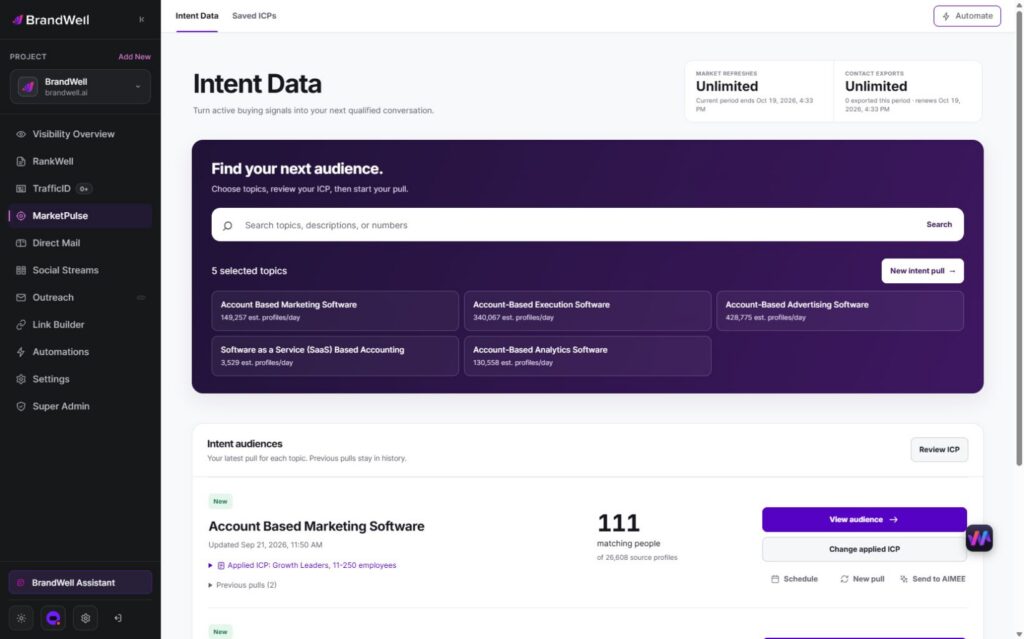
MarketPulse intent data starts at $250/month and can support topic audience research. Its available signals are distinct from a customer’s search query in your ad report and from a completed purchase. Do not combine those metrics as though they measure the same event.
A practical shared review agenda
- Confirm measurement changes or known reporting gaps.
- Review queries producing suitable customers and queries indicating a mismatch.
- Choose one page improvement with a clear owner.
- Choose one bounded campaign or messaging test when justified.
- Record what changed and the evidence needed to assess it.
- Review qualified outcomes and costs at the next appropriate checkpoint.
Frequently asked questions
Does Google Ads spending help SEO rankings?
No. The channels can share useful research, but ad spending does not buy a higher organic ranking.
Should I advertise on a term where I already rank?
Evaluate the actual business outcome, cost, and potential overlap. Organic position alone does not establish whether paid coverage is useful or redundant.
Can the same page serve SEO and PPC?
Yes, when it answers both audiences’ task and supports the intended action. A research article and a purchase-focused landing page may still need different structures.
Reviewed and updated October 2, 2026.

Written by