On this page
Use ChatGPT for link-building research notes, content ideas and outreach drafts. Supply evidence, ask for a specific output and review the result before contacting anyone. A generated prospect list is not proof that a website exists, accepts contributions or will publish your link.
Keep the work focused on a useful resource and an appropriate relationship. ChatGPT does not guarantee placements or rankings.
Start with a resource worth referencing
Identify the audience problem your resource solves and what you can contribute beyond a summary of existing articles. Possible assets include an original checklist, a documented process, a calculation with explained assumptions or an authorized case study.
For an original example, an IT provider could create a handoff checklist that identifies responsibilities during a provider transition. The useful contribution is the clear division of work and practical questions. Avoid inventing client outcomes or survey statistics to make the resource appear more impressive.
Give ChatGPT a defined task and evidence
Official OpenAI prompting documentation recommends specifying the useful goal, context, output and boundaries. Review the response and refine it with follow-up instructions.
Provide material you are allowed to share. Remove private client details that are unnecessary for the task. Ask for gaps to be flagged instead of completed with guesses.
Original prompt example: improve the asset
Review this IT provider-transition checklist for an operations manager. Identify unanswered questions and ambiguous responsibilities. Use only the supplied text. Return five suggested improvements and flag anything that needs a specialist source. Do not invent client results.
Evaluate each suggestion yourself. Add supporting facts from an appropriate primary source and label any illustrative scenario as hypothetical.
Validate prospects before drafting outreach
Use current evidence to establish why a publication and its readers would care about the resource. Check the actual page, topic, editorial requirements and appropriate contact route. Record where each observation came from.
- Audience fit: does the resource help this publication’s readers?
- Editorial fit: is the proposed contribution relevant to its current coverage?
- Verified observation: what specific page or instruction supports the pitch?
- Permission: are you authorized to share the material and contact the recipient?
Do not treat a remembered website name, a generated email address or an unsupported claim about a broken link as verified research. Inspect the relevant evidence before using it.
Original prompt example: review supplied prospects
Using these verified publication notes, identify which three audiences would benefit most from our transition checklist. Explain the fit and missing evidence for each. Do not add websites or contact information. Return a short prioritized list for human review.
Draft a concise, honest pitch
Explain the relevant observation, the useful contribution and a clear request. Avoid fabricated compliments, pretend familiarity and claims that publication will improve the recipient’s rankings.
Original prompt example: prepare an email
Draft an outreach email under 120 words using this verified editorial note and our approved checklist summary. Explain the reader benefit and ask whether the resource is relevant. Keep it as a draft. Do not claim we are existing partners or promise search results.
Check the recipient, facts, links and tone before sending. Follow the applicable communication requirements and honor objections or opt-outs. A draft task should remain a draft until an authorized person approves the outreach.
Keep commercial arrangements clear
Do not present a paid placement as an independent editorial recommendation. Google recommends rel="sponsored" for advertisements and paid links; nofollow remains acceptable for that purpose. See its outbound-link qualification guidance.
Keep the arrangement, content permissions and disclosure responsibilities documented. A link count alone says little about whether the work helped a relevant audience.
Bring approved content into BrandWell
Use Visibility research to investigate topics and opportunities. Develop the selected brief and reviewed resource in RankWell, then use a configured publishing workflow after checking evidence, product details and permissions.
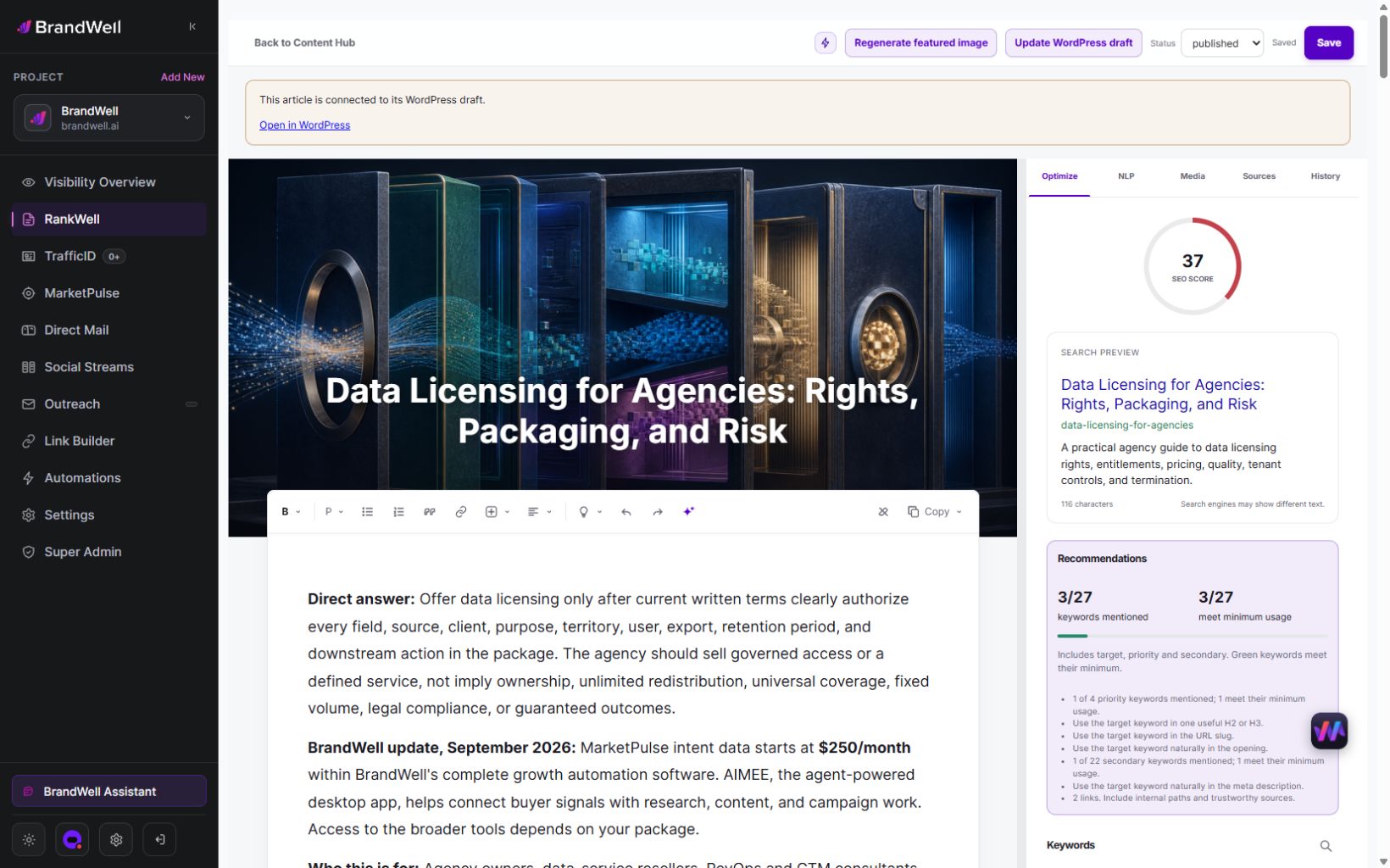
BrandWell’s LinkBuilder research is available with Growth and Scale. Treat research as an input to a reviewed outreach process. Do not assume guaranteed placements, an unrestricted email campaign or a completed publisher agreement.
Measure the useful outcome
Track researched prospects, approved drafts, messages sent, replies and verified placements separately. Record audience fit and useful visits or business actions where available. Keep refusals and follow-up decisions visible.
Hypothetical arithmetic: 20 approved messages produce four replies and one verified placement. The reply rate is 20%; the placement rate is 5%. Those are different measures, and neither establishes a ranking gain. Include research and review time when assessing whether the process is worth repeating.
Frequently asked questions
Can ChatGPT create backlinks automatically?
Generating text is not the same as securing a publication. Any tool-assisted action also needs the appropriate access and authorization. Verify the resulting placement rather than assuming it happened.
Can I trust a generated prospect list?
Use it as a starting point only. Verify current websites, relevance, editorial requirements and contact routes before outreach.
Can I use it for another language?
Have a reviewer familiar with the language and audience check the wording, context and request. Do not assume a translation removes the need for review.
Will link-building guarantee AI-answer visibility?
No. Create a useful, clear resource with traceable evidence and original examples. Observe references and downstream results without promising inclusion.
Explore RankWell to develop reviewed resources in the current BrandWell content workflow.
Reviewed and updated October 3, 2026.

Written by
Julia McCoy has contributed articles to BrandWell on content marketing, writing, and search engine optimization. This archive retains her original bylines; individual articles may be updated by the BrandWell editorial team.

 Justin McGill