On this page
- Who this is for
- In-market audiences versus lookalikes
- A decision framework for choosing the audience
- Build the audience in nine steps
- Comparing in-market, fit, retargeting, and modeled audiences
- Pricing, budget, and total cost
- Measure response and outcomes
- Best-fit clients and disqualifiers
- Combining fit, identity, freshness, and outcomes
- Data quality, privacy, and advertising-policy risks
- Scope an agency service
- Frequently asked questions
- A fictional audience test
- Use MarketPulse for topic research
In-market audiences use behavior interpreted as recent buying interest; lookalikes use similarity to an existing seed audience. Use research signals to investigate relevance and timing, and modeled similarity to explore reach. Neither proves that a person will purchase.
Google Ads’ audience documentation distinguishes recent purchase-intent segments from lookalike segments based on shared seed-list characteristics. Availability depends on campaign type. These platform segments are not interchangeable with a topic-research dataset or a guaranteed named-contact list.
Who this is for
- B2B paid media leaders deciding where to allocate budget across narrow account audiences and modeled reach.
- Agencies adding intent-based audience strategy, activation, and measurement to a recurring service.
- Demand generation teams trying to connect media exposure with qualified pipeline rather than inexpensive form fills.
- RevOps and data teams responsible for account matching, identity, suppression, and outcome reconciliation.
This guide is most relevant to high-consideration B2B sales. Small consumer purchases, undefined markets, or very low-volume account universes may need a different approach.
In-market audiences versus lookalikes
An in-market audience is built from behavior interpreted as current category, problem, product, or purchase research. The behavior may be observed by an ad platform, an approved third-party network, the company’s first-party properties, or a combination. The provider decides which events, baseline, recency, and identity create membership.
A lookalike audience starts with a seed – customers, opportunities, high-value accounts, website converters, or another known cohort – and finds users or companies with similar modeled characteristics. Its quality depends on the seed, the destination’s model, available features, and exclusions. If the seed contains low-quality leads, small customers, churned accounts, or consumer traffic, similarity can scale the wrong pattern.
- What does membership estimate? In-market: current research or buying-stage relevance. Lookalike: similarity to a seed.
- Primary value In-market: timing and message context. Lookalike: incremental discovery and reach.
- Main data risk In-market: ambiguous behavior, stale signal, weak identity. Lookalike: biased or noisy seed, opaque similarity.
- Main media risk In-market: small audience, high frequency, false urgency. Lookalike: broad reach, weak account fit, cheap but poor leads.
- Best control In-market: fit-qualified accounts without current intent. Lookalike: original seed or fit-qualified prospecting cohort.
- Best use In-market: prioritization, sequencing, stage-specific offers. Lookalike: exploration after seed quality is proven.
Platform-native “in-market” segments and provider-built B2B intent audiences can be very different. Ask exactly what behavior is included, how recency works, whether membership is account or person level, and what exits an audience.
A decision framework for choosing the audience
Choose in-market when timing should change treatment
Use an in-market cohort when recent research should change the message, offer, bid, channel sequence, or seller coordination. Examples include migration research, implementation questions, a competitor comparison, a regulatory change, or a capacity problem. If every account gets the same generic ad, timing provides little operational value.
Choose lookalikes when the proven market is too small
Use a lookalike when the seed has known economic quality and the goal is to discover adjacent reach. Clean the seed by excluding churn, low-value customers, non-ICP companies, employees, partners, and records with missing domains. Separate customer-value tiers where the platform and privacy rules allow appropriate use.
Use both only as separate test cells
A useful test can include:
- fit-only named accounts;
- fit plus current in-market evidence;
- lookalikes from high-value seed accounts;
- a broad platform-native B2B or contextual baseline.
Keep creative and offer constant for an audience comparison, or keep audience constant for a treatment comparison. If bid, creative, landing page, and audience all change, the test cannot identify the mechanism.
Use neither when the foundation is weak
Pause if the ICP is undefined, CRM account joins are unreliable, the seed is mostly unqualified leads, the topic is ambiguous, the audience cannot meet destination minimums, or the team cannot return opportunity outcomes. Fix the data and offer before buying another audience.
Build the audience in nine steps
1. Freeze the eligible account universe
Define industry, company size, geography, technology, account tier, current customer status, and disqualifiers. This is the denominator. Do not let a high signal score admit accounts that cannot buy.
2. Select observable buying questions
Instead of a giant category term, map problems and decisions: replacement, integration, implementation, security, pricing, comparison, compliance, and migration. Add negative meanings. A good topic changes the campaign treatment.
3. Define membership and expiry
Document source, baseline, threshold, freshness window, identity level, and update cadence. Require multiple or stronger signals when the topic is common. Expire membership when activity becomes too old for the selected play.
4. Join and score transparently
Make the review criteria explicit:
Use an explicit review checklist: account fit, topic relevance, signal timestamp, identity level and permitted destination. These are separate checks, not a calibrated predictive formula.
Keep the evidence for each check visible so reviewers can explain a decision and investigate poor results.
5. Validate identity and permitted use
Separate account, buying group, and person. Validate identifiers required by the destination. Apply opt-outs, customers, employees, competitors, restricted geographies, and other suppression rules before upload. Confirm that the source and client may use the data for the destination and purpose.
6. Map cohort to treatment
Use a problem diagnostic for early research, a comparison guide for evaluation, an implementation asset for late-stage questions, or an account-specific proof point when verified. Do not tell a person that the advertiser observed their research.
7. Activate with caps and exclusions
Create unique audience and campaign identifiers. Set budget, frequency, bid, geography, placement, and expiry rules. Exclude converted accounts where appropriate. Monitor overlap between in-market, retargeting, lookalike, and customer audiences.
8. Reconcile at the account level
Return media delivery and conversions to CRM accounts. Resolve multiple contacts and devices carefully. Track exposed accounts that did nothing and qualified opportunities that were never exposed. That complete table supports better measurement than a list of “engaged accounts.”
9. Refresh and remove
A dynamic audience needs both additions and removals. Review stale membership, lost fit, customer conversion, opt-outs, failed identifiers, and account ownership changes. An audience that only grows eventually stops representing “in market.”
Comparing in-market, fit, retargeting, and modeled audiences
Do not force a single audience type into every funnel stage.
- Named-account or firmographic audiences establish fit and provide the best control for an in-market test.
- In-market audiences add timing and can select a topic-specific treatment.
- Retargeting sequences known first-party engagement but can overconcentrate frequency.
- Lookalikes discover adjacent reach when the seed is clean and economically meaningful.
- Platform-native interest or demographic audiences add scale but may use broad or opaque definitions.
- Contextual targeting reaches relevant content environments without requiring the same person-level audience model.
Use exclusions and campaign identifiers to estimate overlap. An account seen in three audience types should not automatically receive three times the budget.
Pricing, budget, and total cost
Use a complete cost model:
audience TCO = data and identity + destination/platform + media + implementation + creative + direct labor + measurement + risk reserve
Data providers may price by platform scope, topics, accounts, usage, records, seats, or services. Media has destination minimums, CPM or auction cost, frequency effects, and match loss. Agency work includes audience design, file and identity QA, campaign setup, creative mapping, monitoring, reconciliation, and client reporting.
Budget from the value of the qualified account universe and the minimum learning threshold – not from a universal CPM or cost-per-lead benchmark. Keep ad spend outside the fixed data-service fee unless the contract clearly states otherwise. Add change control for new topics, markets, destinations, creative, and experiments.
Measure response and outcomes
A useful scorecard moves through four levels:
- Audience integrity: eligible accounts, source coverage, freshness, match rate, duplicate rate, suppression, and audience overlap.
- Media delivery: reach, frequency, CPM, spend, and delivery by account tier.
- Qualified response: target-account visits, meaningful page activity, validated forms, buying-group engagement, and sales acceptance.
- Business outcome: opportunity rate, pipeline, win rate, revenue, sales-cycle change, gross profit, and agency margin.
For a causal comparison, define eligible units, randomize treatment where feasible, and avoid contamination between groups. Keep the offer and other conditions comparable. An observational fit-only cohort is useful context, but does not automatically isolate the effect of timing.
Do not count all pipeline touched by an ad as incremental. Reconcile opportunities with exposure timing, account ownership, and other campaigns. Report sourced, influenced, and experimental lift separately.
Best-fit clients and disqualifiers
The strongest fit is a high-value B2B company with a defined account market, observable research topics, sufficient audience size, an activation-ready media team, clean CRM joins, and a sales cycle long enough to justify coordinated influence. Agencies can reuse the framework across similar clients while keeping data, thresholds, and audiences separated.
Disqualifiers include an ICP that changes weekly, a seed made mostly of low-quality leads, sparse or ambiguous topics, no platform-eligible identity, tiny audiences, no opportunity data, and an expectation that intent identifies a certain person. Broad lookalikes may be preferable for discovery when current signal coverage is low. Contextual or fit-based media may be preferable when identity and audience governance are not appropriate.
Combining fit, identity, freshness, and outcomes
The correct order is:
- identify the eligible market;
- observe behavior with source and timestamp;
- interpret the topic conservatively;
- resolve account or person at the required confidence;
- apply geography, purpose, platform, and suppression rules;
- assign the audience cohort and treatment;
- activate with caps and expiry;
- return delivery and opportunity outcomes;
- remove stale or converted members;
- update one rule at a time.
This chain makes in market B2B audiences signal quality and measurement auditable. It also prevents an account event from becoming an automatic person-level message.
Data quality, privacy, and advertising-policy risks
Common in-market audience mistakes include treating platform segments and third-party B2B signals as equivalent, retaining membership indefinitely, using noisy lookalike seeds, uploading unvalidated identifiers, inferring sensitive interests, revealing tracking in creative, ignoring audience minimums, failing to suppress customers, and optimizing to cheap but unqualified conversions.
Before activation, document the source, purpose, destination, retention, suppression process and responsible owner. Review the destination’s current audience-upload and advertising rules. A research signal alone does not establish permission to contact someone or upload their details.
Scope an agency service
Create modules clients can understand:
- Audience intelligence: monitored market signals, fit filtering, monthly branded report, and recommendations.
- Activated in-market: intelligence plus identity checks, weekly audience refresh, one channel, suppression, and outcome reconciliation.
- Managed paid intent: multiple audiences and channels, topic-to-creative strategy, experiments, client portal, agent-ready workflows, and executive pipeline reporting.
If offering a managed service, separate the agency’s research, reporting and approved campaign work from platform licensing. Define the scope, refresh cadence, review owner and support responsibilities. Confirm any client-delivery or resale rights in writing before offering them.
Validate a small, approved audience and sample report before committing a larger media budget. Treat these service modules as proposed operating models, not native BrandWell capabilities.
Frequently asked questions
How should B2B advertisers approach in-market audiences?
Start with fit-qualified accounts, add fresh behavioral evidence, validate identity and policy eligibility, use a distinct treatment, and compare with a fit-only control.
What workflow and team are required?
Define the account universe, topics, membership and expiry, identity, suppression, treatments, budgets, campaign IDs, reconciliation, and rule review. Assign strategy, data, media, approval, and service owners.
Which tools and operational resources are most useful?
Prioritize transparent membership logic, account matching, destinations, refresh, outcome return, client controls, and total cost. Use an ICP sheet, seed audit, audience manifest, suppression log, and experiment plan.
How do in-market and lookalike audiences compare?
In-market audiences estimate current relevance; lookalikes estimate similarity. Use the former for timing and treatment, the latter for discovery, and test them separately.
What budget and pricing should a buyer expect?
Include data, identity, platform, media, implementation, creative, labor, measurement, and risk. Scope the audience and learning threshold rather than relying on a generic benchmark.
How should ROI be measured?
Track audience integrity, delivery, qualified response, pipeline, gross profit, and agency margin. Use randomized or strongest-feasible comparison groups and state attribution limits.
Which clients are the best fit?
High-consideration B2B companies with clear accounts, observable demand, valuable deals, clean CRM data, enough audience scale, and an activation owner fit best.
How should fit, identity, freshness, and outcomes work together?
Treat each as a gate, preserve the rule version, expire stale membership, and return media and revenue outcomes to the account record.
What are the biggest mistakes and privacy risks?
Noisy seeds, ambiguous signals, stale membership, identity overclaims, invalid uploads, sensitive inference, poor suppression, over-frequency, and causal overstatement are frequent failures.
How should an agency package the service?
Sell signal monitoring, branded reports, audience refresh, approved channels, creative mapping, measurement, SLAs, and outcome reviews as fixed modules with usage limits and change control.
A fictional audience test
Suppose two comparable test groups each contain 200 eligible accounts. Twelve treatment accounts and eight comparison accounts create qualified opportunities: 6% versus 4%, a difference of two percentage points. This observed difference is not automatically incremental lift; assess the assignment, contamination, sample size and uncertainty.
If the treatment costs $1,500, dividing by twelve observed opportunities gives $125 per observed opportunity. It is not customer acquisition cost or ROAS. Deduplicate opportunities, separate observed from estimated incremental outcomes, and use actual purchases and revenue for revenue metrics.
Use MarketPulse for topic research
MarketPulse helps investigate people researching topics relevant to your market. Standard plans are starting at $500/mo. Growth includes three topics with daily pulls; Scale includes ten topics with daily pulls. Available contact fields and counts vary, and topic audiences can overlap.
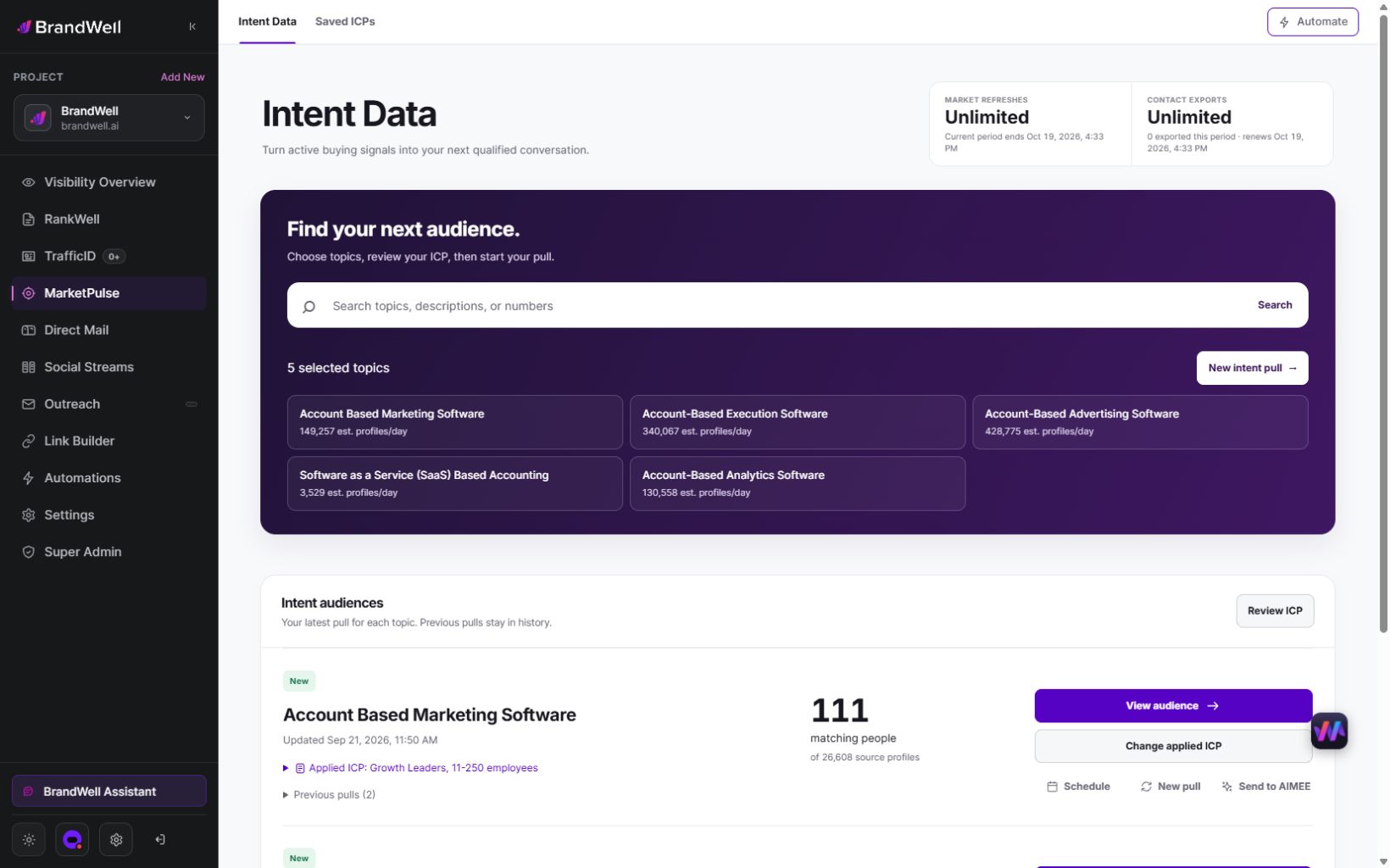
Start with a relevant topic, review the audience using your ICP criteria, and record the signal’s scope and freshness. Verify any advertising destination’s eligibility and permitted use before activation. Topic coverage and export allowances do not establish native ad synchronization, white-label access or resale rights.
See MarketPulse’s demo and current plans, or review the BrandWell product directory.
Reviewed and updated October 3, 2026.

Written by