On this page
- Current MarketPulse research workflow
- Define six evidence-to-decision states
- Use eight implementation steps
- Evaluate seven integration approaches
- Compare manual and automated review
- Budget five actual operating layers
- Measure per-record timing and outcomes
- Check ownership and source prerequisites
- Preserve five decision dimensions
- Test eight failure paths
- Scope managed implementation separately
- Use a bounded launch checklist
- Copyable integration acceptance test
- Frequently asked integration questions
Treat an intent-data integration as a reviewed evidence-to-decision process. Define actual record fields, source rights, fit, identity support, event age, owners, suppression, retries and feedback. Test one bounded workflow before expanding it; successful ingestion is not buyer qualification, permission or proof of improved outcomes.
Who is this for? Revenue operations, marketing operations, demand generation, and agency delivery teams connecting research or engagement signals to nurture, account prioritization, and sales-review workflows.
An intent-data marketing automation integration is successful when it helps the right team review useful evidence sooner without hiding uncertainty. Intent is probabilistic evidence that may indicate research or engagement. It does not prove that a person will buy, has budget, or has authorized outreach. That distinction should survive every sync, score, workflow, alert, and report.
Current MarketPulse offer: intent-data plans start at $500/mo. See the product, demo, and current plans. Updated October 3, 2026.
Current MarketPulse research workflow
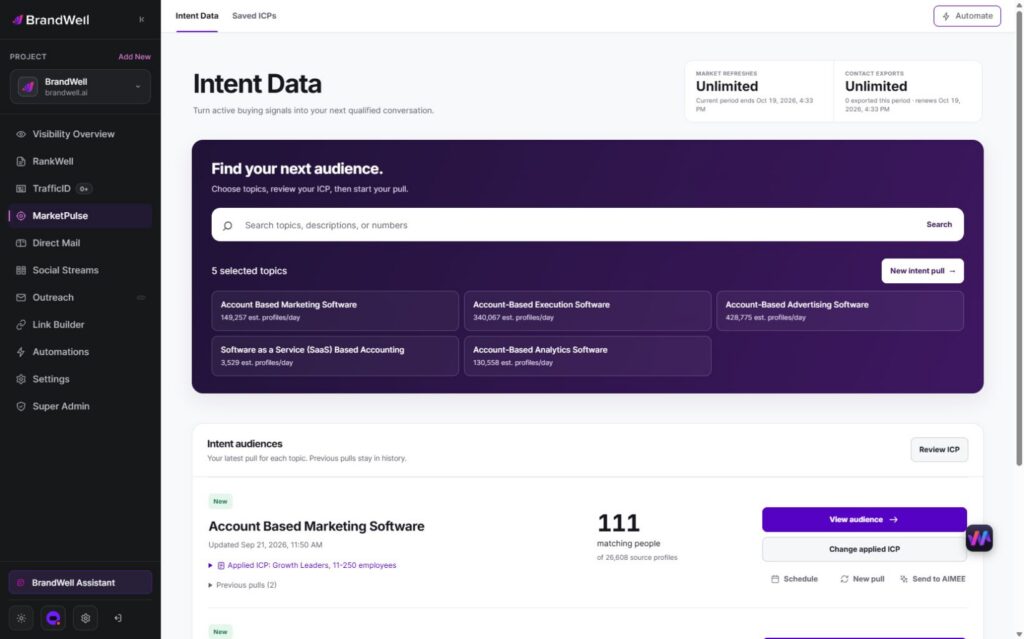
BrandWell MarketPulse: intent data starting at $500/mo. Find people researching topics relevant to what you sell, apply saved ICP filters, and review available contact details before taking action.
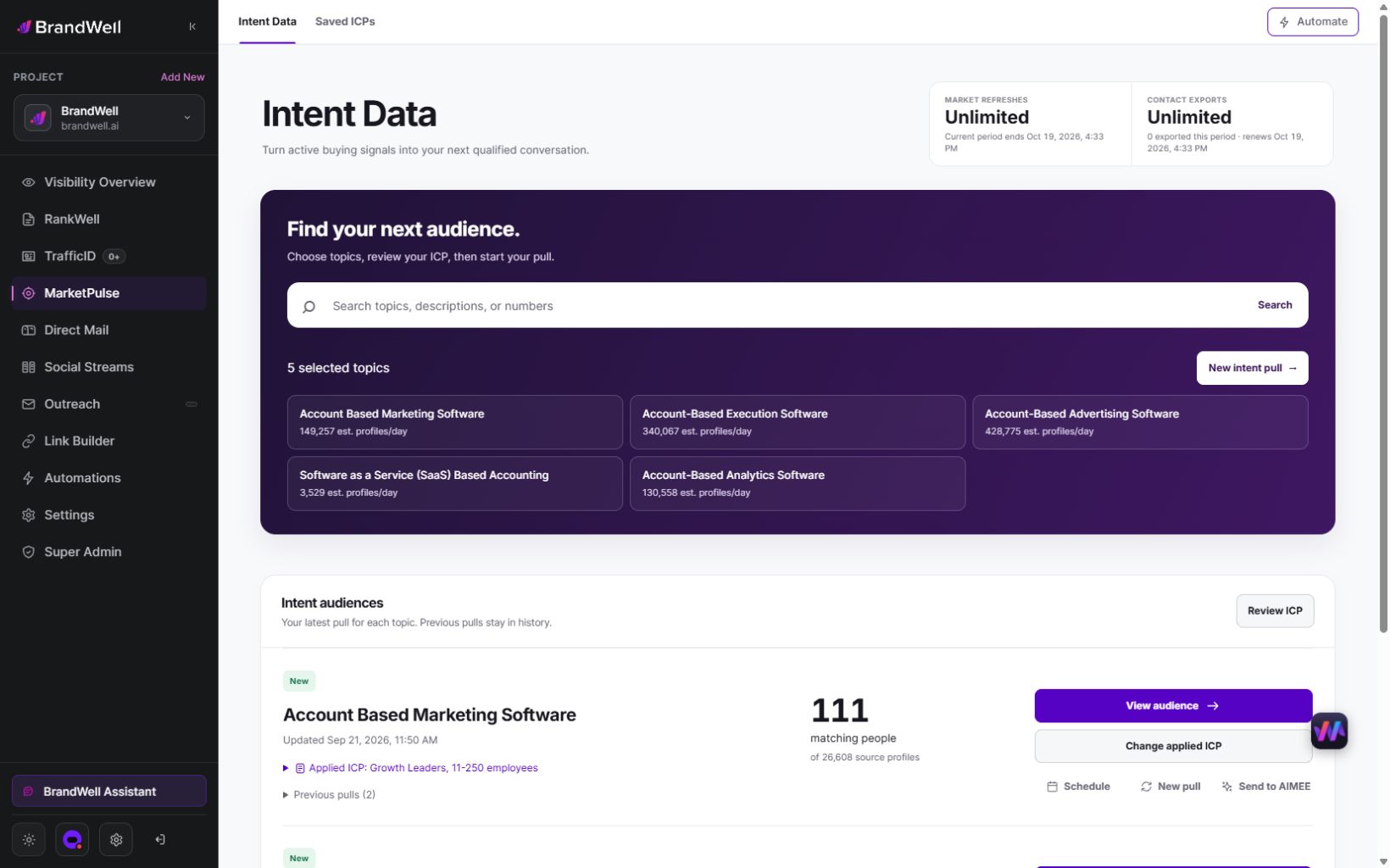
MarketPulse plans are starting at $500/mo. Verify current package scope and offers on the product page.
| Plan | Topics and refreshes | Monthly exports |
|---|---|---|
| Starter | 1 topic, weekly | 25,000 contacts |
| Growth | 3 topics, daily | 100,000 contacts |
| Scale | 10 topics, daily | Unlimited contacts |
Swipe the table to see all columns.
A pull retrieves available data from the previous 24 hours for one topic. Daily use across all included topics provides 90 Growth pulls or 300 Scale pulls in a 30-day month. Weekly Starter pulls vary by calendar month. Available audience size and contact fields vary, and audiences may overlap. Refreshes stop at the plan limit without overage charges.
- Find and qualify: search the topic catalog, save your ICP, and review the people and companies that match.
- Act on the research: export qualified contacts or prepare an Outreach or Direct Mail workflow. Connected products, channel usage, and fulfillment may cost extra.
- Get help from AIMEE: Growth and Scale include AIMEE for the initial user to research accounts and prepare the next step through connected tools.
Agencies and other service businesses can build client deliverables around their available Intent Scans and exports. Keep each client’s scope, permissions, and service fees clear. A subscription is not a promise of a white-label platform or exclusive access to a market.
Explore MarketPulse and watch the demo or compare plans starting at $500/mo. Any early-access discount is a separate, time-limited offer shown to an eligible recipient.
Define six evidence-to-decision states
The integration should turn an observed signal into a traceable decision. A reviewer ought to see what happened, where it came from, what entity it applies to, how fresh it is, why it met the ICP and eligibility rules, what action was recommended, and what eventually happened. If the marketing platform displays only a blended “intent score,” the most important evidence has already been lost.
A practical intent data marketing automation integration framework has six states: observed, normalized, qualified, routed, reviewed, and measured. Each transition needs an owner and a failure path. Test whether the actual implementation preserves these states, expiry rules, exception handling and an auditable record.
Choose the business outcome before the connector. Examples include routing competitor-research accounts for review, placing eligible accounts into a topic-specific nurture, prioritizing a finite account-research queue, or creating a client-ready agency report. Avoid trying to automate every channel in the first release.
Use eight implementation steps
A reliable intent data marketing automation integration workflow begins with a data contract. Create separate fields for the evidence and the decision instead of overwriting one score.
- Define the signal record. Preserve source, signal type, observed entity, topic or action, observation timestamp, last refreshed timestamp, source confidence, identity-confidence state, and permitted-use notes.
- Normalize identifiers. Map actual domains and stable account/contact IDs while preserving original source values. Define the unit and collision rules. An external ID alone does not resolve duplicates, prove identity or guarantee safe destination updates.
- Apply eligibility gates. Test ICP, territory, customer and opportunity status, topic relevance, recency, frequency, identity confidence, consent or permission state, suppression lists, and capacity.
- Choose a destination state. Examples are monitor, nurture, account research, sales-review task, reject, suppress, or expire. Do not equate “qualified for review” with “sales-ready.”
- Configure actual enrollment, re-entry and stop behavior deliberately for the implemented object and workflow. Preserve reason codes, rule version, suppressed state and expiry. Test repeated deliveries rather than assuming a changing signal behaves like one form submission.
- Assign owners and approval boundaries. Marketing ops owns field and workflow behavior; RevOps owns routing and CRM state; the business owner accepts the signal; privacy, security, and legal owners approve data use; sales approves consequential outreach.
- Test exceptions. Simulate stale events, duplicate deliveries, missing identifiers, conflicting identities, deleted records, suppressed contacts, connector outages, and late-arriving outcomes.
- Write outcomes back. Capture acceptance, rejection reason, action time, meeting, qualified opportunity, progression, revenue, and complaint or opt-out. Preserve “no action” as a valid result.
Verify the actual destination schema, object, field type, null behavior, timestamp format, source precedence and update permissions. Keep immutable observations separate from mutable decision state. Test each connector, direction, supported field, limit, latency, retry and failure behavior under the actual entitlement.
Evaluate seven integration approaches
Evaluate these seven approaches against actual evidence preservation, ownership, identity support, freshness, field control, retries, recoverability, costs and permitted use. A native label or connector logo does not establish completeness or a universally best operating model.
1. Native connector
A verified native connector can shorten implementation and centralize support. Verify actual standard fields and supported objects. Limitation: a connector logo does not establish field completeness, two-way sync, real-time delivery, replay, or error handling. Read the current documentation and test the actual plan.
2. Marketing-platform workflow intake
Load qualified fields into the marketing platform and let its workflow engine control enrollment, nurture, ownership, and suppression. Check actual marketing-operations ownership and supported behavior. Limitation: workflow limits, object rules, and re-enrollment behavior can make event-like signals hard to model.
3. CRM-first routing
Resolve and upsert the account or contact in the CRM, then mirror the approved state into marketing automation. This fits sales-led teams with strong CRM ownership. Limitation: using the CRM as an event store can create field sprawl and destructive overwrites.
4. Integration platform or middleware
Middleware can normalize vendors, branch logic, retry failures, and log payloads before delivery. It fits multi-source stacks and agencies managing repeatable deployments. Limitation: every branch adds maintenance, credentials, usage fees, and another place where personal data may persist.
5. Warehouse-controlled audience
A warehouse model can combine intent, fit, account status, identity, and outcome data, then publish only eligible states downstream. It fits data-mature teams with governed models. Limitation: implementation and observability demands are higher, and batch cadence may not suit time-sensitive plays.
6. Reviewed CSV import
Evaluate a controlled CSV as a bounded pilot: analysts validate records, document acceptance, and learn which fields matter before automating. Limitation: manual handling is slower, less reproducible, and vulnerable to stale files, mismatched IDs, and undocumented edits.
7. Human-reviewed agent workflow
AIMEE can prepare a review brief through configured connected tools. Keep proposed actions separate from actual approvals and destination acknowledgements. Confirm the implementation and permissions before execution.
Compare manual and automated review
An intent data marketing automation integration comparison should include the status quo. Reviewed CSVs are often best for a small proof of concept because they expose data-quality problems. Manual monitoring fits a short, strategic account list where human context matters more than speed. Isolated dashboards work for exploration but tend to lose ownership and outcome feedback. Governed automation wins when signal volume, decay, and routing SLAs exceed manual capacity.
Move from manual to automated only when record matching is dependable, suppression works, workflow owners are staffed, and the same qualification rule can be explained without vendor-specific jargon. Keep a manual exception queue after automation. A workflow that silently rejects half of its inputs is not more mature than a spreadsheet.
Switching effort includes field migration, historical-state preservation, deduplication, consent and suppression transfer, workflow reenrollment decisions, reporting baselines, and rollback. Treat vendor comparison as an operating-model decision, not a feature checklist.
Budget five actual operating layers
Intent data marketing automation integration pricing has at least five components: the signal source, enrichment or identity services, the marketing/CRM platform, middleware or warehouse usage, and implementation plus recurring QA. Add internal labor for data contracts, testing, privacy review, reporting, and seller feedback. A low subscription can still have a high total cost if analysts must repair identities or sellers reject most alerts.
Request a written quote that specifies topics or coverage, record or credit units, seats, exports and API access, connector entitlements, refresh cadence, support, implementation, contract term, renewal, data retention, and permitted use. Keep actual product prices, custom implementation quotes and client fees separate.
Measure per-record timing and outcomes
Intent data marketing automation integration KPIs should follow the funnel rather than celebrate signal volume. Track ingestion success, duplicate rate, identity-confidence distribution, eligibility rate, signal age at routing, time to owner review, sales acceptance, rejection reason, approved action, held meeting, qualified opportunity, stage progression, win, and opt-out or complaint.
Useful formulas include:
- Accepted-signal rate = accepted signals ÷ signals reviewed.
- Qualified-opportunity rate = qualified opportunities ÷ eligible accounts activated.
- Median routing time = median of each eligible record’s owner-review time minus that same record’s eligible-signal time. Preserve matched records, time zones, unfinished work and actual pause rules; do not subtract separately calculated timestamp medians.
- Compare actual defined opportunity outcomes under a credible assignment or comparison design with compatible units, maturity, exposure and qualification rules. A simple difference in cohort pipeline is descriptive; it is not automatically an incremental estimate.
- Defined program ROI uses a credible estimate of incremental contribution in dollars before program costs: subtract full program costs and divide by those same costs. Keep attributed outcomes separate and do not subtract costs already included in contribution. Without a credible estimate, report observed costs and descriptive outcomes.
There is no universal intent data marketing automation integration benchmark. Establish a fit-only or prior-process baseline, state the sample size, preserve attribution rules, and report uncertainty. A signal can influence research without deserving full revenue credit.
Check ownership and source prerequisites
This approach fits B2B teams with a defined ICP, meaningful deal value, measurable topics or behaviors, clean account ownership, enough volume to compare cohorts, and a RevOps owner. Agencies can use it when clients agree on evidence, routing, approval, reporting, and data-use responsibilities.
Stay manual when traffic or signal volume is low, identities cannot be sampled, territories are disputed, suppression is unreliable, the offer has no topic-specific message, or sellers cannot act within the useful window. Do not automate sensitive-category profiling or personalized outreach merely because a platform can produce a record.
Preserve five decision dimensions
A useful intent data marketing automation integration playbook keeps five dimensions visible:
- Fit: Is the company eligible by size, industry, geography, customer state, territory, and exclusions?
- Identity: Is the evidence anonymous, account-matched, known first-party, or resolved to a profile at a stated confidence?
- Freshness: When was it observed, refreshed, and set to expire?
- Activation: Which action is permitted, useful, owned, capacity-aware, and reversible?
- Outcome: Was the signal accepted, acted on, and associated with a qualified result?
Do not average these dimensions into false precision. A strong-fit account with uncertain identity and fresh topic research may deserve account research or nurture, not a personalized message. A known first-party contact with stale behavior may deserve no new action. The decision guide should show which gate failed.
Test eight failure paths
- Source ambiguity: document whether evidence is first-party engagement, publisher research, account inference, or a resolved profile.
- Identity overstatement: use matched or resolved at a stated confidence; never present an inferred person as certain.
- Stale enrollment: define expiry and re-enrollment so old evidence cannot trigger new action indefinitely.
- Field overwrite: preserve raw evidence and write decision state to separate fields.
- Duplicate action: use stable event IDs or idempotency rules, then test retries.
- Suppression drift: reconcile global, client, customer, employee, competitor, and jurisdiction-specific exclusions before activation.
- Silent connector failure: monitor delivery counts, rejected payloads, stale queues, permissions, and credential expiry.
- Automation overreach: agents may prepare, route, enrich, or recommend; human reviewers approve consequential outreach, public posting, spend changes, and material CRM changes.
Publish objective claims only within actual supporting evidence and current product terms. A subscription, score or integration does not guarantee buyer identity, qualified opportunities, revenue, compliance, rankings or AI citations.
Scope managed implementation separately
An agency can sell a recurring program built around topic design, signal QA, field mapping, workflow monitoring, exception review, sales enablement, and outcome reporting. The deliverable is not “more leads.” It is a governed system that shows what evidence qualified, what the team did, and what the business learned.
Review an available MarketPulse topic, saved ICP and actual preceding-24-hour matches for the approved research purpose. Keep uncertain company context visible. AIMEE can organize supplied context through configured tools; named owners approve actual exports, messages, audience uploads and CRM writes.
MarketPulse supplies topic research and available match details. AIMEE can organize supplied context through configured tools. An agency operating service, branded weekly report, CRM synchronization or custom client interface needs separately verified implementation, rights, scope and fees. The research subscription does not establish those delivery capabilities.
Use a bounded launch checklist
- Choose one outcome, topic set, ICP, and activation play.
- Define the event schema, stable IDs, evidence states, confidence, and expiry.
- Map eligibility, suppression, enrollment, re-enrollment, and unenrollment.
- Assign business, RevOps, data, privacy, security, legal, and sales owners.
- Test duplicates, stale records, missing IDs, conflicts, outages, and rollback.
- Run a reviewed sample before automatic routing.
- Measure accepted signals and qualified outcomes against a baseline.
- Keep human approval for consequential action.
- Refresh product, pricing, connector, and legal facts before publishing.
Copyable integration acceptance test
Record: [Source, unique event, observation unit, timestamps and version.] Destination: [Supported object, fields, update rules and access.] Gates: [Fit, identity, freshness, purpose, suppression and owner.] State: [Observed, normalized, eligible, routed, reviewed and measured.] Retry: [Action key, acknowledgement, collision and reconciliation.] Feedback: [Accepted work, actual buyer outcomes, pending cases and costs.] Exit: [Stop, correction, rollback and retention ownership.]
A delivered payload is not a safely completed action
AWS’s idempotent-API guidance distinguishes retries without additional side effects. Apply that pattern only after verifying actual destination semantics and request keys. A timeout can leave the caller uncertain; preserve destination reconciliation rather than assuming failure or blindly creating another task. This is custom implementation guidance, not a MarketPulse API entitlement.
Take the median of matched elapsed times
Three fictional records begin at hours 0, 10 and 11 and finish at hours 20, 12 and 13, respectively. Their durations are 20, two and two hours, so median elapsed time is two hours. The median finish timestamp is 13 and median start is ten; subtracting those gives three hours, a different and inappropriate calculation for median duration. Preserve row-level pairing, unfinished records and the clock convention.
Replay should not create another action
A fictional approved event E-42 is delivered three times after a timeout. All three deliveries concern one intended research task. Reconcile destination state and use the tested action key so retries do not become new tasks. A different intended action must not be silently merged under the same key. Preserve suppression and approval checks at the actual execution point, including changes after the original event.
Report the full handoff funnel
A fictional cohort has 100 received events, 80 normalized records, 50 eligible records, 30 reviewed acceptances and 20 acknowledged actions. Eligibility is 62.5% of normalized records or 50% of all events. Acceptance is 60% of eligible records only when all 50 were actually reviewed under that rule. Acknowledgements are 66.7% of accepted records. Five confirmed opportunities are 25% of acknowledged accounts only if those stages use the same unique account unit. An event, record and account denominator cannot be interchanged silently.
Record unknown and stopped work
Suppose ten fictional actions are approved, but two become suppressed before execution and one has no confirmed destination acknowledgement. Seven are acknowledged. The two stopped actions are not execution failures; the unknown acknowledgement is not a confirmed failure or success. Preserve original approval, changed eligibility, suppression propagation and actual final state.
Count the implemented pilot cost
A fictional pilot costs $500 standard Growth subscription, $400 setup, $600 review and $300 integration monitoring, totaling $1,800. Twenty acknowledged actions imply $90 each; five confirmed qualified opportunities imply $360 each. Another $300 correction makes opportunity cost $420. Media, acquisition, general overhead, tax and financing are excluded. Zero opportunities makes the ratio undefined. These invented inputs are not BrandWell integration-service fees or expected outcomes.
Use the supported research input
Review an available MarketPulse topic, saved ICP and actual preceding-24-hour matches with variable contact fields. Keep source context, exclusions and uncertainty attached to the approved brief. AIMEE can organize supplied context through configured tools; owners approve exports, messages, audience uploads and CRM writes. Custom connectors, enrollment logic, client interfaces, scoring, reporting and synchronization require separately verified implementation, rights, scope and fees.
Frequently asked integration questions
Is a successful sync a qualified lead?
No. Preserve eligibility, review and buyer evidence as separate states.
Can timestamp medians be subtracted for median duration?
Not generally. Calculate matched per-record durations first.
Does a timeout prove the destination did nothing?
No. Reconcile actual state before a retry.
Does a research subscription include every custom connector?
Do not assume that. Verify implementation, access and entitlements.
Review the research input: explore MarketPulse and current plans.
Reviewed and updated October 3, 2026.

Written by