On this page
- Current MarketPulse research workflow
- Define the service promise and limits
- Assign nine delivery steps
- Evaluate seven operating resources
- Compare building, supplying and referring
- Price actual implementation and delivery
- Separate clicks from qualified outcomes
- Check client and audience prerequisites
- Preserve five activation layers
- Record seven failure modes
- Write recurring scope and review conditions
- Copyable ad-personalization pilot
- Frequently asked personalization questions
Scope intent-informed advertising as a separately operated relevance test: verify actual audience eligibility, choose a useful cohort hypothesis, approve claims and creative, preserve a suitable comparison and measure qualified outcomes. Research records do not guarantee platform reach, lower acquisition costs or buyer demand. A subscription is a research input, not native managed ad-personalization delivery.
Who is this for? Paid-media and performance-marketing agencies considering a recurring intent-informed service for B2B clients, especially teams deciding whether to build, resell, refer, or avoid the offer.
Current MarketPulse offer: intent-data plans start at $500/mo. See the product, demo, and current plans. Updated October 3, 2026.
Current MarketPulse research workflow
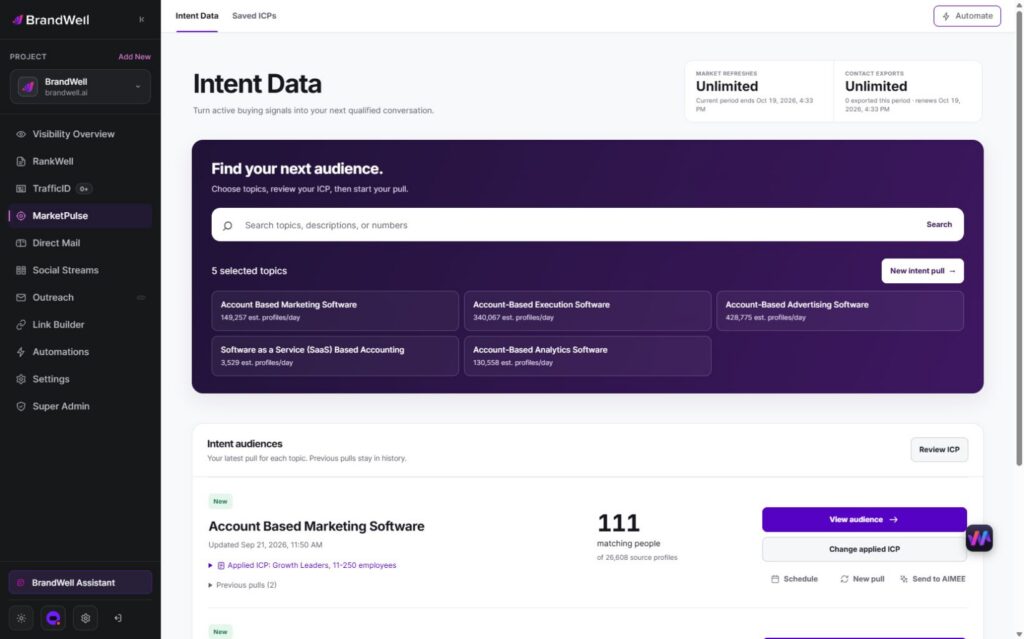
BrandWell MarketPulse: intent data starting at $500/mo. Find people researching topics relevant to what you sell, apply saved ICP filters, and review available contact details before taking action.
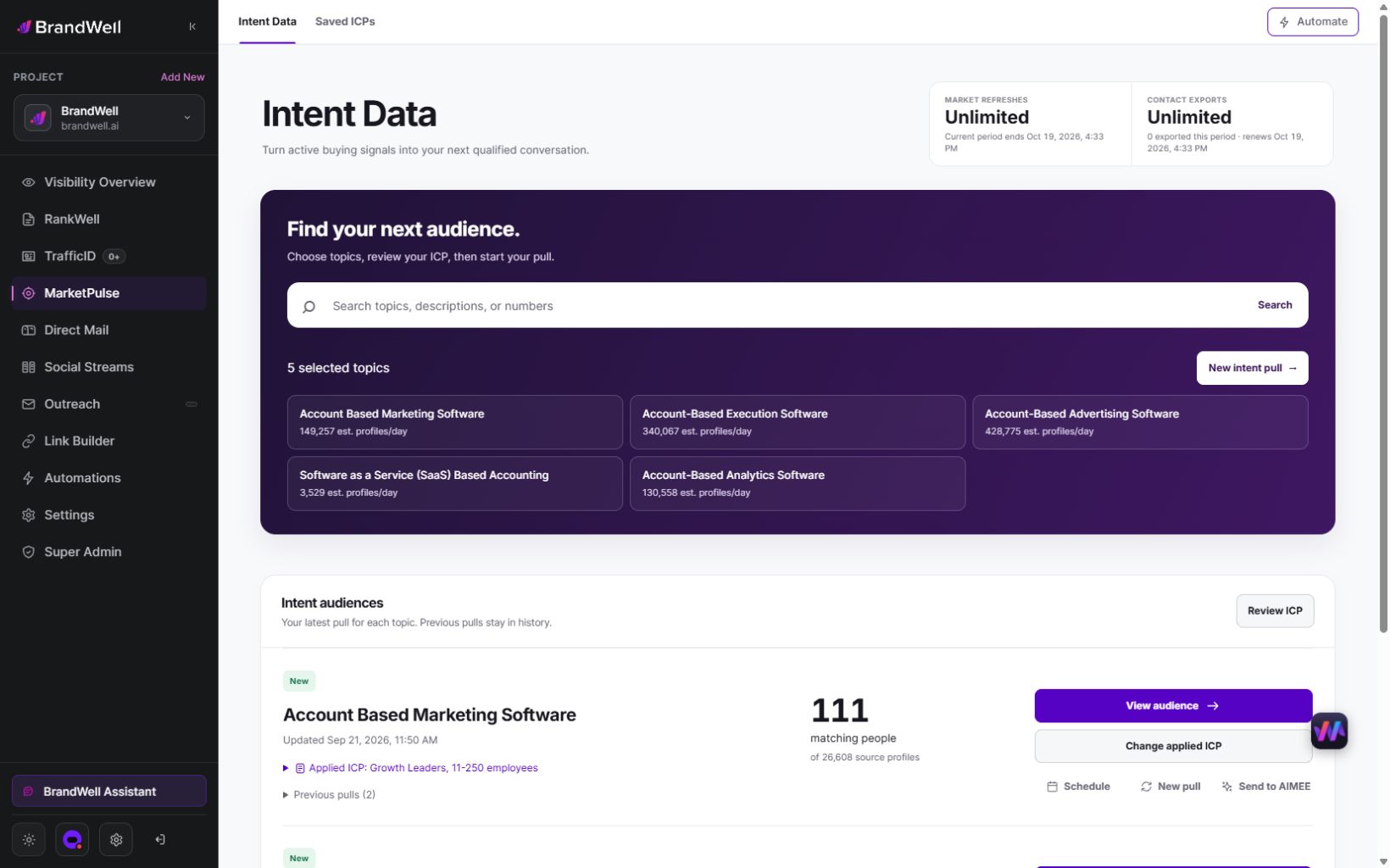
MarketPulse plans are starting at $500/mo. Verify current package scope and offers on the product page.
| Plan | Topics and refreshes | Monthly exports |
|---|---|---|
| Starter | 1 topic, weekly | 25,000 contacts |
| Growth | 3 topics, daily | 100,000 contacts |
| Scale | 10 topics, daily | Unlimited contacts |
Swipe the table to see all columns.
A pull retrieves available data from the previous 24 hours for one topic. Daily use across all included topics provides 90 Growth pulls or 300 Scale pulls in a 30-day month. Weekly Starter pulls vary by calendar month. Available audience size and contact fields vary, and audiences may overlap. Refreshes stop at the plan limit without overage charges.
- Find and qualify: search the topic catalog, save your ICP, and review the people and companies that match.
- Act on the research: export qualified contacts or prepare an Outreach or Direct Mail workflow. Connected products, channel usage, and fulfillment may cost extra.
- Get help from AIMEE: Growth and Scale include AIMEE for the initial user to research accounts and prepare the next step through connected tools.
Agencies and other service businesses can build client deliverables around their available Intent Scans and exports. Keep each client’s scope, permissions, and service fees clear. A subscription is not a promise of a white-label platform or exclusive access to a market.
Explore MarketPulse and watch the demo or compare plans starting at $500/mo. Any early-access discount is a separate, time-limited offer shown to an eligible recipient.
Define the service promise and limits
Define the operating work the agency can actually deliver: source review, eligible cohort design, useful creative hypotheses, approvals, verified activation and an agreed comparison. These are proposed service responsibilities, not a promise of market response or improved performance.
Define what the service includes. A focused intent-based ad personalization service might cover signal qualification, audience-governance review, cohort design, creative briefs, approved variations, trafficking handoff, experiment design, and pipeline reporting. Full media strategy, buying, landing-page production, sales follow-up, and conversion operations can be separate scopes.
Personalize at the cohort or account-stage level rather than exposing inferred individual behavior. “Security leaders evaluating access governance” is a defensible creative hypothesis. “We saw you reading a specific article” is surveillance-like and can undermine trust. Intent is research or engagement evidence that may improve prioritization when combined with fit, freshness, identity confidence, and context; it is not proof of a purchase plan.
Assign nine delivery steps
- Qualify the client. Confirm ICP, sales cycle, traffic and audience scale, CRM outcomes, creative capacity, privacy posture, platform eligibility, and an economic reason to personalize.
- Define the service promise. Lock included channels, cohorts, creative units, refresh cadence, reporting, client responsibilities, exclusions, and approval times.
- Audit the signal. Record source, collection context, subject level, freshness, identity-confidence, permitted use, retention, and alternative explanations.
- Build an eligible audience. Apply fit, consent/rights, advertiser authority, platform policy, regional, sensitive-category, minimum-size, suppression, and match-quality gates before upload or API activation.
- Create the hypothesis and variants. Translate evidence into stage, problem, proof, offer, and landing-page hypotheses. Use approved claims and avoid personal or sensitive inferences.
- Obtain approvals. Client, creative, privacy/legal, and platform-policy owners approve the audience, claims, destinations, spend limits, and rollback.
- Activate and verify. Confirm processing status, eligible reach, exclusion behavior, creative mapping, frequency, and delivery. Hashing or matching does not establish lawful use.
- Run a control. Hold creative, audience, budget, and measurement differences as stable as possible. Use platform experiments where appropriate, but do not assume availability for every account.
- Report and decide. Connect exposure to qualified outcomes, full cost, guardrails, and uncertainty; then renew, revise, narrow, or stop.
A lean team needs a strategist/account lead, paid-media operator, data/RevOps owner, creative lead, analyst, and privacy/platform-policy reviewer. Define an SLA for client approvals and a pause rule when eligibility or data quality changes.
Evaluate seven operating resources
Evaluate these seven operating resources against actual evidence quality, platform eligibility, implementation work, client effort, full costs and failure handling. A list of resources does not establish native product capabilities or a universally best service.
1. Cohort and client-outcome brief
Define the eligible audience, problem or stage hypothesis, approved outcome, excluded attributes, channel, and decision rule. Limitation: a polished brief cannot repair weak signal provenance or insufficient audience scale.
2. Audience-eligibility checklist
Review collection context, permission or rights, advertiser authority, region, sensitive categories, minimum audience requirements, suppression, and current platform policy. Limitation: policies change and a checklist is not legal advice; recheck before activation.
3. Match and delivery diagnostic
Separate submitted records, accepted records, matched records, eligible audience, reachable audience, and actual delivery. Limitation: a high match rate is not guaranteed and does not prove the audience should be used.
4. Cohort creative system
Maintain modular problem, proof, offer, and landing-page variants with approved claims and a fallback. Limitation: excessive variation fragments learning and creates approval overhead.
5. Approval and change log
Record audience definition, creative version, approver, spend cap, destination, launch state, exception, and rollback. Limitation: an approval log fails if operators can bypass it in the ad account.
6. Experiment and holdout plan
Choose a test unit, control, primary outcome, exposure window, exclusions, and guardrails before launch. Limitation: platform experiments may not be available or sufficiently powered for every B2B audience.
7. Separately implemented client report
Scope an actual client report with audience eligibility, delivery, creative exposure, qualified outcomes, full costs, comparison limits and next actions. Verify implementation and branding rights. Limitation: branding does not transfer ownership of underlying data or remove the client’s compliance and approval responsibilities.
Compare building, supplying and referring
- Build: assess actual data, media, creative, review and analytics skills, implementation rights, maintenance and supported client volume. Compare the resulting costs and responsibilities before assuming in-house delivery is appropriate.
- Supply through a provider: verify actual resale and branding rights, supported deliverables, pricing, client access, permissions and exit terms. Do not infer wholesale rates, a branded portal or managed operating modules from a research subscription.
- Refer: verify the specialist’s actual scope, client handoff, fee terms, ownership and review responsibilities. A referral is not automatically safer, cheaper or recurring revenue.
- Defer or avoid: hold the offer when source rights, advertiser authority, suppression, audience eligibility, creative review, measurement or operating capacity cannot be established. Resolve the actual prerequisite before accepting delivery obligations.
The right choice can vary by module. An agency might resell signal reporting, build creative and media operations, and refer specialized legal or statistical review. Document who owns each failure path before selling the package.
Price actual implementation and delivery
Intent-based ad personalization services pricing should separate setup and recurring work. Setup can include discovery, policy and data audit, cohort design, integrations, baseline, creative system, experiment plan, and launch QA. Recurring fees can cover signal/audience refresh, media operations, creative variants, monitoring, reporting, and optimization meetings.
Keep pass-through costs visible: data or identity usage, platform/media spend, design production, landing pages, experimentation, and specialist review. Add internal labor by role and client-approval rework. Reconcile client fees and every stated direct delivery cost; divide the defined remainder by the same fee for its percentage. Label actual allocations and exclusions before calling it gross margin or company profit. There is no responsible universal margin benchmark without the agency’s labor, revision, risk, and support model.
Use a capacity model. Estimate monthly cohorts, platforms, creative units, refreshes, approval cycles, reports, and exception volume. Add a scope-change trigger for extra audiences, channels, or variants. A lower recurring price can be uneconomic if client approvals arrive late or every cohort requires custom analysis.
Separate clicks from qualified outcomes
Start with operating metrics: accepted and rejected audience records, eligible audience size, processing time, delivery, frequency, creative exposure, landing-page behavior, and cost. Then connect to qualified meetings, opportunities, stage progression, and contribution margin. Keep platform-attributed conversions separate from CRM outcomes.
Compare a defined treatment with a suitable generic or status-quo alternative. Preserve assignment, actual delivery, follow-up, maturity, contamination, costs and the preselected outcome. Platform experiments require current account/campaign eligibility and sufficient evidence; they do not guarantee a positive or conclusive result.
Preselect the primary outcome, guardrails, window, and stopping rule. Report denominators, full cost, confidence or uncertainty, contamination, and implementation failures. Do not equate better click-through rate with lower CAC or pipeline. Intent-based ad personalization services ROI is decision-useful only when the attribution method and its limits are visible.
Check client and audience prerequisites
Check the actual ICP, usable cohort size, useful message hypotheses, source rights, outcome definitions, available creative reviewers and action owners. Neither an industry nor a sales-cycle label establishes readiness or a need for this service.
Exclude or pause clients with unclear data provenance, no advertiser authority, sensitive or restricted use cases, missing suppression, tiny audiences, weak security, unstable offers, insufficient creative review, or no downstream measurement. Evaluate a permitted contextual or no-activation alternative when person- or account-level methods cannot meet actual requirements.
The service is also a poor fit when the client expects every impression to use one-to-one creative. Evaluate cohort-level usefulness without exposing inferred individual research. Measure actual review work and testability rather than assuming easier governance.
Preserve five activation layers
Build the activation record in layers:
- Intent evidence: source, observed behavior, subject level, freshness, confidence, and alternative explanations.
- Fit and identity: ICP state plus anonymous, account, matched-person, or known-contact confidence.
- Eligibility: collection context, rights or consent, advertiser authority, region, sensitive category, account status, suppression, and current platform rules.
- Cohort and creative: minimum viable audience, stage/problem hypothesis, approved claims, variants, destinations, and exclusions.
- Exposure and outcome: processed, matched, eligible, delivered, frequency, qualified response, opportunity, cost, and control result.
Verify current rules for the actual platform, account, source, recipient, region, purpose and audience method. A hash, topic research record or successful match does not establish first-party status, permission, eligibility or actual reach. Hold unresolved uploads rather than assuming arbitrary third-party lists are accepted.
Record seven failure modes
- Signal error: stale or ambiguous evidence creates irrelevant cohorts. Use freshness and rejection rules.
- Identity error: a match can be wrong or inappropriate for activation. Retain confidence tiers and suppression.
- Policy error: source, region, account, audience, or sensitive-category rules can block use. Recheck the exact platform and client context.
- Creative overreach: copy can expose an inferred interest or sensitive detail. Personalize the helpful hypothesis, not the surveillance trail.
- Delivery skew: the platform decides who actually sees an ad within an eligible audience. Measure delivered exposure, not only uploaded records.
- Automation error: audience refresh or spend changes can propagate bad data. Require approval, caps, audit logs, and rollback.
- Expectation error: a client may interpret “in market” as guaranteed demand. Put uncertainty and non-fit cases in the sales proposal and report.
Write recurring scope and review conditions
A recurring package can include one setup sprint, a fixed number of cohorts and creative units, audience refresh, activation QA, policy recheck, experiment operations, monthly reporting, and a quarterly renewal decision. Define client responsibilities for lawful collection, platform access, creative claims, budgets, landing pages, sales follow-up, and final approvals.
MarketPulse supplies topic research and available match details. AIMEE can organize supplied context through configured tools. An agency operating service, branded weekly report, CRM synchronization or custom client interface needs separately verified implementation, rights, scope and fees. The research subscription does not establish those delivery capabilities.
AIMEE can prepare a review brief through configured connected tools. Keep proposed actions separate from actual approvals and destination acknowledgements. Confirm the implementation and permissions before execution.
BrandWell is not a substitute for the ad platforms, a legal basis, a privacy review, a media strategy, or an experiment owner. Renew the service when the client values the governed operating system and the evidence supports continued learning – not because a dashboard implies guaranteed demand.
Copyable ad-personalization pilot
Decision: [Actual client problem and useful message hypothesis.] Eligibility: [Source, purpose, platform, account, region and exclusions.] Cohort: [Unique unit, size, overlap and timing.] Creative: [Approved claim, variant, destination and fallback.] Comparison: [Assignment, primary outcome, maturity and contamination.] Cost: [Subscription, media, creative, labor and exceptions.] Owner: [Approval, delivery check, feedback and stop rule.]
Do not change the experiment silently
Google Ads custom-experiment instructions warn that changes to the original or experiment during a run can make interpretation harder. Preserve actual configuration, creative version and change history, and verify the campaign’s current eligibility. The documentation is not evidence that a particular client test is valid, adequately powered or profitable.
A match is not a served impression
In a fictional diagnostic, 1,000 submitted records yield 800 accepted rows, 500 matched records and 300 records counted as eligible under the stated method. Match rate is 62.5% of accepted rows or 50% of submitted rows. Suppose reporting shows 200 exposed unique recipients; that is not 200 impressions. Reconcile actual reporting units, modeled populations, overlap and delivery before building these ratios. Successful processing is not proof of permitted use or buyer demand.
Higher CTR can coexist with worse opportunity costs
Suppose each fictional variant receives 10,000 impressions and $1,000 media spend. Variant A produces 100 clicks and ten qualified opportunities; B produces 200 clicks and five qualified opportunities. CTR rises from 1% to 2%, but media cost per opportunity rises from $100 to $200. Opportunity share per click is 10% versus 2.5%. These are invented descriptive figures, not a causal finding or BrandWell ad results. Confirm equal maturity, qualification rules and assignment before interpreting the difference.
Overlapping cohorts are not additive reach
Two fictional topic cohorts contain 100 accounts each and share 40 accounts. Their unique union is 160 accounts, not 200. These are account records, not verified exposed people. Apply the actual exclusion and assignment rules, preserve the overlap and avoid treating topic appearances as independent audience members.
Include the operating layer in the pilot cost
A fictional pilot costs $500 standard Growth subscription, $2,000 media, $600 creative, $400 analysis and $300 setup, totaling $3,800. Ten confirmed qualified opportunities imply $380 each across those costs; five imply $760. Acquisition, general overhead, tax and financing are excluded. Zero opportunities makes the ratio undefined. These invented costs are not BrandWell agency-service prices or performance benchmarks. Attributed opportunities do not by themselves demonstrate incremental contribution.
Use MarketPulse as a reviewed research input
Review an available topic, saved ICP and actual preceding-24-hour matches. Check variable contact fields and public company context before drafting a cohort hypothesis. Confirm actual destination eligibility before any export or upload. AIMEE can organize supplied research and draft instructions through configured tools. Named owners approve creative, recipients, audience uploads, spend changes and CRM writes. Managed advertising, dynamic creative, client portals and custom experiment reports require separately verified implementation, rights and scope.
Frequently asked personalization questions
Does a successful audience match establish reach?
No. Match, eligibility and actual exposure are separate states.
Does higher CTR mean lower acquisition cost?
No. Track qualified outcomes and full costs separately.
Can topic counts be added as unique audience size?
Not when cohorts overlap or units differ.
Does MarketPulse include managed personalized ads?
Do not assume that. Verify actual implementation and scope separately.
Review the research product: explore MarketPulse and current plans.
Reviewed and updated October 3, 2026.

Written by