On this page
- The short answer: personalize to the evidence level
- Build the workflow before generating copy
- Decide what to personalize by channel
- Compare intent-based, generic, and fully manual personalization
- Budget for content operations, controls, and measurement
- Measure relevance without optimizing for clicks alone
- Protect privacy, data quality, and trust
- Productize intent-based personalization as an agency service
- A bounded personalization brief for AIMEE
- The relevance rule
- Test an approved hypothesis
- Compare outcomes rather than specificity
- Review the research context in MarketPulse
Intent-based personalization uses current, relevant evidence to choose the next message, page experience, audience, or research step for an eligible account. It is not inserting a company name into generic copy, and it is not telling a prospect that they were secretly observed. The safest and most useful approach matches the specificity of the message to the confidence and entity level of the signal.
Who this is for: B2B outbound, demand generation, RevOps, ABM, sales development, web teams, and agencies trying to improve relevance without making manual research unscalable.
Current MarketPulse offer: intent-data plans start at $500/mo. See the product, demo, and current plans. Updated October 1, 2026.
The short answer: personalize to the evidence level
Use intent data as a prioritization and context input, then apply an evidence ladder:
- Segment evidence: Personalize by industry, role, company size, region, or broad problem. This is scalable and relatively low risk when the source is accurate.
- Account evidence: Adapt proof, offer, routing, or landing-page emphasis to an eligible company or account tier. Do not imply that a specific person took an action.
- Recent topic evidence: Select content or a research hypothesis based on a fresh, relevant topic signal. Phrase the message around the problem, not the surveillance event.
- Known first-party behavior: Use an authenticated or consented interaction within the approved channel and context. Preserve purpose, permissions, and frequency limits.
- Person-specific inference: Use only when identity and permitted purpose are established, the inference is not sensitive, and a human reviews consequential outreach. Often the better choice is to stay at the account or problem level.
Ask a relevant question without asserting an unverified problem: “How does your team route accounts for review?” Avoid claiming a named person researched a topic unless the actual evidence supports that observation and its use is appropriate. Even a broad claim that peers commonly struggle needs support.
The operating rule is simple: the message may be less specific than the evidence, never more specific. Confidence should control action, and uncertainty should remain visible to the operator.
Build the workflow before generating copy
Intent-based personalization requires more than an LLM prompt. Map the full path:
signal → eligibility → identity level → confidence → freshness → approved use → message rule → human review → channel execution → disposition → outcome.
Define each stage:
- Signal: first-party page activity, configured topic research, review activity, campaign engagement, product use, or another approved event.
- Eligibility: ideal-customer fit, geography, account status, opportunity status, suppression, customer conflict, and channel permission.
- Identity: account, buying group, known contact, or validated person. Never silently convert account evidence into person evidence.
- Confidence and freshness: source reliability, match quality, observation window, decay, repeat activity, and conflicting evidence.
- Message rule: which value proposition, proof, offer, asset, CTA, or page module may change – and what language is prohibited.
- Approval: which variants can run automatically and which need SDR, account executive, client, privacy, or legal review.
- Outcome: deliverability, page engagement, response, accepted meeting, opportunity progression, opt-out, complaint, and qualitative feedback.
Use stable templates with bounded variables. A template may select one of several approved pain points and proof assets; it should not let an agent invent a customer fact, event, relationship, benchmark, or performance promise. Store the source evidence and template version with every variant so it can be audited.
Decide what to personalize by channel
Not every channel should use the same evidence or automation boundary.
| Channel | Appropriate intent use | Required control |
|---|---|---|
| Website | Adjust headline emphasis, proof, CTA, routing, or resource selection at an account/segment level | Fallback experience, frequency control, identity confidence, test allocation, privacy review |
| Advertising | Build or suppress eligible account audiences and change creative by problem or stage | Audience minimums, platform rules, suppression, refresh and removal SLA, matched-control measurement |
| Prioritize research and choose an approved problem/asset | Lawful channel basis, validation, opt-out, frequency, human review, no surveillance language | |
| Sales tasks | Supply an account brief, reason codes, and recommended next step | Rep sees uncertainty and evidence; no automatic claim that a named person researched |
| Chat or routing | Direct known visitors or accounts to relevant resources or teams | Clear identity boundary, fallback, no sensitive inference, monitored escalation |
Swipe the table to see all columns.
Website personalization is often safer at the segment or account level because the experience can remain useful without making a personal allegation. Outbound is more consequential: a wrong inference arrives in a person’s inbox or social feed. Require a higher confidence threshold, stronger permissions, and human review.
Compare intent-based, generic, and fully manual personalization
Generic personalization tokens such as first name, company name, and role are inexpensive and easy to scale. They may improve readability, but they do not make an irrelevant offer relevant. Use them only when the underlying data is accurate and the message stands without the token.
Fully manual account research can produce the richest context for a small set of strategic accounts. It is appropriate for large deal values, complex buying groups, and high-consequence communication. Its drawbacks are cost, inconsistent depth, repeated work, and limited coverage.
Intent-based personalization narrows who deserves research and selects a bounded message hypothesis from current evidence. It works best for a defined B2B market with recurring topics, enough volume to justify prioritization, approved content modules, and measurable actions. It is a weak fit when the offer is generic, identity is unreliable, signal volume is sparse, the topic is sensitive, or the team cannot respond promptly.
The most practical hybrid uses intent to prioritize accounts, agents to assemble evidence and approved variants, and humans to review high-consequence messages. Strategic accounts still receive deeper manual research; low-confidence records receive generic or no personalization.
Budget for content operations, controls, and measurement
Intent-based personalization cost is more than data access. Include signal providers, website or ad destinations, identity and validation, CRM and marketing automation, content modularization, copy review, design and QA, agent orchestration, sales research, deliverability, privacy and legal review, monitoring, and experiment analysis.
Compare written scope for the actual accounts, topics, users, records, sites, destinations, media, services, implementation, usage and support. Include the cost of maintaining content variants and reviewing exceptions, rather than comparing software fees alone.
Capacity is a central cost driver. Estimate signals received, records accepted, variants generated, variants reviewed, messages or experiences launched, exceptions, client approvals, and analysis time. A workflow that saves research time but doubles review or complaint handling may not improve economics.
Measure relevance without optimizing for clicks alone
Use a treatment ladder and a holdout. Compare generic content, segment personalization, account or topic personalization, and – only where justified – deeper reviewed personalization. Random assignment within eligible cohorts is best when practical. If that is not possible, use phased or matched comparisons and state the limits.
Track operational metrics: eligible coverage, accepted-signal rate, identity confidence, time from signal to treatment, launch failures, review time, and content reuse. Track experience metrics: engagement, bounce or continuation, reply sentiment, unsubscribe, complaint, and sales rejection. Track revenue metrics: accepted meetings, opportunity creation, stage progression, pipeline, and won revenue.
A higher click or reply rate is not enough if negative sentiment, opt-outs, low-quality meetings, or sales workload rises. Preserve variant ID, evidence level, channel, cohort, model or rule version, owner, and outcome. Report “associated” or “influenced” results separately from incremental effects.
Stop or narrow the program when errors cluster, message specificity exceeds identity confidence, complaint or opt-out signals rise, the team cannot act within the signal window, or personalization fails to outperform a simpler treatment.
Protect privacy, data quality, and trust
The most common failure is creepy specificity. Other mistakes include using stale topics, confusing an account with a person, exposing confidential customer status, generating unsupported facts, sending to unvalidated contacts, ignoring suppression, creating sensitive inferences, and allowing an autonomous agent to publish without review.
Maintain approved variables, source and identity labels, retention rules, access, suppression and review ownership. NIST’s Privacy Framework is a voluntary privacy-risk reference. ICO’s UK direct-marketing guidance, updated April 2026, covers planning, collection and preferences. Have the relevant owner review the actual jurisdiction, purpose and channel.
FTC’s advertising guidance requires truthful, non-deceptive, evidence-based claims. Retain support for claims in every variant. Account-level activity does not establish a named person’s research.
Productize intent-based personalization as an agency service
An agency offer can include topic and market design, signal and identity QA, priority queues, account briefs, approved copy modules, website or ad treatments, human review, launch operations, outcome reporting, and recurring optimization. Separate strategic accounts that receive manual research from scaled accounts that use bounded templates.
Define the client promise as better-timed relevance, not guaranteed meetings or revenue. State which channels are included, who approves content, how quickly signals are processed, what is suppressed, what happens when identity is uncertain, how many variants are supported, and how changes affect fees. The agency should own the service experience while leaving the client in control of claims and high-consequence outreach.
Evaluate MarketPulse with a relevant topic and defined ICP. Inspect the available fields and record which conclusions are supported. Use AIMEE through configured tools for a bounded brief with references and unknowns; the owner checks it before any permitted next action.
A bounded personalization brief for AIMEE
Provide an approved evidence record, eligibility status, entity level, confidence, recency, permitted variables, content modules, prohibited language, channel rules, approval threshold, and destination. Then instruct the agent to:
- reject suppressed, stale, low-confidence, sensitive, or conflicting records;
- state the strongest supported personalization level before drafting;
- choose only approved problem, proof, offer, asset, and CTA modules;
- never mention observation, identity, relationship, or performance facts that are not explicitly supported and permitted;
- show the source reasons and uncertainty to the human reviewer;
- execute only approved variants, preserve a treatment log, and write back outcomes; and
- escalate external messages, production website changes, legal questions, and new claim types to named owners.
The relevance rule
Personalization is successful when it helps an eligible buyer reach useful information faster without surprising them with claims the evidence cannot support. Prefer a modest, accurate hypothesis over a highly specific fiction. If a generic, segment, or manually researched treatment performs as well with less risk and effort, use it.
Start by reviewing the MarketPulse demo and plans, starting at $500/mo. Choose a relevant topic and ICP, then evaluate audience fit, available contact fields, and the workflow you will use. The first-purchase 3-day satisfaction guarantee requires no data exports and no more than 2 Intent Scans; review the current guarantee terms before testing. A short evaluation can establish fit, but cannot prove future pipeline or revenue.
Test an approved hypothesis
Suppose a company’s current website says it provides payroll software, and separate topic research supports reviewing payroll implementation. A useful message can offer a relevant implementation checklist or ask who owns rollout planning. It should not claim that a named employee researched payroll yesterday, that the company has a budget or that it is replacing its provider.
Keep the website reference, observation date, topic source and reviewer attached to the brief. If the website is unavailable or its offering is ambiguous, use a generic question or no personalization. Do not let a missing field become a generated company fact.
Compare outcomes rather than specificity
In a fictional randomized test, 100 eligible accounts see a generic treatment and 100 see an approved topic treatment. Five and eight accounts respectively reach the defined qualified outcome: 5% versus 8%, a three-percentage-point observed difference. These small invented figures are not a benchmark or a reliable lift estimate. Check allocation, contamination, timing, uncertainty and negative feedback before expanding.
Keep account outcomes, contact replies and session clicks as distinct units. More variants or higher click-through alone do not establish better qualified outcomes or profitable use of seller time.
Review the research context in MarketPulse
MarketPulse standard plans are starting at $500/mo for one topic with weekly refreshes. Growth includes three topics with daily pulls; Scale includes ten topics with daily pulls. Fields, audience sizes and overlap vary.
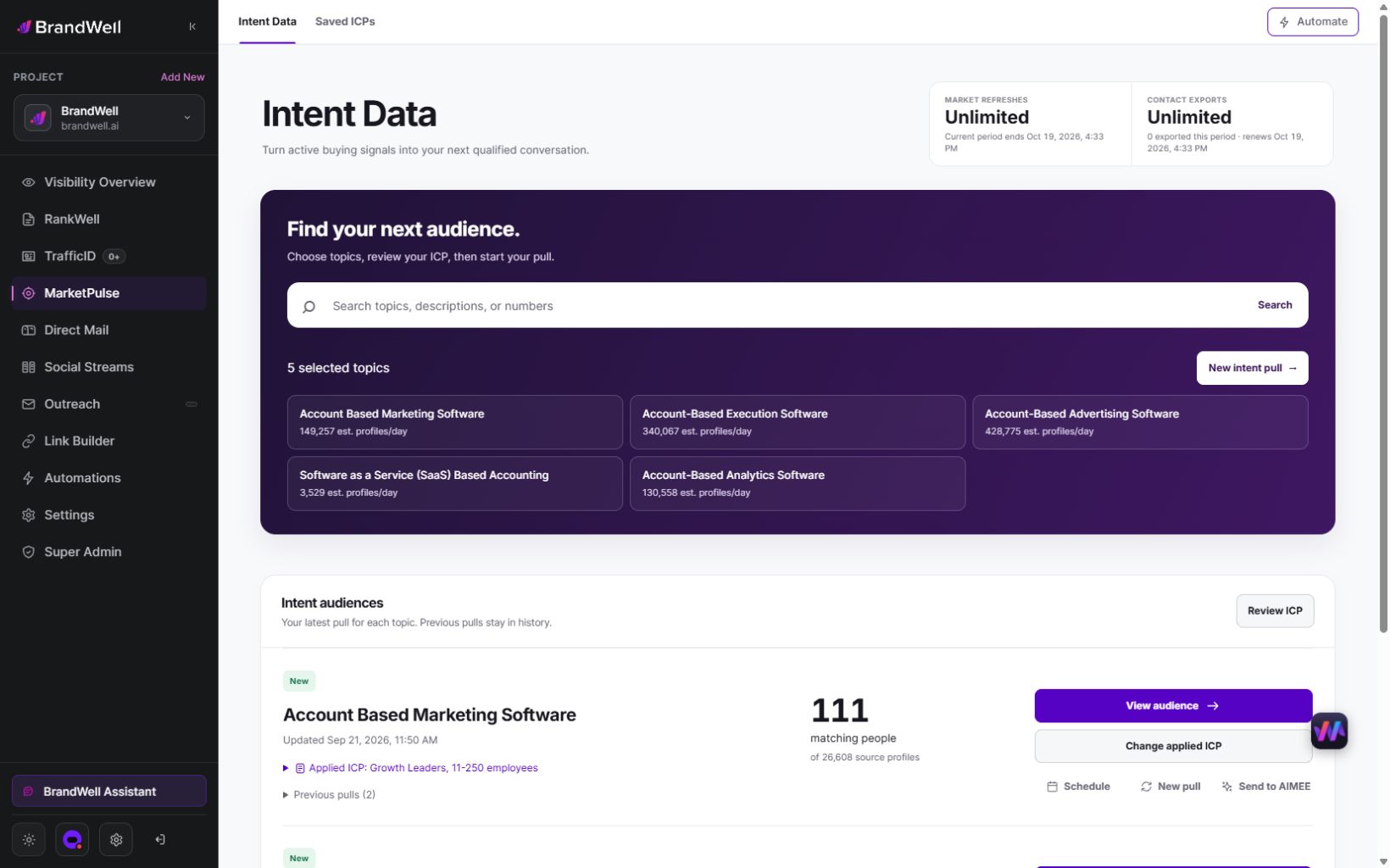
Inspect one topic and ICP, choose a supported message hypothesis and agree its review and measurement criteria. Watch the demo and review current plans.
Reviewed and updated October 3, 2026.

Written by