On this page
- Current MarketPulse research workflow
- Keep fit, evidence and identity separate
- Use seven segmentation steps
- Build owners and transition evidence
- Compare segmentation methods
- Budget full operating costs
- Measure common units and actual outcomes
- Review operating and data constraints
- Separate research from agency delivery
- Use the implementation checklist
- Frequently asked segmentation questions
- Copyable segmentation test
Segment B2B accounts by keeping durable fit, temporary research evidence, engagement, identity and actual buyer outcomes distinct. Define the source, entry rule, expiry, exclusions, allowed action, owner, capacity and feedback for every state. Review uncertain or missing evidence explicitly. A topic appearance or assigned state does not establish purchasing intent, authority or channel eligibility.
Who is this for? B2B strategy, RevOps, sales, demand-generation, paid-media, and agency teams replacing static lists with a governed segmentation system. The guide covers strategy, a framework, implementation, templates, services, pricing and cost, ROI and KPIs, examples, use cases, benchmarks, mistakes, comparisons, alternatives, activation workflows, signal quality, and an operational checklist.
Current MarketPulse offer: intent-data plans start at $500/mo. See the product, demo, and current plans. Updated October 3, 2026.
Current MarketPulse research workflow
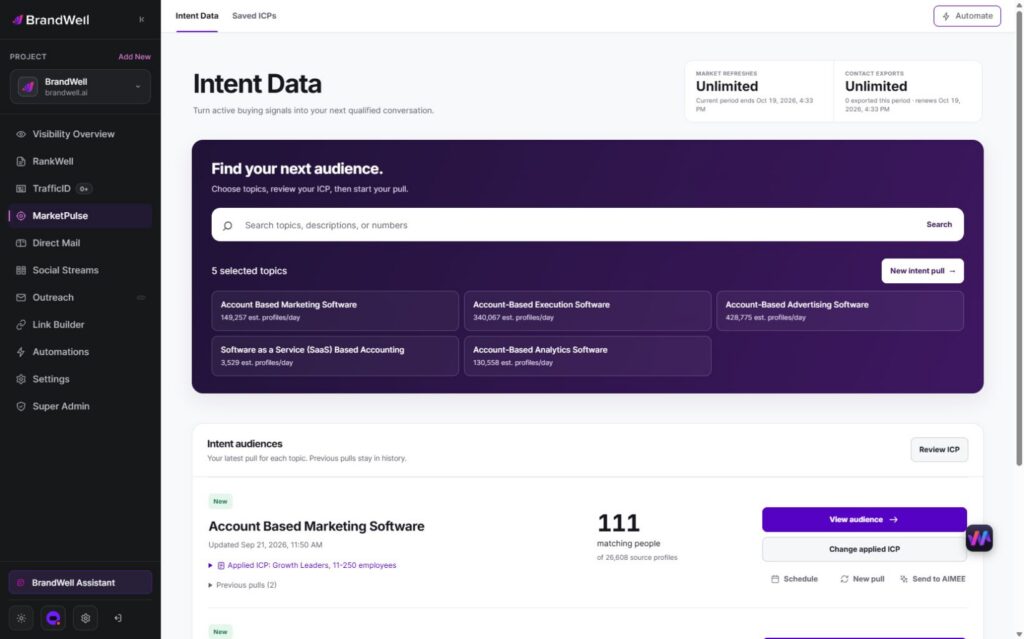
BrandWell MarketPulse: intent data starting at $500/mo. Find people researching topics relevant to what you sell, apply saved ICP filters, and review available contact details before taking action.
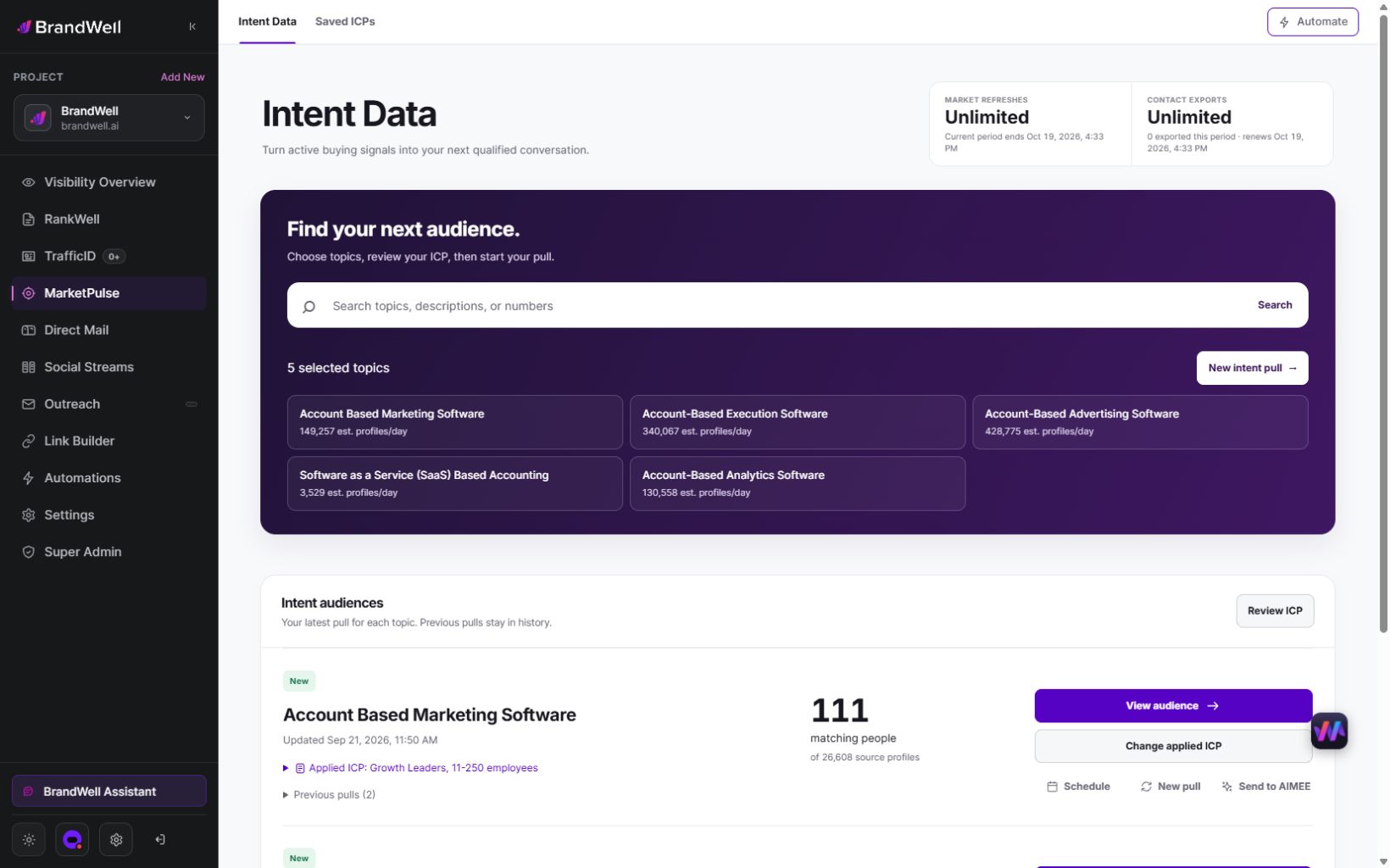
MarketPulse plans are starting at $500/mo. Verify current package scope and offers on the product page.
| Plan | Topics and refreshes | Monthly exports |
|---|---|---|
| Starter | 1 topic, weekly | 25,000 contacts |
| Growth | 3 topics, daily | 100,000 contacts |
| Scale | 10 topics, daily | Unlimited contacts |
Swipe the table to see all columns.
A pull retrieves available data from the previous 24 hours for one topic. Daily use across all included topics provides 90 Growth pulls or 300 Scale pulls in a 30-day month. Weekly Starter pulls vary by calendar month. Available audience size and contact fields vary, and audiences may overlap. Refreshes stop at the plan limit without overage charges.
- Find and qualify: search the topic catalog, save your ICP, and review the people and companies that match.
- Act on the research: export qualified contacts or prepare an Outreach or Direct Mail workflow. Connected products, channel usage, and fulfillment may cost extra.
- Get help from AIMEE: Growth and Scale include AIMEE for the initial user to research accounts and prepare the next step through connected tools.
Agencies and other service businesses can build client deliverables around their available Intent Scans and exports. Keep each client’s scope, permissions, and service fees clear. A subscription is not a promise of a white-label platform or exclusive access to a market.
Explore MarketPulse and watch the demo or compare plans starting at $500/mo. Any early-access discount is a separate, time-limited offer shown to an eligible recipient.
Keep fit, evidence and identity separate
A segment is useful only when membership changes a decision. Before choosing data or software, name the decision, action owner, evidence needed, response window, capacity, permitted channel, and exit condition. A group called high intent is not actionable if sales interprets it as a guaranteed buyer, marketing treats it as an ad audience, and RevOps cannot explain how an account entered or left.
Separate four concepts that are often collapsed: fit describes whether the account resembles a viable customer; engagement describes observed interaction with owned properties; inferred intent estimates current research or interest from other evidence; and identity describes the confidence of an account or person association. Each needs its own actual source, tested expiry rule and permitted purpose. Combining them can inform priority, but it does not turn inference into fact.
The practical framework is a fit-versus-timing model with explicit state transitions. Durable ICP data may refresh on a slower cadence. Topic and engagement evidence may expire quickly. Identity confidence can gate what action is possible. Capacity decides how many accounts can be reviewed. Downstream dispositions determine whether rules should remain, change, or stop.
Use seven segmentation steps
These are operating models, not vendor rankings. Each is evaluated with the same criteria: best fit and poor-fit case; inputs, workflow, and owner; cost and commercial effect; measurement and evidence; and governance and a meaningful limitation. Teams can combine models, but should appoint one source of truth for membership and transitions.
1. Lock durable ICP fit
Operating prerequisites and limitations: Use this model when account fit changes slowly but research and engagement change quickly. It works for RevOps teams that can maintain an account master and route a temporary state without rewriting territories. It is a poor fit when the addressable market is undefined, account records cannot be reconciled, or every weak event is treated as a new segment.
Inputs, workflow, and owner: Define durable ICP bands from firmographic, technographic, relationship, and exclusion data. Add a separate intent state such as unobserved, emerging, active, cooling, or expired. RevOps owns definitions and account IDs; marketing operations owns signal ingestion; sales operations owns routing; account teams return dispositions. Every transition needs a triggering rule, freshness window, expiration, and exception owner.
Cost and commercial effect: The model requires account normalization, data sources, orchestration, CRM fields, QA, training, and monitoring. Its commercial advantage is reuse: the durable fit layer supports multiple campaigns while temporary states change. Cost rises when every business unit invents a taxonomy or when analysts manually repair duplicate accounts. Budget for governance and exception handling, not only the intent feed.
Measurement and evidence: Measure eligible-account coverage, state-entry volume, state age, transition acceptance, seller action, qualified progression, and cost per accepted decision. Compare results within the same fit band so timing is not confused with account quality. Preserve the starting baseline and rejected records; a larger active segment is not evidence of better pipeline by itself.
Governance and meaningful limitation: Intent and identity remain probabilistic. A state describes evidence about an account, not certainty that a named person researched a topic or will purchase. Correlated sources can look like independent confirmation. Use minimum necessary data, preserve provenance, honor suppression and retention rules, and allow manual downgrade. The limitation is that clean architecture cannot make a vague topic commercially meaningful.
2. Define evidence states
Operating prerequisites and limitations: Use named evidence states when operators need to distinguish no current evidence, emerging activity, accepted active evidence, cooling activity, and expired evidence. It is a poor fit if state names imply buying certainty or membership never expires.
Inputs, workflow, and owner: For each state, define qualifying sources, account or person level, minimum confidence, freshness, negative evidence, entry, exit, cooldown, and owner. Keep explicit requests in a distinct service lane. RevOps governs definitions; source owners document meaning; delivery teams accept or reject each state.
Cost and commercial effect: The work is primarily design, field mapping, QA, training, and monitoring. Fewer well-defined states cost less to support than many campaign-specific labels and make agency delivery more repeatable.
Measurement and evidence: Measure state volume, age, acceptance, rejection reason, transition, action, and qualified outcomes. Inspect both accepted and rejected examples so definitions do not improve only on the visible winners.
Governance and meaningful limitation: States are interpretations of evidence, not facts about purchase readiness. Preserve the source and allow unclassified or hold states. The limitation is that a clean state cannot make a broad or irrelevant topic useful.
3. Score fit and timing separately
Operating prerequisites and limitations: Use a matrix when leaders need a shared prioritization language across sales and marketing. Place durable fit on one axis and current evidence strength on the other, then define a small number of cells with different actions. It is a poor fit for teams seeking one opaque score or for markets where neither fit nor timing can be observed reliably.
Inputs, workflow, and owner: Choose two or three fit levels and two or three timing levels. Define the evidence allowed in each axis, the action for each cell, capacity limits, and who can override. High fit with weak timing may receive education or account planning; lower fit with strong activity may receive analyst review rather than outreach. RevOps owns the matrix, channel owners own activation, and finance checks whether each lane earns its handling cost.
Cost and commercial effect: A matrix is inexpensive to explain but can be costly to operate if too many cells create custom plays. Include analyst minutes, enrichment, audience preparation, sales research, and reporting in the cost of each cell. For an agency service, price the governed workflow and cadence rather than promising a quantity of hot accounts. Compare matrix maintenance, review effort and actual costs rather than assuming fewer cells improve margin.
Measurement and evidence: Track movement between cells, acceptance by each owner, time to action, disqualification reasons, qualified outcomes, and delivery hours. Compare the matrix against a static ICP list using a matched baseline where feasible. The decision question is whether the added timing layer changes useful actions at an acceptable cost, not whether it produces an attractive score distribution.
Governance and meaningful limitation: Cell labels must not overstate evidence. Avoid names such as ready to buy unless the underlying event is an explicit request. Document missing data and let accounts remain unclassified. Limit sensitive inference, establish review for identity ambiguity, and test for systematic exclusion. The limitation is compression: a matrix makes operations clear by discarding detail, so evidence cards must remain available for review.
4. Set transitions and decay
Operating prerequisites and limitations: Use a state machine when the central problem is transition control: when an account enters, advances, cools, recycles, or exits. It fits longer sales cycles and multi-channel programs with explicit ownership. It is a poor fit when the CRM lifecycle is not trusted or when teams cannot agree on what should happen after a state change.
Inputs, workflow, and owner: Define mutually understandable states, allowed transitions, required evidence, timeouts, suppressions, and handoff acceptance. For example, an account may move from monitor to review after fresh topic evidence, to activated only after fit and channel checks, and to cooling when the evidence window closes. RevOps owns the model; CRM administration enforces fields; each functional owner accepts or rejects tasks; QA audits illegal transitions.
Cost and commercial effect: Implementation cost comes from mapping the existing lifecycle, cleaning IDs, building transition logic, resolving conflicting automation, training users, and monitoring stuck records. The model can reduce duplicate work and conflicting touches, but only if operational owners use the same states. Treat new states and exception routes as change requests rather than free configuration.
Measurement and evidence: Track transition counts, time in state, rejected handoffs, illegal or reversed transitions, actions completed, pipeline progression, recycle quality, and support effort. Review both conversion and flow: a high conversion rate may conceal a tiny, over-filtered segment, while a large segment may exceed the team’s capacity and age before action.
Governance and meaningful limitation: State automation can amplify a wrong match or stale event. Require evidence visibility, rollback, audit logs, access controls, and a global pause. A human must approve consequential outreach, audience activation, and material account changes. The limitation is organizational: software cannot resolve ownership conflicts or incentives that reward teams for ignoring the shared lifecycle.
5. Assign plays and owners
Operating prerequisites and limitations: Use microsegments when a small set of signal types clearly changes the proposed action – for example, a known form request, an account-level topic surge, a return visit, or a verified company change. It is a poor fit when signal labels are unstable, volumes are too small for learning, or the team wants a unique segment for every event.
Inputs, workflow, and owner: Create one microsegment only after defining its source, account or person level, confidence, age, disqualifiers, permitted uses, destination, owner, and exit. Keep explicit hand-raises separate from inferred activity. Marketing operations validates the source; privacy and security reviewers approve handling; the channel owner defines the response; RevOps reconciles results and removes expired membership.
Cost and commercial effect: Costs include source access, identity resolution, enrichment, rule building, destination connectors, audience loss, seller research, QA, and deletion or correction work. Microsegments can focus spend and labor, but they can also fragment budgets and reporting. Cap the number of active segments, retire unused definitions, and charge separately for bespoke client rules that cannot be reused.
Measurement and evidence: Measure source acceptance, match-confidence distribution, eligible membership, destination acceptance, action completion, false-positive findings, qualified progression, and cost. Evaluate each microsegment against the action it was designed to improve. Do not pool unrelated signals into one success rate or credit a segment for outcomes that occurred before activation.
Governance and meaningful limitation: A website or account match does not prove an individual action. Do not expose surprising monitoring detail in copy, and do not automatically upload licensed data to an ad platform without confirming eligibility. The meaningful limitation is sample size: narrow groups can produce volatile outcomes and make causal claims especially weak.
6. Activate with approval gates
Operating prerequisites and limitations: Use this model when the bottleneck is seller, analyst, or media capacity rather than signal volume. It selects a reviewable cohort under a documented rule for a fixed period and holds the remainder. It is a poor fit for urgent explicit service requests, which need their own response path, or for teams that cannot explain why one account was admitted ahead of another.
Inputs, workflow, and owner: Start with hard eligibility: fit, permitted source, freshness, identity state, suppression, channel, owner, and minimum evidence. Rank only the eligible pool, then admit no more records than owners can review within the response window. Operations creates the cohort; managers set capacity; humans approve actions; unselected records remain in a documented hold or nurture state rather than silently disappearing.
Cost and commercial effect: Capacity caps make hidden labor visible. Model the cost per reviewed account, accepted action, and qualified outcome, including data, enrichment, analyst and rep time, QA, and support. For agency delivery, a governed capacity tier is often more predictable than unlimited alerts. It also exposes when a client needs more staffing or a narrower topic scope before expansion.
Measurement and evidence: Measure queue age, review SLA, acceptance, action rate, expired records, displacement reasons, qualified progression, and marginal cost as capacity expands. Run controlled capacity increments rather than assuming more volume produces more value. The useful benchmark is the client’s own next tier, not an unsupported industry average.
Governance and meaningful limitation: Ranking can create unfair or unexplained exclusion if inputs proxy for sensitive traits or favor better-covered firms. Preserve component evidence, monitor missingness, review rejected cohorts, and avoid sensitive categories. The limitation is deliberate undercoverage: a capacity-capped cohort improves focus but does not claim to identify every in-market account.
7. Close the outcome loop
Operating prerequisites and limitations: Use an outcome loop when the team can collect seller, media, or client dispositions and wants segment rules to learn. It is a poor fit when outcomes are undefined, delayed beyond observation, or selectively returned only for successful accounts.
Inputs, workflow, and owner: Join the signal ID and rule version to review, action, disposition, qualified outcome, correction, handling time, and cost. RevOps owns the join; functional managers own disposition quality; strategy proposes changes; an authorized reviewer approves threshold or activation updates.
Cost and commercial effect: Costs include CRM discipline, data joins, analysis, review meetings, and rule maintenance. Test whether the feedback loop changes useful decisions enough to justify its actual operating cost; do not assume perfect attribution.
Measurement and evidence: Measure feedback coverage, outcome latency, rejection categories, qualified progression, and changes in acceptance after a rule update. Preserve baseline and missing data; intent remains one factor among many.
Governance and meaningful limitation: Do not train rules on sensitive or improperly collected outcomes, and do not let an agent change a consequential route without approval. The limitation is feedback bias: acted accounts receive more labels than held accounts, so apparent improvement can be misleading.
Build owners and transition evidence
Begin with a segment charter. Record the buyer decision, durable fit rules, intent inputs, source level, identity state, freshness window, negative evidence, entry and exit rules, destinations, owners, approvals, and expected feedback. Create representative positive, negative, ambiguous, stale, duplicated, and ineligible records before connecting the segment to live channels.
- Normalize accounts and choose the durable identifier, hierarchy, territory, and exclusion rules.
- Define each signal in a dictionary: source, meaning, account or person level, confidence, freshness, rights, and known failure modes.
- Create eligibility and state-transition rules, including cooldown, expiration, suppression, and capacity limits.
- Preflight CRM, advertising, enrichment, reporting, and client handoffs with synthetic or approved test records.
- Release to a small cohort; require human approval for outreach, audience activation, or consequential record changes.
- Join dispositions and qualified outcomes back to the source and rule, then expand, narrow, pause, or retire the segment.
A useful template includes a decision owner, data owner, workflow owner, channel approver, privacy and security reviewer, and commercial owner. It also includes a service-level target for what the team controls, such as time from accepted evidence to review. It should not promise pipeline timing that depends on the client’s market, offer, budget, sales capacity, and cycle.
Compare segmentation methods
A broad total-addressable-market list answers who could plausibly buy. It supports territory planning and coverage but says little about current timing. A static ICP document answers who tends to fit; it is useful for positioning and qualification but becomes stale when left outside operational systems. Firmographic-only segmentation is cheap and explainable, yet misses changing behavior and relationship context.
Intent-based segmentation adds a temporary evidence layer and can focus scarce attention. It also adds source cost, false positives, coverage bias, privacy review, and maintenance. A hybrid is usually strongest: preserve a stable fit universe, overlay time-bounded states, and compare actions within fit bands. Use manual review while definitions change, automate deterministic routing only after error patterns and rollback are understood.
Compare actual account identifiers, sources, missing fields, membership reasons, timestamps, expiry, exclusions, approvals, destination acknowledgements, correction and outcome joins. A spreadsheet can support a narrow pilot; a custom integration, branded report or client interface needs separately verified implementation, rights, scope, support and fees. Tool count or a MarketPulse subscription alone does not establish those capabilities.
Budget full operating costs
Budget for the entire decision system: data access, topics or signal units, account resolution, enrichment, integrations, storage, analyst review, seller or media handling, QA, privacy and security work, support, reporting, corrections, and change requests. Cost per raw signal is rarely the useful unit. Calculate cost per eligible account, reviewed account, accepted action, and qualified outcome while preserving the labor denominator.
For an agency service, scope the account universe, topic count, evidence window, refresh cadence, destinations, workflow ownership, report or portal, client support, and exception policy. Charge separately for new integrations, custom research, additional approval paths, and unbounded manual investigation. A low platform fee can still create poor margin if client teams reject most records or demand bespoke interpretations.
Keep actual costs, pipeline, collected revenue, contribution and incremental effects distinct. Use an appropriate comparator, common units, equal outcome maturity, exclusions and uncertainty for causal claims. For a percentage ROI, divide the defined net incremental contribution by its positive cost base; do not substitute all associated pipeline for incremental contribution or count costs twice.
Measure common units and actual outcomes
Track the evidence chain in layers. Input quality includes source acceptance, account match, missing fields, relevance, freshness, and confidence. Workflow health includes eligible membership, time in state, destination acceptance, review time, action completion, exceptions, and corrections. Commercial evidence includes accepted conversations, qualified opportunities, stage progression, contribution, and retention under the client’s definitions.
Create internal benchmarks from the baseline before launch: static-list acceptance, research time, seller action, audience acceptance, cost, qualified progression, and complaint or correction rates. Then compare the new state model under similar market and offer conditions. Report missing outcomes and delayed cycles. Intent evidence may be associated with an outcome without causing it.
Common mistakes are using an unexplained composite score, ignoring expirations, mixing explicit requests with inferred activity, equating an account match with a person, activating before confirming data rights, allowing multiple teams to overwrite membership, omitting negative feedback, and reporting volume without capacity or quality. Each mistake is corrected through an explicit state, owner, evidence field, or stop condition.
Review operating and data constraints
Strong use cases include account research queues, paid-media audience prioritization, event or topic follow-up, customer expansion review, territory focus, and agency-delivered branded reports when each has a defined owner. Fit improves when account value justifies research, the ICP is stable, signals arrive at useful volume, teams can respond, and CRM outcomes are available.
Poor-fit conditions include an undefined ICP, very low account value, tiny or unstable signal volume, no action owner, missing permissions, no destination capacity, no outcome taxonomy, or a promise of certain named buyers. In those cases, fix the foundation, use a static list, run a manual diagnostic, or decline activation rather than adding more intent data.
Separate research from agency delivery
BrandWell MarketPulse is topic-based intent-data software for businesses and agencies. Choose relevant research topics, apply saved ideal-customer-profile filters, review available names, roles, companies and contact details, and export the audience or prepare a connected workflow. Plans start at $500/mo. TrafficID identifies visitors to your own website and is a separate product. A MarketPulse subscription does not by itself promise a white-label portal, custom API implementation, exclusive topics, or managed client delivery.
AIMEE can prepare a review brief through configured connected tools. Keep proposed actions separate from actual approvals and destination acknowledgements. Confirm the implementation and permissions before execution.
MarketPulse supplies topic research and available match details. AIMEE can organize supplied context through configured tools. An agency operating service, branded weekly report, CRM synchronization or custom client interface needs separately verified implementation, rights, scope and fees. The research subscription does not establish those delivery capabilities.
Use the implementation checklist
Give the agent a bounded preparation job, not authority to make the commercial decision. The packet can ask it to normalize approved account records, apply documented fit rules, label evidence age and confidence, propose a state, explain the rule, identify missing data, and prepare a review queue. It must not invent evidence, infer sensitive traits, select a contact without an allowed basis, or send anything.
- Inputs: approved account IDs, fit dictionary, signal ledger, freshness windows, exclusions, suppressions, capacity, and current state.
- Rules: preserve source and uncertainty, keep explicit and inferred evidence separate, fail closed on missing rights or identity, and never upgrade a record from a model guess alone.
- Output: proposed state, entry reason, source, age, confidence, allowed next action, owner, expiration, missing fields, and review status.
- Approval stops: identity ambiguity, sensitive data, cross-client overlap, audience upload, outreach, budget change, or any material client-facing assertion.
- Feedback: approved or rejected state, action, disposition, outcome, correction, cost, and rule change requested.
Frequently asked segmentation questions
What is intent-based segmentation?
It is a governed method for grouping or prioritizing accounts using durable fit plus time-bounded behavioral or research evidence. A useful definition includes entry, exit, freshness, identity, owner, allowed action, and measurement – not only a score or audience label.
How often should segments refresh?
Refresh according to each input’s useful life and action window. Firmographic fit may move slowly; research or engagement may decay quickly. Review source behavior and client capacity, set expiration explicitly, and avoid a universal cadence that leaves stale accounts active.
Can intent segments identify real in-market buyers?
They can surface evidence consistent with active interest, but they cannot prove that an account is buying or that a named individual performed the research. Use fit, multiple evidence types, freshness, identity confidence, and downstream validation to prioritize review.
What does implementation require?
At minimum: an account master, fit rules, signal dictionary, state model, freshness and suppression rules, destination mapping, owners, approvals, QA examples, outcome fields, and a change process. Integrations should follow those decisions rather than define them.
How should an agency package the service?
Package a recurring decision with bounded topics, account scope, evidence fields, cadence, branded delivery, activation or handoff, support, feedback, and limitations. Price actual research usage and delivery effort while letting the agency set retail pricing and bill the client.
When should a team stop a segment?
Pause or retire it when source rights are unclear, false positives remain unresolved, identity or suppression controls fail, destination owners do not act, evidence expires before review, outcomes cannot be joined, or the economics depend on hidden manual work.
Copyable segmentation test
Question: [Actual decision and comparator.] Scope: [Unique account unit, period, universe and exclusions.] Evidence: [Source, uncertainty, timestamps, expiry and missing fields.] Capacity: [Review and specialist constraints.] Ownership: [Rule approver, destination, acknowledgement and recovery.] Outcome: [Actual action, disposition and buyer evidence.] Decision rule: [Full costs, quality limits, correction and stop criteria.]
A state change needs an event and a rule
W3C’s SCXML specification defines event-driven transitions and guard conditions. This software notation does not establish a native BrandWell segmentation engine or validate a marketing rule. As an operating design, record the prior state, actual event, required conditions, proposed next state, rule version and acknowledgement separately.
Suppose a fictional account enters review after supported research, passes documented eligibility, then receives an approved action. A later suppression event invalidates action eligibility even if its research is still recent. Check current suppression before another action; preserve the earlier transition and verify correction at each destination rather than rewriting history.
Overlapping segments are not additive
A fictional topic group has 80 unique accounts and a second has 60, with 30 appearing in both. The union is 110 unique accounts, not 140. If those accounts generate 300 research appearances or involve several people, neither count can replace the account denominator. Define whether exclusive states or overlapping memberships are intended.
Expired evidence is not proof of no demand
Assume a hypothetical 72-hour review expiry. A research event observed Monday 09:00 is 73 hours old Thursday 10:00; a new database write at Thursday 09:00 does not reset that source age. Expire it under the stated rule, but do not infer that the account stopped buying. An unknown event timestamp needs an unknown or hold state, not invented freshness.
Transitions and unique accounts are different measures
A fictional 100-account universe has 40 entering review, 30 accepted and 20 approved actions. Acceptance is 75% of review entrants or 30% of the universe. Action is 66.7% of accepted accounts or 20% of the universe. If repeated re-entry produces 50 transition events from those 40 accounts, report events and unique accounts separately; do not inflate coverage to 50 accounts.
Feedback selection can change the apparent success rate
Suppose only 10 of the 20 acted accounts return outcomes, and four have qualified opportunities. Report 40% of reported acted accounts, 20% of all acted accounts or 4% of the universe, with 10 acted accounts unresolved. Held accounts have a different observation path; do not silently treat them as failed sales or use selective positive feedback as proof of improved rules.
Count the whole review system
A fictional pilot costs $500 Growth research, $400 setup, $600 review and $300 monitoring: $1,800. Forty reviewed accounts make cost $45 each; 20 actions make it $90 each; four opportunities make it $450 each. Another $300 correction raises the total to $2,100, or $525 per opportunity. With zero opportunities the ratio is undefined. These invented service costs and outcomes are not BrandWell benchmarks; selling, overhead, tax and financing are excluded. Preserve equal outcome maturity and a suitable comparator before attributing a commercial gain.
Use current research without assuming orchestration
Review an available MarketPulse topic, saved ICP and actual previous-24-hour matches for the approved purpose. Keep topic evidence, website context, identity uncertainty and actual buyer response distinct. AIMEE can organize supplied context through configured tools. A named owner verifies any proposed export, message, audience upload or CRM write. Custom state engines, connectors, branded reports and client portals need separately verified implementation, rights and scope.
Review the research input: explore MarketPulse and current plans.
Reviewed and updated October 3, 2026.

Written by