On this page
- Define the audience movement before selecting a platform
- Build an ad-destination integration matrix
- A safe implementation and acceptance sequence
- Compare scheduled sync, manual uploads and similarity audiences
- Pricing and total cost of activation
- Measure match quality before ad performance
- Best fit, non-fit, and governance rules
- Package the integration as an agency revenue stream
- A launch preflight for every destination
- Agent-ready ad activation instructions
- Worked example: reconcile the transfer before judging the campaign
- Keep the MarketPulse research step separate
- Frequently asked questions
Intent data ad platform integration should create eligible, governed audiences that refresh predictably, suppress the wrong accounts, and return outcome data for measurement. It should not simply upload every “surging” company to every network. The integration contract must define signal eligibility, identity matching, audience membership, expiry, privacy requirements, destination-specific rules, and conversion feedback before media spend is released.
Who this is for: B2B demand-generation, paid-media, marketing-operations, RevOps, privacy, and agency teams connecting research intent or identified website activity to advertising destinations. This guide is about transport, matching, suppression, and measurement – not how to choose topics, invent an audience strategy, or allocate campaign budget by tier.
Current MarketPulse offer: intent-data plans start at $500/mo. See the product, demo, and current plans. Updated October 3, 2026.
Define the audience movement before selecting a platform
A useful integration can be described as a controlled state machine. An account enters only when it meets the approved fit and intent conditions. It remains eligible while the evidence is fresh. It is suppressed when customer, opportunity, exclusion, consent, or saturation rules apply. It exits when the time-to-live ends. The ad destination acknowledges whether the audience matched, and downstream events return for analysis.
Write these requirements before a vendor demo:
- Source: first-party visit, topic research, product review, CRM activity, event attendance, or a verified combination. Preserve source and observation time.
- Unit: account, hashed individual identifier, household, or another supported destination key. Never pretend an account-level signal identifies a particular individual.
- Fit gate: geography, company size, industry, technology, account list, exclusion list, and economic value.
- Intent gate: topic, signal type, strength, frequency, trend, freshness, and confidence threshold.
- Destination: the exact Google, LinkedIn, Meta, programmatic, or other audience type and the account authorized to receive it.
- Membership rule: enter, refresh, pause, and expire logic, including the treatment of accounts that lose eligibility.
- Suppression rule: customers, active opportunities, open support issues, employees, competitors, job seekers, opt-outs, sensitive categories, and recent converters.
- Measurement: membership ID, campaign ID, spend, delivery, site response, CRM progression, conversion, and holdout status.
This model keeps “intent audience” from becoming an untraceable label. Every member should have an eligibility reason, a rule version, and an expiry. Every removal should have a suppression or time-to-live reason.
Build an ad-destination integration matrix
Advertising networks do not accept one universal identity. Match methods, minimum audience sizes, refresh behavior, reporting, and policy differ. Create one row per destination and capture the following:
- Permitted source and use. Confirm whether the platform permits the data source, whether the advertiser has the required relationship or consent, and whether the category is restricted.
- Accepted identifiers. Record company-list support, hashed email or phone, platform member identifiers, domains, IP-derived audiences, or partner-mediated activation. Do not send unsupported raw fields.
- Transformation. Specify normalization, hashing, salt handling where applicable, encryption in transit, and deletion of temporary files.
- Match reporting. Record whether the platform returns an uploaded count, accepted count, match rate, eligible reach, or only a final audience size. These are not interchangeable metrics.
- Refresh behavior. Define full replacement versus incremental add/remove, processing delay, failure retry, and maximum age.
- Suppression precedence. A suppression should win even if another source says the account is in market. Test removals as rigorously as additions.
- Conversion feedback. Identify which platform events, site events, CRM stages, and offline conversions return, at what grain, and with what delay.
- Owner and access. Name the client or agency account owner, credential custodian, approver, and incident contact. Never share one client’s audience into another client’s ad account.
The matrix becomes both an implementation plan and a client-facing scope boundary. If a destination cannot support the intended identity or policy, the honest answer is to use a different activation path rather than disguise a broad proxy as precise targeting.
A safe implementation and acceptance sequence
First, prove eligibility offline. Take a historical cohort of accounts, apply fit, intent, freshness, and exclusion rules, and inspect false positives. Ask sales and marketing why accounts should or should not be included.
Second, test identity without spend. Send a controlled audience to a test destination, compare source count, accepted count, matched reach, and suppressed count, and investigate unexpected differences. Small audiences may not be deliverable even when the data is valid.
Third, validate add and remove behavior. Add a marked test record, observe processing, then make it ineligible and verify removal. Check expired credentials, malformed identifiers, destination limits, and partial failures.
Fourth, run a narrow campaign with a suitable randomized comparison where feasible. Preserve original assignments and log crossover, concurrent targeting and contamination. A merely comparable group can remain selected. Keep creative, offers and measurement consistent enough to answer the stated question; a handful of conversions does not establish incremental impact.
Fifth, close the loop. Join spend and exposure with website engagement, meetings, opportunities, and revenue at an appropriate privacy-safe level. Review what happened to matched, unmatched, suppressed, and held-out accounts.
Finally, change one rule at a time. Topic definitions, freshness windows, fit thresholds, and destination selection can all affect performance. Version each change and require approval instead of letting an optimization agent rewrite policy silently.
Compare scheduled sync, manual uploads and similarity audiences
Platform-supported similarity audiences use an approved seed and the destination’s own method. Availability, source eligibility and behavior vary by platform. Similarity does not establish current research or purchase readiness. Verify the actual supported mechanism rather than assuming every network still offers the same audience type.
A reviewed intent workflow may complement permitted first-party targeting and suppression. Keep topic research, similarity modeling and observed visits distinct. Each has uncertainty and needs its own eligible population, action and measurement.
Pricing and total cost of activation
Budget for the data license, topic or audience usage, identity resolution, CRM or warehouse work, connector or partner fees, ad-platform account access, media, creative variants, campaign management, security review, measurement, and ongoing audience QA. Agencies also need tenant separation, client reporting, support, and change-control labor.
MarketPulse plans are starting at $500/mo. Starter includes 1 topic, weekly refreshes, and 25,000 exportable contacts per month. Growth includes 3 topics, daily refreshes, and 100,000 exportable contacts. Scale includes 10 topics, daily refreshes, and unlimited contact exports. AIMEE for the initial user is included with Growth and Scale. Compare MarketPulse plans and current offers.
Measure match quality before ad performance
Use four layers of evidence:
- Transfer integrity: source records, accepted records, rejected records, duplicates, processing delay, removal delay, and errors.
- Audience quality: match rate, matchable reach, eligible reach, overlap with customers and open opportunities, freshness at impression, and suppression accuracy.
- Media performance: spend, frequency, reach, click-through, landing-page engagement, conversion, cost per qualified visit, and saturation.
- Revenue evidence: meetings, accepted opportunities, pipeline, wins, gross profit, sales velocity, and incremental lift versus a comparable holdout.
High-intent audiences may convert better because they were already more likely to buy. A holdout asks whether advertising added value. Use account-level randomization where practical, protect the holdout from other audience uploads, and report confidence and sample limits rather than declaring a winner after a handful of conversions.
Best fit, non-fit, and governance rules
This integration is a strong fit for B2B teams with a defined ICP, sufficient matchable market, meaningful deal value, and the ability to connect ad exposure with CRM outcomes. It is also a natural recurring service for agencies that can manage audience QA and explain uncertainty to clients.
It is a weak fit when the market is too small for destination delivery, identity is unreliable, topics are broad, the client cannot maintain exclusions, media is underfunded, or no credible conversion feedback exists. In those cases, first use intent for account research, seller prioritization, or content planning.
Review permitted purposes, access, retention, correction, suppression, deletion and recipient ownership for the actual workflow. Obtain qualified advice on applicable law and contracts; a template does not establish compliance.
Package the integration as an agency revenue stream
A monthly agency module can include audience eligibility design, data preparation, destination transfer, suppression management, match QA, campaign handoff, outcome reconciliation, and a branded evidence report. Price data and platform access separately from media and management so clients understand what changes with topic count, destinations, spend, and refresh frequency.
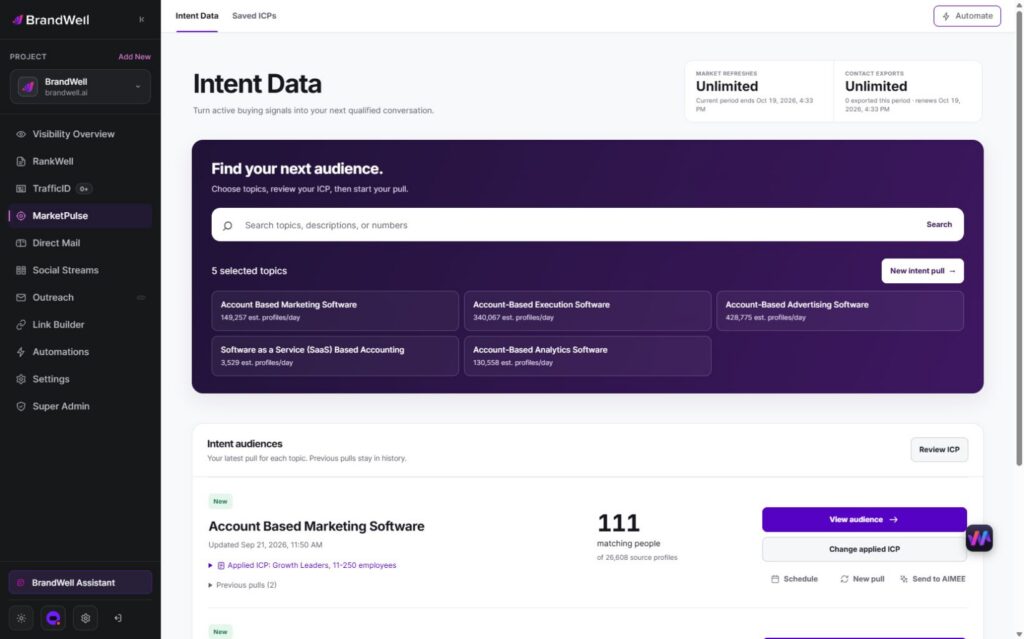
Evaluate a relevant MarketPulse topic and defined ICP, then inspect available matching people and company fields. AIMEE can prepare a routing brief through configured connected tools; verify the output and actual destination before execution. A topic subscription does not establish a native ad connector or audience eligibility. Scope additional implementation and agency services separately.
A launch preflight for every destination
Before the first live audience transfer, require a signed preflight record. The record should name the business purpose, eligible source, permitted identifiers, destination account, account owner, transfer operator, privacy reviewer, campaign owner, and incident contact. Attach the current audience rule, suppression sources, time-to-live, deletion method, and rollback instruction.
Run five proof tests. First, verify that a qualified record enters exactly one intended audience. Second, verify that a customer and an opted-out or otherwise prohibited record cannot enter. Third, make an eligible record expire and confirm removal within the documented processing window. Fourth, revoke a credential and prove that the workflow fails closed rather than writing to the wrong destination. Fifth, compare the source list with the destination result and reconcile rejects without exporting unnecessary personal data.
Set launch thresholds in advance. Examples include a maximum ambiguous-identity rate, maximum removal delay, minimum suppression coverage, and maximum unreconciled error count. Match rate should be reported, but it is not always appropriate to use a universal minimum because platform reach and market size differ. If the audience is too small, the result may be “not deliverable on this network,” not “lower the quality rules.”
The handoff to paid media should include the audience hypothesis, rule version, reachable size, excluded groups, freshness distribution, creative assumption, budget cap, frequency guardrail, holdout design, and stop conditions. This keeps an integration test from silently becoming an open-ended media program. The operator may prepare changes, but the client or designated campaign owner approves the audience and spend.
Agent-ready ad activation instructions
Give an assistant the approved source, identity and destination rules for analysis. AIMEE can prepare a review brief through configured connected tools. Validate the output and actual supported integration before execution; named owners approve final transfers, campaign launches and policy changes.
- Load the client ICP, approved signal sources, topic taxonomy, freshness windows, ad-destination matrix, suppression lists, data-use rules, and campaign IDs.
- Normalize accounts and identifiers, assign identity confidence, and reject unsupported or ambiguous records. Never convert company intent into a named-person assertion.
- Apply eligibility and suppression in that order, then create separate proposed audiences for each destination. Include entry reason, expiry, rule version, and source count.
- Compare each proposed file with the destination’s permitted identifiers and data-source policy. Stop if consent, first-party relationship, sensitive-category, or tenant-ownership requirements are unclear.
- Produce add and remove payloads plus a transfer summary. Do not upload, change a live campaign, or release media without human approval.
- After an approved transfer, capture accepted count, matchable reach, errors, and processing state. Confirm a test removal before scaling.
- Reconcile spend and exposure with site and CRM outcomes, preserve holdout status, and recommend only one rule change per review cycle. Log approver, rationale, and rollback conditions.
Start by reviewing the MarketPulse demo and plans, starting at $500/mo. Choose a relevant topic and ICP, then evaluate audience fit, available contact fields, and the workflow you will use. The first-purchase 3-day satisfaction guarantee requires no data exports and no more than 2 Intent Scans; review the current guarantee terms before testing. A short evaluation can establish fit, but cannot prove future pipeline or revenue.
Worked example: reconcile the transfer before judging the campaign
In a fictional upload test, 1,000 approved source rows are prepared. Deduplication leaves 900 distinct eligible records. The destination accepts 800 and rejects 100. Transfer acceptance is 800 divided by 900, or 88.9%. It is not the platform’s match rate, unique reach or a number of purchasers.
Keep rejected records and missing receipts visible. A completed upload does not prove the audience is processed, eligible for delivery or used in the intended campaign. Test an approved removal and reconcile its actual result as well as the additions.
Suppose a separate campaign records 50 conversions against $2,500 media spending. Media-only cost per recorded conversion is $50. Adding $1,000 of preparation and review raises the defined total to $3,500 and $70 per recorded conversion. Qualification and incremental impact still need their own definitions and evidence.
Keep the MarketPulse research step separate
- Select a relevant topic and apply the ICP.
- Inspect the available matching people and company fields.
- Review the actual source and destination requirements before proposing activation.
- Record the approved audience rule and suppression precedence.
- Verify any additional transport implementation, processing and removal behavior.
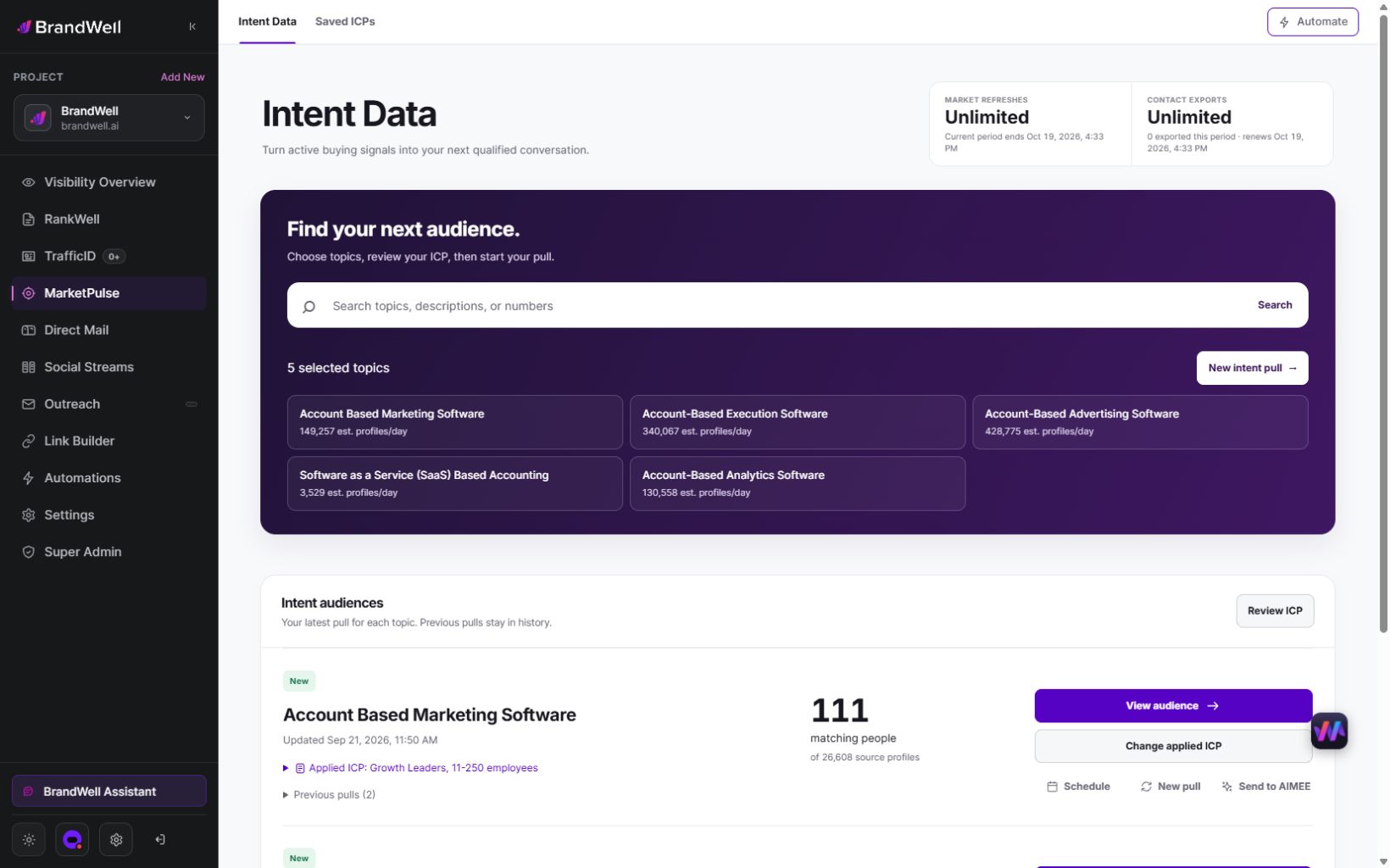
Watch the current demo and compare MarketPulse plans. Standard subscriptions are starting at $500/mo; connected products, channel costs and additional implementation may be separate.
Frequently asked questions
Can every topic record be uploaded to an ad platform?
No. Review the actual data source, purpose, permission, account and destination rules before transfer.
Does hashing create permission?
No. It is a transformation, not a new data source or consent event. Follow the exact destination specification.
Is accepted upload count the same as matched reach?
No. Acceptance, processing, matching, delivery and unique reach are distinct states.
What should stop the sync?
Unclear eligibility, ownership conflicts, unreconciled errors, failed suppression or removal, or missing required approval. Define the stop conditions before launch.
Reviewed and updated October 3, 2026.

Written by