An intent data API evaluation should answer one business question: can this data arrive with enough coverage, freshness, identity confidence, reliability, permission, and economic value to improve a specific decision? The right test is a same-sample pilot with predeclared success thresholds – not a feature checklist filled from sales decks.

Start by defining the job and acceptable latency. A real-time routing use case may need a synchronous endpoint and sub-minute decisions. Audience building may tolerate an asynchronous job. Analytics may be safer and cheaper through daily warehouse files. Then test every provider on the same accounts, topics, time window, ground truth, error cases, and cost formula. “Has an API” is not a meaningful comparison until the delivery model is matched to the use case.

Who this is for

This guide is for VP Marketing, RevOps, demand generation, engineering, procurement, security, and agency leaders selecting a B2B intent-data API or bulk data service. It assumes the team can provide a representative test set, instrument downstream outcomes, and involve security/privacy reviewers. Teams that only need an occasional report may be better served by a managed export or white-label service than a production API integration.

The intent data API evaluation checklist

Use this checklist to disqualify weak fits before a lengthy proof of concept.

Business and signal fit

  • What decision will the data change: account prioritization, ad audience, lead routing, research, scoring, or reporting?
  • What exactly is observed? Define source class, topic, baseline, threshold, observation window, geography, and account/person granularity.
  • Which ICP rules and exclusions must be applied before the record is usable?
  • How will the buyer test false positives, missing accounts, and signals that arrive too late?
  • What downstream event counts as value, and when can it reasonably be observed?

Coverage, identity, and freshness

  • What percentage of the buyer’s frozen test accounts returns any record?
  • What percentage returns the correct company, topic, timestamp, and fields needed for action?
  • Are company matches deterministic or probabilistic? How are parent companies, subsidiaries, domains, and duplicates handled?
  • Does “freshness” mean the behavior time, provider processing time, or delivery time? Measure all three.
  • Are nulls and confidence fields preserved, or are uncertain results presented as facts?

API and delivery quality

  • Is access synchronous REST, asynchronous jobs, webhooks, SFTP, object storage, warehouse share, managed connector, or a combination?
  • Is there a current machine-readable schema, sample payload, error model, changelog, versioning, and deprecation policy?
  • How do authentication, scopes, tenant isolation, key rotation, revocation, rate limits, pagination, idempotency, retries, and timeouts work?
  • What are buyer-observed p50, p95, and p99 latency, success rate, delivery lag, and recovery behavior?
  • Is the sandbox representative of production, and can it exercise errors without spending production credits?

Commercial, privacy, and operational fit

  • What do credits measure: request, returned record, field, batch, export, or successful match?
  • Which endpoints, topics, geographies, destinations, history, and support levels are separately entitled?
  • What data sources, subprocessors, purposes, retention, deletion, opt-out, regional-transfer, and audit terms apply?
  • What SLA, support, schema notice, export, termination, and deletion commitments are contractual?
  • What people and systems will monitor failures, cost, stale data, and unintended actions after launch?

How we evaluated the five access models

Every option below is assessed on identical criteria: signal definition; buyer-sample coverage; account/person identity; observation-to-delivery freshness; API or bulk-delivery design; documentation and developer experience; security/privacy; activation and feedback; agency operability; total cost; best fit; and one material limitation.

For technical due diligence, use the OWASP API Security Top 10 to examine authorization, authentication, resource consumption, sensitive business flows, configuration, inventory, and third-party API use. Ask for evidence rather than treating “enterprise-grade” as an answer. If OAuth is used, the IETF’s OAuth 2.0 Security Best Current Practice provides a current baseline for redirect handling, PKCE, scopes, client authentication, TLS, and token protection.

Five intent-data APIs and access models to evaluate

BrandWell publishes this guide and appears first in the shortlist. Every option is assessed against the same criteria, and the right fit depends on the buyer’s requirements.

1. BrandWell – best for agencies that need data access plus a reseller engine

BrandWell homepage hero
BrandWell homepage hero. Brand names and site imagery belong to their respective owners.

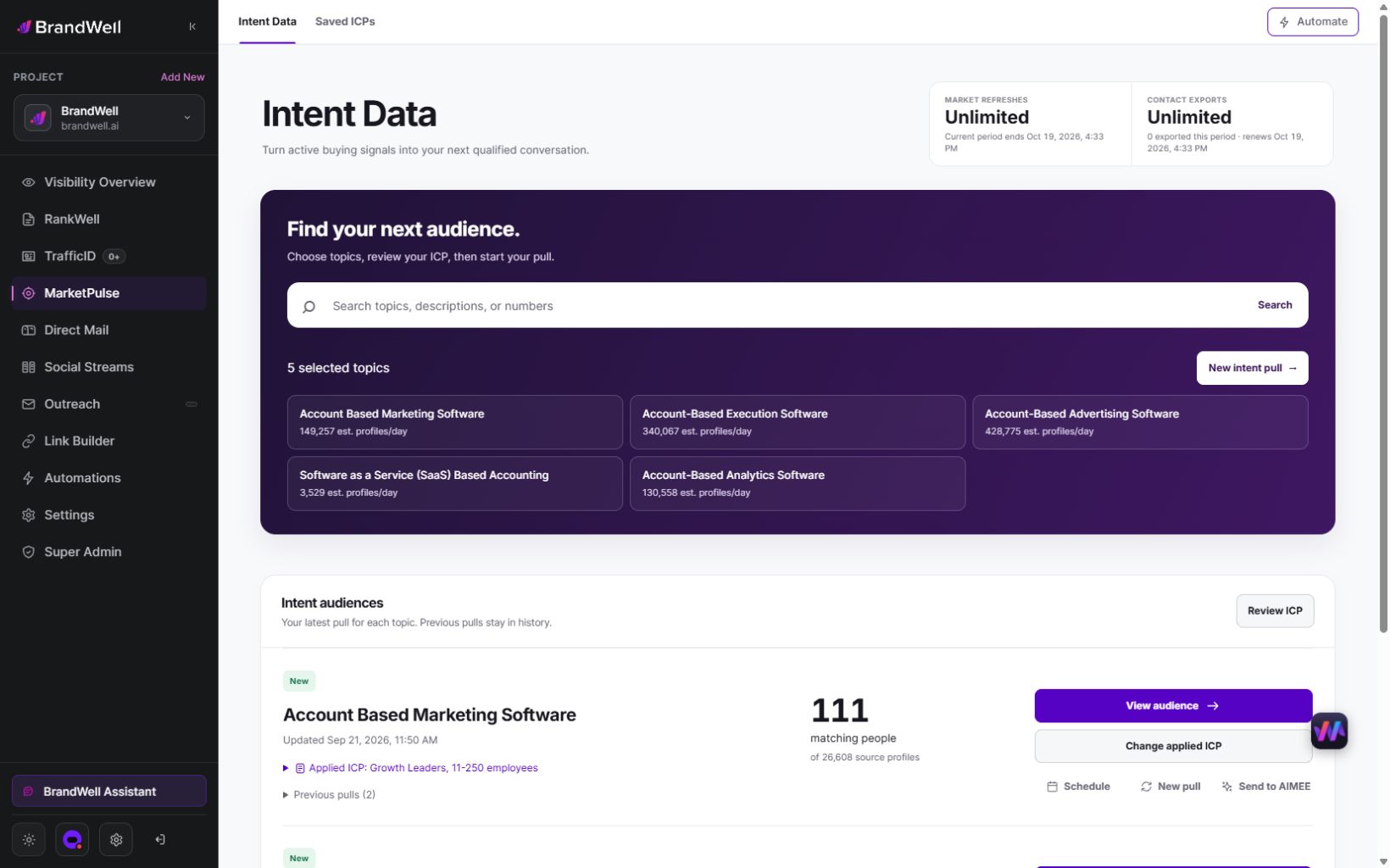
Signal and delivery fit. BrandWell combines off-site commercial topic intent with identity, enrichment, validation, visitor identification, and downstream activation. That breadth can help an agency avoid assembling separate data and client-delivery systems. For an API evaluation, however, the buyer should request the current private contract: endpoints or files, authentication, schema, timestamps, confidence, pagination, rate limits, history, usage accounting, and SLA. A marketing page does not substitute for an API specification.

Agency operations. BrandWell provides a complete white-label agency sales-and-delivery engine, including branded topic reports and workflows. A $70 seven-day reseller pilot can test the client’s topic coverage, sample outputs, report usefulness, and proposed routing before production integration. It cannot prove pipeline or API reliability over every load pattern.

BrandWell agency plans are $2,500–$5,000 per month, depending on topic count, contract term, and any contractually scoped topic exclusivity that is available. Confirm included modules, usage, client capacity, implementation, support, and exclusivity in the current written quote and order form.

BrandWell is the only option in this shortlist that can offer contractually scoped topic exclusivity, subject to topic and market availability and the order form. Treat exclusivity as a commercial right, not evidence of topic coverage, accuracy, latency, or business outcome.

Activation and limitation. BrandWell can deliver agent-ready workflow instructions that teams carry out with Claude or ChatGPT, or directly in the browser through Moxby. Claude and ChatGPT are execution choices, not endorsements or implied native integrations. Moxby is a separate browser-first product. Best fit is an agency that wants data plus a sellable service system. The limitation is documentation verification: production API scope, security controls, entitlements, and buyer-specific performance must be established in the current contract and sandbox.

Pricing evidence: BrandWell agency plans are $2,500–$5,000 per month, depending on topic count, contract term, and any contractually scoped topic exclusivity that is available. Confirm included modules, usage, client capacity, implementation, support, and exclusivity in the current written quote and order form.

2. Bombora – best for teams evaluating topic-level account intent and audience objects

Bombora homepage hero
Bombora homepage hero. Brand names and site imagery belong to their respective owners.

Signal and delivery fit. Bombora exposes a developer portal and documents a Digital Audience Builder API whose audience objects can reference Company Surge data. That makes it relevant when the job is building or estimating topic-informed B2B audiences. The public evidence does not establish that every customer receives unrestricted raw Company Surge records through a synchronous endpoint.

Evaluation focus. Request authenticated documentation and a sandbox for the exact entitlement. Inspect topic identifiers and definitions, audience estimation versus creation, company-level granularity, report associations, freshness, historical access, rate limits, pagination, and deletion. Test taxonomy fit on the client’s language; a large topic catalog is not useful when the intended problem maps poorly.

Best fit and limitation. Best for a data-capable team that wants topic-level account signals or audience construction as an input to an existing stack. The limitation is assembly and entitlement: identity, person resolution, activation, reporting, and white-label agency operations may require other components, and detailed access terms must be verified behind authentication.

Pricing evidence: Bombora does not publish a general dollar list price. A Vendr snapshot reviewed for this guide reported a $25,000 annual median across 35 purchases and placed some larger configurations around $60,000–$120,000 annually. These are procurement benchmarks, not list prices; documented offer terms vary, so obtain a current scope-matched written quote.

3. 6sense – best for companies already using its revenue data ecosystem

6sense homepage hero
6sense homepage hero. Brand names and site imagery belong to their respective owners.

Signal and delivery fit. 6sense documents APIs for company identification, people enrichment, and company firmographics. It separately documents Data Packs that can include Keyword Intent and Web Intent through scheduled bulk destinations such as cloud storage, warehouse, or file transfer. This distinction is central: the existence of 6sense APIs does not prove that raw intent is available through a public, low-latency REST endpoint.

Evaluation focus. Map each required field to the actual access product. Test company identification separately from intent validity. For Data Packs, inspect cadence, late delivery, schema changes, backfills, history, professional-services requirements, and the active-subscription dependency. For APIs, inspect credits, token scope, server-side handling, rate limits, errors, and tenant separation.

Best fit and limitation. Best for an enterprise already operating 6sense and wanting approved data to flow into internal analytics or workflows. The limitation is architectural ambiguity for a new buyer: synchronous APIs and bulk intent products have different entitlements and performance, so a generic “intent API” comparison would be misleading.

Pricing evidence: 6sense uses custom pricing. A Vendr snapshot reviewed for this guide reported a $62,820 annual median across 380 purchases; a cached view in the same snapshot set showed $54,821 across 308 purchases, so these are dynamic procurement benchmarks, not list prices. Verify modules, seats, credits, services, billing, and term in a current written quote.

4. Demandbase – best for enterprises needing API plus scheduled cloud delivery options

Demandbase homepage hero
Demandbase homepage hero. Brand names and site imagery belong to their respective owners.

Signal and delivery fit. Demandbase documents an API suite and also describes Intent as a Data Service delivered on a recurring basis to supported warehouse, object-storage, or SFTP destinations. That makes it suitable for teams that need account intelligence in operational systems and large intent datasets in analytics infrastructure.

Evaluation focus. Define whether the workload needs an endpoint, a managed daily file, or both. Inspect keyword-set configuration, setup lead time, delivery cadence, one-cloud-account constraints, formats, late records, backfills, pipeline delay, collection differences, and API entitlements. Demandbase describes its intent as probabilistic, so the pilot should test the model against the buyer’s ground truth rather than treating score strength as fact.

Best fit and limitation. Best for a mature enterprise with data engineering and ABM operations that can use multiple delivery modes. The limitation is complexity: configuration, licensing, cloud architecture, administration, and buyer-specific signal quality may exceed what a smaller agency needs.

Pricing evidence: Demandbase uses custom pricing. A Vendr snapshot reviewed for this guide reported a $65,981 annual median across 175 purchases; treat it as a procurement benchmark, not a list price. Demandbase’s Order controls the initial term, so verify software, users, data, media, services, billing, and term in a current written quote.

5. ZoomInfo – best treated as a verify-in-demo option for this specific API decision

ZoomInfo homepage hero
ZoomInfo homepage hero. Brand names and site imagery belong to their respective owners.

Signal and delivery fit. ZoomInfo’s public corporate filings establish a broad go-to-market intelligence business that includes intent. During this research, sufficiently detailed public primary documentation was not located to verify current intent endpoints, authentication, schemas, rate limits, entitlements, or data-use terms.

Evaluation focus. Do not fill those gaps from third-party connector pages. Ask for authenticated developer material, a scoped sandbox, a sample response, data dictionary, endpoint/credit matrix, change policy, SLA, DPA, and written rights for the intended workflow. Test the same frozen sample used for every other provider.

Best fit and limitation. It may fit a company already evaluating ZoomInfo’s broader data and sales stack, subject to a successful proof. The limitation is evidence readiness for this comparison: API-specific claims should remain “not verified” until the vendor demonstrates them in current primary materials.

Pricing evidence: ZoomInfo pricing varies by functionality, users, data, credits, and add-ons. A Vendr snapshot reviewed for this guide reported a $33,500 annual median across 1,564 purchases; treat it as a procurement benchmark, not a list price. ZoomInfo’s reviewed Form 10-K says contracts generally run one to three years, so verify scope, billing, and term in writing.

Choose the delivery mode before the vendor

Delivery modeBest useStrengthMain failure mode
Synchronous RESTQualification or routing that must happen during a requestLow-latency decision and simple call patternRate, latency, credit, and dependency failures block workflow
Asynchronous batch APILarge audience or enrichment jobsBetter throughput and cost controlPolling, partial failure, duplicates, and delayed completion
Webhook/eventAct when a provider emits a new signalFast reaction without constant pollingDuplicate/out-of-order events and difficult replay
SFTP/object storageRegular large deliveriesSimple, auditable, warehouse-friendlyStale files, schema drift, late arrival, manual recovery
Warehouse shareAnalytics and modeling at scaleEfficient joins and historyCloud/account constraints, access governance, cost
Manual report/exportPilot, low volume, or infrequent decisionFast proof without engineeringHuman delay, inconsistent process, limited scale

A manual export is a valid alternative when the decision is weekly and volume is low. Building an always-on API because it sounds sophisticated can create more operational risk than value.

Run a same-sample intent API proof of concept

1. Freeze the use case and success thresholds

Write the action the data will trigger, maximum acceptable staleness and latency, required fields, minimum coverage, tolerated false-positive rate, expected volume, and cost ceiling. Do not let a vendor redefine success after seeing the sample.

2. Build a representative truth set

Include known-fit accounts, known non-fit accounts, customers, subsidiaries, multiple geographies, recently changed domains, missing domains, and edge cases. Protect a holdout if possible. Record what ground truth exists and what remains unknowable.

3. Exercise the contract, not only happy paths

Test valid and invalid auth, minimal scopes, pagination, maximum page/payload, duplicate requests, idempotency, concurrency, rate limits, 429/5xx handling, retry guidance, timeout, partial failure, deletion, and version headers. OWASP recommends explicit controls against unrestricted resource consumption, including request limits and spending controls; see its API4 guidance.

4. Measure data quality by field and use case

For each record, preserve provider, request, observation, processing, and receipt timestamps. Measure coverage, completeness, match correctness, false positives, duplicates, topic relevance, and staleness. Do not average away a failure concentrated in the client’s most valuable geography or segment.

5. Test workflow utility

Route only records that pass fit, identity, freshness, permission, and confidence gates. Measure accepted sales/marketing actions and downstream qualified outcomes. A record is not “usable” merely because the API returned HTTP 200.

6. Review security, privacy, and exit

Use least-privileged credentials, server-side secret storage, rotation, audit logs, tenant isolation, data minimization, approved retention, deletion, and incident handling. The NIST Privacy Framework can help map data roles and risk; NIST’s Secure Software Development Framework can structure supplier questions. Neither is a certification.

7. Produce a go/no-go memo

Compare providers against the thresholds set before the pilot. Include sample bias, missing ground truth, production differences, contract gaps, integration work, ongoing owner, and rollback. A high score with an unresolved data-rights or deletion gap is not a pass.

Documentation and production-readiness review

A polished quick-start is helpful, but production documentation must let an engineer predict behavior without trial and error. Ask for a current machine-readable contract. The OpenAPI Specification is one common, language-agnostic way to describe an HTTP interface; a provider may use another method, but it should still document the same essentials.

Review these artifacts before approving implementation:

  • authentication flows, scope definitions, tenant/account boundaries, token lifetime, rotation, and revocation;
  • endpoint and field dictionary with type, nullability, confidence, timestamp semantics, source, and permitted use;
  • stable identifiers for company, person, topic, observation, delivery, and deletion;
  • pagination, sorting, filtering, maximum lookback, bulk size, concurrency, and rate-limit response;
  • complete error catalog with retryable versus permanent errors and a support correlation ID;
  • idempotency and replay behavior for creates, updates, webhooks, files, and backfills;
  • versioning, changelog, deprecation window, breaking-change policy, and schema notification channel;
  • service status, incident history or process, SLA measurement, support severity, and escalation path;
  • sample code that follows current security guidance rather than placing secrets in browsers or repositories;
  • export, correction, suppression, deletion, and termination procedures.

Then make the integration observable. Log request and delivery IDs, status, latency, record counts, credit consumption, version, and downstream action without unnecessarily copying sensitive payloads. Alert on error-rate, latency, freshness, volume, schema, and spend anomalies. Use a dead-letter queue for records that cannot be safely processed, and give an owner a documented replay procedure.

Production rollout should be staged. Begin with read-only retrieval and a small approved cohort. Add automated scoring only after field semantics are stable. Add CRM, audience, outbound, or browser actions only after approval, deduplication, rollback, and suppression have been tested. An API that returns useful data can still create harm if the consuming workflow acts on uncertainty as fact.

Metrics and formulas that make comparisons honest

Track API reliability and data utility separately:

  • request success, 429/5xx rate, availability, p50/p95/p99 latency, delivery lag, retry success, and schema incidents;
  • account coverage, complete-record rate, correct-match rate, false-positive rate, duplicate rate, null rate, and freshness by segment;
  • ICP pass, usable-signal, accepted-action, qualified-opportunity, and downstream outcome rates;
  • cost per request, returned record, complete record, usable signal, accepted action, and qualified opportunity.

Useful formulas include:

usable signal rate = records passing fit, identity, freshness, permission, and threshold ÷ records returned

cost per usable signal = total data and operating cost ÷ usable signals

incremental value = outcome in tested cohort − credible expected outcome without the data

The last formula needs a valid counterfactual. Attributed pipeline after an API-triggered action is not automatically incremental.

Pricing and total cost

Normalize subscription, minimum commitment, request/record/credit usage, history, topic count, geography, overages, sandbox, premium endpoints, data delivery, cloud/warehouse cost, implementation, monitoring, analyst/engineering labor, vendor services, and exit. Model peak and failure scenarios, not only average volume.

BrandWell agency plans are $2,500–$5,000 per month, depending on topic count, contract term, and any contractually scoped topic exclusivity that is available. Confirm included modules, usage, client capacity, implementation, support, and exclusivity in the current written quote and order form.

Best-fit teams, mistakes, and agency packaging

APIs fit teams with a repeatable, high-volume decision, an owner for production reliability, security/privacy capacity, and measurable downstream outcomes. A managed report or scheduled file fits teams with low frequency, limited engineering, or a seven-day validation need. Do not build a permanent integration before signal relevance is proven.

Common intent data API evaluation mistakes include ranking topic counts, confusing company identification with intent accuracy, accepting a vendor’s “real-time” definition, ignoring nulls, testing only successful requests, failing to price retries and internal labor, exposing long-lived tokens, skipping deletion tests, and signing before export/exit terms are clear.

An agency can productize evaluation as a recurring data-quality and activation service: define the signal contract, run quarterly sample audits, monitor delivery/freshness, validate identities, manage routing rules, maintain agent-ready workflow instructions, and report cost per qualified outcome. White-label reports make the evidence client-facing; human review and production permissions keep the automation accountable.

The final decision is not “which API has the most data?” It is “which access model can reliably and lawfully improve this buyer’s decision at an acceptable cost?” If a provider cannot show its exact signal, delivery path, error behavior, data rights, and outcome measurement on the same sample, it has not passed the evaluation.

Record the rejected options and reasons as carefully as the winner. That decision history will shorten the next procurement review and reveal when a changed use case deserves a fresh test.

Agencies evaluating data access alongside resale can review BrandWell’s current agency offer and request the exact API or delivery contract, pilot sample, topic scope, security material, and total usage model.

Before production, create a field-level mapping from provider schema to every downstream destination. Mark required, optional, derived, sensitive, and prohibited fields; specify null handling and confidence thresholds. That mapping prevents a harmless upstream schema change from silently becoming an incorrect score, audience inclusion, CRM update, or agent action.

Test the reseller model before full enrollment

Agencies enter the BrandWell reseller pilot by paying $70 for seven days of access. The deliverables include agency-branded topic reports and a complete sales playbook for explaining the service and seeking client commitments before selecting a full plan.

The agency uses that evidence to test demand, assess whether expected commitments offset its costs, and decide whether the service merits a profit-center rollout. There is no guarantee of commitments, cost recovery, or profitability. Review the $70 seven-day reseller pilot.