On this page
- Who is this for?
- Define the approval decision, baseline, counterfactual, and options
- Write the causal pathway before the spreadsheet
- Model assumptions, scenarios, costs, and opportunity cost
- Include the complete cost waterfall
- Use templates, tools, and evidence grades
- Choose the right evidence approach for the question
- Set metrics, confidence checks, risks, and stop or expand gates
- Put privacy and overclaiming risk inside the model
- Where BrandWell fits in the option set
- Hand the approved model into agency reporting without turning it into proof
- Make the business case agent-ready
- One-page approval checklist
- Audit a fictional scenario and switching value
- Review current MarketPulse scope
- Frequently asked questions
Direct answer: An intent data business case should be a forward-looking approval model, not a victory report. Define the decision owner, business-as-usual baseline, credible alternatives, causal pathway, full cost, evidence grade, and the assumptions that must be true. Model downside, base, and upside scenarios; calculate the switching values that would reverse the recommendation; and agree on stop, revise, and expand gates before spending begins.
Current MarketPulse offer: intent-data plans start at $500/mo. See the product, demo, and current plans. Updated October 3, 2026.
Who is this for?
This guide is for CEOs, CFOs, CROs, marketing and RevOps leaders, procurement teams, and agency owners deciding whether to fund an intent-data program. It covers the ex-ante investment decision: what should be approved, at what scope, on which assumptions, and under what controls. It does not try to prove ex-post ROI, create an agency renewal report, assign credit to influenced pipeline, or design an executive dashboard.
Intent data can help prioritize accounts and people for permitted actions. It is probabilistic evidence, not proof of identity, consent, buying-stage membership, purchase intent, or future revenue. A defensible business case prices that uncertainty rather than hiding it.
Define the approval decision, baseline, counterfactual, and options
Start with one decision sentence:
Approve, reject, or run a limited pilot of the defined intent-data operating model for the named market, use cases, duration, and maximum total cost, subject to the stated stop and expand gates.
Name a single accountable decision owner and the people who must sign off on finance, operations, data, privacy, security, legal, and channel policy. Then define business as usual: how accounts are currently selected, what data and labor are already paid for, how quickly teams act, and which outcomes are recorded. This is the baseline against which an investment will later be judged.
The counterfactual is not “do nothing” unless nothing is genuinely the alternative. It might be manual named-account research, first-party website engagement, CRM scoring, paid-platform native audiences, a narrower data purchase, or fixing sales routing before buying more signals. Include at least three feasible options:
- Business as usual: continue the current process and its known costs.
- Minimum viable change: improve definitions, routing, and measurement using existing data.
- Scoped intent pilot: one audience, use case, and activation workflow with a comparison.
- Full operating model: broader signals, identity, activation, reporting, and agency delivery.
The 2026 Green Book provides UK public-sector appraisal guidance on objectives, options, costs, benefits and risks. Its public-spending purpose differs from a commercial growth investment; use the planning discipline without presenting it as a required business certification.
Write the causal pathway before the spreadsheet
A business case needs a theory of change that explains how a signal could create value:
Observed research or engagement → eligible account → resolved identity or account → fit and suppression check → prioritized action → timely execution → accepted commercial response → qualified opportunity → gross profit.
Every arrow is an assumption. A larger signal volume does not help if identities cannot be resolved, sales ignores the queue, messages are irrelevant, or outcomes are never recorded. Assign an owner and evidence grade to each link.
Use a small set of distinct use cases. Examples include prioritizing seller research, building paid audiences, identifying website visitors, detecting active account research, preparing account briefs, or giving agencies branded topic reports. Do not combine all possible use cases into one conversion rate. Each has different data, activation, capacity, risk, and value.
Model assumptions, scenarios, costs, and opportunity cost
Build the model from explicit drivers rather than market benchmarks pasted into a calculator. A basic use-case model can follow this sequence:
- Eligible accounts × observable-signal rate = signaled accounts.
- Signaled accounts × resolution rate = resolved accounts.
- Resolved accounts × ICP-fit rate = qualified accounts.
- Qualified accounts × operational acceptance rate = accepted accounts.
- Accepted accounts × action rate = activated accounts.
- Activated accounts × incremental opportunity-rate change = incremental opportunities.
- Incremental opportunities × win rate × average gross profit = expected incremental gross profit.
- Expected incremental gross profit − total program cost = expected net benefit.
Resolution, fit, acceptance, and action rates can be measured during a pilot. Incremental opportunity lift requires a credible comparison and should begin as a range, not a promise. Use gross profit rather than revenue when delivery cost varies materially.
Create downside, base, and upside scenarios. The downside should not be a cosmetically lower version of the preferred case. It should represent plausible failure: lower matchability, slower adoption, no measurable lift, delayed implementation, more compliance work, or reduced action capacity. The base case should use the most defensible evidence available. The upside case should remain achievable without assuming every funnel step improves simultaneously.
Calculate switching values: the exact value at which the recommendation changes. Examples include the minimum opportunity-rate lift, minimum accepted-account volume, maximum cost per activated account, or maximum implementation delay that still produces an acceptable decision. Sensitivity analysis is more useful than a single ROI percentage because it shows which uncertain assumption deserves the next test.
GAO’s updated cost-estimating guide includes scope, assumptions, sensitivity and risk analysis, documentation and updating estimates with actual costs. Apply a proportionate cost review to the commercial workflow; the guide does not establish its likely return.
Include the complete cost waterfall
An intent data business case cost model should include:
- data license, topic, record, seat, credit, or usage fees;
- identity resolution, enrichment, email or phone validation, and visitor identification;
- implementation, integrations, APIs, data warehouse, CRM, and monitoring;
- paid-media platform fees and working media as separate lines;
- creative, landing pages, offers, and content production;
- analyst, RevOps, sales, customer-success, agency, and management labor;
- privacy, security, procurement, legal, and compliance review;
- training, change management, support, and correction work;
- taxes, currency, minimum commitments, renewal mechanics, and exit costs;
- the opportunity cost of team capacity and of holding out some eligible units for measurement.
Avoid comparing a narrow data feed with a complete managed service on sticker price. Normalize quotes to the same topic count, client capacity, use cases, support, implementation, media treatment, term, data rights, and cancellation assumptions. The current written order form – not a planning estimate – must control.
Use templates, tools, and evidence grades
The most useful tools are simple enough for decision makers to audit:
- One-page decision brief: owner, objective, options, recommendation, maximum exposure, and gate.
- Assumption register: driver, value or range, source, evidence grade, owner, sensitivity, and test.
- Scenario calculator: downside, base, upside, switching values, cash timing, and capacity limits.
- Cost waterfall: every cash, labor, media, risk, and opportunity-cost line.
- Evidence map: which data supports each step in the causal pathway.
- Risk register: probability, impact, mitigation, owner, trigger, and rollback.
- Measurement charter: unit, eligible population, comparison, outcomes, windows, contamination, and reporting rules.
- Decision log: what was approved, rejected, changed, and why.
Grade evidence consistently:
- Grade A: directly observed, quality-checked internal data or a credible prospective comparison relevant to the proposed use.
- Grade B: relevant internal observational data, a comparable pilot, or primary external research with important limitations.
- Grade C: vendor documentation, procurement evidence, expert judgment, or a related case with incomplete comparability.
- Grade D: unverified estimate, generic benchmark, anecdote, or aspiration.
Evidence grade is not a score of whether a claim is true. It records how much confidence the decision should place on it. Never average grades into a false precision; surface the few high-sensitivity, low-evidence assumptions.
Intent, identity, and activation data belong in the evidence map, not in a “proof” column. Intent shows observed behavior under a provider’s method. Identity indicates a probable link to an account or person. Activation shows that an action occurred. Outcome data shows a later event. Only an appropriate comparison can estimate what changed because of the program.
Choose the right evidence approach for the question
Use existing observations to size the feasible population, historical replay to inspect data and a limited pilot to measure fit, acceptance, latency and cost. Where feasible, design a randomized holdout for an incremental-impact question. Phased or matched comparisons remain observational unless their design supports stronger inference. Record selection, timing, interference and other limitations.
Experimental evidence is strongest for causal claims when units can be assigned, groups remain comparable, and contamination is controlled. Quasi-experimental designs can be useful when randomization is unavailable. Attribution reports help describe recorded interactions and inform operations. Vendor case studies can supply hypotheses but should not provide the assumed lift unless the context and method are truly comparable.
Fund the measurement work as well as implementation. Operational evidence can test whether the workflow runs; an impact claim needs a suitable comparison and stated uncertainty. Do not treat successful routing or associated pipeline as proof of causal revenue lift.
Set metrics, confidence checks, risks, and stop or expand gates
Separate feasibility, operating, outcome, economics, and risk metrics.
Feasibility: eligible accounts, signal coverage, resolution, fit, suppression, usable contact or account coverage, and data latency.
Operating: accepted records, action rate, action latency, reviewer burden, routing errors, duplicate rate, and sales adoption.
Outcome: qualified meetings, accepted opportunities, pipeline progression, wins, and gross profit – with the chosen comparison and uncertainty.
Economics: total cash cost, labor, media, cost per accepted and activated account, break-even lift, expected net benefit, payback range, and switching values.
Risk: opt-outs, complaints, policy violations, identity corrections, access incidents, sensitive-data flags, and vendor or integration failures.
Set gates before approval:
- Stop immediately for prohibited data use, security failure, material policy breach, uncontrolled identity errors, or inability to preserve required suppression.
- Stop commercially when no feasible scenario clears the break-even switching value, the audience is too small, or operating capacity cannot support the action.
- Revise when the value path is plausible but data quality, definitions, integration, or adoption fails a precondition.
- Expand only when the approved use case meets data, operating, evidence, risk, and economic gates – not merely because signal volume is high.
Document sample sufficiency. Rare enterprise outcomes may not support a revenue conclusion during a short pilot. In that case, approve or reject the next stage using earlier operational gates while explicitly leaving the revenue assumption unresolved. Do not manufacture confidence by extending attribution windows until a result appears.
Put privacy and overclaiming risk inside the model
Have qualified reviewers assess actual purpose, notices, contracts, access, retention, deletion, suppression, sensitive categories, jurisdictions and channel rules. A checklist is not a legal determination or certification.
Treat false identity and overconfident language as costs. A salesperson acting on an incorrect person-level inference can damage the relationship even when the account-level topic is accurate. Use phrasing such as “this account showed signals associated with research into the topic” rather than “this executive is ready to buy.”
Maintain a claim register for external statements with supporting evidence, scope, date and an approving owner. Label forecasts, internal observations, provider assertions and causal findings separately. Remove promises the available evidence cannot support.
Where BrandWell fits in the option set
Use MarketPulse topic and ICP research as one option in the planning model. AIMEE can prepare configured research or analysis through connected tools. Define the available tools, permissions, human review and destination checks; agency delivery and commercial scope need separate agreement.
before use, require product, pricing, privacy, security, compliance, legal, and platform-policy review.
A standard subscription does not promise exclusive topics, a white-label portal, custom API implementation or managed delivery. Do not put those features in the base case without an explicit current agreement.
Hand the approved model into agency reporting without turning it into proof
After approval, give the operating team the baseline, causal pathway, assumptions, scenario values, cost categories, metrics, data definitions, gates, and claim boundaries. Monthly client reporting can then show which assumptions have been measured, revised, or remain unknown.
Keep this handoff narrow. It is not a renewal argument and it should not retroactively change the baseline. A later ROI or renewal analysis must use actual cost, exposure, action, and outcome data with an appropriate comparison. The original business case remains the record of what decision makers believed before the intervention.
For agencies, separate wholesale platform cost from the agency’s retail pricing and client billing. Price the recurring service for the real operating loop – signal QA, audience and routing work, activation, monitoring, analysis, governance, and reporting. Do not promise a lead count or pipeline result that the evidence cannot support.
Make the business case agent-ready
Give AIMEE approved inputs, cost definitions, scope and review points. Check its arithmetic and sources independently before using the analysis in an approval decision. Missing inputs remain unknown; an assistant should not insert a benchmark to make the model look complete.
Use an instruction such as: “Build downside, base, and upside scenarios from these approved inputs. Do not insert external benchmarks. Calculate switching values for signal coverage, resolution, acceptance, incremental opportunity lift, gross profit, implementation delay, and total cost. List the five highest-sensitivity assumptions and the least expensive safe test for each. Return stop, revise, and expand gates. Do not approve spend, contact anyone, change systems, or make public claims.”
Every consequential step still needs named human approval. Agents can prepare analysis; they should not decide the lawful use of data, sign a contract, launch an audience, authorize spend, send outreach, or certify a claim.
One-page approval checklist
- Is the decision, owner, scope, duration, and maximum exposure explicit?
- Is business as usual measured and is the real counterfactual named?
- Were minimum-change, pilot, and full-model alternatives considered?
- Does the causal pathway show every assumption between signal and gross profit?
- Are downside, base, upside, and switching values visible?
- Does total cost include data, identity, integrations, media, labor, review, risk, and opportunity cost?
- Is each material assumption sourced and evidence-graded?
- Are data sufficiency, contamination, and uncertainty acknowledged?
- Are stop, revise, and expand gates agreed before launch?
- Are privacy, security, legal, and platform-policy approvals assigned?
- Can the team preserve a comparison and record actual actions and outcomes?
- Does the written quote control price, scope, rights, support, and exit terms?
A sound intent data business case does not promise that signals create revenue. It shows decision makers exactly what must be true, what it will cost to learn, how downside is contained, and what evidence will justify the next dollar.
Audit a fictional scenario and switching value
Assume 100 activated eligible accounts, a modeled incremental opportunity increase of 0.05 per activated account, a 20% win rate for those incremental opportunities and $2,000 contribution per won customer. Expected incremental opportunities are five; expected incremental wins are one; expected contribution is $2,000. After $1,500 included program cost, modeled net benefit is $500.
Holding the other assumptions fixed, break-even incremental opportunity increase is $1,500 divided by (100 × 0.20 × $2,000), or 0.0375 per activated account. That is a 3.75-percentage-point increase when expressed as an opportunity rate. It is a switching value, not a predicted result.
With zero incremental lift, modeled net benefit is negative $1,500. With an assumed 0.08 increase, expected incremental wins are 1.6, contribution is $3,200 and modeled net benefit is $1,700. Fractional expected wins are model averages, not fractional customers or observed sales. These fictional assumptions do not establish BrandWell performance.
Define the contribution basis and include relevant costs without counting them twice. Distinguish the modeled forecast from realized cash, total company profit and a causal estimate. If the lift assumption has no suitable evidence, keep it as an unresolved range and fund a bounded test.
Review current MarketPulse scope
MarketPulse supports topic research, ICP filtering and review of available contact output. Standard plans are starting at $500/mo. Growth includes three daily topics and 100,000 monthly exports; Scale includes ten daily topics and unlimited exports. Counts and fields vary, and audiences can overlap.
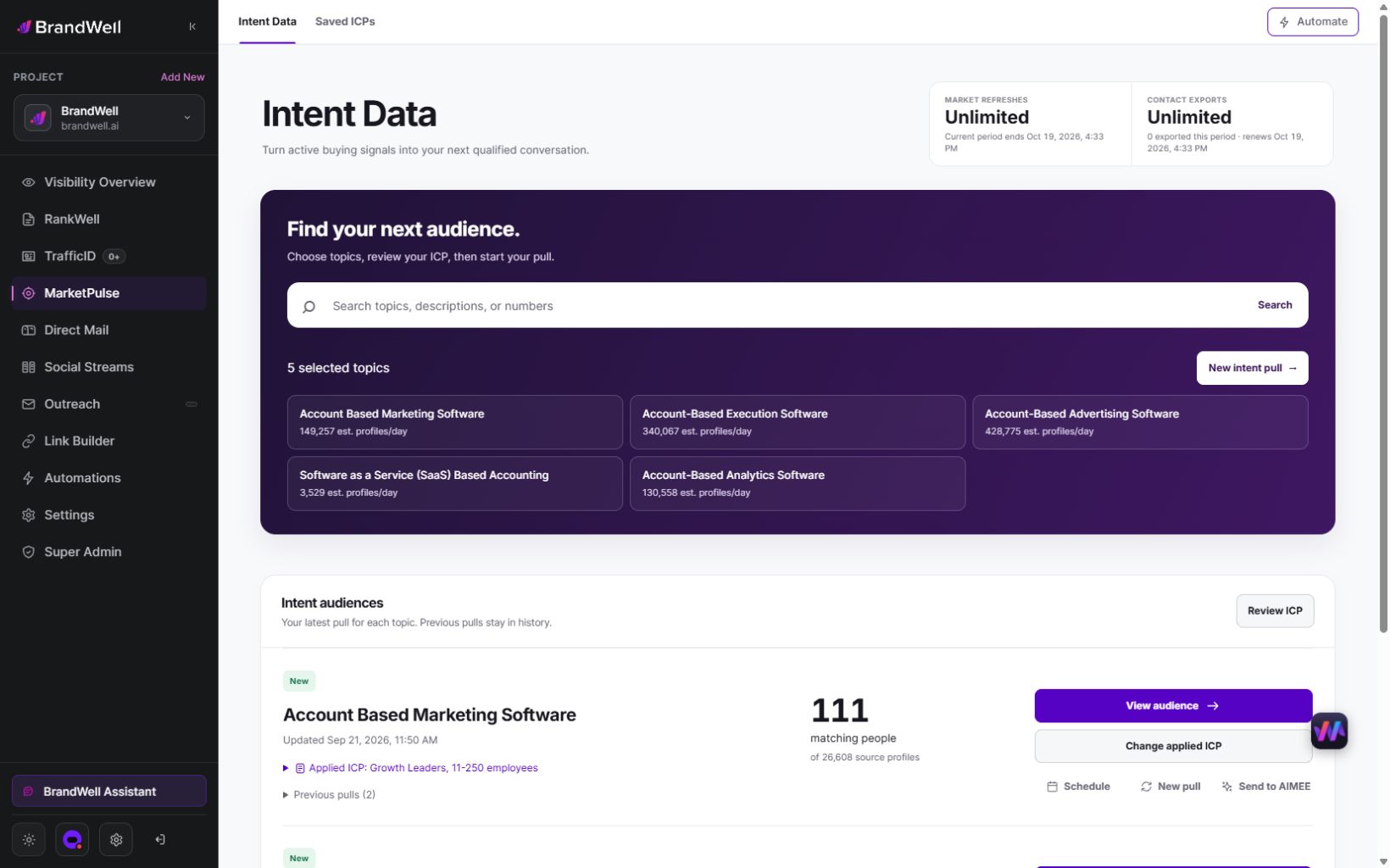
Watch the MarketPulse demo and compare plans. Keep subscription cost separate from operator time, implementation and activation. The first-purchase three-day satisfaction guarantee requires no exports and no more than two Intent Scans; check current terms before an evaluation.
Frequently asked questions
What belongs in an intent-data business case?
A decision owner, objective, real alternatives, baseline, cost model, sourced assumptions, scenarios and predetermined stop, revise and expand gates.
Is a business case proof of ROI?
No. It is a forward-looking approval model. Actual return requires actual costs, outcomes and an evaluation that supports the stated claim.
What is a switching value?
The input value at which the recommendation or modeled break-even result changes, with other assumptions held fixed. It identifies an uncertainty worth testing.
Can a short pilot prove revenue lift?
It may test data and operating feasibility. Sparse sales outcomes, short windows and observational comparisons limit revenue conclusions.
Reviewed and updated October 3, 2026.

Written by