On this page
- Confirm client fit and action ownership
- Use seven onboarding steps
- Preserve the versioned evidence log
- Apply five readiness gates
- Copyable onboarding decision worksheet
- Scope the recurring client operation
- Current MarketPulse research workflow
- Separate product and agency responsibilities
- Budget setup and early support
- Test access, rights and suppressions
- Copyable assistant onboarding review
- Maintain current sources and scope
- Related agency operating guides
- Answers to ten onboarding questions
- Review one supported research use
- Worked example: a successful handoff is not adoption
- Frequently asked questions
Intent-service client onboarding defines the agreed agency workflow before the first report creates expectations. Record the client decision, ICP, available topics, sources, identity states, review rules, deliverables, access, approved activation, outcome definitions, usage, support and exit. If a branded portal is proposed, verify its actual rights and implementation separately. Completion requires documented owner approval and a tested handoff, not simply a login.
Who this is for: White-label intent resellers, agency account teams, RevOps consultants, and client operators starting a recurring intent-data relationship.
Intent data should improve a decision. It should never be presented as proof that a person is ready to buy or as permission for an unreviewed action.
Current MarketPulse offer: intent-data plans start at $500/mo. See the product, demo, and current plans. Updated October 3, 2026.
Confirm client fit and action ownership
The readiness decision is whether the client has a defined market, useful topics, an action owner, acceptable data use, CRM outcomes, budget, and enough capacity to use the service. Promise a governed delivery process and evidence trail, not universal coverage or guaranteed pipeline.
Use seven onboarding steps
- 1. Confirm the business decision, ICP, market size, use case, exclusions, and commercial scope.
- 2. Approve a topic dictionary with inclusion, exclusion, recency, recurrence, and retirement rules.
- 3. Document every signal source, identity state, enrichment field, validation state, and permitted use.
- 4. Configure client separation, branding, users, permissions, exports, suppressions, and retention.
- 5. Define review cadence, SLA, activation approvals, CRM dispositions, and exception handling.
- 6. Run a sample branded report and complete a dry handoff with the actual client owner.
- 7. Sign off on baseline, scorecard, support, billing, changes, renewal, and offboarding.
Preserve the versioned evidence log
Use one versioned record to show why each intent-service client onboarding decision was made. Capture the eligible market, topic definition, source, observed time, identity state, validation result, suppression, reviewer, approved action, downstream disposition, and fully loaded cost. Preserve rejected, expired, duplicated, and corrected records with reason codes rather than overwriting them. This makes client explanations and later comparisons reproducible.
Open the log with Confirm the business decision, ICP, market size, use case, exclusions, and commercial scope. Close each review cycle with Sign off on baseline, scorecard, support, billing, changes, renewal, and offboarding. If a topic, source, identity rule, activation path, outcome definition, price, or policy changes, record the approver, affected records, and whether prior periods remain comparable.
Apply five readiness gates
1. Commercial and fit gate
Confirm the market, use case, client owner, expected action, budget, and economic floor.
Watch-out: Do not onboard buyers seeking guaranteed leads or universal identity.
2. Topic and evidence gate
Approve definitions, sources, freshness, recurrence, confidence, and missing states.
Watch-out: A topic title without a dictionary is not an operating rule.
3. Identity and permission gate
Separate entity states, client data, licensed fields, permitted use, users, and suppressions.
Watch-out: Never promote a candidate match into a known person.
4. Delivery and action gate
Configure reports, portal, cadence, SLA, approvals, CRM fields, and handoff.
Watch-out: A report without an action owner risks going unused.
5. Measurement and exit gate
Freeze baseline, outcomes, costs, support, corrections, export, deletion, and stop rules.
Watch-out: Do not wait for renewal to discover that evidence cannot be exported.
Copyable onboarding decision worksheet
Use this field set during discovery, onboarding, and the first client review. It turns intent-service client onboarding into a reproducible decision record instead of an informal promise. Replace every bracketed prompt with written evidence and leave unknowns visible.
INTENT-SERVICE CLIENT ONBOARDING DECISION WORKSHEET
Client decision: [one decision this service must improve]
Eligible market and exclusions: [written ICP, geography, lifecycle, customers, competitors]
Evidence required: [source, observed time, topic rule, identity state, validation]
Path being evaluated: [Commercial and fit gate; Topic and evidence gate; Identity and permission gate; Delivery and action gate; Measurement and exit gate]
First operating control: [Confirm the business decision, ICP, market size, use case, exclusions, and commercial scope.]
Final operating control: [Sign off on baseline, scorecard, support, billing, changes, renewal, and offboarding.]
Owners and approvals: [agency, client, data, CRM, activation, privacy, billing]
Fully loaded monthly cost: [platform + usage + labor + support + risk reserve]
Evidence of use: [accepted, rejected, corrected, acted on, downstream disposition]
Stop, revise, or expand rule: [threshold, reviewer, next action]
Scope the recurring client operation
Translate the workflow into a client scope for intent-service client onboarding: the decision being improved, eligible market, topic set, branded deliverable, portal or export, action SLA, review cadence, usage boundary, support path, change control, and stop rule. Mark records as eligible, review, suppressed, expired, or unresolved so the client knows what can happen next.
Assign named owners for sales, client success, data operations, identity review, CRM, activation, privacy, security, analytics, and billing. Attach evidence to every handoff. Review the first month as an operating test by comparing accepted, rejected, corrected, suppressed, and acted-on records with delivery hours, outcome return, and contribution margin. Narrow or stop the service when the client cannot use the evidence reliably.
Current MarketPulse research workflow
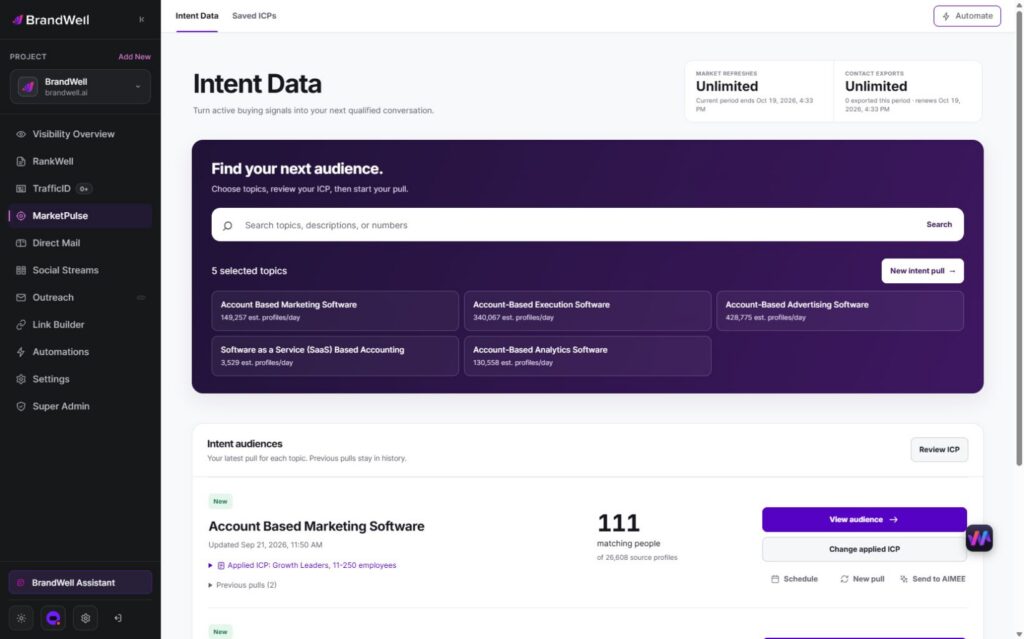
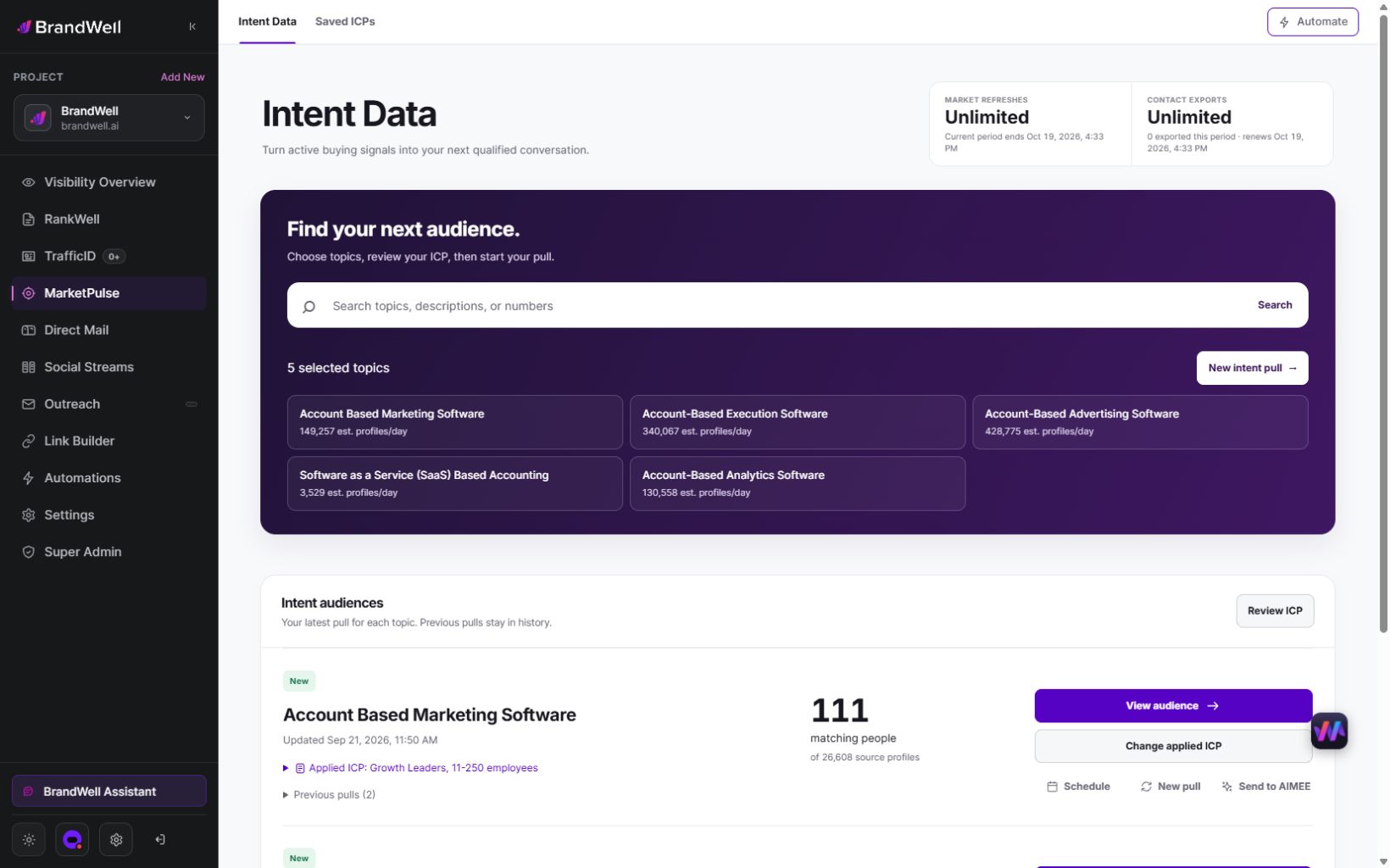
BrandWell MarketPulse: intent data starting at $500/mo. Find people researching topics relevant to what you sell, apply saved ICP filters, and review available contact details before taking action.
MarketPulse plans are starting at $500/mo. Verify current package scope and offers on the product page.
| Plan | Topics and refreshes | Monthly exports |
|---|---|---|
| Starter | 1 topic, weekly | 25,000 contacts |
| Growth | 3 topics, daily | 100,000 contacts |
| Scale | 10 topics, daily | Unlimited contacts |
Swipe the table to see all columns.
A pull retrieves available data from the previous 24 hours for one topic. Daily use across all included topics provides 90 Growth pulls or 300 Scale pulls in a 30-day month. Weekly Starter pulls vary by calendar month. Available audience size and contact fields vary, and audiences may overlap. Refreshes stop at the plan limit without overage charges.
- Find and qualify: search the topic catalog, save your ICP, and review the people and companies that match.
- Act on the research: export qualified contacts or prepare an Outreach or Direct Mail workflow. Connected products, channel usage, and fulfillment may cost extra.
- Get help from AIMEE: Growth and Scale include AIMEE for the initial user to research accounts and prepare the next step through connected tools.
Agencies and other service businesses can build client deliverables around their available Intent Scans and exports. Keep each client’s scope, permissions, and service fees clear. A subscription is not a promise of a white-label platform or exclusive access to a market.
Explore MarketPulse and watch the demo or compare plans starting at $500/mo. Any early-access discount is a separate, time-limited offer shown to an eligible recipient.
Separate product and agency responsibilities
BrandWell MarketPulse is topic-based intent-data software for businesses and agencies. Choose relevant research topics, apply saved ideal-customer-profile filters, review available names, roles, companies and contact details, and export the audience or prepare a connected workflow. Plans start at $500/mo. TrafficID identifies visitors to your own website and is a separate product. A MarketPulse subscription does not by itself promise a white-label portal, custom API implementation, exclusive topics, or managed client delivery.
Review an available MarketPulse topic, saved ICP and actual preceding-24-hour matches against the client scope. AIMEE can help organize the approved onboarding packet through configured tools. Custom agency onboarding, portals and implementation require separate scope, capacity and fees.
Use the current plan table above for standard topic, refresh and export allowances. Any eligible early-access offer is separate. Agency setup, training, custom reporting and integrations require independently agreed service scope.
AIMEE can help inspect supplied onboarding evidence through configured connected tools. Preserve missing access, unresolved rights and incomplete handoffs. Human owners approve actual provisioning, client destinations and launch.
Budget setup and early support
Charge for discovery, topic design, setup, branding, permission configuration, integrations, training, sample reports, and early support. Separate setup from recurring usage and delivery. Protect margin with client, topic, signal, user, report, support, and integration boundaries in the written scope.
The intent-service client onboarding stop-or-expand scorecard
Track onboarding cycle time, access completion, topic acceptance, sample-report approval, user training, first action, SLA readiness, errors, corrections, support hours, launch cost, client adoption, and first renewal signal. Track time to first useful decision separately from time to first login.
Important: Intent signals are probabilistic evidence. They do not prove identity, consent, need, authority, budget, stage, qualification, purchase, pipeline, or revenue. Report association and uncertainty honestly.
Test access, rights and suppressions
Risks include vague topics, cross-client exposure, unlicensed end-client use, excessive permissions, bad identity assumptions, missing suppressions, undefined support, and no deletion path. Use least privilege, explicit roles, versioned policy, and a written responsibility matrix.
The OWASP authorization guidance distinguishes identity authentication from authorization and recommends minimum necessary privileges. Test the actual approved user, resource and operation boundaries. This reference does not certify a provider or establish source rights, client resale permissions or legal compliance.
- Preserve source, observed time, identity state, confidence, validation, and policy version.
- Separate known people, candidate people, companies, domains, and unresolved visitors.
- Apply customer, employee, competitor, duplicate, geography, consent, and opt-out suppressions.
- Require named human approval before CRM writes, audience uploads, spend, or outreach.
- Give clients correction, export, deletion, escalation, incident, and offboarding paths.
Copyable assistant onboarding review
Objective: Audit a client onboarding package for commercial fit, ICP, topics, signal sources, identity states, fields, permissions, suppressions, portal users, branded reports, cadence, SLAs, integrations, actions, outcomes, costs, support, renewal, and exit. Return ready, missing, blocked, and counsel-review items. Do not provision access.
Inputs: approved ICP, topic dictionary, signal source and time, identity state, client lifecycle, suppressions, permitted-use policy, outcome definitions, and current written commercial scope.
Rules: preserve provenance and uncertainty; never infer budget, authority, consent, or purchase readiness; never expose private behavior in messaging; stop before external action.
Output: decision, reason codes, missing evidence, recommended next step, and audit log.
Keep the supplied evidence, missing item, responsible owner, agreed acceptance test and approval version together. An assistant-generated checklist does not provision approved access or establish launch readiness. Reconcile the draft with actual client and system evidence.
Maintain current sources and scope
This guide evaluates intent-service client onboarding through one defined client decision, a seven-step operating workflow, consistent option criteria, a fully loaded cost model, an outcome scorecard, and explicit limitations. The workspace image illustrates the interface; its example counts do not establish coverage or client outcomes. Current contracts, official product documentation, platform policies, and scope-matched written quotes control volatile facts.
Recheck the relevant claim before a client quote and whenever a provider changes pricing, modules, permitted uses, reseller rights, retention, export, support, platform policy, or contract terms. Revise the affected statement and workflow rather than carrying an old assumption into a new engagement.
Related agency operating guides
Use these companion guides to move from the current decision into the next operating layer without collapsing distinct buyer questions into one oversized page.
- Intent Advertising Client Onboarding: An Agency Checklist
- How to Build an Intent-Data Compliance Program for an Agency
- Intent-Data Reporting for Agencies: Metrics, Templates, and Workflows
Answers to ten onboarding questions
What should an agency decide before onboarding a client to an intent-data service, and what client outcome can it responsibly promise?
Make a go, revise, or stop decision before delivery begins. The governing test is: The readiness decision is whether the client has a defined market, useful topics, an action owner, acceptable data use, CRM outcomes, budget, and enough capacity to use the service. Promise a governed delivery process and evidence trail, not universal coverage or guaranteed pipeline.
What workflow, owners, SLA, quality checks, approvals, and client handoff does intent-service client onboarding require?
Assign a named agency owner, client owner, operator, and technical or CRM owner. The sequence is: 1) Confirm the business decision, ICP, market size, use case, exclusions, and commercial scope. 2) Approve a topic dictionary with inclusion, exclusion, recency, recurrence, and retirement rules. 3) Document every signal source, identity state, enrichment field, validation state, and permitted use. 4) Configure client separation, branding, users, permissions, exports, suppressions, and retention. 5) Define review cadence, SLA, activation approvals, CRM dispositions, and exception handling. 6) Run a sample branded report and complete a dry handoff with the actual client owner. 7) Sign off on baseline, scorecard, support, billing, changes, renewal, and offboarding. Set the response SLA, log exceptions, preserve uncertainty, and require a client handoff with permitted next steps and ownership.
Which platforms, tools, templates, calculators, and integrations best support onboarding a client to an intent-data service?
Start with the operational resources in this guide: Commercial and fit gate, Topic and evidence gate, Identity and permission gate, Delivery and action gate, Measurement and exit gate. Use the client CRM as the outcome system of record, a permissioned review queue or database for evidence, the copyable worksheet in this guide, a topic dictionary, qualification scorecard, cost calculator, responsibility matrix, client report, and approval checklist. Add integrations only after field IDs, permitted writes, owners, retries, deletion, and exception handling are documented for intent-service client onboarding.
How do full-service, phased, pilot-first, portal-first, and integration-first compare for onboarding a client to an intent-data service?
Compare full-service, phased, pilot-first, portal-first, and integration-first against the same client decision, market, evidence, owners, SLA, implementation time, fully loaded cost, governance, outcome scorecard, and exit path. The right approach to onboarding a client to an intent-data service is the one the client can adopt and the agency can deliver repeatedly without hiding labor, rights, uncertainty, or risk.
How should an agency price intent-service client onboarding, and which setup, usage, labor, support, and risk costs determine gross margin?
Build a client-level cost model before setting price. Charge for discovery, topic design, setup, branding, permission configuration, integrations, training, sample reports, and early support. Separate setup from recurring usage and delivery. Protect margin with client, topic, signal, user, report, support, and integration boundaries in the written scope. Put usage overages, client work, exception handling, and out-of-scope activation in writing.
Which quality, adoption, meeting, opportunity, pipeline, cost, margin, and retention metrics show whether intent-service client onboarding is working?
Use a baseline and one review cadence. Track onboarding cycle time, access completion, topic acceptance, sample-report approval, user training, first action, SLA readiness, errors, corrections, support hours, launch cost, client adoption, and first renewal signal. Track time to first useful decision separately from time to first login. Do not call correlation incremental impact without an appropriate comparison.
Which clients are ready for intent-service client onboarding, and which prospects should the agency exclude?
A client is ready for intent-service client onboarding when it has a clear ICP, sufficient market or qualified traffic, relevant commercial topics, a named action owner, measurable outcomes, conservative economics, privacy readiness, and a way to return dispositions. Require this first control: Confirm the business decision, ICP, market size, use case, exclusions, and commercial scope. Exclude clients demanding guaranteed leads, universal identity, prohibited use, or automation without review.
Which signal sources, identity checks, qualification rules, activation steps, and outcome evidence matter most for intent-service client onboarding?
For intent-service client onboarding, combine topic or first-party behavior with fit, recency, recurrence, identity state, validation, suppressions, human acceptance, the approved activation path, and returned outcomes. Apply the specific controls in this workflow: Approve a topic dictionary with inclusion, exclusion, recency, recurrence, and retirement rules. Document every signal source, identity state, enrichment field, validation state, and permitted use. Keep evidence types separate so an inference never becomes a false fact.
Which data-quality, privacy, security, scope, billing, delivery, and client-trust risks must the agency control for intent-service client onboarding?
Maintain a risk register owned by the agency and client. Risks include vague topics, cross-client exposure, unlicensed end-client use, excessive permissions, bad identity assumptions, missing suppressions, undefined support, and no deletion path. Use least privilege, explicit roles, versioned policy, and a written responsibility matrix. Record the control, owner, evidence, exception path, and next review for every material risk.
What belongs in the final client onboarding sign-off and first-month plan?
Final sign-off should identify the approved use case, available topics, necessary fields, access boundaries, suppressions, required destination, actual dry-run result and accountable client action owner. Record open blockers, launch approval, billing start, support limits and first-month review date. Include the baseline, outcome definitions and exit path. Do not mark a required failed control as complete to meet a planned launch date.
Review one supported research use
Review an available MarketPulse topic, saved ICP and actual preceding-24-hour matches against the client scope. AIMEE can help organize the approved onboarding packet through configured tools. Custom agency onboarding, portals and implementation require separate scope, capacity and fees.
Worked example: a successful handoff is not adoption
Assume a fictional dry run starts with 50 sample records. Ten are excluded by the agreed rules, leaving 40 eligible. A required destination acknowledges 36, while four remain unresolved. Handoff acceptance is 90% of eligible records, or 72% of original records. If the client owner reviews 24 acknowledged records, review adoption is 66.7% of acknowledged records, or 60% of eligible records. These stages cannot be merged into a single success rate.
Retain exclusion reasons, destination acknowledgments and unresolved states. Separately test that an unauthorized client user cannot read another client’s record or perform an unapproved export. A positive technical handoff does not override a failed required access test. The counts are invented planning inputs, not BrandWell reliability results or evidence of client revenue.
Recover actual setup before promising a healthy retainer
Suppose initial setup takes 12 hours at $75 and requires $300 of defined tools or implementation, totaling $1,200. A separately agreed $1,000 setup fee leaves a $200 shortfall. The recurring service then charges $1,500 per month and costs $1,000, leaving $500, or 33.3%, before acquisition, general overhead, tax and financing. Two extra support hours at $100 reduce that month’s remainder to $300, or 20%.
Across the setup and first stressed month, receipts are $2,500 and defined costs $2,400, leaving $100, or 4%. Preserve this horizon alongside the recurring view, and do not deduct the same setup shortfall again. These invented figures are not typical agency margins or BrandWell onboarding fees. Collection timing and client continuation remain separate risks.
Run the supported product dry review
Choose an available MarketPulse topic and saved client ICP, preserve the actual preceding-24-hour window, and inspect available fields against the approved need. Define the client’s next review action before proposing an export or connected Outreach workflow. TrafficID own-site work has separate scope. AIMEE can organize supplied evidence through configured tools; human owners approve actual rights, access, destinations and launch.
Frequently asked questions
Does a login prove client adoption?
No. Verify the agreed review or action separately.
Is destination acceptance the same as a client decision?
No. Preserve distinct handoff and adoption measures.
Should setup and early support enter pricing?
Yes. Include them once and state the recovery horizon.
Does MarketPulse include a custom white-label portal?
Do not assume that. Verify capabilities, rights and agency implementation separately.
Review the supported research product: explore MarketPulse and current plans.
Reviewed and updated October 3, 2026.

Written by