On this page
- Start with document precedence and the operating decision
- Build the contract workflow and evidence pack
- Choose the operating model and best-fit use case
- Scope a MarketPulse evaluation around the actual plan
- Normalize pricing and total cost before negotiation
- Write measurement language that survives a renewal review
- Connect signal, identity, activation, and outcome evidence
- Control privacy, quality, renewal, and portability risks
- Mirror vendor obligations into the agency client agreement
- Check data-processing roles with the appropriate legal reviewer
- A quote-normalization example
- Test the exit path before signing
- Frequently asked questions
- Put buyer intent to work with MarketPulse
An intent-data contract should make the operating system enforceable, not merely grant access to a platform. Before signing, resolve document precedence, signal definitions, permitted uses, identity and validation boundaries, integrations, service and support duties, price drivers, change control, measurement, renewal, portability, deletion, and exit. If a clause cannot be tested against a real workflow, it is not specific enough for the buyer to rely on.
Who this is for: agency owners, CMOs, CROs, RevOps, procurement, data leaders, and privacy or legal reviewers shortlisting intent-data solutions or agency infrastructure. This is a commercial and operational intent-data contract checklist, not legal advice; qualified counsel should adapt it to the parties, jurisdictions, and data flows.
The guide stays focused on the signing decision: what must be written, which evidence should be tested, how unlike operating models should be compared, and what the buyer needs to measure, renew, or take away at exit. Procurement teams can turn the clause groups into their own review checklist without treating one contract form as universal.
Current MarketPulse offer: intent-data plans start at $500/mo. See the product, demo, and current plans. Updated October 1, 2026.
Start with document precedence and the operating decision
The first question is not “Who owns the data?” It is “Which document controls each promise?” A sales deck, demo, security answer, data-processing addendum, order form, acceptable-use policy, support schedule, product description, and master agreement can all say different things. Create a precedence clause that says which document wins for scope, price, usage, privacy, service, support, change, renewal, and exit. Put negotiated exceptions in the signed order, not in an email that may have no contractual force.
Define the buyer decision in operational terms. State the target market, selected topics or signals, client or business-unit count, users, data inputs, refresh expectations, identity level, validation, destinations, workflow approvals, reports, measurement, and prohibited uses. Distinguish account-level research evidence from a named-person match. Define “available,” “delivered,” “usable,” “accepted,” and “qualified” so a volume metric cannot substitute for business value.
Clause group one: licensed scope and data rights
List every input and output: first-party events, account or IP resolution, topic evidence, person or company enrichment, validation state, derived score, audience, report, export, and outcome field. For each, document source class, permitted purpose, territory, client or tenant rights, retention, onward transfer, suppression, deletion, model-training rights, aggregation, and what can leave at termination. “Customer data” is too broad if licensed or derived fields follow different rules.
Require the supplier to explain whether the buyer receives a copy, a time-limited license, a derived result, or only an in-product view. A portability clause should name formats, fields, configuration, suppression, topic lists, workflow instructions, historical outcomes, timing, charges, and data that cannot legally or contractually travel.
Clause group two: signals, identity, and quality
The agreement should describe the signal unit, topic taxonomy, baseline, refresh, expiry, history, coverage exclusions, known failure modes, and change notification. Identity and account association may involve probabilistic methods. Distinguish inferred matches from directly supplied identifiers and verify each method rather than assigning one confidence model to every record. A result may be incomplete or wrong; it is not proof that a named person performed the research, intends to purchase, or will buy. Contract the source, time, confidence, suppression, and human-review context that must travel with it.
Create acceptance tests for representative accounts, subsidiaries, remote traffic, duplicates, false-match traps, missing records, expired evidence, and suppressions. The remedy for a missed or wrong match should be explicit: correction, credit, reprocessing, root-cause review, or termination right – not an undefined promise to “improve accuracy.”
Clause group three: service, support, change, renewal, and exit
Name the implementation deliverables, owners, dependencies, support channels, severity definitions, response process, exclusions, and escalation. Do not imply an SLA, uptime commitment, continuity target, audit log, or access-control feature that is absent from the written schedule. A change clause should cover taxonomy, field definitions, source mix, integrations, limits, pricing dimensions, deprecation, and policy changes, plus notice and a remedy if a material change breaks the use case.
Specify renewal notice, pricing review, volume reset, unused credits, service changes, data deletion, configuration export, transition assistance, credential revocation, and post-termination restrictions. Auto-renewal should not be the first time stakeholders revisit value. Put a review window before the notice deadline and define the evidence required for expansion, right-sizing, or exit.
Build the contract workflow and evidence pack
The strongest contract process starts with a workflow diagram rather than a vendor questionnaire. Map signal source → identity or account association → enrichment → validation → suppression → review → CRM, report, advertising, or outreach activation → outcome capture. Under each arrow, write the system, owner, permission, expected time, failure mode, and evidence. That map reveals which integration and support promises belong in the agreement.
Run this sequence before signature:
- Define one primary outcome and the decision the signal should change.
- Inventory inputs, outputs, licensed fields, systems, roles, and jurisdictions.
- Build a representative test set, including negative and ambiguous cases.
- Request the current product, data, privacy, security, support, pricing, and exit documents.
- Mark every sales claim as contractual, testable but non-contractual, or unsupported.
- Run the end-to-end integration with failed writes, suppression, correction, and outcome return.
- Normalize a scope-matched quote and internal operating cost.
- Negotiate precedence, acceptance, change, renewal, portability, deletion, and exit.
- Have product, finance, data, privacy, security, legal, and operating owners approve their sections.
- Store the signed document set, evidence, owner, review trigger, and renewal calendar together.
Useful intent data contracts templates include a requirements brief, data-flow map, field and rights register, acceptance-test plan, quote-normalization worksheet, support responsibility matrix, change log, renewal scorecard, and exit checklist. Tools are secondary: a spreadsheet and diagram can work if the contract owner keeps them current and links every requirement to a signed clause or accepted test.
Choose the operating model and best-fit use case
An enterprise ABM suite can fit a direct revenue team that wants account intelligence, scoring, activation, and orchestration in one environment. A point tool fits a narrow identity, enrichment, validation, or alerting problem. A data feed fits a buyer that already owns the portal, orchestration, governance, and measurement layers. An in-house build fits unusual rights or control needs only when engineering, licensing, observability, compliance, and support are funded. An agency-reseller model fits agencies that want a repeatable branded client service and wholesale-to-retail economics.
Compare those alternatives on the same service boundary. A low feed quote is not comparable to a package that includes identity, portal, activation, reporting, support, and client operations. Conversely, an enterprise suite can be wasteful when a buyer needs only one reliable signal and a human workflow. The contract should reflect the selected operating model rather than importing every enterprise clause into a small proof.
Scope a MarketPulse evaluation around the actual plan
BrandWell MarketPulse: intent data starting at $500/mo. Find people researching topics relevant to what you sell, apply saved ICP filters, and review available contact details before taking action.
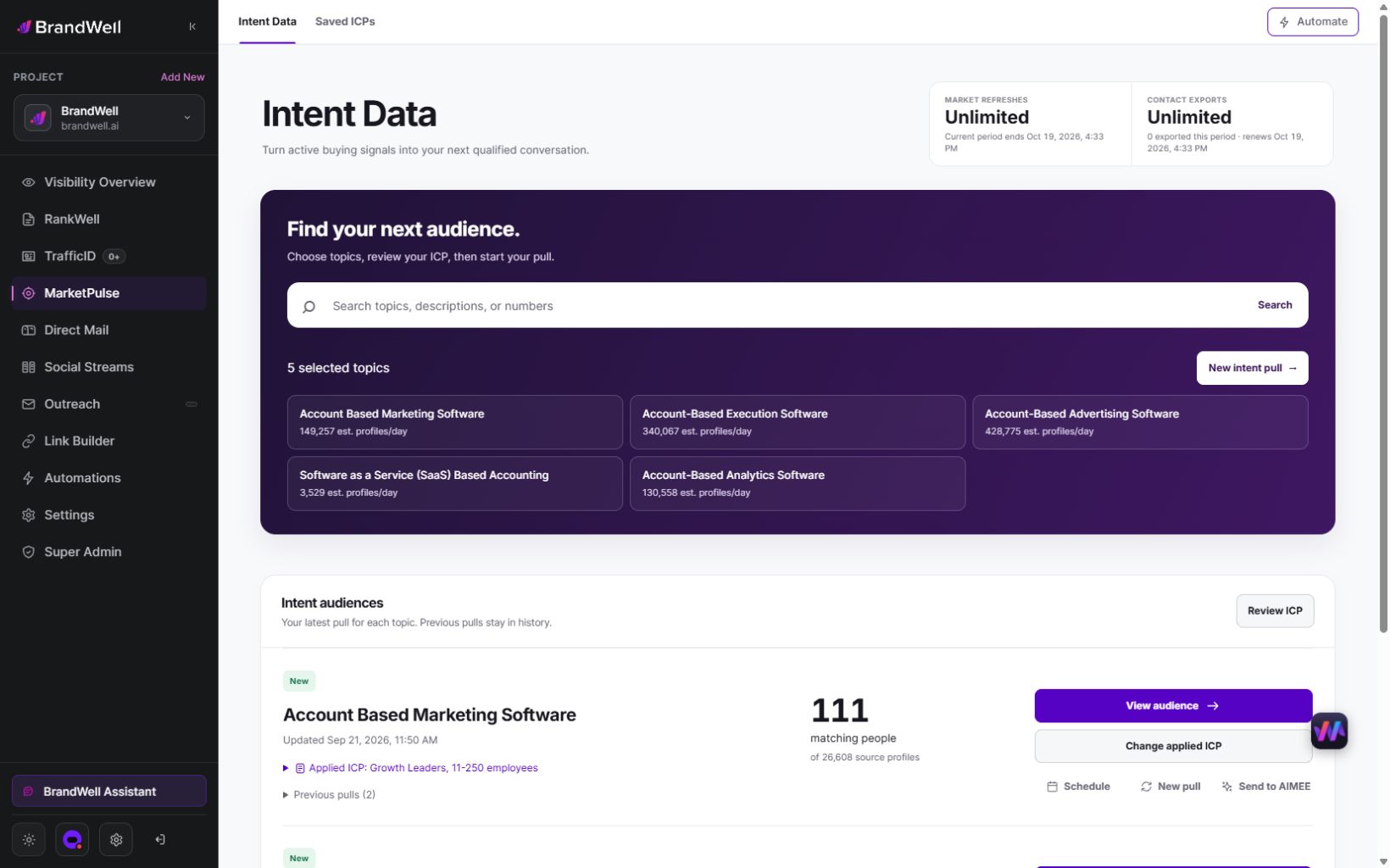
MarketPulse plans are starting at $500/mo. Verify current package scope and offers on the product page.
| Plan | Topics and refreshes | Monthly exports |
|---|---|---|
| Starter | 1 topic, weekly | 25,000 contacts |
| Growth | 3 topics, daily | 100,000 contacts |
| Scale | 10 topics, daily | Unlimited contacts |
Swipe the table to see all columns.
A pull retrieves available data from the previous 24 hours for one topic. Daily use across all included topics provides 90 Growth pulls or 300 Scale pulls in a 30-day month. Weekly Starter pulls vary by calendar month. Available audience size and contact fields vary, and audiences may overlap. Refreshes stop at the plan limit without overage charges.
- Find and qualify: search the topic catalog, save your ICP, and review the people and companies that match.
- Act on the research: export qualified contacts or prepare an Outreach or Direct Mail workflow. Connected products, channel usage, and fulfillment may cost extra.
- Get help from AIMEE: Growth and Scale include AIMEE for the initial user to research accounts and prepare the next step through connected tools.
Agencies and other service businesses can build client deliverables around their available Intent Scans and exports. Keep each client’s scope, permissions, and service fees clear. A subscription is not a promise of a white-label platform or exclusive access to a market.
Explore MarketPulse and watch the demo or compare plans starting at $500/mo. Any early-access discount is a separate, time-limited offer shown to an eligible recipient.
Normalize pricing and total cost before negotiation
Intent data contracts pricing should separate subscription or wholesale access, variable records or credits, topics, users, client workspaces, identity and enrichment, validation, integrations, API or export rights, implementation, training, support, reporting, media, privacy review, operator labor, and transition. Ask every vendor for the same base, expected, and growth scenario. Record what the quote excludes.
Total cost is not the invoice alone. Include internal data mapping, administration, quality review, sales enablement, client support, failed-record handling, security and legal review, and the cost of rebuilding integrations at exit. Avoid unsupported market estimates when a vendor requires a quote. The controlling proposal should state the price dimension and the consequence of exceeding it.
Write measurement language that survives a renewal review
Contract metrics should move from input to outcome. Leading measures include eligible account coverage, freshness, match review, validation status, usable-field completeness, time to route, and alert or report delivery. Operating measures include seller acceptance, approved activation, correction rate, suppression compliance, operator hours, and support issues. Pipeline measures include qualified conversations, opportunities created or progressed, and disqualification reasons.
Do not promise revenue from a signal. Define the baseline, eligible population, observation window, attribution rule, and confounders. Where feasible, use a phased rollout or holdout. The contract can require data and cooperation needed to measure outcomes without guaranteeing an outcome the vendor or agency does not control.
Connect signal, identity, activation, and outcome evidence
No single signal should carry the decision. Combine market and account fit, identity confidence, evidence type, recency, frequency, source diversity, first-party engagement, relationship context, validation, negative signals, and seller feedback. A strong account-level topic surge may justify research; it does not justify claiming a named person is buying. A known demo requester is a stronger hand raise, but still needs routing, suppression, and fit context.
Control privacy, quality, renewal, and portability risks
Common intent data contracts mistakes include vague definitions, assuming company evidence identifies a person, accepting a demo as coverage proof, omitting no-match tests, comparing unlike prices, hiding operator labor, failing to contract downstream rights, leaving support ownership unclear, allowing unilateral product changes, missing the renewal-notice deadline, and discovering at exit that configuration or licensed fields cannot travel.
Mitigate them with a signed data register, representative test, documented confidence and correction, permission matrix, named support owners, change remedy, scope-normalized quote, renewal scorecard, and tested export. Controller and processor labels should follow actual purposes and means, not marketing labels; deployment-specific legal review remains necessary.
Mirror vendor obligations into the agency client agreement
An agency should not promise clients more than the upstream agreement supports. Define the client deliverable, cadence, eligible data, excluded uses, human review, quality process, support boundary, client responsibilities, reporting, change control, term, renewal, and exit. Mirror upstream limitations without copying confidential pricing or granting rights the agency does not have.
Build recurring revenue around work the client can see: topic and account calibration, branded reports, data-quality review, approved routing, seller feedback, outcome reporting, governance review, and quarterly scope decisions. The agency controls its client retail price and billing only when the upstream Order Form permits the intended modules and client model. Keep a margin model that includes wholesale cost, usage, operator time, support, and exception handling.
The practical next step is to choose one workflow, create the clause and evidence matrix, request scope-matched documents and quotes for the selected operating model, and refuse signature until every red-line requirement has an owner, test, controlling document, and exit path.
Check data-processing roles with the appropriate legal reviewer
The ICO’s UK controller-processor contract guidance describes written arrangements, documented processing instructions, security, subprocessors and end-of-contract duties. The guidance is under review following legislative changes. It is UK-specific and does not establish that every intent-data supplier is acting as a processor.
Have counsel assess the actual processing roles and applicable requirements. Commercial license terms, privacy responsibilities and platform activation rules are separate questions. A signed subscription does not remove the need to check the intended use.
A quote-normalization example
Fictional first-year budget: A $500 monthly data subscription costs $6,000 over 12 months. Add $1,500 implementation, $400 monthly review labor ($4,800 annually) and a $1,200 transition allowance. The listed first-year cost is $13,500 before other channels, taxes or legal costs. The subscription alone is less than half of that amount.
If recurring review labor stays at $400 per month and implementation is not repeated, a later-year listed cost would be $12,000 when the transition allowance is retained. This is a planning scenario, not a quote or a guarantee of the supplier’s future renewal rate. Check the actual renewal price and notice deadline.
Test the exit path before signing
- Define the deliverable: Name the fields, configuration, reports and history included in an export.
- Check rights: Mark licensed data that cannot be retained or transferred after termination.
- Run a sample export: Use an authorized representative sample and inspect encoding, identifiers, dates and field meanings.
- Validate the receiving system: Confirm that required fields and suppression state survive import.
- Specify timing and costs: Resolve retrieval windows, transition help and any export charges.
- Close access: Assign responsibility for credential revocation, deletion and any legally required retention.
An export button is not the same as tested portability. Keep the sample result, limitations and responsible owner with the contract record.
Frequently asked questions
How should buyers shortlisting intent-data solutions or agency infrastructure approach intent data contracts to select the right signal coverage and operating model?
Begin with the operating model and one measurable outcome, then contract signal scope, rights, workflow, support, change, measurement, renewal, and exit around that decision.
What workflow, data, integrations, and team are required for intent data contracts?
Use a data-flow map, representative test set, CRM or destination acceptance test, named product/data/technical/privacy/finance owners, and one accountable contract owner.
Which tools, services, templates, or operational resources are most useful for intent data contracts?
A requirements brief, rights register, acceptance plan, quote worksheet, responsibility matrix, renewal scorecard, and export checklist are more useful than a generic feature questionnaire.
How should a buyer compare intent data contracts with enterprise ABM suites, point tools, data brokers, or building in-house, and when should each be used?
Choose a suite for broad internal orchestration, a point tool for one capability, a feed when you own the surrounding stack, an in-house build for justified control, and a reseller model for branded client delivery.
What budget, pricing model, and total cost should a buyer expect for intent data contracts?
Expect quote-specific licensing plus usage, implementation, integrations, services, operator labor, governance, and exit costs. Compare identical scope rather than unsupported category averages.
How should intent data contracts be measured and tied to qualified pipeline or revenue?
Measure usable evidence, validated matches, accepted actions, qualified conversations, opportunities, and operating cost against a defined baseline, with attribution limits stated.
Which companies, clients, or use cases are the best fit for intent data contracts?
The best fit has a defined market, sufficient eligible accounts, a workflow owner, approved destinations, outcome data, and the staffing to review probabilistic signals.
How should intent data contracts be combined with fit, identity, freshness, activation, and downstream outcome evidence?
Require fit, identity confidence, freshness, validation, activation permission, and outcome return together. No match or score alone proves a buyer or a purchase.
What are the biggest mistakes, data-quality issues, and privacy risks in intent data contracts?
The largest risks are unclear rights, false certainty, poor test data, uncontracted change, hidden TCO, missed renewal deadlines, and unusable exports.
How should an agency include intent data contracts within a broader recurring client service?
Mirror upstream rights and limitations into the client scope, sell recurring calibration and evidence work, retain client billing control, and avoid guarantees the vendor contract cannot support.
Reviewed and updated October 3, 2026.

Written by