On this page
- Define seven action and ownership decisions
- Map five logical record layers
- Test eight implementation stages
- Verify current research and separate integration scope
- Compare controlled manual and integrated workflows
- Budget full implementation and operation
- Separate integrity, actions and outcomes
- Check actual workflow readiness
- Control permissions, uncertainty and failures
- Scope separate agency CRM operations
- Use reviewed payload instructions
- Copyable CRM write acceptance record
- Frequently asked integration questions
Intent-data CRM integration works when the CRM receives a small set of governed, actionable records – not a fire hose of vendor activity. The practical design is to define which signal qualifies, which identity key joins it to an account, which fields may be written, who owns the next action, when the record expires, and how the outcome returns for review. If any one of those decisions is missing, a technically successful sync can still create duplicates, stale alerts, and seller distrust.
Who this is for: RevOps, marketing operations, sales operations, demand-generation leaders, and agencies implementing an intent program for a B2B revenue team. It assumes the team already has a CRM and can name a specific action the integration should improve.
Current MarketPulse offer: intent-data plans start at $500/mo. See the product, demo, and current plans. Updated October 3, 2026.
Define seven action and ownership decisions
A connector answers how data moves. An operating contract answers whether that movement is useful. Before choosing an intent data CRM integration, write one sentence in this form: “When an account that fits X shows Y signal with Z confidence, create or update this CRM record, assign this owner, require this review, and measure this outcome.”
That sentence forces seven decisions:
- Eligibility: the minimum firmographic fit, topic relevance, signal strength, and recency required for action.
- Identity: the domain, CRM account ID, contact ID, or other durable key used to join the signal without creating a second truth.
- Destination: the CRM object and field that will hold the signal, score, source, evidence summary, and expiry.
- Ownership: the territory, account-owner, round-robin, or client-specific rule that chooses a responsible person.
- Action: alert, task, campaign membership, account-plan update, or review queue – not an automatic sales message by default.
- Suppression: open opportunity, customer, competitor, employee, opt-out, recent contact, duplicate, or low-confidence conditions that stop activation.
- Evidence: an acknowledgement, disposition, meeting, opportunity, win, loss, or disqualification that can be connected back to the original signal.
The goal is not to put every research event in the CRM. It is to preserve enough context for a seller or operator to make a better decision while keeping the system of record readable and auditable.
Map five logical record layers
A durable field map separates the signal event from the account’s current state. Overwriting a single “intent score” field destroys history; creating a new task for every event overwhelms sellers. A useful design usually has five logical layers even when a CRM cannot represent each as a custom object.
- Account layer: CRM account ID, normalized domain, segment, territory, lifecycle status, owner, customer status, and open-opportunity flag.
- Person layer: lead or contact ID, role fit, business contactability, source, consent or opt-out state where applicable, and relationship to the account. Do not infer that a company-level research signal identifies a particular person.
- Signal layer: source, topic, event type, observed-at value, received-at value, strength band, identity confidence, supporting evidence, and expiry. A separate event store or warehouse can retain detail if the CRM should only receive a summary.
- Action layer: eligibility decision, routed owner, recommended next step, SLA, approval state, task ID, suppression reason, and error status.
- Outcome layer: accepted, rejected, worked, no response, meeting, qualified opportunity, disqualified, won, lost, and reason codes. These values should be controlled, not free-text-only.
Choose a sync direction field by field. CRM ownership and opportunity stages normally flow outward from the CRM. Verified intent summaries, evidence references, and eligibility status may flow inward. A vendor should not overwrite a salesperson’s account notes or change lifecycle stages without a documented rule. If both systems can edit the same field, define which value wins, how conflicts are logged, and who can reverse a bad write.
The minimum field-map worksheet should include source field, destination object, destination field, data type, allowed values, write direction, update frequency, retention period, null behavior, conflict rule, owner, and acceptance test. Add a “why this field exists” column. If the answer is only “the vendor exposes it,” leave it out of the first release.
Test eight implementation stages
1. Baseline the current system. Count duplicate accounts, missing domains, unassigned records, stale owners, and existing automation touching the same objects. Check whether the feed exposes or reproduces existing data-quality problems.
2. Define one use case. Examples include reviewing in-market named accounts, assigning newly revealed qualified visitors, or opening an agency client’s weekly research queue. Do not launch prospecting, advertising, customer expansion, and routing together.
3. Create the identity hierarchy. Prefer the CRM account ID when it already exists. Use normalized root domain as a matching aid, then document treatment of subsidiaries, franchises, multiple brands, and shared domains. Route ambiguous matches to an exception queue rather than guessing.
4. Establish eligibility and suppression. Apply fit, signal type, recency, and confidence before writing an action record. Check customers, active opportunities, recent touches, opt-outs, owner conflicts, and blocked industries. Store the exact rule version that made the decision.
5. Configure in a sandbox. Test creates, updates, deletes, nulls, retries, rate limits, permission failures, and revoked credentials. Include intentionally bad domains and duplicate accounts. A happy-path demo is not an acceptance test.
6. Release to a review queue. For the first cohort, let a human accept or reject every recommended action. Capture structured reasons. The review is how the team discovers topic ambiguity, bad identity joins, and impractical SLAs before automation scales them.
7. Monitor an error queue. Track failed writes, unmatched accounts, stale signals, duplicate tasks, routing conflicts, and permission changes. Every error needs a retry rule, an owner, and a maximum age.
8. Expand only after outcome evidence. Increase topic count, record volume, or automated actions when accepted-signal rate, on-time follow-up, and downstream conversion support it. More records are not proof of more value.
Verify current research and separate integration scope
Each option is reviewed on intended use, identity and freshness, CRM mapping and activation, implementation effort, governance, pricing evidence, and measurement. A vendor belongs on the shortlist only if its documented operating model fits the use case; market recognition alone is not a selection criterion.
Current MarketPulse research input
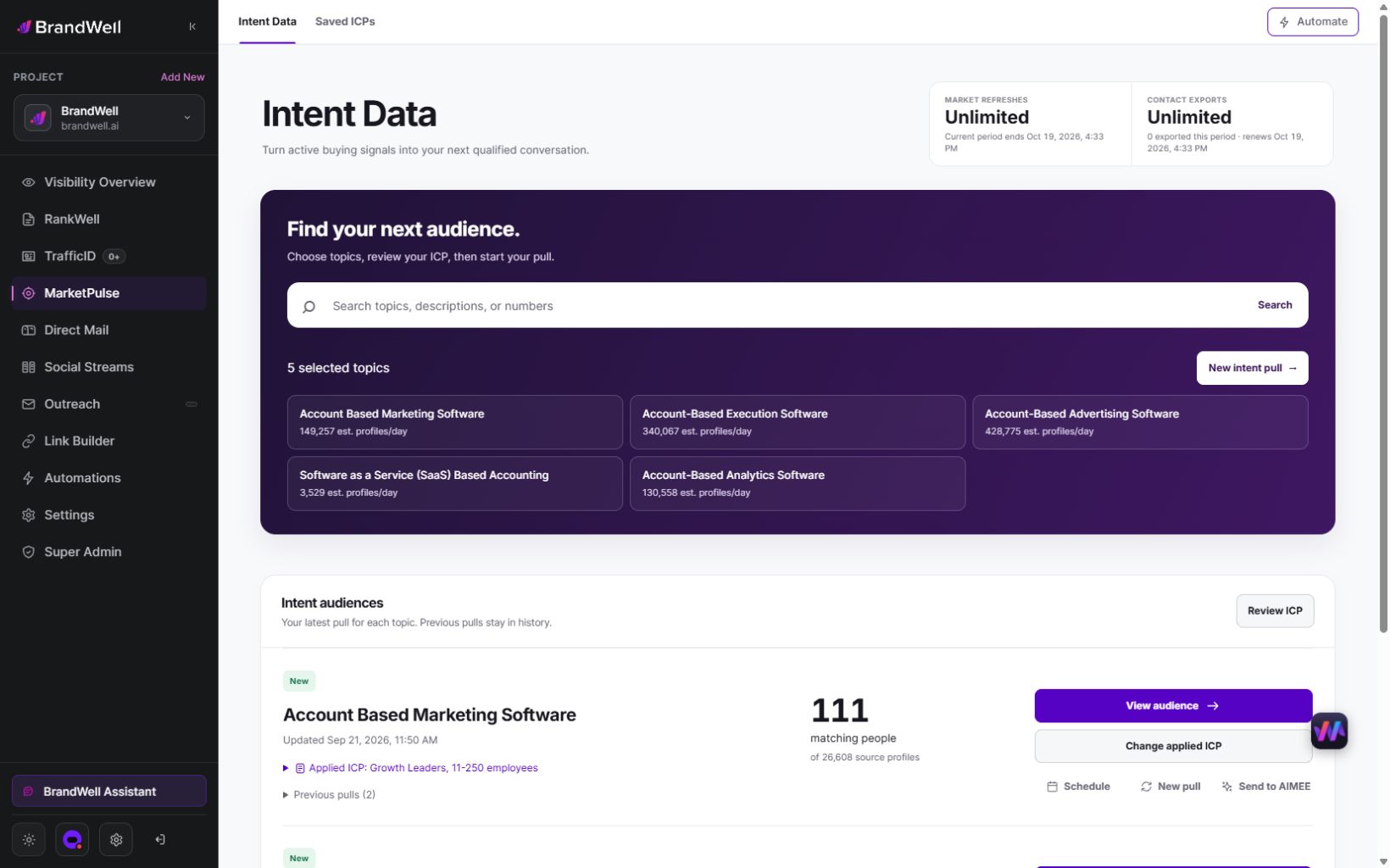
BrandWell MarketPulse: intent data starting at $500/mo. Find people researching topics relevant to what you sell, apply saved ICP filters, and review available contact details before taking action.
| Plan | Topics and refreshes | Monthly exports |
|---|---|---|
| Starter | 1 topic, weekly | 25,000 contacts |
| Growth | 3 topics, daily | 100,000 contacts |
| Scale | 10 topics, daily | Unlimited contacts |
Swipe the table to see all columns.
A pull retrieves available data from the previous 24 hours for one topic. Daily use across all included topics provides 90 Growth pulls or 300 Scale pulls in a 30-day month. Weekly Starter pulls vary by calendar month. Available audience size and contact fields vary, and audiences may overlap. Refreshes stop at the plan limit without overage charges.
- Find and qualify: search the topic catalog, save your ICP, and review the people and companies that match.
- Act on the research: export qualified contacts or prepare an Outreach or Direct Mail workflow. Connected products, channel usage, and fulfillment may cost extra.
- Get help from AIMEE: Growth and Scale include AIMEE for the initial user to research accounts and prepare the next step through connected tools.
Agencies and other service businesses can build client deliverables around their available Intent Scans and exports. Keep each client’s scope, permissions, and service fees clear. A subscription is not a promise of a white-label platform or exclusive access to a market.
Explore MarketPulse and watch the demo or compare plans starting at $500/mo. Any early-access discount is a separate, time-limited offer shown to an eligible recipient.
Compare controlled manual and integrated workflows
A direct integration is not automatically better. CSV export is reasonable for a small, infrequent analyst-led test where no sensitive action is automated and the file has a controlled owner and deletion rule. Manual monitoring works when there are only a few named accounts and a seller can review them without missing the response window. An isolated dashboard can be appropriate for exploration and topic calibration before the team knows which signal deserves a CRM record.
Move to an integration when volume, response time, multiple owners, auditability, or outcome measurement makes manual work unreliable. The migration trigger should be operational pain – not fear of missing every possible signal. Keep the dashboard for diagnosis, but make the CRM carry only the decisions sellers need.
Budget full implementation and operation
Total cost includes the intent subscription, identity and validation, connector or middleware, CRM administration, sandbox testing, security review, agency or implementation labor, seller training, monitoring, data retention, and rework when fields or territories change. Normalize quotes to the same topic count, signal types, refresh, account or contact volume, users, destinations, white-label rights, service level, exclusivity, term, and renewal basis.
MarketPulse research is starting at $500/mo. Verify current topics, refreshes, exports and included tools on the product page. Custom integrations, client interfaces and managed reporting require separately verified implementation, rights and fees.
Separate integrity, actions and outcomes
Use three metric layers:
- Integrity: match rate to existing accounts, ambiguous-match rate, duplicate-create rate, write failure rate, stale-signal rate, routing conflict rate, and time to clear errors.
- Operations: eligible-signal rate, human acceptance rate, median time to review, on-time action rate, suppression rate by reason, tasks completed, and seller rejection reasons.
- Outcomes: meeting rate, qualified-opportunity rate, pipeline per accepted signal, win rate, sales-cycle time, and gross profit attributable to the program – with a comparable non-activated cohort where feasible.
A high match rate does not establish revenue. Compare qualified accounts exposed to the workflow with a holdout or a phased rollout, while controlling for fit, territory, and existing demand. Track the signal ID and rule version through the outcome so later calibration is possible.
Check actual workflow readiness
Check actual account volume, prioritization needs, ICP, owners, consistent CRM use and response constraints before integration. For client delivery, verify separate implementation, record boundaries and reporting or billing responsibilities.
It is a poor first move when the CRM is full of unresolved duplicates, no one owns follow-up, topics are vague, the sales team rejects the underlying motion, or the buyer cannot explain what action will change. Fix the record model and operating agreement before adding more data.
Control permissions, uncertainty and failures
Document source, purpose, applicable rights, necessary fields, retention, access, correction, suppression and deletion. Resolve missing rights before writes or activation; a match or enrichment field does not establish permitted contact.
Use least-privilege CRM credentials, separate client environments, secret rotation, audit logs, field-level permissions, and a kill switch. Never turn a company-level topic signal into a claim that a named person performed a specific act. In outreach, say why the account is relevant; do not reveal or exaggerate surveillance. Legal, privacy, and security reviewers should approve the operating rules before scale.
Scope separate agency CRM operations
Scope a separately implemented CRM-operations service: topic and ICP review, field-map ownership, error handling, routing maintenance, seller feedback and approved reports. Define actual research licensing, agency fees, client boundaries and usage separately. The subscription does not establish custom client billing or a native resale platform.
Propose a separately implemented research review and human-approved CRM queue with actual deliverables, rights, identity limitations and costs. Verify any client interface, branded report or exclusive scope in the actual agreement. A pilot does not promise meetings.
Use reviewed payload instructions
Use approved supplied context for analysis. AIMEE can organize that context through configured tools. Named owners approve actual exports, CRM writes, messages and audience uploads; a proposed payload does not authorize a production write.
- Import the approved ICP, topic definitions, signal schema, CRM field map, ownership table, suppression list, and SLA policy.
- For each incoming signal, normalize the domain, locate the existing account, and assign an identity-confidence status. Never create an account when the match is ambiguous.
- Apply fit, recency, strength, customer, open-opportunity, opt-out, recent-touch, and duplicate rules. Record every pass or stop reason.
- Produce a proposed create-or-update payload showing old value, new value, source, rule version, expiry, routed owner, and recommended next step.
- Place all proposed writes in a human approval queue. Do not send email, enroll a cadence, change opportunity stages, or overwrite owner-entered notes.
- After approval, execute only the permitted fields, confirm the CRM acknowledgement, and send failures to the error queue with a retry limit.
- Return a daily exception summary and a weekly report covering integrity, adoption, outcomes, and suggested rule changes. Require named approval before any rule or threshold changes.
Review MarketPulse and current plans, starting at $500/mo. Evaluate a relevant topic, approved ICP, available fields and operating effort. Verify current guarantee conditions before testing. A short evaluation cannot establish future pipeline or revenue.
Copyable CRM write acceptance record
Identity: [Actual CRM ID, source event and unresolved joins.] Field: [Object, type, allowed values and authoritative owner.] Write: [Old value, proposed value, null semantics and conflict rule.] Timing: [Observation, receipt, expiry and rule version.] Permission: [Client scope, credentials, suppression and approver.] Result: [Operation token, destination acknowledgement, retries and reconciliation.] Outcome: [Actual action, feedback, correction and rollback owner.]
A retry needs an operation identity
AWS idempotency guidance uses an operation token to recognize repeats and avoid duplicate effects. This is distinct from resolving which real company a record represents.
A fictional approved task-create request times out after the CRM creates task T1. Retrying with a new operation identity can create T2; retrying through an actually tested idempotent contract should reconcile the original operation. Verify destination behavior, retention and payload-conflict rules. The same email address does not identify every action as the same operation.
Missing, null and cleared are different instructions
A fictional CRM account already has an owner-entered phone value. An incoming research record omits phone; another explicitly reports unknown; an approved correction requests clearing an invalid value. The field map must define these separately. Do not let an omitted optional source field silently erase an authoritative CRM value.
Receipt time does not refresh an old observation
A fictional signal observed September 28 arrives October 3. With an approved two-day freshness rule measured from observation, it remains five days old, even though it was received today. Preserve both times and the actual timezone. Do not stamp a late event as current research.
Reconcile unknown writes before retrying blindly
Of 100 fictional unique proposed writes, 80 have confirmed acknowledgements, ten confirmed failures and ten unknown responses. Fifteen retries create 115 attempts. Five corrected failures accepted later bring confirmed unique writes to 85; ten remain unresolved. An unknown response is neither a confirmed failure nor a completed write.
A shared domain does not settle account ownership
Two fictional CRM records share a parent domain but represent different subsidiaries and owners. A domain-only match cannot establish which record should receive the task. Hold the ambiguous join and verify the actual account hierarchy, client boundary and permitted routing rule.
Test critical failures separately
A fictional release passes nine of ten scenarios, but the failed case writes into another client’s account. Do not accept the release as 90% correct. Contain the write, verify the scope and repair the critical boundary before approving the release.
Use supported research within the implemented scope
MarketPulse research is starting at $500/mo. Search a relevant topic, save the approved ICP and inspect actual available matches. AIMEE can organize supplied context through configured tools. Owners approve exports, messages, audience uploads and CRM writes. Custom connectors, client interfaces, outcome synchronization and managed reporting require separately verified implementation, rights and fees.
Frequently asked integration questions
Does a successful write establish an opportunity?
No. Track destination acceptance, actual actions and qualified outcomes separately.
Can root domain always resolve the CRM account?
Verify subsidiaries, shared domains, existing IDs and unresolved joins.
Should an omitted field clear the existing value?
Use an explicit field-level rule for missing, unknown and approved clearing.
Does a timeout mean the write failed?
Reconcile the original operation and destination state before a repeat action.
Review current research: explore MarketPulse and current plans.
Reviewed and updated October 3, 2026.

Written by