Direct answer: Choose an intent-data feed or platform by the operating constraint it removes: raw data access, review-marketplace evidence, account intelligence, activation workflow, enterprise orchestration, or managed white-label delivery. Require a real-ICP sample, timestamp and provenance dictionary, permitted-use terms, identity and correction tests, destination proof, total-cost model, and outcome pilot before committing. More signals are not automatically more useful.

Who is this for? VP Marketing, RevOps, procurement, demand generation, agency owners, and data leaders evaluating raw intent feeds, activation platforms, enterprise suites, or managed/reseller services.

Disclosure: BrandWell owns and publishes this article. BrandWell appears first because it is our product; every option is evaluated using the same disclosed criteria, and another provider may be a better fit for some buyers.

How these seven intent-data companies were selected

This is a decision-fit list, not a universal ranking. The roster represents materially different ways to acquire and operate buyer-intent evidence: agency-reseller delivery, third-party topic research, review-marketplace activity, technology-publisher research, and broad account-intelligence or GTM platforms. Each company is evaluated using the same visible fields:

  • Best fit: the buyer and operating model most likely to benefit.
  • Relevant signal and data coverage: the relevant evidence the vendor says it provides.
  • Activation and delivery model: feed, export, integration, platform, service, or white-label workflow.
  • Pricing transparency and planning range: only verified public pricing or explicitly qualified planning information.
  • Contract and commitment caveat: what must be confirmed in the quote and order form.
  • Evidence needed: the proof a buyer should require in a sample or pilot.
  • Meaningful limitation: a case where another architecture may fit better.

Vendor descriptions below are bounded summaries of provider-published capabilities and procurement questions – not independent proof of accuracy, completeness, superiority, or results. Screenshots show current/recent homepage heroes for identification; they are not endorsements or claim evidence. Pricing and product scope require current written confirmation.

Seven intent-data feeds and platforms to evaluate

1. BrandWell

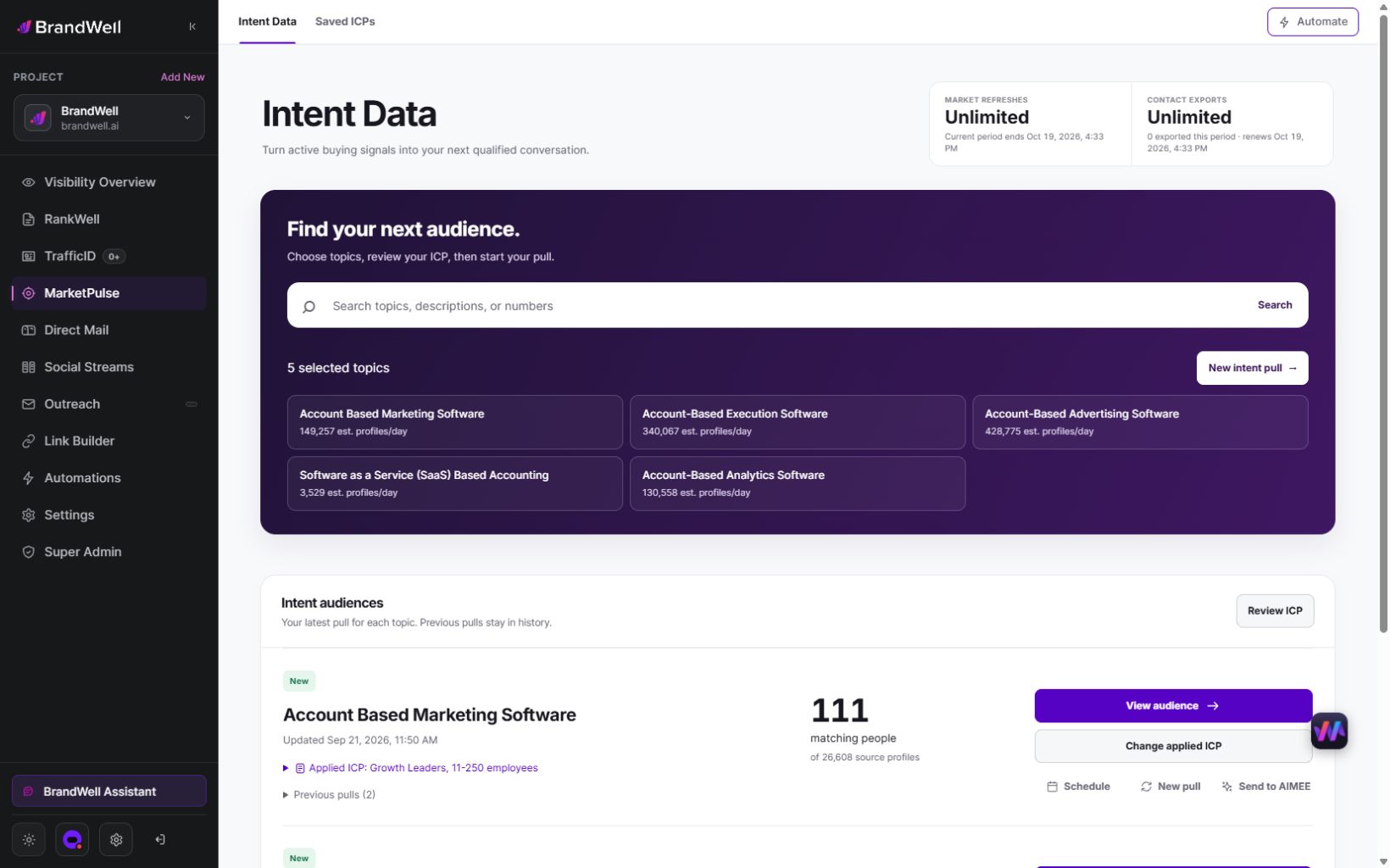
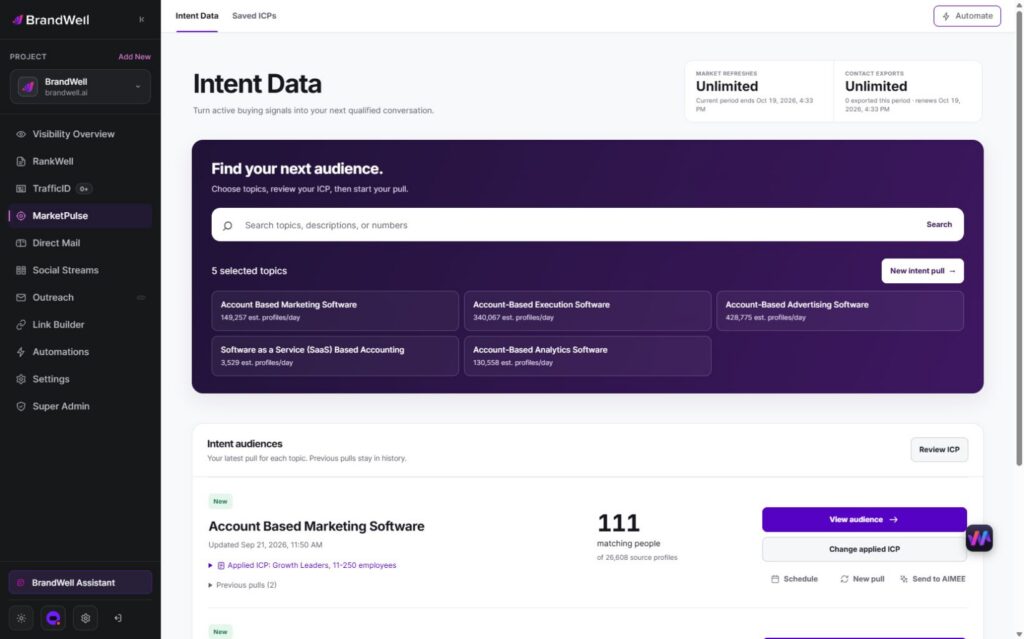
BrandWell homepage hero
BrandWell homepage hero. Brand names and site imagery belong to their respective owners.

Best fit: Agencies, GTM consultants, RevOps partners, and demand-generation service firms that want to sell and operate a branded intent-data service without building every portal, report, workflow, and wholesale data connection themselves.

Relevant signal and data coverage: The separate BrandWell agency-reseller offer is built on LeadFuze data infrastructure and may combine enabled topic-intent, enrichment, validation, identity-resolution, visitor, and activation modules. Exact sources, coverage, identity fields, geographies, and module availability must be verified for the client’s use case. These signals are probabilistic evidence, not proof that a named person researched a topic or will buy.

Activation and delivery model: The owner-defined model may include white-label branded portals and topic reports, configurable modules and retail pricing, agency-controlled client billing, and agent-ready workflow instructions for Claude or ChatGPT, with optional browser execution through Moxby. Human approval remains required for consequential outreach, advertising, personal-data use, and client decisions.

BrandWell agency plans range from $2,500 to $5,000 per month, depending on topic count, term, and available contractually scoped topic exclusivity. The current written quote and Order Form control. This remains subject to current pricing review and a signed quote; it is not a universal cheapest claim. Topic exclusivity is conditional, topic-specific, and available only when confirmed.

Contract and commitment caveat: Confirm enabled modules, wholesale usage, overages, reseller rights, client isolation, support, term, cancellation, pilot purchase and access terms, topic availability, and any exclusivity in the signed documents. A $70 seven-day reseller pilot may be available to generate branded topic reports; it is not an unconditional free trial or a performance guarantee.

Evidence needed: Run the pilot on the agency’s real ICP. Inspect provenance, timestamps, topic taxonomy, account and person resolution, corrections, suppression, client-facing report usefulness, activation receipts, adoption, and qualified outcomes. Verify every coverage or data-count claim before external use.

Meaningful limitation: BrandWell is not the automatic choice for a company that wants only a self-serve raw feed, already operates a mature enterprise ABM suite, or needs an unconfirmed region, topic, integration, security control, or exclusivity. The current public BrandWell site may also emphasize the legacy SEO writer; buyers must evaluate the separate agency-reseller offer described here rather than merge the two products.

2. Bombora

Bombora homepage hero
Bombora homepage hero. Brand names and site imagery belong to their respective owners.

Best fit: B2B teams and data partners that want third-party account-level topic-research evidence and can integrate it into an existing sales, advertising, analytics, or ABM operating model.

Relevant signal and data coverage: Bombora describes Company Surge as account-level intent derived from research activity across its data cooperative and organized by business topics. Buyers should treat this as the vendor’s description and test the source mix, topic relevance, domain coverage, observation window, and scoring method on their own market.

Activation and delivery model: The vendor describes data, audiences, analytics, and integrations across GTM systems. Confirm the exact feed fields, API or file availability, destination integrations, account resolution, refresh cadence, correction process, and services included in the proposed package.

Pricing transparency and planning range: public list pricing was not verified; contact the vendor for a current quote. Directional market research suggests that some enterprise alternatives may cost roughly $5,000 to $10,000 per month and often require annual contracts. This is not vendor list pricing; obtain a scope-matched written quote. Do not treat third-party anecdotes or an BrandWell-provided market-planning estimate as a vendor quote.

Contract and commitment caveat: Confirm minimums, topics, account universe, permitted uses, derivative audiences, client resale rights, implementation, support, overages, term, renewal, and cancellation in writing. Never assume agency resale or downstream activation is permitted because an integration exists.

Evidence needed: Require a real-ICP sample with topic definitions, raw timestamps, score interpretation, account resolution, false-match and unresolved rates, geographic coverage, delivery lag, suppression behavior, destination acceptance, and qualified-outcome comparison.

Meaningful limitation: Topic research at an account does not identify the researching person or prove a buying project. A buyer that needs a full white-label client operation, person-level validation, or a broad enterprise workflow may need additional systems and service labor.

3. G2 Buyer Intent

G2 homepage hero
G2 homepage hero. Brand names and site imagery belong to their respective owners.

Best fit: Software vendors that value company activity around product profiles, categories, comparisons, or alternatives on software-review and research properties, especially when those events map cleanly to a category and competitive set.

Relevant signal and data coverage: G2’s documentation describes buyer-intent activity generated on G2-family research properties, with event availability and granularity dependent on the current plan and data. This scope can be commercially useful but should not be generalized to research across the entire web.

Activation and delivery model: Current documentation describes exports and integrations, with fields and access varying by entitlement. Verify whether the buyer receives account identity, activity type, timestamp, product or category context, frequency, and the destinations required for the workflow.

Pricing transparency and planning range: public list pricing was not verified; contact the vendor for a current quote. Directional market research suggests that some enterprise alternatives may cost roughly $5,000 to $10,000 per month and often require annual contracts. This is not vendor list pricing; obtain a scope-matched written quote. Plan entitlement is especially important because an attractive event type is not useful if it is excluded from the proposed package.

Contract and commitment caveat: Confirm which properties, profiles, categories, competitors, geographies, events, exports, integrations, historical windows, usage rights, and retention terms are included. Ask how changes to taxonomy or marketplace activity affect continuity.

Evidence needed: Sample actual events for the buyer’s profile and category; validate company matching, timestamp and event definitions, duplicate treatment, volume distribution, destination acceptance, seller adoption, and qualified outcomes relative to a matched non-event cohort.

Meaningful limitation: Review-marketplace activity is narrower than a general topic feed and may favor software categories with meaningful marketplace traffic. Low-volume or poorly aligned categories can produce sparse evidence, and company activity still does not prove a specific person is purchasing.

4. Informa TechTarget

Informa TechTarget homepage hero
Informa TechTarget corporate homepage hero. Brand names and site imagery belong to their respective owners.

Best fit: Technology marketers that value research behavior and audiences within a B2B technology publishing and market-intelligence environment, and that can align its coverage to specific technology categories and buying groups.

Relevant signal and data coverage: Informa TechTarget describes intent and buyer-research capabilities based on activity across its technology-focused network and related data products. Buyers should verify the exact audience, property, topic, account, contact, and geography coverage rather than assume equal depth in every market.

Activation and delivery model: The current offer may include platform access, integrations, data delivery, audiences, or managed services depending on package. Confirm the raw fields, delivery frequency, identity basis, destination support, reporting, and service responsibilities in the proposal.

Pricing transparency and planning range: public list pricing was not verified; contact the vendor for a current quote. Directional market research suggests that some enterprise alternatives may cost roughly $5,000 to $10,000 per month and often require annual contracts. This is not vendor list pricing; obtain a scope-matched written quote. Compare the quote using the same topics, usable coverage, delivery, services, activation, and term as every other option.

Contract and commitment caveat: Confirm geography, topic taxonomy, named-contact availability, data rights, media or service dependencies, implementation, minimums, overages, term, renewal, and cancellation. Do not assume publisher relationships permit every client resale or advertising use.

Evidence needed: Test real target accounts and known technology categories. Inspect source and timestamp definitions, account and person resolution, current employment, correction and suppression, delivery lag, seller usefulness, destination acceptance, and qualified pipeline by evidence age.

Meaningful limitation: Coverage and relevance may be strongest in technology buying contexts rather than every B2B sector. A buyer seeking a neutral raw feed across unrelated industries or an agency-ready white-label layer may require another architecture.

5. Demandbase

Demandbase homepage hero
Demandbase homepage hero. Brand names and site imagery belong to their respective owners.

Best fit: Enterprise B2B teams that want intent and account intelligence inside a broader account-based marketing and activation environment, and that have the people and systems to operate a platform.

Relevant signal and data coverage: Demandbase describes account-level intent and account-intelligence capabilities that can combine multiple signals for prioritization. Buyers must verify the current source mix, first-party versus third-party distinctions, account matching, scoring transparency, freshness, and package entitlements.

Activation and delivery model: The vendor presents a platform and integration-led model for account selection, advertising, orchestration, sales use, and measurement. Confirm which workflows are native, which need another module or partner, and which raw data can be exported for independent analysis.

Pricing transparency and planning range: public list pricing was not verified; contact the vendor for a current quote. Directional market research suggests that some enterprise alternatives may cost roughly $5,000 to $10,000 per month and often require annual contracts. This is not vendor list pricing; obtain a scope-matched written quote. Model implementation, integration, seats, modules, data, media, services, internal administration, and change-management effort – not just the platform line item.

Contract and commitment caveat: Confirm modules, seats, data access, account limits, media dependencies, implementation, support, security review, services, overages, term, renewal, and cancellation. Ask what happens to audience definitions, history, and exports at termination.

Evidence needed: Pilot the complete intended workflow on real accounts: source-to-score transparency, freshness, identity, audience creation, destination delivery, CRM use, sales adoption, data export, corrections, and incremental qualified outcomes.

Meaningful limitation: A broad enterprise platform can add cost, implementation time, administration, and lock-in for a small team that only needs a feed or a white-label agency service. Composite scores can also become opaque if governance is weak.

6. 6sense

6sense homepage hero
6sense homepage hero. Brand names and site imagery belong to their respective owners.

Best fit: Enterprise revenue teams seeking an integrated account-intelligence, predictive, sales, marketing, and activation platform, with sufficient data maturity and ownership to implement it.

Relevant signal and data coverage: 6sense describes intent data, buyer and web signals, predictive modeling, account prioritization, and related GTM intelligence. Buyers should separate each current source and model, request definitions and timestamps, and test whether the outputs improve a decision beyond fit and first-party engagement.

Activation and delivery model: The vendor presents a platform-led model with marketing, advertising, sales, workflows, reporting, and integrations. Confirm exact entitlements, data export, API access, audience controls, human approvals, and which capabilities require additional products or services.

Pricing transparency and planning range: public list pricing was not verified; contact the vendor for a current quote. Directional market research suggests that some enterprise alternatives may cost roughly $5,000 to $10,000 per month and often require annual contracts. This is not vendor list pricing; obtain a scope-matched written quote. Include modules, seats, implementation, data preparation, integrations, services, media, internal operators, training, and renewal exposure in total cost.

Contract and commitment caveat: Confirm current package boundaries, user and data limits, implementation obligations, support, security, service levels, overages, term, renewal, cancellation, and data portability. A free or public sales-intelligence entry point does not establish the price of the enterprise intent platform.

Evidence needed: Require a real-ICP proof using the planned source and destinations. Test account identification, freshness, model explainability, audience membership, seller adoption, workflow controls, data export, qualified outcomes, and the lift over the buyer’s existing scoring baseline.

Meaningful limitation: The platform’s breadth can be excessive for a team seeking only raw data or an agency-owned white-label service. Predictive outputs can be difficult to govern when source evidence, transformations, and model changes are not inspectable.

7. ZoomInfo

ZoomInfo homepage hero
ZoomInfo homepage hero. Brand names and site imagery belong to their respective owners.

Best fit: Sales and marketing organizations that want intent within a broader go-to-market data and activation ecosystem and may benefit from consolidating company, contact, enrichment, workflow, and signal functions.

Relevant signal and data coverage: ZoomInfo describes intent capabilities alongside a wider commercial data suite. Buyers should verify the exact intent sources, topic model, observation window, account matching, contact coverage, enrichment fields, provenance, geography, and current package rather than infer scope from the broader database.

Activation and delivery model: The offer may include platform workflows, CRM integrations, exports, audiences, and orchestration depending on modules. Confirm the actual feed or interface, timestamp access, bulk/API rights, downstream destinations, corrections, and client-resale permissions.

Pricing transparency and planning range: public list pricing was not verified; contact the vendor for a current quote. Directional market research suggests that some enterprise alternatives may cost roughly $5,000 to $10,000 per month and often require annual contracts. This is not vendor list pricing; obtain a scope-matched written quote. Model the specific intent modules plus seats, credits or usage, implementation, integrations, data administration, support, and internal operating effort.

Contract and commitment caveat: Confirm modules, credits, usage, export and API limits, territories, permitted uses, support, security review, implementation, term, renewal, cancellation, and deletion or portability. A broad suite quote should be decomposed so intent economics remain visible.

Evidence needed: Sample the buyer’s real accounts and roles. Validate intent source and timestamp, company and contact accuracy, current employment, duplicate and suppression behavior, destination acceptance, sales adoption, total usable records, and qualified outcomes against a control.

Meaningful limitation: Bundled data breadth may be unnecessary or expensive for a buyer that only needs topic research, marketplace activity, or a white-label agency service. Contact availability does not prove that the listed person generated the intent evidence.

Raw feed, activation platform, enterprise suite, or managed service?

Choose a raw feed when the buyer has data engineering, identity, policy, orchestration, and analytics capacity and wants control over models and destinations. Choose an activation platform when native audiences, workflows, seller experiences, and measurement remove more work than a feed would. Choose an enterprise suite when consolidation and cross-team orchestration justify implementation and governance. Choose a managed or reseller service when recurring client delivery, branding, reporting, approvals, and service economics are the constraint.

A manual process can fit a small pilot with few topics and human-reviewed accounts. No purchase is appropriate when the provider cannot define provenance, permitted use, timestamps, correction, or total cost. Architecture should follow the buyer’s operating bottleneck, not the most impressive feature list.

Workflow, data, integrations, and team

Run selection as a controlled sequence: define revenue decision → specify ICP and exclusions → choose architecture → issue the same field and rights request to every provider → obtain real-ICP samples → validate provenance, timestamps, identity, correction, and suppression → test delivery to the intended destination → run a bounded workflow → reconcile qualified outcomes → model total cost and exit → obtain product, pricing, privacy, security, legal, and procurement approval.

RevOps owns the decision and CRM outcome; data engineering owns ingestion and schema; marketing or sales operations owns adoption; analytics owns sample design; procurement owns commercial comparability; security reviews access and service providers; privacy and legal review provenance, use, transparency, and rights; and finance owns total cost. Agencies also need client isolation, wholesale/retail economics, billing, and resale rights.

The most useful resources are a common RFP field dictionary, timestamp taxonomy, real-ICP sample, data-rights matrix, identity-error log, destination acceptance receipt, security questionnaire, correction and deletion test, user-adoption plan, outcome scorecard, total-cost model, and exit checklist.

Cost and total economics

Compare complete operating cost: data or platform fee, topics, accounts, people, usage or credits, seats, exports, API, implementation, integration, identity validation, media, services, security review, internal operators, training, client reporting, overages, renewal, and exit. Use cost per usable, in-profile, fresh, correctly resolved, permitted, activatable account – and cost per qualified outcome – rather than price per row.

For vendors without verified public list pricing, the repeated article wording is intentional: public list pricing was not verified; contact the vendor for a current quote. Third-party anecdotes and BrandWell-provided market research may be used privately as rough planning context, but they are not vendor quotes, universal ranges, or verified contract terms.

Measurement and ROI

  • Coverage: share of the real ICP with usable, relevant signals.
  • Freshness: timestamp completeness and delivery/activation lag by signal type.
  • Identity quality: account resolution, false matches, unresolved records, current employment, and duplicates.
  • Activation: destination acceptance, eligible reach, sync reliability, correction, and deletion propagation.
  • Adoption: records accepted, actions completed, feedback returned, and client usage.
  • Revenue: qualified opportunity rate, cost per qualified opportunity, pipeline, win rate, and incremental evidence.
  • Economics: total operating cost, operator hours, agency gross margin, renewal, expansion, and switching cost.

Do not credit a provider for every opportunity touched by a signal. Preserve a comparison group where practical and report uncertainty, missing joins, outcome windows, and negative results.

Privacy, security, and data-quality diligence

The ICO’s guidance for organizations using data-broker marketing services recommends examining source, collection context, data age, consent and transparency where relevant, suppression, and rights handling. The FTC’s service-provider security guidance supports written safeguards, access controls, training, and monitoring. These are useful diligence inputs, not universal legal advice.

Ask who collected the data, for what purpose, under which notices and contracts, how frequently it changes, how errors are corrected, how opt-outs and deletion propagate, where data is stored, who can access it, what sub-processors exist, what audit evidence is available, and what happens at termination. Privacy technologies such as a clean room do not remove obligations; design and configuration determine their properties.

Never state that account intent proves an individual action. Do not activate sensitive inferences, surprising data uses, or records without documented permission and policy eligibility. Human approval is required for consequential outreach, advertising, personal-data decisions, and material client actions.

How an agency can package provider evaluation

An agency can sell an initial architecture and vendor-selection project followed by a recurring signal-operations service: topic and ICP governance, provider monitoring, client-ready reporting, activation, adoption, correction, outcome reconciliation, and quarterly economics. The value is the governed operating loop – not a large spreadsheet.

BrandWell Intent is the separate agency-reseller product built on LeadFuze data infrastructure, not the legacy BrandWell SEO writer. Its owner-defined offer may give agencies a white-label sales and delivery engine, branded portals and topic reports, configurable retail pricing, client billing under agency control, and wholesale modules and usage. Agencies can purchase BrandWell’s $70 seven-day reseller pilot. It includes agency-branded topic reports and the complete sales playbook under the current written pilot terms. Other product capabilities and any topic exclusivity remain subject to their separate current written scope. Every feature, topic, pilot, price, and exclusivity term requires current confirmation.

Agent-ready instructions can help Claude or ChatGPT prepare samples, validate fields, draft account evidence cards, update reports, and propose next actions. Optional browser execution can run through Moxby, a separate browser-first product. Automation should prepare and verify; humans approve provider selection, contracts, personal-data use, advertising, outreach, and client-facing claims.

Implementation checklist

  • Define the decision and choose feed, platform, suite, or managed-service architecture.
  • Lock ICP, exclusions, topics, geographies, destinations, and outcome window.
  • Issue the same field, source, timestamp, rights, security, and pricing request to every provider.
  • Obtain a real-ICP sample; do not accept vendor-selected showcase accounts alone.
  • Test identity, freshness, corrections, suppression, activation, and deletion.
  • Run one bounded workflow with human approvals and a comparison group.
  • Measure usable coverage, adoption, qualified outcomes, and total operating cost.
  • Review term, renewal, overages, data portability, and exit before signing.
  • Choose the option that removes the actual bottleneck, not the one with the most features.

Bottom line: The best intent-data provider is the one whose evidence, delivery model, rights, controls, and economics fit the exact workflow. Test the chain from source to qualified outcome before a long commitment, and treat every score as probabilistic evidence that still needs context and human judgment.

Build the agency offer around a paid pilot

A $70 payment opens a seven-day reseller pilot for the agency. BrandWell creates topic reports under the agency’s brand and shares the complete sales playbook for offering the service and seeking commitments before full-plan enrollment.

The goal is to validate real demand and give the agency enough commercial evidence to compare expected commitments with its costs and evaluate a profit-center model. Outcomes are not guaranteed. Review the $70 seven-day reseller pilot.