On this page
- Compare five operating models
- Assign responsibilities before requesting quotes
- Verify actual research and delivery scope
- Test models against the same workload
- Calculate full operating and transition costs
- Separate accepted signals from incremental outcomes
- Check organizational readiness
- Preserve distinct evidence stages
- Rehearse failures and ownership gaps
- Scope a separate agency operating service
- Managed-service statement-of-work checklist
- Copyable managed-service acceptance record
- Frequently asked managed-service questions
Choose a managed service only after defining the work being delegated: review, validation, routing, reporting, support or activation. Compare models against the same responsibilities, acceptance tests and actual workload; the word managed does not establish scope.
Who this is for: Demand-generation leaders, RevOps teams, procurement owners, agencies, and GTM operators deciding how much of an intent-data program to outsource.
Intent data does not create an operating model. A source can deliver useful research signals and still fail commercially because nobody validates them, maps them to accounts, selects an action, or records outcomes. Buy the combination of data, responsibility, controls, and evidence that your team can sustain.
Current MarketPulse offer: intent-data plans start at $500/mo. See the product, demo, and current plans. Updated October 3, 2026.
Compare five operating models
Use five models as the starting decision:
- Managed service: an external team performs defined recurring tasks and produces named deliverables. It fits teams short on operating capacity, provided the statement of work names the humans, cadence, approvals, and exclusions.
- Self-service platform: the buyer configures segments, scoring, routing, and reporting. It suits a capable internal demand-gen and RevOps team that wants control.
- Data feed or point tool: a vendor supplies signals or records while the buyer owns identity, orchestration, activation, and measurement. It is flexible but can hide substantial internal labor.
- Agency service on reseller infrastructure: the agency owns the client relationship and combines wholesale data or tooling with strategy, branded delivery, workflow operation, and reporting.
- In-house system: internal teams source, normalize, resolve, score, route, and govern the data. It requires verifying actual design control at the cost of engineering, data operations, privacy, vendor management, and maintenance.
The right answer changes with use-case complexity, internal skills, time to launch, client branding, control requirements, and willingness to operate exceptions. Do not call a product “fully managed” unless its contract defines the people, tasks, hours, response targets, dependencies, and client support model.
Assign responsibilities before requesting quotes
A useful intent data managed services implementation guide begins with one observable workflow, such as a weekly list of high-fit accounts researching an approved topic that enters a review queue and then a CRM task.
- Define eligibility. Marketing owns the target market and use case; RevOps verifies account rules; privacy/legal approves permitted sources, regions, and actions.
- Document sources and identity. The provider explains source class, signal time, topic meaning, entity level, confidence, and exclusions. The buyer approves what evidence is acceptable.
- Normalize and resolve. Name who maps domains, aliases, parents, subsidiaries, contacts, duplicates, and existing customers. Ambiguous results must enter a review queue.
- Apply fit and freshness. The service operator runs agreed firmographic, recency, suppression, and capacity rules. The client owns business exceptions.
- Enrich and validate. State which fields are added, how material fields are checked, and what happens when sources conflict.
- Activate with approvals. Name the destination, field map, human checkpoint, retry behavior, and prohibited channels. Data delivery is not campaign authorization.
- Return dispositions. Sales or marketing records accepted, rejected, reached, qualified, opportunity, and outcome states. RevOps reconciles those outcomes to stable signal IDs.
- Review and tune. The service owner reports denominators, rejection causes, adoption, cost, and outcome evidence, then proposes controlled changes.
Your RACI should identify who is Responsible, Accountable, Consulted, and Informed for every step. The service schedule should cover delivery cadence, data latency definition, incident contact, support hours, response expectations, correction process, planned changes, and exit assistance. BrandWell’s reviewed public terms do not establish an active intent-service SLA, so uptime, recovery, support, and credits remain written-order questions.
Verify actual research and delivery scope
Current MarketPulse research input
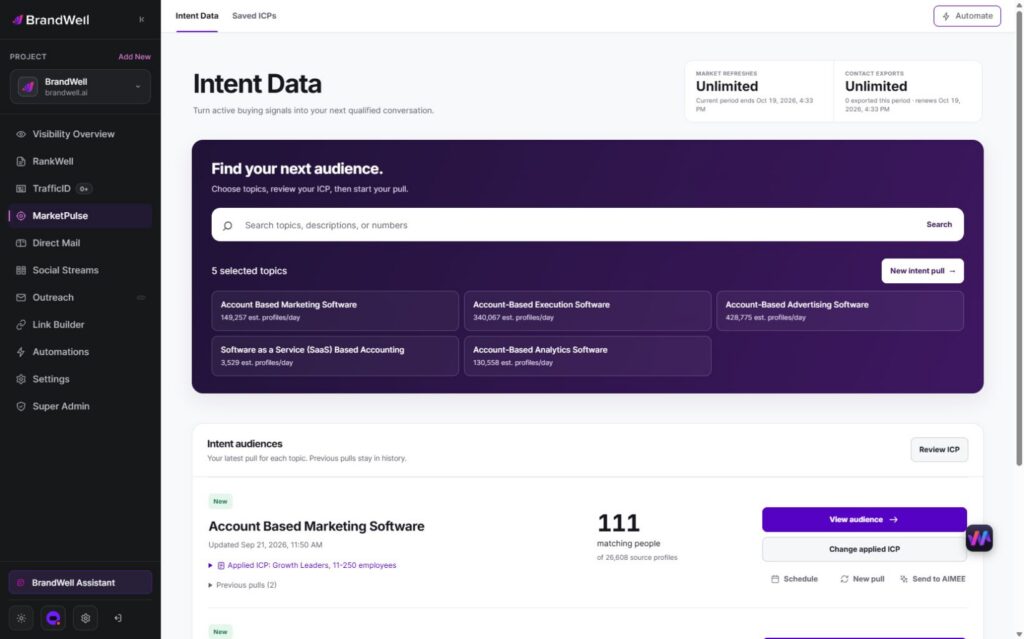
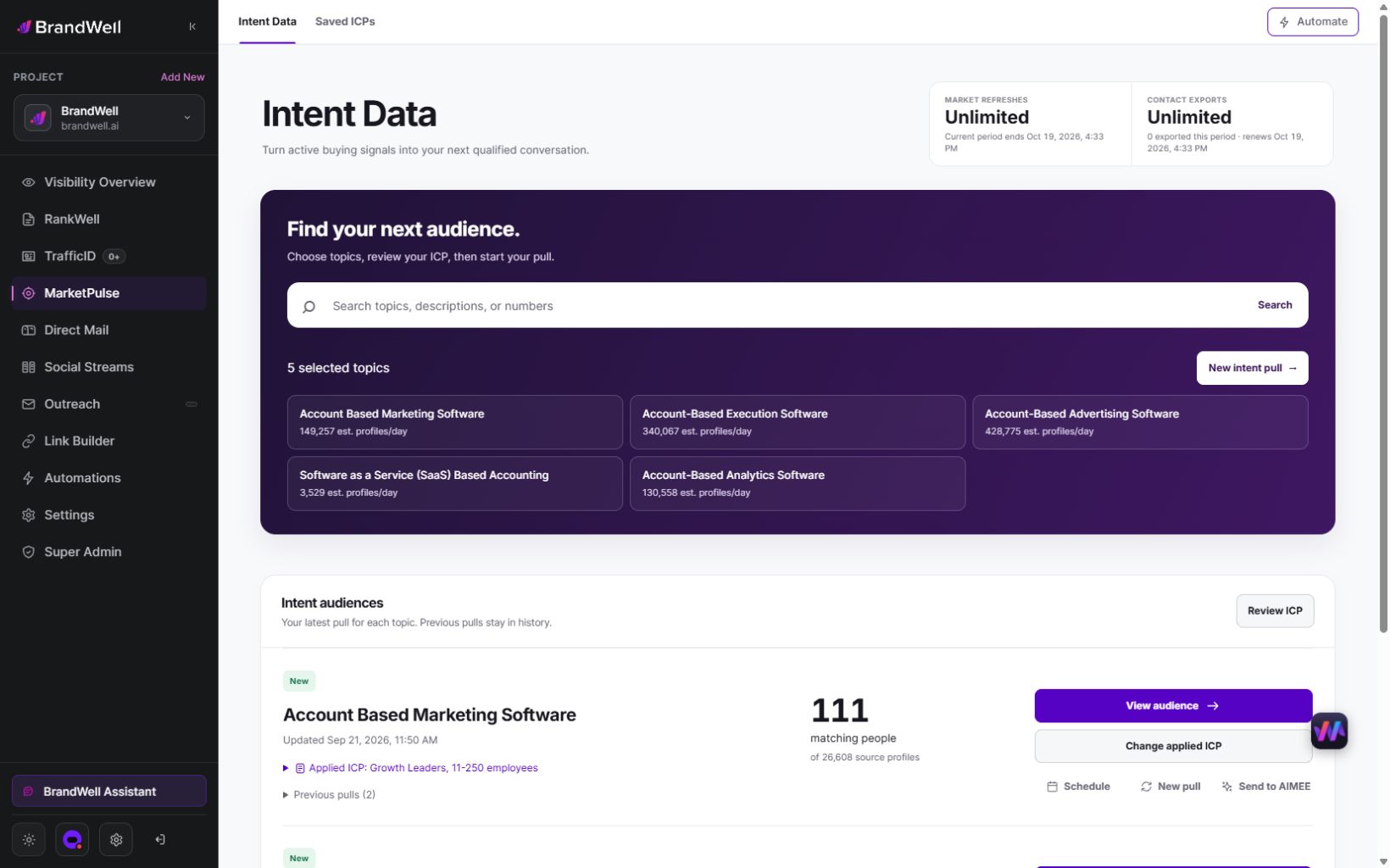
BrandWell MarketPulse: intent data starting at $500/mo. Find people researching topics relevant to what you sell, apply saved ICP filters, and review available contact details before taking action.
| Plan | Topics and refreshes | Monthly exports |
|---|---|---|
| Starter | 1 topic, weekly | 25,000 contacts |
| Growth | 3 topics, daily | 100,000 contacts |
| Scale | 10 topics, daily | Unlimited contacts |
Swipe the table to see all columns.
A pull retrieves available data from the previous 24 hours for one topic. Daily use across all included topics provides 90 Growth pulls or 300 Scale pulls in a 30-day month. Weekly Starter pulls vary by calendar month. Available audience size and contact fields vary, and audiences may overlap. Refreshes stop at the plan limit without overage charges.
- Find and qualify: search the topic catalog, save your ICP, and review the people and companies that match.
- Act on the research: export qualified contacts or prepare an Outreach or Direct Mail workflow. Connected products, channel usage, and fulfillment may cost extra.
- Get help from AIMEE: Growth and Scale include AIMEE for the initial user to research accounts and prepare the next step through connected tools.
Agencies and other service businesses can build client deliverables around their available Intent Scans and exports. Keep each client’s scope, permissions, and service fees clear. A subscription is not a promise of a white-label platform or exclusive access to a market.
Explore MarketPulse and watch the demo or compare plans starting at $500/mo. Any early-access discount is a separate, time-limited offer shown to an eligible recipient.
Test models against the same workload
Compare each operating model against actual capacity, required control, implementation effort, available skills, permitted client use, support and ongoing costs. A managed team, configured tool, feed, agency delivery or internal build can leave different responsibilities with the buyer. Verify those gaps rather than naming a universal winner.
Migration effort matters. Inventory current topics, account lists, suppression records, score thresholds, destinations, event IDs, reports, and contract rights. Run the new model in parallel long enough to compare accepted signals and actions. Never cut over based on a polished interface alone.
Calculate full operating and transition costs
Intent data managed services pricing may combine subscription, data, topics, accounts, users, client workspaces, implementation, professional services, media, enrichments, integrations, support, and overages. A vendor with no public numeric price should remain “quote required,” not receive an invented range.
Build three cost views:
- Cash cost: invoices, setup, data usage, media, and services.
- Operating cost: cash plus internal administration, review, routing, client support, sales enablement, and reporting.
- Risk-adjusted transition cost: operating cost plus likely rework, lock-in, export limitations, renewal exposure, and replacement effort.
MarketPulse research is starting at $500/mo. Verify current coverage, refreshes, exports and included tools on the product page. Managed delivery, client interfaces, custom integrations and reporting require separately verified implementation, rights and fees.
Separate accepted signals from incremental outcomes
Define the chain before launch: eligible accounts, delivered signals, accepted signals, activated accounts, reached accounts, positive responses, qualified meetings, opportunities, pipeline, and revenue. Add adoption, latency, duplicate rate, stale rate, rejection reasons, and cost per accepted signal.
Use a randomized holdout when practical. Otherwise phase rollout by comparable segment and document confounders. “Influenced pipeline” can describe overlap; it does not prove the service caused the opportunity. Require stable event IDs and destination dispositions so the service can be audited.
Check organizational readiness
Managed intent data services fit teams with a defined market, recurring activation use case, measurable destinations, executive ownership, and a real operations gap. They also fit agencies that can translate signal work into client decisions and support.
Avoid a managed service when the buyer has no agreed ICP, no response capacity, no clean account baseline, no permission model, or expects the vendor to repair strategy by delivering more rows. A self-service pilot or manual research benchmark may expose the real constraint at lower risk.
Preserve distinct evidence stages
An intent signal should not jump directly to outreach. First confirm that the account is eligible and fits. Resolve the entity at the necessary level. Check that the signal remains fresh for the action. Apply channel and suppression rules. Then record both the action and outcome.
This sequence is more useful than one opaque score because operators can explain why a record moved. A service provider should expose the evidence and let the buyer tune thresholds instead of hiding every decision in a black box.
Rehearse failures and ownership gaps
Major risks include ambiguous topics, biased observable populations, stale data, false account resolution, duplicate activations, hidden subcontractors, unclear client rights, automated outreach without review, weak exit terms, and a service RACI that leaves critical work unowned.
Verify actual source, permitted purpose, recipients, jurisdiction, responsibilities, contracts, access, retention, correction, suppression, deletion and incident ownership. Resolve outstanding requirements with qualified reviewers before action; a supplier assertion does not establish permitted use.
Before accepting implementation, run a failure-focused service rehearsal rather than checking only the happy path. Feed the workflow a valid account, an excluded customer, a duplicate, a stale signal, an ambiguous domain, a record from a restricted geography, and a destination outage. Confirm who sees each exception, which data is retained, how the provider communicates an incident, and when the client must approve a retry. Then ask an operator who did not design the workflow to reconstruct the decision from the event log. This acceptance test reveals whether “managed” means observable responsibility or merely a handoff into another queue. Put unresolved failures, remediation owners, and retest conditions in the launch record; do not waive them because a dashboard looks complete.
Scope a separate agency operating service
An agency package can include market definition, topic selection, weekly signal review, identity and enrichment QA, suppression, approved routing, account briefs, client reporting, workflow changes, and quarterly value review. State whether the agency or client operates campaigns and outreach. Give every recurring deliverable an owner, cadence, input, output, approval, and exclusion.
Review an available MarketPulse topic, saved ICP and actual preceding-24-hour matches for the approved research purpose. Keep uncertain company context visible. AIMEE can organize supplied context through configured tools; named owners approve actual exports, messages, audience uploads and CRM writes.
AIMEE can prepare a review brief through configured connected tools. Keep proposed actions separate from actual approvals and destination acknowledgements. Confirm the implementation and permissions before execution.
Review the MarketPulse demo and current plans, starting at $500/mo. Test a relevant topic, approved ICP, actual match details and operating effort. Review current guarantee conditions before purchasing or testing; a short evaluation cannot establish future pipeline or revenue.
Managed-service statement-of-work checklist
| Requirement | Evidence before commitment |
|---|---|
| Recurring deliverable | Actual input, output, period, acceptance and accountable owner |
| Implementation | Mappings, credentials, destination tests, maintenance and fees |
| Approvals | Permitted purpose, recipient, action, approver and exception route |
| Support | Hours, acknowledgement, diagnosis, restoration and closure definitions |
| Exit | Export rights, transfer format, revocation, retention and unresolved work |
Swipe the table to see all columns.
Copyable managed-service acceptance record
Scope: [Actual work, cohort, period and exclusions.] Ownership: [Buyer, supplier, agency and specialist responsibilities.] Evidence: [Sources, units, validation and uncertainty.] Action: [Approval, destination and acknowledgement.] Acceptance: [Unique outputs, critical failures and unresolved responses.] Cost: [Invoices, internal labor, corrections and transition assumptions.] Decision: [Launch, repair, hold or exit with owner and review date.]
Put supplier responsibilities in writing
NIST’s supply-chain risk guide recommends documented roles and communicated supplier requirements. This is cybersecurity guidance, not certification of a provider or evidence of a BrandWell service SLA.
More attempts do not mean more delivered outputs
A fictional service attempts 100 records: 80 accepted, ten rejected and ten unanswered. Fifteen retries create 115 attempts, not 115 unique delivered outputs. Correcting and accepting five rejected records raises unique acceptance to 85; reconcile unanswered responses rather than assuming success.
Compare full cost against the same workload
For the same fictional monthly scope, a $500 research subscription plus $1,200 internal labor and $300 QA totals $2,000. A $1,800 managed-service quote plus $400 buyer review totals $2,200. The quoted invoice is not the full operating cost. Verify equivalent outputs, rights, support and outcome definitions; these invented inputs are not BrandWell managed-service prices.
Separate transition assumptions from actual expenses
A fictional migration costs $2,000 setup, $1,000 overlapping subscriptions and $1,500 mapping and review labor: $4,500 actual defined transition cost. An unused $1,000 contingency remains a reserve, not another incurred expense. Track later correction and termination costs separately, and disclose excluded overhead, tax and financing.
Use outcome feedback without claiming causation
Forty fictional seller-accepted accounts include 30 with feedback and six qualified opportunities. Feedback coverage is 75%; opportunities are 20% of reported accounts or 15% of accepted accounts. Ten remain unresolved. Neither seller acceptance nor attributed pipeline proves incremental impact. Use an appropriate comparator and state its limitations.
Hold critical failures even when most tests pass
Nine of ten fictional acceptance tests pass, but the failing test delivers one client’s records to another client’s destination. A 90% pass rate does not authorize that path. Contain exposure, correct the boundary and verify the affected tests before launch.
Use current research within a separate operating scope
MarketPulse research is starting at $500/mo. Review a relevant topic, approved saved ICP and actual available matches. AIMEE can organize supplied context through configured tools; owners approve exports, messages, audience uploads and CRM writes. An agency team, managed service, client portal or custom synchronization requires separately verified implementation, rights and fees.
Frequently asked managed-service questions
Does managed describe a standard scope?
No. Verify actual tasks, staff responsibilities, deliverables, support and exclusions.
Is the invoice the full operating cost?
Include buyer review, integration, corrections, support and transition work.
Does a high test pass rate authorize launch?
Hold unresolved critical failures regardless of the aggregate rate.
Does MarketPulse include an agency operating team?
Verify separately contracted implementation, rights, staffing and fees.
Review current research: explore MarketPulse and current plans.
Reviewed and updated October 3, 2026.

Written by