On this page
- Who this is for
- Organize a review with the proposed TRACE checklist
- Review before selection, ingestion and activation
- Authoritative starting points
- Informal practices vs governed operations
- Cost and staffing
- Measure whether the controls operated
- Jurisdictions, roles, channels, and data that change the answer
- Test likely control failures
- Data minimization and a topic-approval policy
- What an agency must document
- Frequently asked questions
- A fictional suppression test
- Evaluate MarketPulse with a defined purpose
Before activating intent data, document its source, intended use, identity support, permitted action and responsible owner. A research signal is not proof of consent, purchase intent or a named person’s activity. Verify the channel requirements and controls separately from the usefulness of the research.
The following checklist is a proposed operational review for B2B teams and service businesses, not a compliance certification or legal opinion. Applicable requirements depend on the actual jurisdiction, recipient, source, data, channel, contract and organizational role. Have qualified reviewers resolve those requirements for the deployment.
Who this is for
This guide is for B2B companies, agencies, procurement teams, privacy leaders, security reviewers, RevOps, and sales or marketing operators that buy, resell, enrich, route, or activate intent and identity data. It is especially important when an agency works across multiple clients or when data moves into email, phone, social, advertising, AI, or browser automation.
Organize a review with the proposed TRACE checklist
TRACE is an author-proposed planning mnemonic: trace, review, authorize, control and evidence. It is not a regulator-approved framework, certification or complete statement of applicable law. Use it to organize questions for the responsible reviewers.
T – Trace data and purpose
Create a data inventory that records:
- vendor and original source class;
- first-party, partner, public, cooperative, inferred, or licensed origin;
- account-, household-, device-, or person-level identity;
- topics, behaviors, attributes, confidence, and observed time;
- geography and applicable restrictions;
- sensitive-data exclusions;
- collection notice, consent, lawful basis, or other permitted-use rationale;
- contract rights, resale rights, and destination limits;
- intended purpose and prohibited purposes.
The inventory should distinguish observation from inference. “Visited a pricing page” and “ready to buy” are not the same field.
R – Review roles, contracts, and risk
Determine who acts as controller, processor, service provider, contractor, data broker, reseller, independent business, or another legally relevant role in each data flow. Labels in a sales deck do not decide the role; actual purposes and control matter.
Review the master agreement, DPA, security terms, subprocessors, data-source warranties, permitted uses, restrictions, deletion, audit, breach notification, indemnity, client contact, offboarding, and cross-border transfers. An agency also needs a client agreement that allocates instructions, approvals, notices, suppressions, rights requests, incidents, and reporting.
Run privacy, security, and ethical risk assessments before launch and after material changes. Higher-risk cases include person-level identity, sensitive topics, large-scale profiling, unexpected collection, vulnerable populations, automated decisions, new jurisdictions, and combining datasets.
A – Authorize the channel and action
Build an action matrix. For each jurisdiction and recipient type, document whether the record may be used for:
- account research;
- CRM enrichment;
- sales task creation;
- email;
- phone or text;
- social outreach;
- advertising audience creation;
- personalization;
- AI-assisted preparation;
- automated browser execution;
- client reporting or resale.
Permission for one action does not automatically permit another. A contract allowing analytics may not allow cold email. A business address does not erase privacy or electronic-marketing rules.
C – Control identity, suppression, and automation
Before activation, check:
- identity confidence and contact validation;
- account/person distinction;
- employee, customer, partner, competitor, and active-opportunity exclusions;
- global, business-unit, client, and channel suppressions;
- objections, opt-outs, do-not-call, complaints, and rights requests;
- sensitive-topic and restricted-role filters;
- frequency and recency;
- human approval and escalation;
- error queues, retries, and rollback;
- least-privilege access, logging, retention, and deletion.
Do not let an agent or integration silently retry a restricted record. Exceptions should stop in a review queue.
E – Evidence outcomes and audit controls
Retain evidence that the control operated:
- vendor and source record;
- contract and version;
- purpose and authorization;
- field-level provenance where feasible;
- suppression check and timestamp;
- user or agent that approved and executed the action;
- message or audience version;
- delivery, reply, complaint, opt-out, and correction;
- retention and deletion;
- incident, root cause, and remediation;
- client approval and periodic review.
Evidence should be useful enough to answer a rights request, client question, regulator inquiry, security review, or internal incident – not just prove that a checkbox existed.
Review before selection, ingestion and activation
Before vendor selection
- [ ] Define the purpose and business outcome.
- [ ] Identify jurisdictions, industries, recipient types, and channels.
- [ ] Classify signal and identity data, including sensitive inferences.
- [ ] Map the original data sources and all downstream recipients.
- [ ] Determine organizational roles for each flow.
- [ ] Review public claims against contracts and technical evidence.
- [ ] Assess security, subprocessors, transfers, retention, and deletion.
- [ ] Verify the specific client-delivery, export and activation rights required by the service.
- [ ] Design a representative acceptance test.
Before data ingestion
- [ ] Approve topics and exclude sensitive or ambiguous categories.
- [ ] Document the permitted purpose and legal rationale.
- [ ] Configure market, role, identity, freshness, and confidence rules.
- [ ] Import all relevant suppression lists.
- [ ] Test tenant separation and least-privilege access.
- [ ] Create provenance, audit, exception, correction, and deletion fields.
- [ ] Verify the client has supplied required notices, consents, or instructions.
- [ ] Set retention and automatic expiration.
Before outreach or audience activation
- [ ] Recheck fit, identity, geography, and observed time.
- [ ] Confirm source and destination permission.
- [ ] Check global, client, and channel suppressions.
- [ ] Check customer, opportunity, partner, employee, and competitor conflicts.
- [ ] Apply frequency limits and stop rules.
- [ ] Remove sensitive inferences from external messaging.
- [ ] Obtain the required human or policy approval.
- [ ] Log the action, version, operator, and evidence.
After activation
- [ ] Capture delivery, disposition, complaint, opt-out, and correction.
- [ ] Route rights requests to all relevant systems and vendors.
- [ ] Investigate false matches and suppression failures.
- [ ] Delete or expire records on schedule.
- [ ] Reconcile client and platform suppressions.
- [ ] Review access and exports.
- [ ] Report control effectiveness and incidents.
- [ ] Reassess when a vendor, purpose, source, model, channel, or jurisdiction changes.
Authoritative starting points
Review commercial-email, calling, texting and applicable state or sector rules separately. The channel and audience determine the questions to resolve; no single operational checklist provides a universal authorization to contact people.
The California Attorney General’s CCPA resources describe consumer rights and responsibilities for covered businesses. Determine coverage, the actual data flow and current requirements before applying the workflow; this guide does not make that determination.
ICO data-broker guidance places responsibility on buyers too and calls for due diligence. It is under review following UK legislative changes.
For relevant EU processing, review the European Commission’s GDPR principles overview, including purpose, necessary data, correction, retention and accountability. National electronic-marketing requirements need separate review.
These links are evidence starting points, not a universal checklist.
Informal practices vs governed operations
- “The vendor says it is compliant”: Map source, role, purpose, contract, and applicable rules. Review purpose: Compliance obligations are shared and fact-specific.
- One master list for every client: Separate tenants, instructions, access, and suppressions. Review purpose: Prevents leakage and conflicting requests.
- Account signal treated as person behavior: Preserve identity level and confidence. Review purpose: Reduces false and invasive claims.
- Every signal triggers outreach: Apply fit, permissions, channel rules, and approval. Review purpose: Prevents uncontrolled processing.
- Opt-out stored in one sending tool: Reconcile global, client, channel, and vendor suppressions. Review purpose: Stops re-entry through another system.
- Keep data indefinitely: Set purpose-based expiration and deletion. Review purpose: Reduces stale decisions and exposure.
- Audit only after an incident: Test controls and exceptions continuously. Review purpose: Finds failures before they compound.
Vendor due diligence without operating controls is incomplete. Operating controls without source and contract diligence are also incomplete.
Cost and staffing
Budget the proposed workflow: data and platform access, professional review, contracts, integration, access controls, suppression, requests, evidence, training, incident handling and continuing operations. Spending on these items does not by itself establish compliance.
data/platform + privacy and security review + contract work + integrations + access controls + suppression + rights handling + audit evidence + training + incident response + ongoing operations
Pricing may be subscription, records, credits, topics, clients, modules, API calls, or a custom package. Add internal and external professional time. A smaller data purchase can be more expensive if it requires extensive manual lineage and correction; a broad platform can be more expensive because it creates more data flows and users.
Assign:
- an executive or business owner for purpose and risk;
- privacy/legal for rules, roles, notices, and contracts;
- security for access, transfer, vendors, and incidents;
- RevOps or marketing operations for data flow and suppressions;
- channel owners for permitted execution;
- procurement/vendor management for ongoing assurance;
- an agency client owner for instructions and evidence.
Measure whether the controls operated
Measure whether controls work:
- percent of active data flows inventoried;
- percent with current purpose, role, contract, and retention;
- records missing source, observed time, identity level, or permission fields;
- suppression match and propagation success;
- unauthorized, stale, duplicate, or wrong-person activation;
- opt-out and rights-request completion time;
- access reviews and anomalous exports;
- agent or integration actions requiring rollback;
- vendor changes reviewed before release;
- incidents, root causes, repeat failures, and remediation;
- client approvals and audit exceptions.
Intent data outreach compliance ROI should be framed carefully. Governance protects buyers, reduces operational and regulatory exposure, improves data quality, and prevents wasted activity; it should not be justified by invented revenue. Report avoided rework, fewer bad activations, faster rights handling, and reliable client evidence alongside program cost.
Jurisdictions, roles, channels, and data that change the answer
The control set changes with:
- country, state, and recipient location;
- company versus individual or sole-trader recipient;
- email, phone, text, social, advertising, direct mail, or offline use;
- first-party, public, brokered, cooperative, inferred, or sensitive data;
- account-level versus person-level identity;
- controller/processor/service-provider/broker/reseller relationships;
- consumer versus business context;
- regulated industries and professional obligations;
- automated decision-making, profiling, or high-impact use;
- children, health, financial, precise location, employment, or other sensitive contexts;
- transfers, subprocessors, and data residency.
Do not create one global “B2B compliant” toggle.
Test likely control failures
Prioritize:
- undocumented data origin or resale chain;
- person-level identity built from an account-level signal;
- sensitive topic inference used for targeting;
- outreach without an appropriate channel analysis;
- suppressions not shared across tools or clients;
- automated activation without approval or exception handling;
- client data leakage or excessive agency access;
- stale records and indefinite retention;
- rights requests that do not reach vendors and derived systems;
- claims that a vendor or exclusivity contract guarantees compliance.
Reduce risk with narrow purposes, minimal data, transparent source fields, representative tests, expiration, approvals, least privilege, reconciled suppressions, monitored exceptions, and reversible automation.
Data minimization and a topic-approval policy
Minimization is not merely deleting fields after collection. Start by asking which data is necessary for the defined decision. An account-level topic signal may be sufficient for market analysis or an account-research task; person-level enrichment may add risk without improving the action. A time-limited score may be sufficient; a permanent behavioral history may not be.
Create a topic policy with allowed, review-required, and prohibited categories. Review-required topics may reveal health, finances, employment, politics, religion, children, precise location, legal problems, or other sensitive circumstances even when the vendor labels them “B2B.” Consider combinations: an ordinary job title plus a topic and location can create a sensitive inference. Record the reviewer, decision, permitted use, market, and expiration.
Test reports and workflows with the minimum identity needed. Redact or aggregate client-facing artifacts where detail does not improve the decision. Delete rejected and expired records rather than retaining them “just in case.” Minimization makes permissions, access, rights handling, incident response, and buyer expectations easier to manage.
What an agency must document
Before selling the service, maintain:
- service description and prohibited uses;
- data-flow and system diagram;
- source and vendor register;
- role and responsibility matrix;
- client instructions and approval record;
- topic and sensitive-data policy;
- jurisdiction/channel action matrix;
- suppression and rights-request procedure;
- access, tenant, credential, and export controls;
- retention and offboarding schedule;
- agent-workflow boundaries and logs;
- incident and correction procedure;
- control metrics and client report;
- contract, DPA, security, and subprocessor evidence.
Frequently asked questions
Does a vendor’s compliance claim make outreach compliant?
No. The buyer and agency remain responsible for their roles, purposes, data use, notices or consent where required, channel rules, suppressions, security, rights handling, and evidence.
Is an intent signal proof of consent?
No. Intent and consent answer different questions. A research signal may inform prioritization; permission to use data or contact someone requires a separate analysis.
Which platform is best for compliance?
No platform selection establishes compliance. Evaluate the exact product configuration, source rights, intended actions and contractual commitments. Verify required controls rather than assuming a native white-label or enterprise-governance service.
How often should controls be audited?
Continuously monitor operational controls and perform formal reviews on a defined cadence and after material changes, incidents, vendor changes, new data sources, new channels, or new jurisdictions.
Can AI agents execute compliant workflows?
Use AI for preparation through configured tools and permitted access. Approve the action scope, inputs, credentials, logging and exceptions before execution. An agent cannot determine compliance or remove the organization’s accountability.
A fictional suppression test
Suppose a test queues 50 records for an approved action. Ten have a suppression state. The workflow blocks all ten and routes the remaining 40 for review. That is 10/10 successful blocks among the known suppressed test cases, not proof that every production opt-out is captured.
Repeat with a missing suppression field, a stale permission state, a retry, a client mismatch and a downstream failure. Record the expected decision, actual decision, destination response and correction. Keep unknown states in review. These are proposed tests, not BrandWell’s measured control results.
Evaluate MarketPulse with a defined purpose
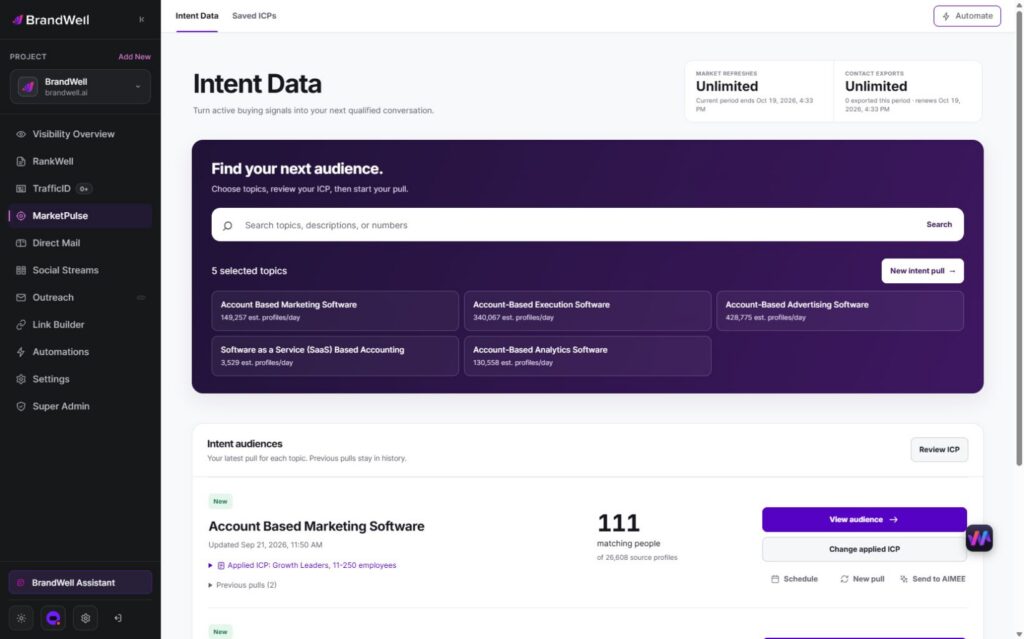
MarketPulse provides topic research with standard plans starting at $500/mo. Growth includes three topics with daily pulls; Scale includes ten topics with daily pulls. Available fields and audiences vary, and audiences can overlap.
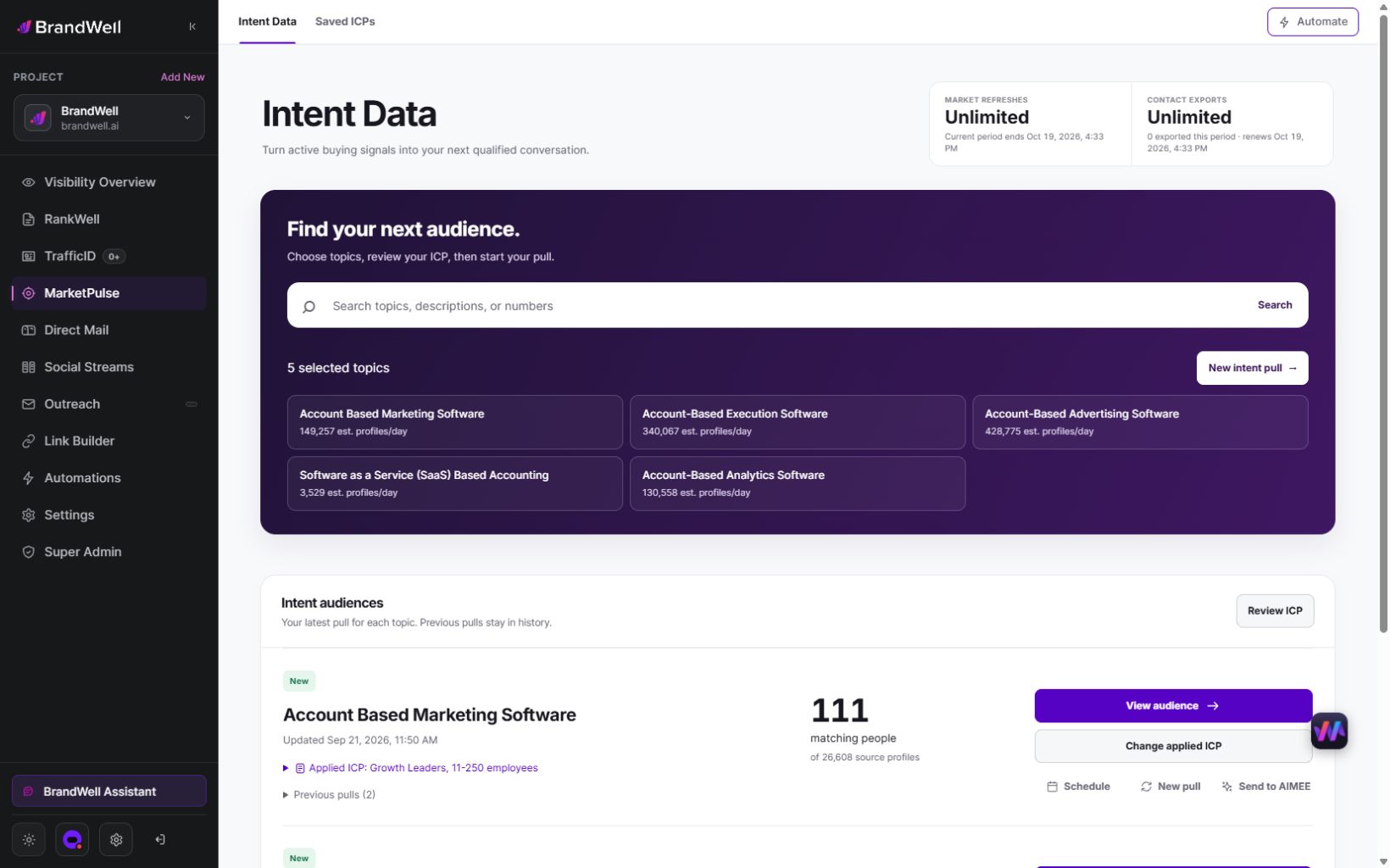
Review a relevant topic using your ICP and evaluate the available records. Before external activation, confirm the intended use, destination support and required permissions. Verify contract-specific controls and client requirements rather than assuming every proposed checklist item is a native product feature.
AIMEE can help prepare research and tasks through configured tools. Keep credentials, consequential action approvals and exceptions within the authorized workflow.
Watch the MarketPulse demo and compare current plans or browse BrandWell’s product directory.
Reviewed and updated October 3, 2026.

Written by