Direct answer: An intent-data reseller platform should let an agency contractually sell the service, protect each client tenant, brand delivery, set retail pricing, own end-client billing, configure signal/data modules, activate and report outcomes, and reconcile wholesale usage without hiding rights or margin. “Partner,” “agency,” “DaaS,” and “reseller” are not interchangeable; the order form and operating proof decide what is real.

Who this is for: Agency owners, GTM and RevOps consultants, demand-generation firms, data-service resellers, and procurement leaders comparing client billing, white-label delivery, wholesale economics, and governance.

Select a reseller operating model, not just a data source

Start with the operating model. The agency needs one contract and evidence model for its wholesale relationship, and a separate client scope, invoice, data-purpose record, workspace, approval trail, deliverable, and outcome ledger for every end customer. A platform that supplies good data but no resale rights, tenant boundaries, billing control, or client-ready delivery is an input – not a reseller business.

Define exactly what the client buys: topic monitoring, website identification, enrichment, validation, audiences, prospect research, reports, automation instructions, managed activation, or a combination. Then specify who owns the data purpose, advertiser or sender account, approvals, support, errors, opt-outs, security incident, and deletion. Price the work around that scope.

Five intent-data reseller platforms to evaluate

Disclosure: BrandWell owns and publishes this article. BrandWell appears first because it is our product; every option is evaluated using the same disclosed criteria, and another provider may be a better fit for some buyers.

The shortlist includes providers with official evidence of agency, partner, reseller, DaaS, channel, or white-label positioning. The degree of white label, resale authority, tenant isolation, and billing differs materially. It is not exhaustive and does not imply that every option supplies the same intent data. We apply the same ten criteria to each company; homepage images identify vendors but are not linked evidence.

  • Contractual resale and data-use rights
  • Agency branding and domain control
  • Client and tenant isolation
  • Agency-controlled retail pricing
  • End-client billing ownership
  • Signal and data types plus real-ICP coverage
  • Client reporting and activation
  • Onboarding, support, and pilot
  • Wholesale economics, overages, and term
  • Privacy, security, suppression, and auditability

1. BrandWell

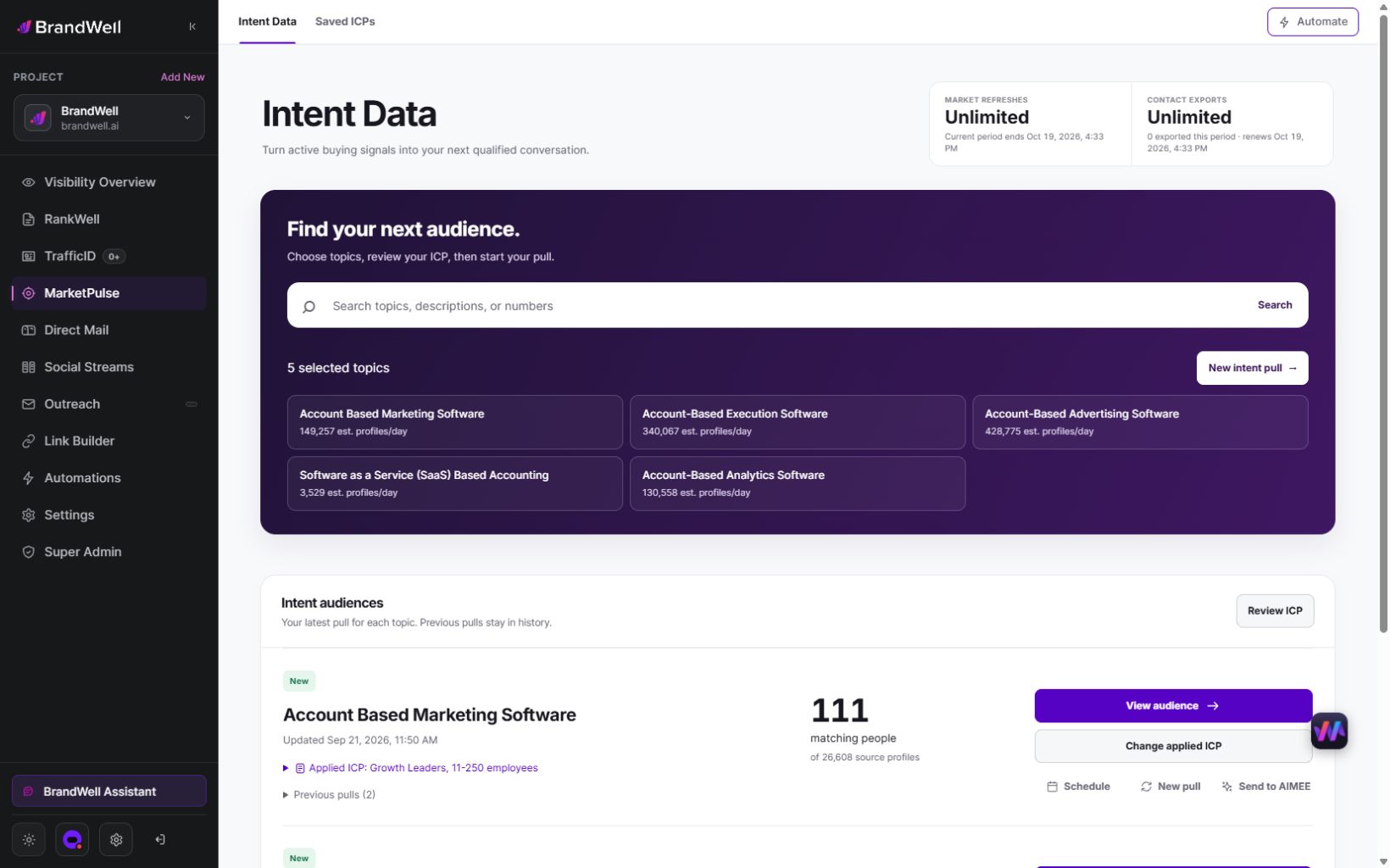
BrandWell homepage hero
BrandWell homepage hero. Brand names and site imagery belong to their respective owners.

Contractual resale and data-use rights: For an approved reseller order, scope the right to sell the defined intent-data service, use each module for named client purposes, deliver branded outputs, and pass only permitted fields to approved destinations. The signed order and data terms – not a marketing summary – control.

Agency branding and domain control: Can be scoped as a complete white-label sales and delivery engine with agency-branded components, topic reports, client presentation, and workflow materials. Confirm exactly which portal, domain, email, report, module, support, and sales assets are included.

Client and tenant isolation: The agency should require separate client workspaces, roles, credentials, sources, topics, exports, instructions, approvals, reports, costs, and retention. Test that one client’s data and commercial terms cannot appear in another tenant.

Agency-controlled retail pricing: The intended reseller model lets the agency set its retail packages and prices. Wholesale fees, enabled modules, topic usage, client capacity, custom work, and overages still determine minimum viable margin.

End-client billing ownership: The agency owns the client commercial relationship and end-client billing in the intended model. Define taxes, refunds, failed payments, credits, disputes, service suspension, data deletion, and what BrandWell invoices the agency.

Signal and data types plus real-ICP coverage: Configurable off-site topics and website identification can be joined to LeadFuze-powered identity/enrichment and validation. Every agency should test topics, geographies, company bands, personas, fields, freshness, and usable client activation against real ICP samples.

Client reporting and activation: Branded topic reports and governed routing can support CRM, reviewed outbound, ads, research, and client operating reviews. Agent-ready workflow instructions may be reviewed in Claude or ChatGPT; Moxby is a separate optional browser product for direct execution.

Agencies can purchase BrandWell’s $70 seven-day reseller pilot. It includes agency-branded topic reports and the complete sales playbook under the current written pilot terms. Other product capabilities and any topic exclusivity remain subject to their separate current written scope. Use it to validate coverage, report usefulness, client conversation, operator effort, and next-step evidence, not to guarantee revenue.

Wholesale economics, overages, and term: Public pricing is custom quote. Internal approval-gated planning is $2,500–$5,000 per month depending on topic count, term, enabled scope, and any written topic-protection option; the low end is $2,500/month. Current pricing approval and the signed quote control. Model client onboarding, support, activation, media, and agency labor separately.

Privacy, security, suppression, and auditability: Require current evidence for provenance, permissions, controller/processor or independent roles, subprocessors, access, tenant separation, encryption, retention, deletion, incident response, suppressions, rights handling, audit logs, and agent access. This offer is distinct from the legacy BrandWell SEO writer.

Meaningful limitation: Public numeric pricing and broad product proof are absent; coverage and every approval-gated reseller claim must be validated. Topic exclusivity or protection may exist only for specific topics, territories, scopes, terms, and written availability – never as a universal promise.

2. AudienceLab

AudienceLab homepage hero
AudienceLab homepage hero. Brand names and site imagery belong to their respective owners.

Contractual resale and data-use rights: Positions DaaS and reseller-oriented options, but its base terms restrict white-label or resale use unless an agreement permits it. Obtain explicit written rights for audience creation, client delivery, resale, sublicensing, exports, destinations, and each client category.

Agency branding and domain control: Potential fit for agencies exploring audience infrastructure and agency branding. Verify custom domain, portal, logos, reports, communications, user experience, support identity, and whether the end client can see the underlying vendor.

Client and tenant isolation: Request a demonstration of tenant boundaries, per-client sources, destinations, credentials, exports, roles, deletion, and logs. Marketing use of “agency” or “DaaS” does not itself establish isolation.

Agency-controlled retail pricing: Confirm whether the agency can freely set retail pricing or must follow plan, volume, minimum-advertised-price, channel, or usage constraints. Document how plan changes affect existing client packages.

End-client billing ownership: Determine who contracts with and invoices the end client, which party handles taxes, refunds, disputes, failed payments, credits, suspension, and cancellation, and whether vendor communication bypasses the agency.

Signal and data types plus real-ICP coverage: Test the actual data and audience products against the agency’s B2B segments, geographies, identity requirements, freshness, required fields, and destinations. Product positioning is not a coverage benchmark.

Client reporting and activation: Validate audience construction, activation destinations, report export, client-facing evidence, match diagnostics, outcome writeback, and correction workflows. Separate platform attribution from causal client results.

Onboarding, support, and pilot: Ask for the reseller onboarding plan, support ownership, implementation, training, client migration, proof environment, response SLAs, and escalation. A stale promotion element on a marketing page is a reason to recheck the current offer.

Wholesale economics, overages, and term: A public selector displayed monthly plan points of $497, $997, $1,500, $1,997, and $3,500. Treat these as page observations, not a scope-matched reseller quote; verify current inclusions, eligibility, term, credits, overages, support, and written resale rights.

Privacy, security, suppression, and auditability: Review provenance, notice and rights, source contracts, suppression, client sharing, access, security, retention, deletion, subprocessors, incidents, audit logs, and authorization for every destination and client.

Meaningful limitation: The base contract may not permit the white-label/resale use an agency expects, and the current plan, tenant, billing, promotion, and support scope require written verification. A lower plan price may not represent a complete managed client service.

3. Visitor InSites

Visitor InSites homepage hero
Visitor InSites homepage hero. Brand names and site imagery belong to their respective owners.

Contractual resale and data-use rights: Positions visitor identification, buyer-intent audiences, and a reseller portal. The agency still needs written rights to resell each data type, operate for end clients, use destinations, export fields, and present vendor-derived evidence.

Agency branding and domain control: Potential fit for smaller agencies seeking visitor and audience services with a branded presentation. Verify custom domain, portal branding, report design, communications, support visibility, and which artifacts can carry only the agency brand.

Client and tenant isolation: Test per-client pixels or configurations, data storage, credentials, users, exports, audience destinations, retention, deletion, and logs. Confirm how shared agency users are prevented from mixing tenants.

Agency-controlled retail pricing: Get the wholesale schedule and confirm whether the agency can set retail pricing across visitor identification, audience products, reports, and services. Include promotions, usage thresholds, client minimums, and future plan changes.

End-client billing ownership: Document who invoices clients and handles subscriptions, usage reconciliation, taxes, failed payments, refunds, disputes, suspension, and offboarding. A reseller portal does not automatically include end-client billing control.

Signal and data types plus real-ICP coverage: Test website/company resolution, buyer-intent audience sources, B2B ICP coverage, identity confidence, freshness, required fields, false positives, and available suppressions. Visitor and off-site intent are different evidence types.

Client reporting and activation: Validate branded reports, audience exports, approved destinations, match feedback, usage statements, client explanations, correction handling, and outcome reconciliation. Avoid presenting visitor or audience records as certain named buyers.

Onboarding, support, and pilot: Request a representative proof, onboarding checklist, pixel or source setup, data review, destination test, support SLA, reseller enablement, and offboarding process. Promotional pricing should not dictate the test scope.

Wholesale economics, overages, and term: Website Visitor ID was shown from $299/month; Buyer Intent Audiences was shown at a limited promotional $999/month with $1,599 displayed as the normal amount. High-volume/reseller terms are quote-based and usage rates may apply. Recheck current written pricing and inclusions.

Privacy, security, suppression, and auditability: Review source and match methods, privacy notices, permitted uses, opt-outs, suppression, client instructions, security, access, retention, deletion, subprocessors, auditability, and incident duties for each product.

Meaningful limitation: The visible intent-audience price was promotional, while usage, wholesale economics, tenant separation, billing control, and contract rights were not established by the public page. Obtain a complete current reseller order before comparison.

4. USADATA

USADATA homepage hero
USADATA homepage hero. Brand names and site imagery belong to their respective owners.

Contractual resale and data-use rights: Positions agency/reseller and white-label data services. Obtain the exact agreement for list ordering, enrichment, API use, client delivery, resale, destination activation, permitted industries, retention, and whether end clients receive any direct rights.

Agency branding and domain control: Potential fit for agencies wanting branded audience and lead ordering, enrichment, list services, APIs, and a portal. Verify domain, branding, report, order flow, client login, support visibility, and what remains vendor-branded.

Client and tenant isolation: Test per-client lists, users, API keys, credits, exports, order histories, custom audiences, deletion, and logs. Confirm that shared data and suppression files do not cross clients.

Agency-controlled retail pricing: Official agency/reseller positioning supports agency-set retail pricing. Confirm any wholesale minimums, suggested prices, volume tiers, restricted uses, client limits, and how per-record price changes flow into retail packages.

End-client billing ownership: Determine whether the agency invoices the client directly and owns tax, refund, dispute, credit, chargeback, and collection processes. Define who can contact the end client and what happens to data when the commercial relationship ends.

Signal and data types plus real-ICP coverage: The offer is broad audience, lead, enrichment, mailing-list, and API data; it may not supply off-site B2B topic intent. Test the exact dataset against the agency’s ICP, required fields, freshness, validation, and activation.

Client reporting and activation: Validate ordering, enrichment, export, API, audience delivery, client reporting, corrections, and downstream match. The agency may need to build its own signal taxonomy, workflow instructions, outcome loop, and managed service.

Onboarding, support, and pilot: Request reseller onboarding, portal and API setup, sample data, data dictionary, support, usage reconciliation, client migration, and offboarding. A sample should include positive, negative, no-match, stale, and suppressed cases.

Wholesale economics, overages, and term: Official agency/reseller pages say no subscription or platform fee and usage/base pricing per record with volume discounts. Current reseller rates are separately quoted. Model minimum orders, record usage, API work, enrichment, validation, operations, and client support.

Privacy, security, suppression, and auditability: Review source rights, data provenance, notice, direct-marketing and telemarketing use, suppression, access, security, retention, deletion, subcontractors, client instructions, and compliance claims for the exact data ordered.

Meaningful limitation: The offer centers broad audience and lead data rather than necessarily off-site topic intent or a complete recurring intent-service engine. Wholesale schedules and data-use rights are private, and regulatory compliance cannot be inferred from a marketing claim.

5. Versium

Versium homepage hero
Versium homepage hero. Brand names and site imagery belong to their respective owners.

Contractual resale and data-use rights: Offers enrichment, audience append, identity resolution, API/MCP access, and channel-partner positioning. Get written rights for client work, co-branding or white label, resale, derived outputs, API use, exports, destinations, retention, and subresellers.

Agency branding and domain control: The partner page describes co-branded support, which is not necessarily full white label. Verify portal, domain, report, API response, communications, support, documentation, and whether the vendor remains visible to clients.

Client and tenant isolation: Test client-level keys, files, projects, credit pools, users, models, exports, logs, retention, deletion, and support access. Confirm how an agency prevents a prompt, API job, or upload from using another tenant’s data.

Agency-controlled retail pricing: Determine whether the agency can set retail prices for enrichment, audience, identity, API, and services and whether partner discounts, tier floors, usage pools, or co-selling requirements constrain packaging.

End-client billing ownership: Clarify whether the agency bills clients, the vendor co-sells or invoices, and who owns taxes, refunds, usage disputes, credits, service suspension, contract changes, and offboarding.

Signal and data types plus real-ICP coverage: Potential fit for data consultancies needing enrichment and identity services. Verify whether required intent signals exist separately; test B2B ICP coverage, match confidence, fields, recency, validation, and source rights.

Client reporting and activation: Validate file and API delivery, CRM or audience destinations, MCP or agent controls, client reporting, match diagnostics, corrections, and outcome evidence. Agent access needs the same minimization and tenant controls as other integrations.

Onboarding, support, and pilot: Request sample files or API tests, partner onboarding, solution design, credit planning, support and escalation, migration, and deletion. Confirm whether sales enablement is partner, co-sell, or full reseller support.

Wholesale economics, overages, and term: The current pricing page showed a $125 minimum per file, credit packages from $250, a table subscription start of $5,000, and a separate FAQ statement of $3,600/year; annual plans paid monthly were shown from $10,000. Treat the page as internally inconsistent and require a current quote.

Privacy, security, suppression, and auditability: Review provenance, identity methods, permitted uses, source rights, consent or lawful basis where applicable, suppression, security, access, retention, deletion, subprocessors, MCP/API credentials, logs, and incident responsibilities.

Meaningful limitation: Public material indicates co-branded rather than clearly full-white-label support, and the pricing page contains conflicting subscription starting figures. The agency must obtain one controlling written price, scope, and rights schedule.

Reseller platform, ABM suite, point tool, or in-house

Choose a reseller platform when the agency needs contractual resale, branding, tenants, module control, retail packaging, billing ownership, and repeatable delivery. Choose an enterprise ABM suite when the end client wants to operate a broad internal GTM platform and the agency mainly implements it. Choose a point data or identity tool when the agency has already built its portal, billing, workflow, and governance. Build in-house only when proprietary workflow and margins justify product, security, support, and compliance obligations.

An affiliate or referral program pays for introducing the vendor and generally leaves the client with the vendor. Co-branded partnership leaves both brands visible. Managed service means the agency operates a tool but may not have resale rights. DaaS can describe data delivery without a client portal or billing. Ask the vendor to classify the exact offer in the contract.

Workflow, data, integrations, and team required

  1. Define client ICPs, topics, signals, fields, outputs, destinations, service levels, exclusions, and qualified outcomes.
  2. Negotiate resale and data-use rights, branding, tenants, billing ownership, wholesale usage, overages, support, security, termination, and deletion.
  3. Create a client intake, purpose record, data map, topic brief, role matrix, suppression file, approval matrix, and commercial scope.
  4. Configure a separate workspace and credentials; test positive, negative, ambiguous, no-match, cross-tenant, rollback, and offboarding cases.
  5. Run a bounded client pilot, reconcile source through delivery and action, and obtain approval before expanding data, destinations, users, or spend.
  6. Invoice the client, reconcile wholesale usage and margin, report qualified evidence, handle corrections and rights, and review renewal fit.

The agency needs a service owner, commercial/billing owner, data operations, QA, client strategist, activation specialist, RevOps/analytics, security/privacy lead, and escalation counsel appropriate to the work. Small teams may combine roles but should not remove separation between building, approving, releasing, and billing.

Connect signals, identity, freshness, activation, and evidence

A reseller should expose the full signal chain in client-facing language: account fit, signal source and topic, identity state, freshness, permitted use, suppression, destination acceptance, match, action, disposition, outcome, cost, and limitation. White labeling should change presentation, not erase provenance or make probabilistic evidence certain.

Store upstream evidence privately and show clients the level needed to make a decision. A topic surge can prioritize an account without proving a person; a visitor/company match can guide research without proving identity; a valid contact supports delivery checks without creating consent; a platform match enables reach without proving the ad caused pipeline.

Wholesale pricing, retail packaging, and total cost

Model reseller unit economics by client: wholesale platform allocation + topic/signal usage + identity/enrichment/validation + portal and integrations + setup + operator/analyst/QA hours + client success + reporting + activation or media operations + support + billing + privacy/security + exception reserve. Then add the contribution needed to fund sales, management, churn, and product change.

Separate a setup or diagnostic fee, recurring base scope, variable usage, managed activation, ad spend, and custom work. Do not compare a per-record product with a full white-label service as if both were subscriptions for the same thing. Quote-required and inconsistent public pricing should remain visibly uncertain until a current scope-matched written offer controls.

Best-fit agencies and use cases

Best-fit agencies have a defined niche, enough clients or pipeline to reuse the operating system, confidence selling a business outcome, data and media competency, client success capacity, and discipline around tenant separation and claims. GTM consultants can begin with topic reports and research; demand-gen agencies can add activation; data firms can build enrichment and identity services.

Poor fits are agencies seeking passive affiliate revenue, unwilling to own billing or support, unable to explain signal limits, dependent on prohibited sensitive targeting, or lacking client approval and outcome systems. A referral partnership or a narrow implementation service is safer until the agency can operate a recurring product.

Measure reseller economics and client outcomes

Track clients acquired, time to first useful report, pilot-to-recurring conversion, active modules, wholesale usage, gross and contribution margin, operator hours, support burden, corrections, billing disputes, retention, expansion, and churn. Pair those commercial measures with usable signal coverage, client action, destination match, qualified opportunities, and gross profit.

Do not report vendor-attributed pipeline as incremental agency value. Reconcile unique accounts and opportunities, show denominators, and use holdouts or staggered activation where feasible. The service is healthy when clients make better, timely decisions and margin survives support, exceptions, and data change.

Tenant, privacy, billing, and client-trust risks

Reseller risk is multiplied by clients. A single error can expose another tenant’s records, instructions, pricing, reports, ad account, suppression list, or API credential. Use least privilege, client-specific keys, environment separation, approved exports, secure transfer, logging, reconciliation, retention/deletion, tested offboarding, and an incident plan. The NIST Privacy Framework can help organize privacy risk, but it is not a certification or legal advice.

Review sources, notices, lawful basis or consent where applicable, direct-marketing and telemarketing rules, client and vendor roles, sale/sharing analysis, rights handling, subprocessors, cross-border transfers, sensitive categories, destination terms, security, AI-agent access, and contractual indemnities. The ICO guidance for organizations using brokered data underscores that buyers retain due-diligence responsibilities.

Build a durable recurring intent-data service

A durable offer has a narrow promise, standardized intake, client-specific configuration, recurring evidence, defined actions, measurable outcomes, and a renewal decision. Start with one niche and one module bundle. Productize the topic brief, coverage test, report, activation checklist, monthly review, billing statement, and exception process before adding more data or channels.

Use pilot evidence to decide whether to stop, correct, narrow, or expand. Client reports should include topic and scope changes, signal counts with denominators, fit and identity states, freshness, suppressions, activation results, qualified outcomes, cost, limitations, and next actions. Never use a white-label surface to conceal material vendor, data, or methodology information a client needs.

Common questions

Does white label mean the agency owns the data?

No. Branding, licensing, data ownership, permitted use, derived outputs, retention, deletion, resale, and client rights are separate contract questions. Confirm each in writing.

Should the platform bill end clients?

That can reduce agency operations but weakens billing control and may expose the vendor relationship. If the agency bills, it assumes tax, collection, refunds, usage reconciliation, disputes, and suspension work. Choose intentionally.

How should an agency test tenant separation?

Use test clients with distinct topics, sources, users, exports, credentials, pricing, suppressions, and reports. Attempt unauthorized search, export, prompt, support, billing, deletion, and destination access; preserve evidence and require remediation.

Is the lowest wholesale price the best option?

No. Compare scope-matched usable coverage, rights, activation, client experience, support, operating labor, reliability, and churn risk. Cheap records can produce an expensive service when the agency must repair them.

How the $70 seven-day reseller pilot works

Agencies pay $70 for seven days of pilot access. BrandWell generates topic reports with the agency’s branding and provides the complete sales playbook for presenting the service and seeking client commitments before the agency enrolls in a full plan.

The purpose is to validate demand and help the agency check whether expected client commitments cover its costs before treating the service as a profit center. Client commitments, cost coverage, and profit are not guaranteed. Review the $70 seven-day reseller pilot.