On this page
- Current MarketPulse research workflow
- Define work units and constraints
- Inventory seven workflow checks
- Compare seven capacity methods
- Test automation, staffing or scope changes
- Calculate role-hours and defined costs
- Track queues, blocked time and service levels
- Scope actual tier complexity
- Forecast each signal-to-action stage
- Reserve capacity by required skill
- Write enforceable service guardrails
- Copyable service-capacity test
- Frequently asked capacity questions
An agency’s intent-service capacity depends on actual work units, skill constraints, exception load and service windows, not client count alone. Forecast work by role, preserve blocked time and uncertainty, and test the operating envelope before accepting more scope. A buffer or a service price does not guarantee profitability.
Who is this for? Agency founders, operations leaders, delivery managers, RevOps consultants, and finance owners planning a recurring managed intent-data service.
AIMEE can prepare a review brief through configured connected tools. Keep proposed actions separate from actual approvals and destination acknowledgements. Confirm the implementation and permissions before execution.
Intent, visitor identification, identity resolution, and enrichment are probabilistic. Capacity automation may prepare queues, but people must approve consequential outreach, ad-spend changes, CRM overwrites, and public posting.
Current MarketPulse offer: intent-data plans start at $500/mo. See the product, demo, and current plans. Updated October 3, 2026.
Current MarketPulse research workflow
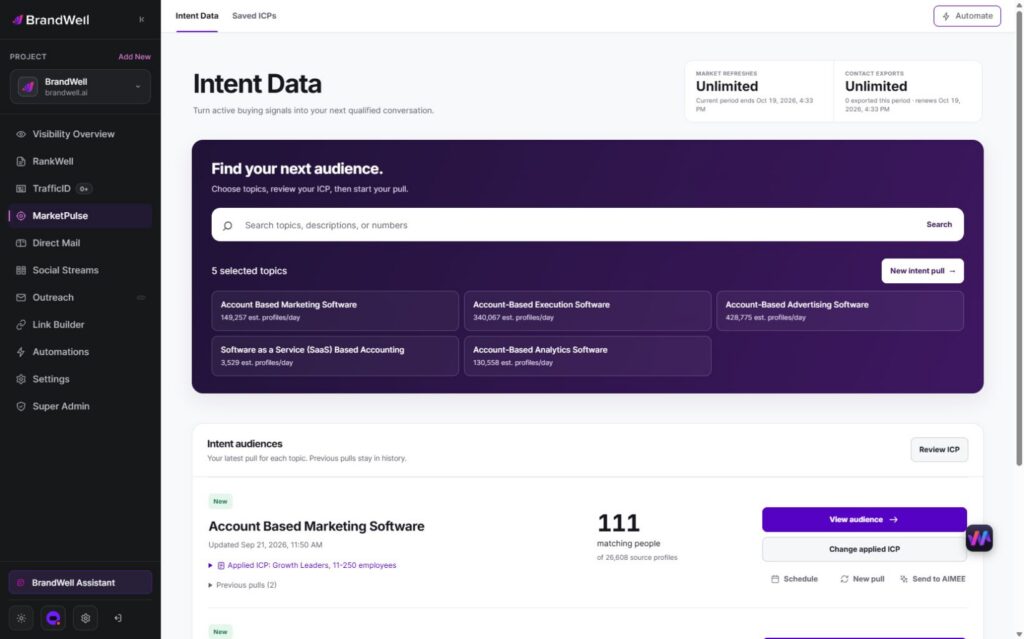
BrandWell MarketPulse: intent data starting at $500/mo. Find people researching topics relevant to what you sell, apply saved ICP filters, and review available contact details before taking action.
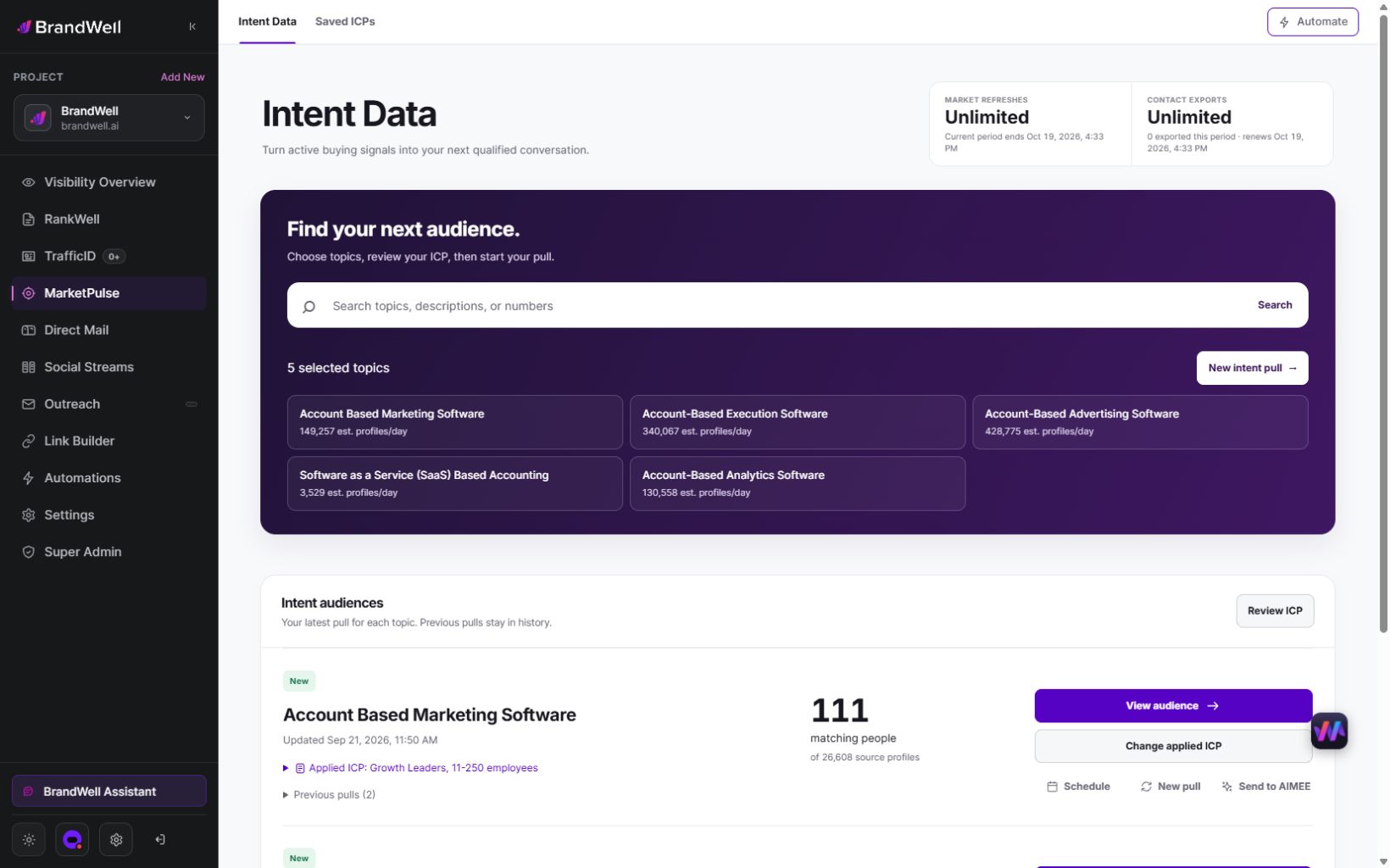
MarketPulse plans are starting at $500/mo. Verify current package scope and offers on the product page.
| Plan | Topics and refreshes | Monthly exports |
|---|---|---|
| Starter | 1 topic, weekly | 25,000 contacts |
| Growth | 3 topics, daily | 100,000 contacts |
| Scale | 10 topics, daily | Unlimited contacts |
Swipe the table to see all columns.
A pull retrieves available data from the previous 24 hours for one topic. Daily use across all included topics provides 90 Growth pulls or 300 Scale pulls in a 30-day month. Weekly Starter pulls vary by calendar month. Available audience size and contact fields vary, and audiences may overlap. Refreshes stop at the plan limit without overage charges.
- Find and qualify: search the topic catalog, save your ICP, and review the people and companies that match.
- Act on the research: export qualified contacts or prepare an Outreach or Direct Mail workflow. Connected products, channel usage, and fulfillment may cost extra.
- Get help from AIMEE: Growth and Scale include AIMEE for the initial user to research accounts and prepare the next step through connected tools.
Agencies and other service businesses can build client deliverables around their available Intent Scans and exports. Keep each client’s scope, permissions, and service fees clear. A subscription is not a promise of a white-label platform or exclusive access to a market.
Explore MarketPulse and watch the demo or compare plans starting at $500/mo. Any early-access discount is a separate, time-limited offer shown to an eligible recipient.
Define work units and constraints
“Clients per manager” is too coarse for intent service capacity planning. One client may receive a monthly topic report; another may require daily visitor review, enrichment, CRM routing, paid-media audiences, custom analysis, and weekly calls. Count the work that consumes capacity.
Build a work-unit catalog. Typical units include a topic monitored, signal reviewed, identity exception, enrichment request, accepted record, activation prepared, campaign audience refreshed, failed integration investigated, client report assembled, QBR prepared, and governance request handled. Each unit needs an owner, expected time, variability, and service level.
Then separate base work from volume work and exception work. Base work occurs even if no signals appear: client communication, access checks, monitoring, and reporting. Volume work scales with signals or activations. Exception work is irregular and often expensive: duplicates, identity conflicts, CRM schema changes, permission failures, and custom requests.
Capacity is the minimum of several constrained resources, not the sum of available hours. A data reviewer may have time while the only RevOps specialist is overloaded. Model each role and bottleneck separately. The deliverable is a tested operating envelope for every tier, with a defined trigger to throttle, add capacity, change scope, or pause activation.
Inventory seven workflow checks
Start with a service blueprint for each client. A practical operational checklist follows the signal from source to outcome:
- List inputs. Topics, first-party events, visitor activity, account lists, identity fields, CRM states, exclusions, and outcome data.
- Map transformations. Matching, enrichment, validation, deduplication, fit scoring, suppression, routing, and report assembly are distinct operations.
- Name owners and backups. Assign data review, client strategy, channel execution, RevOps, quality, and approval.
- Set service levels. Define freshness, review time, delivery cadence, exception response, and escalation – not just “real time.”
- Measure work time. Sample actual routine and exception cases by role and preserve their distribution. A median describes a typical case; use observed total effort or a suitable mean and explicit scenarios when estimating aggregate hours. An upper-percentile case is a stress input, not a guaranteed buffer.
- Document failure modes. Include missing access, API limits, duplicate records, schema drift, poor identity confidence, absent client action, and delayed feedback.
- Define stop rules. Pause a workflow when volume exceeds the tier, data quality falls below the agreed threshold, required approval is absent, or a security issue appears.
Use a single intake path for scope changes. A client’s “small” new segment can add topics, routing branches, reports, and meetings. Estimate the work before acceptance and update the capacity model and fee through change control.
Compare seven capacity methods
These methods can be implemented in a spreadsheet, work-management platform, data warehouse, or portal. The tool matters less than consistent definitions and honest time data.
1. Work-unit catalog
Inventory every recurring, volume-driven, and exception activity. Assign a standard owner and an estimated range rather than one optimistic number. Possible use: a new service that needs visibility. Limitation: estimates stay speculative until the agency records actual delivery time.
2. Activity-time model
Multiply forecast units by observed mean minutes for each comparable role/task, then add fixed work and separately modeled exceptions. Compare with actual available role-hours. Possible use: repeatable steps with measured work. Limitation: a pooled mean can hide long tails, context switching and changed task mix; retain the distribution and scenario assumptions.
3. Volume-envelope model
Set maximum topics, reviewed signals, activations, audiences, integrations, and reports per tier. Possible use: protecting a standard package. Limitation: client complexity can consume capacity before a volume cap is reached; calibrate any weights against observed work.
4. SLA-capacity model
Forecast how many units must be completed inside each response window and match them to shift coverage and skills. Possible use: time-sensitive sales or visitor workflows. Limitation: aggressive SLAs create idle-time and surge costs even when average volume looks manageable.
5. Scenario and sensitivity model
Run base, growth, spike, and failure scenarios. Change signal volume, acceptance rate, exception rate, client meeting load, and automation reliability. Possible use: pricing and hiring decisions. Limitation: scenarios are only as credible as the assumptions and need regular recalibration.
6. Bottleneck and buffer board
Track queued work, age, blocked reason, assigned skill, and remaining buffer by role. Possible use: multi-client operations. Limitation: a board can become another reporting task unless source systems update it consistently.
7. Tier guardrail calculator
Connect included work units, expected cost, utilization, gross margin, and change triggers to each service tier. Possible use: agencies productizing delivery. Limitation: strict caps can frustrate clients unless proposals explain separately agreed service changes, prioritization and exceptions clearly.
Test automation, staffing or scope changes
Automate stable, reversible, observable steps such as formatting, deduplication suggestions, enrichment requests, queue assembly, draft generation, and SLA alerts. Automation is attractive when volume is high and exceptions are rare. Its limitation is hidden failure: a bad rule can scale faster than a person notices.
Add people when judgment, client communication, quality adjudication, and exception handling dominate. Hiring adds resilience and relationship capacity. It also adds ramp time, management, and fixed cost. Do not hire against one client’s temporary spike without a broader demand and margin case.
Reduce scope when the workflow creates little client value, cannot meet quality standards, or consumes disproportionate expertise. Test fewer topics, a slower cadence, a capped review queue or standardized reporting against the actual constraint. Scope reduction is not failure; it can be the correct service design.
Evaluate a separately implemented client interface or reporting system only after verifying its actual capabilities, rights, costs and exit path. A MarketPulse subscription does not establish white-label access, custom reports or reduced setup labor. Measure any operating savings against the actual implementation.
Calculate role-hours and defined costs
For each role, required hours equal fixed work plus the sum of comparable forecast units multiplied by observed mean minutes divided by 60, plus separately modeled exceptions. Available hours equal scheduled coverage minus leave, meetings, training and administration. Show a resilience reserve separately and do not subtract it twice when reporting utilization.
Reconcile allocated subscription/usage, actual role-hours at stated loaded rates, setup treatment, shared operations and exceptions. Name included costs and exclusions before labeling the result gross or contribution margin. A defined service remainder is client fee minus stated costs; its percentage divides by the same fee. It is not necessarily company profit.
Use complexity points when clients differ: additional CRM, custom field logic, high-risk identity use, multiple regions, extra meetings, and bespoke reports each add points. A tier can cap both volume and complexity. Weights are local planning assumptions; validate them against actual work.
Track queues, blocked time and service levels
Monitor capacity with a balanced scorecard. Backlog shows queued units; age shows whether work is becoming stale; cycle time shows how long accepted work takes; SLA attainment shows reliability; first-pass acceptance and rework show quality; utilization shows pressure; and exception rate shows instability.
Add client measures: percentage of accepted signals acted on, client approval delay, access blockers, report adoption, outcome feedback completeness, and renewal risk. An agency can appear “at capacity” when the true bottleneck is client approval. Track blocked time separately from active work.
Define queue age as the current observation time minus queue-entry time for unfinished work. Report completed elapsed time separately. Define active work, blocked time, approval and destination acknowledgement distinctly. Rework and SLA rates need consistent eligible units and observation windows, including unfinished overdue work where the rule requires it. State which hours are in the utilization numerator and denominator.
A weekly operations review should decide where to rebalance work; a monthly service review should adjust rules; and a quarterly review should reconsider tier, price, staffing, and automation. Avoid universal benchmarks. Establish a baseline for the agency’s own workflows and change it only with documented evidence.
Scope actual tier complexity
A reporting-only client needs predictable base capacity and modest analysis. A managed-activation client needs time-window coverage and more exception handling. A multi-channel strategic client needs senior judgment, experiment design, meetings, and outcome analysis. Model these as different products, not one service with three prices.
Segment clients by data readiness, number of systems, topic and signal volume, identity level, channels, risk, cadence, customization, and decision complexity. Set qualification rules for each tier. If a client lacks a usable CRM or action owner, a reporting pilot may be the only responsible starting point.
Use a weighted client equivalent for portfolio planning. For example, a standard reporting client can equal one unit, a managed activation client two units, and a custom multi-channel client four or more. Determine weights from observed role-hours, not sales intuition. Recalculate after the first full service cycle.
Compare direct software, consulting and separately scoped managed delivery against actual client skills, volume, review rights and operating responsibilities. No client category establishes a universally better model or a native white-label entitlement.
Forecast each signal-to-action stage
Forecast volume through a funnel: observed signals, records available for identity checks, records resolved above the review threshold, ICP-qualified records, accepted records, activations prepared, and actions completed. Each transition has a rate and a work time. Do not multiply all raw signals by the most expensive downstream step.
For example, forecast reviewer hours as reviewed records × minutes per review. Forecast sales-research hours as accepted records × minutes per brief. Forecast RevOps hours from routes, sync failures, and field exceptions. Forecast client-strategy hours from standard cadence plus decisions and changes.
Include volatility. Topic launches, events, news, traffic spikes, new campaigns, and source outages can change volume quickly. Use an upper-range scenario and reserve a buffer for time-sensitive workflows. If volume breaches the tier, prioritize by fit and freshness rather than lowering QA standards.
MarketPulse supplies topic research and available match details. AIMEE can organize supplied context through configured tools. Custom branded reports, routing, client interfaces, scoring and synchronization require separately verified implementation, permissions, scope and fees. Research volume does not establish agency delivery capacity.
Reserve capacity by required skill
Reserve capacity by bottleneck skill. General availability does not solve a shortage of an identity adjudicator, paid-media owner, or CRM administrator. Define a warning level, throttle level, and stop level for backlog age, exception rate, utilization, and data quality.
Separate operational, technical, security, and client risks. Operational risks include leave, turnover, scope creep, and meetings. Technical risks include API limits, schema changes, duplicates, and failed syncs. Security and privacy risks include excess access, improper exports, uncertain provenance, and retention failures. Client risks include delayed approvals and missing outcome data.
Use least privilege, logs, backups, rollback, incident ownership, and tested exit procedures. Seek qualified privacy, security, and legal review for the actual data and jurisdictions. A match must remain labeled as probabilistic. Stop when confidence or permitted use is unclear.
Automation instructions must contain a maximum batch, validation sample, failure threshold, and human approval step. An agent may prepare a CRM change file or message draft; it should not overwrite records or contact people without the named owner’s approval.
Write enforceable service guardrails
A clear tier lists eligible topics, expected and maximum volumes, identity level, included workflows, supported systems, reporting cadence, meeting load, response SLA, exception allowance, client responsibilities, and overage or change rules. Add an escalation route and a right to pause when quality or safety is at risk.
MarketPulse supplies topic research and available match details. AIMEE can organize supplied context through configured tools. An agency operating service, branded weekly report, CRM synchronization or custom client interface needs separately verified implementation, rights, scope and fees. The research subscription does not establish those delivery capabilities.
Review an available MarketPulse topic, saved ICP and actual preceding-24-hour matches for the approved research purpose. Keep uncertain company context visible. AIMEE can organize supplied context through configured tools; named owners approve actual exports, messages, audience uploads and CRM writes.
Copyable service-capacity test
Work unit: [Comparable task, role, cadence and unique unit.] Demand: [Normal, spike and exception scenarios.] Effort: [Observed totals, mean, variation and excluded work.] Capacity: [Actual skill coverage, reserve and blocked dependencies.] Window: [Arrival, deadline, queue age and overdue rules.] Cost: [Subscription, loaded labor, corrections and exclusions.] Decision: [Throttle, repair, secure coverage, change scope or stop.]
Resource constraints differ from record counts
Google’s SRE guidance on overload describes how requests have different resource costs and recommends measuring available resources. It concerns computing, not agency staffing benchmarks. As a planning analogy, measure actual role work and constraints rather than assigning every client or record equal weight.
A typical case is not the total workload
In a fictional sample, nine tasks take five minutes each and one exception takes 100 minutes. The median is five minutes, but total work is 145 minutes and the mean is 14.5 minutes. Multiplying ten tasks by the median predicts only 50 minutes. Keep the observed distribution, exception type and whether the future mix is comparable; neither the mean nor the median guarantees next week’s total.
Check specialist coverage separately
A fictional week has 100 eligible reviews at six minutes each, or ten routine hours. Ten exceptions at 30 minutes each require five specialist hours. With 12 routine hours and four specialist hours available, there is a one-hour specialist gap despite 16 total hours against 15 hours of work. Do not assume the roles are interchangeable. Ten extra routine hours do not by themselves clear that gap.
Keep queue age and completion time distinct
Suppose an unfinished fictional item entered the queue Monday at 09:00 and is observed Tuesday at 09:00. Its queue age is 24 elapsed hours. If it completes at 13:00 Tuesday, completion elapsed time is 28 hours. If active review took 30 minutes, the other 27.5 hours are not automatically labor or idle time: reconcile approval, unavailable coverage, dependencies and actual pause rules. State time zones and calendar versus business hours.
Make the utilization denominator visible
A fictional 40-hour scheduled week loses ten hours to meetings, leave and administration, leaving 30 available hours. A six-hour reserve leaves 24 planned delivery hours. Twenty hours of actual delivery are 66.7% of the 30 available hours or 83.3% of the 24 planned delivery hours. Both describe different denominators; neither is a universal safe utilization benchmark. Do not subtract the reserve again from the 24-hour figure.
Test costs under rework
A fictional $2,500 fee against a $500 standard Growth subscription, $600 routine labor, $300 specialist work and $400 setup yields $1,800 defined costs and a $700 remainder, or 28%. Another $800 correction leaves negative $100. Acquisition, general overhead, tax and financing are excluded. These invented inputs are not BrandWell managed-service prices or margin benchmarks. Custom capacity calculators and client reports require separately verified implementation.
Frequently asked capacity questions
Can spare routine hours cover a specialist gap?
Only if the actual skills and responsibilities are interchangeable.
Does a median predict aggregate hours?
Not reliably. Reconcile total effort, task mix and exceptions.
Is queue age the same as completed cycle time?
No. Queue age applies to unfinished work at the stated observation time.
Does a subscription include managed delivery capacity?
No. Scope actual implementation, people and fees separately.
Review the research input: explore MarketPulse and current plans.
Reviewed and updated October 3, 2026.

Written by