Agencies can deliver intent-data services through a white-label reseller model, a direct enterprise platform, licensed data inputs, a modular build, or a manual managed workflow. The best model depends on who owns the client, branding, billing, implementation, data rights, activation, support, evidence, and risk. Compare the complete operating system, not a feature checklist.

Who this is for: Agency owners and consultants comparing service models before committing to a platform, custom integration, referral relationship, or manual delivery process.

Intent data should improve a decision. It should never be presented as proof that a person is ready to buy or as permission for an unreviewed action.

BrandWell update, September 2026: MarketPulse intent data starts at $250/month within BrandWell’s complete growth automation software. AIMEE, the agent-powered desktop app, helps connect buyer signals with research, content, and campaign work. Access to the broader tools depends on your package.

Decide whether an agency intent-data service model fits the client

Choose the model that matches client maturity and the agency’s actual capacity. Promise a defined decision workflow and deliverable. Do not imply that one model is universally best or that more software creates more accurate intent.

A seven-step agency intent-data service model workflow

  1. 1. Freeze the client decision, market, topics, signal needs, identity states, actions, evidence, and economics.
  2. 2. Map agency and provider ownership of branding, billing, client data, delivery, support, and outcomes.
  3. 3. Test representative quality, workflow, integrations, export, and client separation.
  4. 4. Compare current written rights, terms, minimums, usage, labor, and switching cost.
  5. 5. Run the same client scenario through every short-listed model.
  6. 6. Use a bounded paid validation to measure adoption and operating burden.
  7. 7. Select, combine, or reject models through a written stop-or-expand decision.

Build the evidence log for an agency intent-data service model

Use one versioned record to show why each agency intent-data service model decision was made. Capture the eligible market, topic definition, source, observed time, identity state, validation result, suppression, reviewer, approved action, downstream disposition, and fully loaded cost. Preserve rejected, expired, duplicated, and corrected records with reason codes rather than overwriting them. This makes client explanations and later comparisons reproducible.

Open the log with Freeze the client decision, market, topics, signal needs, identity states, actions, evidence, and economics. Close each review cycle with Select, combine, or reject models through a written stop-or-expand decision. If a topic, source, identity rule, activation path, outcome definition, price, or policy changes, record the approver, affected records, and whether prior periods remain comparable.

Five intent-data service models agencies should compare

1. White-label reseller service

The agency sells a branded recurring service, controls the client relationship and retail price, and buys contracted capabilities wholesale.

Watch-out: Confirm reseller rights, client isolation, permitted uses, topics, usage, support, data return, termination, and available contract-scoped exclusivity.

2. Client-owned enterprise platform service

The client buys a broad platform and the agency sells implementation, operations, campaign management, reporting, or enablement around it.

Watch-out: This model can support a large mature client, but revenue depends on services around a client-controlled system rather than an agency-owned product.

3. Licensed data-input service

The agency licenses topic, visitor, identity, enrichment, or validation inputs and builds its own qualification, portal, activation, reporting, and support layer.

Watch-out: The license may cover only an input. Verify end-client use, redistribution, derived data, retention, deletion, and export rights before packaging it.

4. Modular custom build

The agency combines APIs, databases, CRM workflows, browser operations, reporting, and human review into a service it maintains.

Watch-out: Engineering, security, observability, exception handling, vendor drift, documentation, and support are recurring costs, not one-time setup.

5. Manual managed workflow

Operators assemble evidence, review accounts, prepare reports, and coordinate client actions with limited automation while the offer is still being validated.

Watch-out: Manual delivery is useful for learning, but inconsistent decisions, high labor, weak auditability, and limited scale become constraints quickly.

Copy this agency intent-data service model decision worksheet

Use this field set during discovery, onboarding, and the first client review. It turns an agency intent-data service model into a reproducible decision record instead of an informal promise. Replace every bracketed prompt with written evidence and leave unknowns visible.

AGENCY INTENT-DATA SERVICE MODEL DECISION WORKSHEET
Client decision: [one decision this service must improve]
Eligible market and exclusions: [written ICP, geography, lifecycle, customers, competitors]
Evidence required: [source, observed time, topic rule, identity state, validation]
Path being evaluated: [White-label reseller service; Client-owned enterprise platform service; Licensed data-input service; Modular custom build; Manual managed workflow]
First operating control: [Freeze the client decision, market, topics, signal needs, identity states, actions, evidence, and economics.]
Final operating control: [Select, combine, or reject models through a written stop-or-expand decision.]
Owners and approvals: [agency, client, data, CRM, activation, privacy, billing]
Fully loaded monthly cost: [platform + usage + labor + support + risk reserve]
Evidence of use: [accepted, rejected, corrected, acted on, downstream disposition]
Stop, revise, or expand rule: [threshold, reviewer, next action]

Package an agency intent-data service model as a recurring client operation

Translate the workflow into a client scope for an agency intent-data service model: the decision being improved, eligible market, topic set, branded deliverable, portal or export, action SLA, review cadence, usage boundary, support path, change control, and stop rule. Mark records as eligible, review, suppressed, expired, or unresolved so the client knows what can happen next.

Assign named owners for sales, client success, data operations, identity review, CRM, activation, privacy, security, analytics, and billing. Attach evidence to every handoff. Review the first month as an operating test by comparing accepted, rejected, corrected, suppressed, and acted-on records with delivery hours, outcome return, and contribution margin. Narrow or stop the service when the client cannot use the evidence reliably.

BrandWell: MarketPulse intent data and connected growth automation

From audience to action: connect intent data with the work needed to use it. BrandWell is complete growth automation software that connects MarketPulse intent data, TrafficID website visitor identification, content, outreach, and campaign workflows. AIMEE, its agent-powered desktop app, helps turn those signals into research, prepared assets, and approved actions.

For agencies, this creates a repeatable client workflow: identify relevant demand, apply a client-specific ICP, prepare a campaign, and review the work in the same platform. Branded delivery and multi-client requirements should be scoped to the agency package.

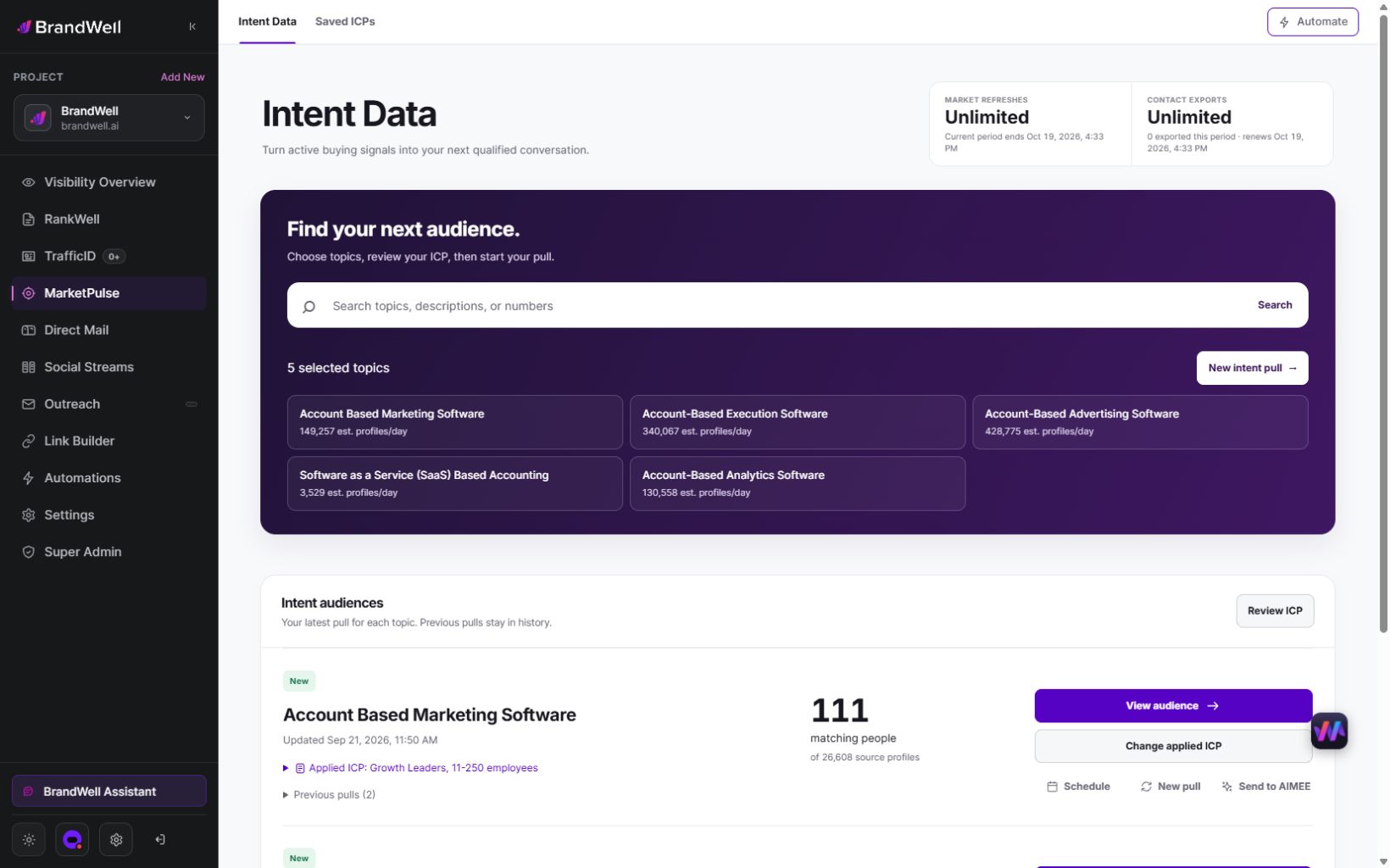
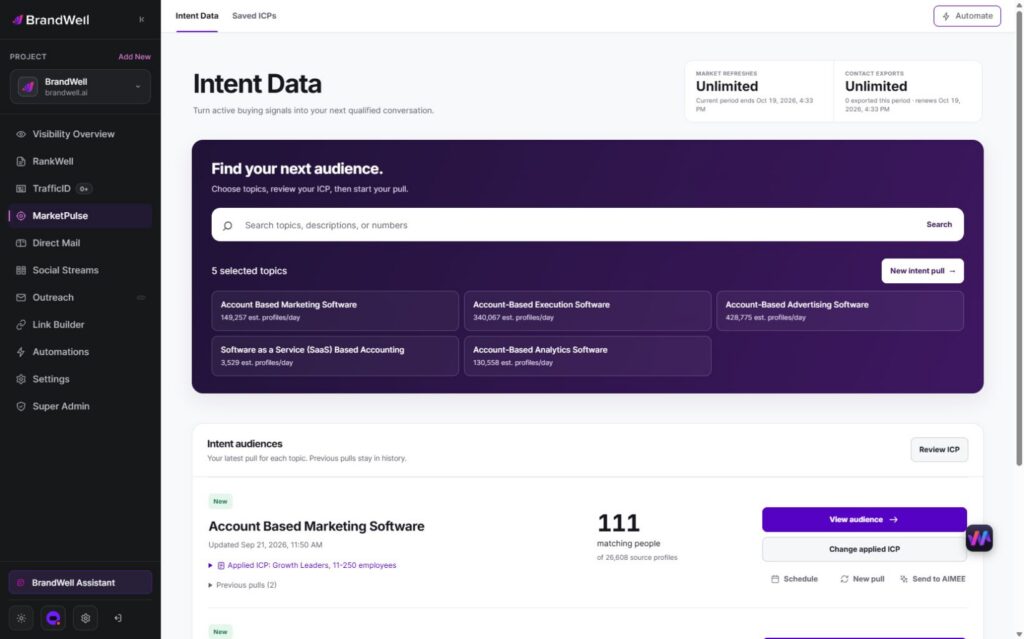
BrandWell MarketPulse showing intent topics, an applied ICP, matching audiences, and Send to AIMEE.
MarketPulse in the current BrandWell app, captured September 21, 2026. Counts and allowances reflect the workspace shown. Select the image to enlarge it.

How the software connects the work:

  • Find and qualify demand: MarketPulse brings topic-based intent into a reviewable audience with saved ICPs and scheduled pulls. TrafficID adds website visitor identification to the growth workflow.
  • Prepare the next campaign: Outreach and Direct Mail provide execution workspaces; Social Streams adds relevant social activity. Use the tools and destinations configured for your project.
  • Build demand as well as capture it: RankWell, Visibility Overview, and Link Builder connect content and visibility work with the same growth operation.

AIMEE helps carry the work forward

AIMEE is BrandWell’s agent-powered desktop app. It helps research accounts, prepare content and messages, and carry out assigned work through connected tools. BrandWell’s Automations workspace connects product events to workflow steps, with owners, approvals, and run history. You choose the connections, allowed actions, and budgets.

BrandWell automation templates connecting MarketPulse, Outreach, Direct Mail, RankWell, Social Streams, Link Builder, and AIMEE.
Current BrandWell automation templates, captured September 21, 2026. Templates show available workflow patterns; execution depends on setup, connected tools, and approvals.

BrandWell MarketPulse intent-data plans start at $250/month. Your selected package determines topic coverage, contact allowances, refresh cadence, AIMEE access, and other growth tools. Channel usage, media, and fulfillment costs depend on the campaign.

What to evaluate: topic relevance, usable audience coverage, ICP fit, and the time it takes to turn an accepted signal into completed work. An intent signal helps prioritize an opportunity; it does not guarantee a purchase or establish permission for every channel. Choose a workflow your team can operate, then evaluate the audience and the completed work against that goal.

How BrandWell fits into an agency intent-data service model

Here, BrandWell means the current MarketPulse intent-data and growth automation platform, connected with the broader BrandWell content and growth tools. LeadFuze supplies underlying data capabilities where contracted and available. BrandWell is designed as a complete growth automation platform with agency delivery options with branded topic reports, portal and client workflows, modular services, configurable retail pricing, and controlled activation. The exact modules, coverage, usage, support, client capacity, and implementation in the current written quote control.

Start with MarketPulse intent data from $250/month. Review a topic and its matching audience, then use BrandWell’s connected growth tools and AIMEE desktop assistance to prepare the next action. Agency packaging and services can be scoped around the client workflow.

BrandWell MarketPulse intent-data plans start at $250/month. Your selected package determines topic coverage, contact allowances, refresh cadence, AIMEE access, and other growth tools. Channel usage, media, and fulfillment costs depend on the campaign. Compare total cost for the same audience, tools, implementation, and campaign scope; starting prices alone do not establish the lowest-cost provider.

AIMEE is the agent-powered desktop app in BrandWell’s growth workflow. Assign work through the tools connected to your workspace and choose which actions can run automatically or require approval. Desktop availability, account permissions, and the configured workflow determine what can execute.

Price and measure an agency intent-data service model

A white-label model includes wholesale cost and agency delivery. An enterprise model includes large-platform implementation and client adoption. A data-input model requires the agency to supply identity, workflow, activation, and reporting. A modular build includes engineering and maintenance. A manual model includes high labor and limited scale. Compare fully loaded client contribution margin.

The agency intent-data service model stop-or-expand scorecard

Track time to launch, coverage, accepted-signal cost, client adoption, action SLA, meetings, opportunities, delivery hours, support load, contribution margin, renewal, export readiness, and switching cost. Use identical definitions across models.

Important: Intent signals are probabilistic evidence. They do not prove identity, consent, need, authority, budget, stage, qualification, purchase, pipeline, or revenue. Report association and uncertainty honestly.

Guardrails for an agency intent-data service model

Risks include comparing mismatched scopes, assuming resale rights, underestimating build cost, depending on one vendor, weak client separation, missing provenance, unclear data ownership, and no exit path. Preserve written evidence and choose a narrower model when uncertainty is high.

The FTC business security guidance recommends collecting only what is needed, limiting access, and disposing of information no longer required. The NIST Privacy Framework offers a voluntary structure for identifying and managing privacy risk. These resources are not legal advice or certifications. Obtain qualified counsel for the actual jurisdictions, contracts, data flows, industries, and channels.

  • Preserve source, observed time, identity state, confidence, validation, and policy version.
  • Separate known people, candidate people, companies, domains, and unresolved visitors.
  • Apply customer, employee, competitor, duplicate, geography, consent, and opt-out suppressions.
  • Require named human approval before CRM writes, audience uploads, spend, or outreach.
  • Give clients correction, export, deletion, escalation, incident, and offboarding paths.

Run the agency intent-data service model review with Claude, ChatGPT, or AIMEE

Objective: Compare agency intent-service models using one frozen client scenario. Use identical criteria for client ownership, rights, branding, signals, identity, validation, activation, portal, integrations, implementation, pricing, support, governance, measurement, export, limitation, and exit. Mark unknowns and require human review.
Inputs: approved ICP, topic dictionary, signal source and time, identity state, client lifecycle, suppressions, permitted-use policy, outcome definitions, and current written commercial scope.
Rules: preserve provenance and uncertainty; never infer budget, authority, consent, or purchase readiness; never expose private behavior in messaging; stop before external action.
Output: decision, reason codes, missing evidence, recommended next step, and audit log.

The NIST AI Risk Management Framework is a useful voluntary reference for roles, oversight, measurement, third-party risk, and ongoing management. It does not validate a specific workflow or remove the need for human review.

Method and maintenance for an agency intent-data service model

This guide evaluates an agency intent-data service model through one defined client decision, a seven-step operating workflow, consistent option criteria, a fully loaded cost model, an outcome scorecard, and explicit limitations. The featured image is decorative and is not evidence of product performance or a client outcome. Current contracts, official product documentation, platform policies, and scope-matched written quotes control volatile facts.

Recheck the relevant claim before a client quote and whenever a provider changes pricing, modules, permitted uses, reseller rights, retention, export, support, platform policy, or contract terms. Revise the affected statement and workflow rather than carrying an old assumption into a new engagement.

Use these companion guides to move from the current decision into the next operating layer without collapsing distinct buyer questions into one oversized page.

Direct answers to ten buyer questions about intent service competitive comparison

What should an agency decide before selecting an intent-data service model for an agency, and what client outcome can it responsibly promise?

Make a go, revise, or stop decision before delivery begins. The governing test is: Choose the model that matches client maturity and the agency’s actual capacity. Promise a defined decision workflow and deliverable. Do not imply that one model is universally best or that more software creates more accurate intent.

What workflow, owners, SLA, quality checks, approvals, and client handoff does an agency intent-data service model require?

Assign a named agency owner, client owner, operator, and technical or CRM owner. The sequence is: 1) Freeze the client decision, market, topics, signal needs, identity states, actions, evidence, and economics. 2) Map agency and provider ownership of branding, billing, client data, delivery, support, and outcomes. 3) Test representative quality, workflow, integrations, export, and client separation. 4) Compare current written rights, terms, minimums, usage, labor, and switching cost. 5) Run the same client scenario through every short-listed model. 6) Use a bounded paid validation to measure adoption and operating burden. 7) Select, combine, or reject models through a written stop-or-expand decision. Set the response SLA, log exceptions, preserve uncertainty, and require a client handoff with permitted next steps and ownership.

Which platforms, tools, templates, calculators, and integrations best support selecting an intent-data service model for an agency?

Start with the operational resources in this guide: White-label reseller service, Client-owned enterprise platform service, Licensed data-input service, Modular custom build, Manual managed workflow. Use the client CRM as the outcome system of record, a permissioned review queue or database for evidence, the copyable worksheet in this guide, a topic dictionary, qualification scorecard, cost calculator, responsibility matrix, client report, and approval checklist. Add integrations only after field IDs, permitted writes, owners, retries, deletion, and exception handling are documented for an agency intent-data service model.

How do white-label reseller, direct enterprise, licensed data input, modular build, and manual managed workflow compare for selecting an intent-data service model for an agency?

Compare white-label reseller, direct enterprise, licensed data input, modular build, and manual managed workflow against the same client decision, market, evidence, owners, SLA, implementation time, fully loaded cost, governance, outcome scorecard, and exit path. The right approach to selecting an intent-data service model for an agency is the one the client can adopt and the agency can deliver repeatedly without hiding labor, rights, uncertainty, or risk.

How should an agency price an agency intent-data service model, and which setup, usage, labor, support, and risk costs determine gross margin?

Build a client-level cost model before setting price. A white-label model includes wholesale cost and agency delivery. An enterprise model includes large-platform implementation and client adoption. A data-input model requires the agency to supply identity, workflow, activation, and reporting. A modular build includes engineering and maintenance. A manual model includes high labor and limited scale. Compare fully loaded client contribution margin. Put usage overages, client work, exception handling, and out-of-scope activation in writing.

Which quality, adoption, meeting, opportunity, pipeline, cost, margin, and retention metrics show whether an agency intent-data service model is working?

Use a baseline and one review cadence. Track time to launch, coverage, accepted-signal cost, client adoption, action SLA, meetings, opportunities, delivery hours, support load, contribution margin, renewal, export readiness, and switching cost. Use identical definitions across models. Do not call correlation incremental impact without an appropriate comparison.

Which clients are ready for an agency intent-data service model, and which prospects should the agency exclude?

A client is ready for an agency intent-data service model when it has a clear ICP, sufficient market or qualified traffic, relevant commercial topics, a named action owner, measurable outcomes, conservative economics, privacy readiness, and a way to return dispositions. Require this first control: Freeze the client decision, market, topics, signal needs, identity states, actions, evidence, and economics. Exclude clients demanding guaranteed leads, universal identity, prohibited use, or automation without review.

Which signal sources, identity checks, qualification rules, activation steps, and outcome evidence matter most for an agency intent-data service model?

For an agency intent-data service model, combine topic or first-party behavior with fit, recency, recurrence, identity state, validation, suppressions, human acceptance, the approved activation path, and returned outcomes. Apply the specific controls in this workflow: Map agency and provider ownership of branding, billing, client data, delivery, support, and outcomes. Test representative quality, workflow, integrations, export, and client separation. Keep evidence types separate so an inference never becomes a false fact.

Which data-quality, privacy, security, scope, billing, delivery, and client-trust risks must the agency control for an agency intent-data service model?

Maintain a risk register owned by the agency and client. Risks include comparing mismatched scopes, assuming resale rights, underestimating build cost, depending on one vendor, weak client separation, missing provenance, unclear data ownership, and no exit path. Preserve written evidence and choose a narrower model when uncertainty is high. Record the control, owner, evidence, exception path, and next review for every material risk.

What should the service-model decision memo, economics, contract checklist, and exit plan include?

Treat the answer to this question as the acceptance test: What should the service-model decision memo, economics, contract checklist, and exit plan include? Connect the decision to five intent-data service models agencies should compare. Document scope, owners, evidence, delivery cadence, approvals, usage, price, scorecard, support, change control, and offboarding. Expand only after the client uses the initial scope and returns actionable dispositions.

The practical next step

Start with MarketPulse intent data from $250/month. Review a topic and its matching audience, then use BrandWell’s connected growth tools and AIMEE desktop assistance to prepare the next action. Agency packaging and services can be scoped around the client workflow.