On this page
- Current MarketPulse research workflow
- Define separate release decisions
- Define quality for the actual decision
- Use five release and audit gates
- Assign owners and reconcile handoffs
- Compare manual and configured validation
- Budget actual quality work
- Measure quality and missing outcomes
- Adapt checks to actual scope
- Test evidence layers separately
- Hold unresolved release requirements
- Scope current BrandWell capabilities
- Verify correction before closure
- Frequently asked QA questions
- Copyable service-QA record
Use separate QA gates for source evidence, identity and contact review, action preflight, client output and actual outcomes. Record the object, requirement, owner, evidence, pass/hold/fail state and corrective action. Passing structural checks, a sample or a technical upload does not establish universal identity quality, permission, buyer interest or revenue impact.
Who is this for? Agency owners, QA leads, delivery managers, RevOps consultants, demand-generation teams, and reseller operators responsible for recurring intent-data services.
Current MarketPulse offer: intent-data plans start at $500/mo. See the product, demo, and current plans. Updated October 3, 2026.
Current MarketPulse research workflow
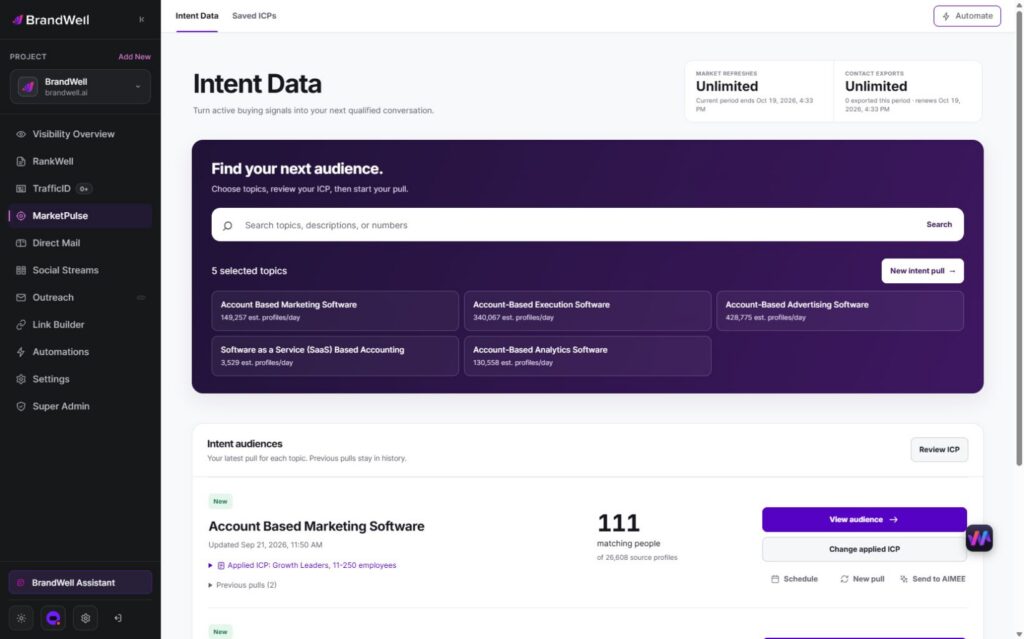
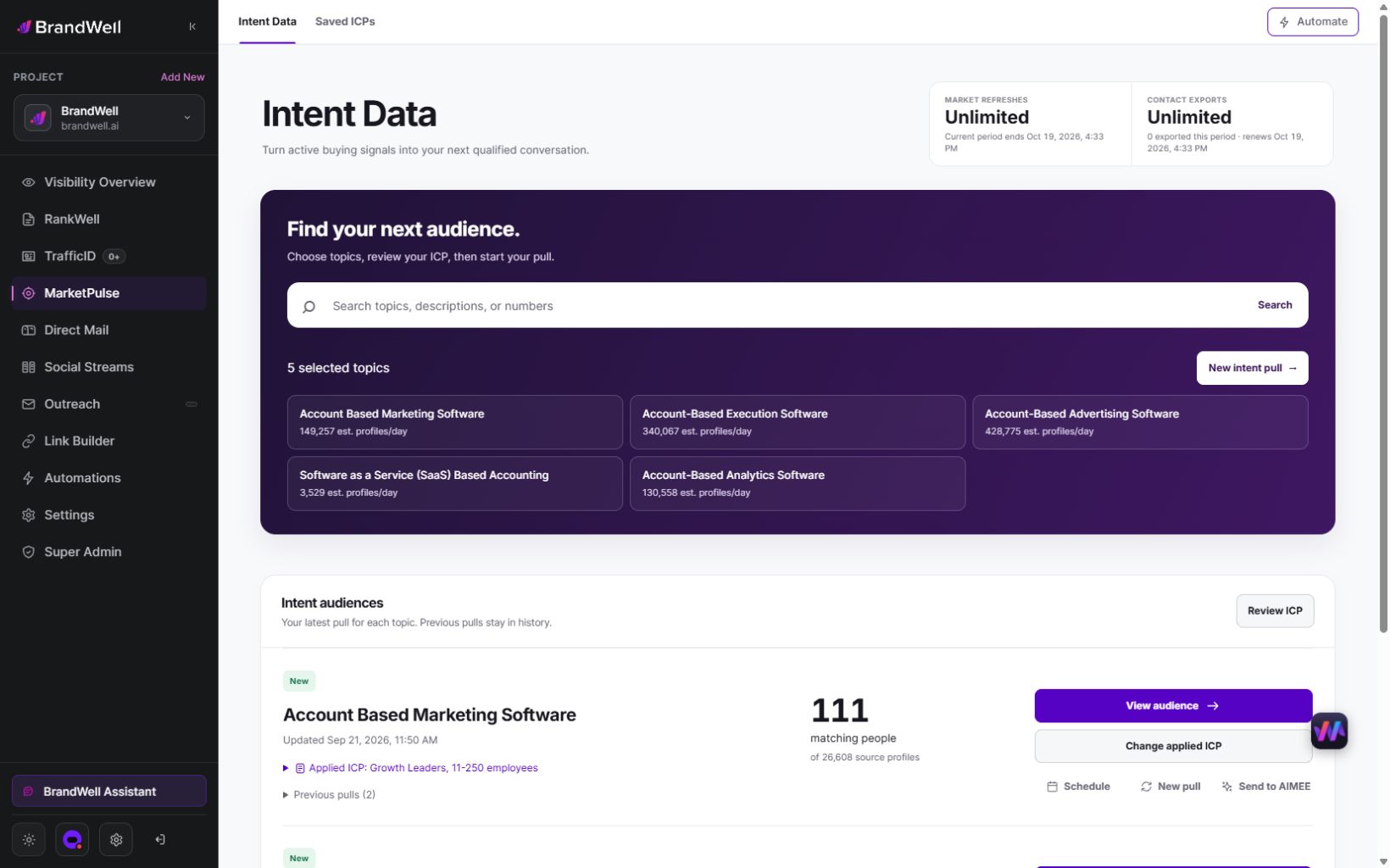
BrandWell MarketPulse: intent data starting at $500/mo. Find people researching topics relevant to what you sell, apply saved ICP filters, and review available contact details before taking action.
| Plan | Topics and refreshes | Monthly exports |
|---|---|---|
| Starter | 1 topic, weekly | 25,000 contacts |
| Growth | 3 topics, daily | 100,000 contacts |
| Scale | 10 topics, daily | Unlimited contacts |
Swipe the table to see all columns.
A pull retrieves available data from the previous 24 hours for one topic. Daily use across all included topics provides 90 Growth pulls or 300 Scale pulls in a 30-day month. Weekly Starter pulls vary by calendar month. Available audience size and contact fields vary, and audiences may overlap. Refreshes stop at the plan limit without overage charges.
- Find and qualify: search the topic catalog, save your ICP, and review the people and companies that match.
- Act on the research: export qualified contacts or prepare an Outreach or Direct Mail workflow. Connected products, channel usage, and fulfillment may cost extra.
- Get help from AIMEE: Growth and Scale include AIMEE for the initial user to research accounts and prepare the next step through connected tools.
Agencies and other service businesses can build client deliverables around their available Intent Scans and exports. Keep each client’s scope, permissions, and service fees clear. A subscription is not a promise of a white-label platform or exclusive access to a market.
Explore MarketPulse and watch the demo or compare plans starting at $500/mo. Any early-access discount is a separate, time-limited offer shown to an eligible recipient.
Define separate release decisions
Use intent-service QA as a chain of decisions. A signal can be structurally complete but stale. An account can fit while the person match is ambiguous. A record can be valid but ineligible for a destination. A report can reconcile while its language overstates certainty. One end-of-month review cannot separate those failure modes.
Create explicit states: pass means evidence satisfies the configured release criteria; hold means a named question or approval remains; fail means the item is ineligible for this use; corrected means a recorded action changed the item or rule. Never use silence as approval.
The gate should be proportional to consequence. Low-risk internal analysis may use sampled review. Personal-data enrichment, ad-platform activation, outbound contact, client-visible claims, or spend changes need stronger evidence and approvals. The service should become faster by eliminating avoidable ambiguity, not by removing the controls that catch it.
Define quality for the actual decision
Define the actual object, population, decision, required fields, source, event age, match method, uncertainty and review evidence. Keep completeness, relevance, identity correctness, contact validation, action eligibility and destination acknowledgement separate. A combined score cannot explain a failure in any one layer.
Define the actual object, population, decision, required fields, source, event age, match method, uncertainty and review evidence. Keep completeness, relevance, identity correctness, contact validation, action eligibility and destination acknowledgement separate. A combined score cannot explain a failure in any one layer.
- Input quality: provenance, completeness, recency, topic relevance, account normalization, and permitted purpose.
- Identity quality: match evidence, confidence, validation, duplication, suppression, and correction.
- Process quality: approval, timeliness, reconciliation, access, change control, and exception handling.
- Outcome quality: client adoption, seller acceptance, qualified progression, complaints, and learning.
Use five release and audit gates
These five gates form a reusable QA checklist. They use the same visible criteria so the agency can compare purpose, required inputs, ownership, risk, cost, measurement, and limitation. The list follows the evidence from source to outcome; skipping an upstream gate makes downstream testing more expensive and less conclusive.
1. Signal-input acceptance gate
Best fit and exclusions: Best before any scoring, identity work, or client delivery. It confirms that a source, topic, account, timestamp, geography, and provenance record meet the contracted use. Reject or hold evidence that cannot support the client’s decision.
Inputs and prerequisites: A source ledger, topic definition, account normalization rules, freshness policy, required fields, permitted-use record, known positives and negatives, and client exclusions. Each batch or stream needs a traceable source and configuration version.
Implementation effort and ownership: Data operations performs deterministic checks; strategy reviews topic ambiguity; QA samples source behavior; privacy or legal specialists review new purposes or jurisdictions. The release state should be recorded, not implied.
Data, privacy, and governance risk: Unknown provenance, stale evidence, sensitive inference, or a use beyond the original permission should block release. Data-supplier assurances do not replace the agency’s own due diligence.
Cost drivers: Source testing, normalization, topic review, monitoring, sample investigation, rejected volume, and reprocessing. Lower-priced data can become expensive when this gate creates heavy manual work.
Measurement and revenue relevance: Measure required-field completeness, freshness distribution, normalization success, source rejection, topic ambiguity, duplicate rate, and the proportion with complete provenance and permitted purpose.
Meaningful limitation: Passing structural checks does not prove that the signal predicts purchase. It only establishes that the evidence is usable for the stated decision and worthy of the next test.
2. Identity and enrichment validation gate
Best fit and exclusions: Best when account evidence may be resolved to companies or people, enriched, or prepared for contact. It keeps account fit, identity confidence, contact validity, and permission as separate decisions.
Inputs and prerequisites: Normalized company identifiers, match candidates, confidence components, recency, contact-source provenance, email or phone validation state, suppressions, geography, and representative positive and negative samples.
Implementation effort and ownership: Identity operations configures matching; QA samples false matches and misses; activation owners decide which confidence states are eligible; reviewers handle ambiguous or high-risk records.
Data, privacy, and governance risk: A match is probabilistic, not proof that a named person performed an action. Do not infer sensitive attributes, expose personal data unnecessarily, or use confidence labels as certainty.
Cost drivers: Resolution and enrichment usage, validation, sampling, manual review, suppression, storage, and correction. Repeated low-confidence handling should trigger a source or workflow change.
Measurement and revenue relevance: Track match-confidence distribution, sample precision, unresolved rate, contact completeness, validation state, suppression, duplicate merge, and correction rate by source and client segment.
Meaningful limitation: A high match rate can still be poor quality if it forces ambiguous candidates into one identity. Optimize for defensible use and downstream value, not match rate alone.
3. Activation preflight gate
Best fit and exclusions: Best before records enter a CRM, ad audience, seller queue, sequence, webhook, or other system that spends money or triggers contact. It validates the action as well as the record.
Inputs and prerequisites: Client authorization, destination owner, scoped credential, field map, suppressions, policy and rights review, test record, budget or volume limit, approver, rollback, and an expected acceptance response.
Implementation effort and ownership: Implementation configures; QA runs the preflight; the client or authorized campaign owner approves material activation; operations monitors acceptance. Separate the person who changes a rule from the final release for high-impact actions.
Data, privacy, and governance risk: Offsite data is not automatically eligible for platform upload or outreach. Confirm written rights, notices, suppressions, destination policies, advertiser authority, and geography before activation.
Cost drivers: Connector setup, credential administration, policy review, testing, mapping, monitoring, destination rejections, rollback, and client approval. Each new destination expands the QA surface.
Measurement and revenue relevance: Reconcile eligible, attempted, accepted, rejected, suppressed, and rolled-back records. Track destination error, approval latency, unauthorized-change findings, and cost per accepted activation.
Meaningful limitation: A successful upload proves only that a destination accepted data technically. It does not prove lawful use, correct audience membership, effective delivery, or business value.
4. Client-deliverable release gate
Best fit and exclusions: Best before a branded portal, topic report, prospect list, campaign brief, or monthly report becomes visible to a client. It checks clarity, reconciliation, confidentiality, and claim language.
Inputs and prerequisites: An approved template, client branding, reconciled counts, source and limitation notes, examples cleared for that client, outcome definitions, accessible links or files, and a named release approver.
Implementation effort and ownership: The analyst prepares; QA verifies data and claims; the account lead checks context and audience; an authorized owner releases. Automated report generation should still stop on material anomalies.
Data, privacy, and governance risk: The deliverable can expose another client’s data, reveal personal information, or imply surveillance. Use tenant-safe examples, appropriate aggregation, redaction, access control, and plain-language uncertainty.
Cost drivers: Report production, branding, narrative review, reconciliation, access support, and corrections. Repetitive manual formatting is an automation candidate to test after release criteria stabilize.
Measurement and revenue relevance: Track on-time release, correction rate, unresolved reconciliation, client questions, portal adoption, decision or action taken, and the time from evidence to usable client output.
Meaningful limitation: A polished report can conceal a weak service. Release should depend on defensible evidence and a clear next decision, not design quality or record volume alone.
5. Outcome audit and corrective-action loop
Best fit and exclusions: Best after enough time for the client to act and outcomes to mature. It compares released evidence with destination results, seller behavior, qualified outcomes, defects, complaints, and commercial assumptions.
Inputs and prerequisites: Stable identifiers across stages, seller dispositions, outcome definitions, timestamps, campaign or workflow version, cost, incidents, client feedback, and an agreed review window.
Implementation effort and ownership: RevOps or analytics joins outcomes; QA investigates failure modes; service owners approve corrective actions; account leads communicate changes; finance updates unit economics and scope where needed.
Data, privacy, and governance risk: Do not claim causation from simple association or expose detailed personal behavior in reports. Use minimization, retention, access controls, aggregation, and controlled tests where feasible.
Cost drivers: Outcome integration, analysis, investigation, reprocessing, source replacement, rule changes, credits, and retraining. Corrective action is a recurring service cost, not free emergency work.
Measurement and revenue relevance: Measure seller acceptance, qualified progression, error by source and rule version, rework, complaint or opt-out signals, contribution margin, action completion, and verified preventive changes.
Meaningful limitation: Outcome data is delayed, incomplete, and affected by sales execution, market conditions, and other marketing. A QA audit can improve decisions without proving that intent caused the result.
Assign owners and reconcile handoffs
A gate record should identify the client, object, workflow version, required tests, result, evidence, reviewer, time, exception, and next state. Define service targets for triage, normal review, high-risk approval, correction, and client communication based on actual capacity. A target without an owner or escalation path is only a wish.
Use a responsibility model that distinguishes who prepares, who checks, who approves, who releases, and who is informed. For routine deterministic checks, the system can prepare and validate while a person reviews exceptions. For a new source, destination, use, or claim, require the relevant data, security, privacy, platform, and client owners.
Handoffs need reconciliation. The sender records how many objects were eligible and attempted; the receiver records accepted, rejected, and reason; QA compares the two. That simple control catches silent losses between a data feed, workflow, CRM, ad account, sequence, portal, and client report.
Compare manual and configured validation
Consider manual QA for new sources, ambiguous topics, unusual client rules, and qualitative claim review. It is slow and inconsistent when reviewers lack test cases or record decisions outside the system. Test configured validation for schemas, required fields, ranges, duplicates, freshness, permission combinations, destination responses, and reconciliation. It needs monitoring and versioned tests.
A white-label workflow can combine repeatable gates, branded deliverables, client configuration, and shared reporting. The agency must still verify what the platform checks, what it cannot know, how exceptions work, how tenants are separated, and who approves activation. Automation should surface evidence, not manufacture confidence.
Test deterministic checks, representative samples, exception review and separately required approvals against actual failure modes and costs. Verify the configured implementation rather than assuming this layered design is universally strongest.
Budget actual quality work
Quality cost includes prevention, appraisal, and failure. Prevention includes source evaluation, configuration, test design, training, access controls, and safe defaults. Appraisal includes validation, sampling, review, reconciliation, and report checks. Failure includes rework, reprocessing, incident response, credits, wasted spend, damaged deliverability, lost seller time, and client trust.
Model QA by service tier and risk. A simple branded topic report has different checks from identity enrichment plus automated outreach. Setup fees can cover initial test design, source sampling, destination preflight, and client acceptance. Recurring fees should cover normal monitoring, sample review, anomaly investigation, report release, and corrective action within defined bounds.
Price deeper investigations, new destinations, new geographies, special security evidence, or custom sampling as explicit scope. Do not reward a client for bypassing controls by making careful delivery look like an optional add-on. The base service needs enough QA to support its core promise.
Measure quality and missing outcomes
Use a scorecard that spans quality and value. Input measures include freshness, required-field completeness, source acceptance, and topic ambiguity. Identity measures include confidence distribution, sample error, unresolved records, contact validation, and suppressions. Process measures include review time, release time, defects, reconciliation, and incidents.
Adoption measures include report use, destination acceptance, seller acceptance, follow-up completion, and feedback coverage. Outcome measures include qualified conversations, accepted opportunities, stage progression, or a client-defined event. Economics include rework, QA hours, cost per released record, support, gross margin, and the cost of failure.
Never optimize one measure in isolation. A higher release rate can mean better data or weaker gates. Faster time-to-value can mean smoother operations or skipped review. A low complaint rate can reflect good practice or missing feedback. Pair each metric with a countermeasure and sample evidence.
Adapt checks to actual scope
An early-stage client with one destination needs a narrow test plan, clear examples, training, and frequent feedback. A mature client with strong RevOps may need automated reconciliation, data contracts, role-based access, and outcome joins. A regulated or security-sensitive client may require stronger approvals, retention controls, audit evidence, and independent review.
Service packages should change the QA surface explicitly. A topic-monitoring package focuses on provenance, relevance, freshness, and report release. A visitor-identity package adds matching and notice review. Enrichment adds field source and validation. Activation adds destination rights, policy, credentials, and rollback. Managed outbound adds deliverability, suppression, message, and human-approval checks.
Test evidence layers separately
Do not collapse the funnel into one accuracy percentage. Test signal quality with known accounts and topic interpretation. Test identity matching with a representative labeled sample and separate false matches from unresolved records. Test contacts for source, completeness, validation, and suppression. Test activation with controlled records and destination reconciliation. Test reports against the source and claim rules.
Samples must represent the actual client population. Include large and small companies, ambiguous domains, subsidiaries, shared devices or networks where relevant, old and recent evidence, positive and negative cases, and each enabled destination. Record the sampling frame and limitations so a result is not generalized beyond what was tested.
Hold unresolved release requirements
QA should block a new source with unclear provenance, an identity claim that outruns its evidence, a credential with excessive access, a destination lacking client authority, a workflow with no rollback, a report containing another client’s example, a billing unit that cannot reconcile, or an outcome promise the data cannot support.
Verify actual source, recipient, purpose, jurisdiction, necessary fields, rights, access, retention, correction, deletion, suppression, security and incident ownership. Resolve unanswered requirements before release. A vendor assurance or a training badge does not establish every permitted action.
Verify actual source, recipient, purpose, jurisdiction, necessary fields, rights, access, retention, correction, deletion, suppression, security and incident ownership. Resolve unanswered requirements before release. A vendor assurance or a training badge does not establish every permitted action.
Scope current BrandWell capabilities
MarketPulse supplies topic research and available match details. AIMEE can organize supplied context through configured tools. An agency operating service, branded weekly report, CRM synchronization or custom client interface needs separately verified implementation, rights, scope and fees. The research subscription does not establish those delivery capabilities.
Review an available MarketPulse topic, saved ICP and actual preceding-24-hour matches for the approved research purpose. Keep uncertain company context visible. AIMEE can organize supplied context through configured tools; named owners approve actual exports, messages, audience uploads and CRM writes.
MarketPulse supplies topic research and available match details. AIMEE can organize supplied context through configured tools. An agency operating service, branded weekly report, CRM synchronization or custom client interface needs separately verified implementation, rights, scope and fees. The research subscription does not establish those delivery capabilities.
Verify correction before closure
Every failed or held item should produce a disposition: correct the record, correct the rule, change the source, change the destination, retrain the owner, narrow the permitted use, change scope, or accept a documented limitation. Assign one corrective-action owner and a verification step. Closing a ticket without verifying the fix leaves the defect in the service.
- Contain the affected release, destination, client, or workflow without exposing more data.
- Preserve evidence and determine whether the defect is isolated or systemic.
- Correct records and configurations, then re-run the relevant gate and regression tests.
- Notify the right client and internal owners using factual language and agreed incident terms.
- Measure recurrence and promote the lesson into a default, test, training item, or contract change.
Frequently asked QA questions
What should block activation immediately?
Unknown client authority, missing provenance, failed suppression, excessive credential scope, ambiguous identity presented as certain, wrong destination, unreconciled test results, or a high-risk change without approval should block release.
Does every record need manual review?
No. Automate deterministic checks and review representative samples and exceptions. Increase human or specialist review when the use is new, the evidence is probabilistic, the consequence is high, or the error history is unstable.
How should an agency set an accuracy SLA?
Define the object, population, measurement method, evidence, sample, state, time, owner, and remedy. Avoid a universal percentage that combines account fit, identity, contact validity, and activation acceptance.
Can QA prove revenue impact?
QA can show that evidence and workflow met defined standards and can connect them to outcomes. Causal revenue impact requires an appropriate counterfactual or experiment and enough data; attribution alone is insufficient.
Copyable service-QA record
Object: [Actual account, contact, action, report or outcome.] Scope: [Population, version, source and period.] Requirement: [Required fields and distinct acceptance rule.] Evidence: [Checked facts, uncertainty and missing data.] Ownership: [Preparer, reviewer and release approval.] Result: [Pass, hold, fail, destination response and correction.] Decision rule: [Full costs, verification and pause or release conditions.]
Acceptance sampling is not a universal quality estimate
NIST’s acceptance-sampling guidance distinguishes a batch-acceptance decision from estimating batch quality. Its manufacturing context is not an intent-data certification. Define the actual population, sampling method, tested requirement and acceptance plan.
A fictional reviewer finds no defects in 50 checked records from a 1,000-record release. That does not prove all 1,000 are correct, or that identity, contact permission and buyer outcomes have all been tested. Keep the unchecked population and sampling uncertainty visible; critical client-separation or authority checks may need a different release rule.
A critical hold must not be averaged away
A report may reconcile 99 of 100 figures but expose another client’s example in the remaining item. A 99% aggregate score does not authorize that release. Name the actual hold condition, containment, owner and verification evidence before closure.
Retries are not new successful records
Suppose 100 fictional records receive a first pass: 80 accepted and 20 rejected. Five of the rejected records pass after correction. Final unique acceptance is 85 of 100, or 85%; first-pass acceptance remains 80%. There are 105 attempts, not 105 distinct accepted records. Keep attempt IDs, original rejection and corrected state separate.
Unknown acknowledgements need reconciliation
Fifty fictional approved actions are submitted, with 40 accepted, five rejected and five without a confirmed response. Acceptance is 80% of submitted actions; the five unknown cases must not be treated as successful or blindly replayed. Verify destination state and the actual duplicate-prevention mechanism before retrying.
Outcomes and costs need their own denominator
If 30 of the 40 accepted actions return feedback, coverage is 75%, with 10 unknown. Six qualified outcomes are 20% of reported actions or 15% of accepted actions. These are associations, not proof that the QA process caused them.
A fictional pilot costs $500 research, $500 setup, $500 QA and $200 support: $1,700, or $42.50 per 40 accepted actions. Another $300 correction raises the cost to $50 each. Zero accepted actions make that ratio undefined. Invented service costs are not BrandWell prices or typical results. Tax, general overhead and financing are excluded; an unused reserve is separate from expense.
Verify current products and actual release scope
MarketPulse research is starting at $500/mo. Review the actual topic, saved ICP and available matches for the approved purpose. TrafficID is separate own-site visitor work. AIMEE can organize supplied review context through configured tools; owners approve exports, messages, audience uploads and CRM writes. Custom QA engines, reports, portals and managed agency delivery require separately verified rights and implementation.
Review current research: explore MarketPulse and current plans.
Reviewed and updated October 3, 2026.

Written by