On this page
- Use the six CRE evidence rungs
- Current MarketPulse research workflow
- Define the commercial research decision
- Assign entity and property reviewers
- Evaluate each evidence layer separately
- Compare market coverage and prioritization
- Model entity ambiguity and validation cost
- Measure reviewed sheets and actual actions
- Choose clients with a verifiable commercial scope
- Build a sourced opportunity sheet
- Control transaction claims and housing boundaries
- Maintain the recurring research service
- Copyable CRE opportunity-sheet review
- Test one property-market workflow
- Worked example: count companies and property sheets separately
- Frequently asked questions
Direct answer: A commercial real-estate intent service should help a client prioritize company and property research, not announce that a tenant is moving. Keep company-level topic signals separate from property, tenancy, legal-entity, contact, and relationship facts. Verify each layer before a broker, owner, operator, or property-service team takes an approved action.
Current MarketPulse offer: intent-data plans start at $500/mo. See the product, demo, and current plans. Updated October 3, 2026.
The defensible service delivers a reviewed opportunity sheet with confidence labels and next steps. It cannot promise qualified pipeline, recurring revenue, a lease event, authority, budget, or purchase intent.
Who this is for: Commercial real-estate marketing agency owners serving B2B office, industrial, brokerage, owner-operator, and property-service programs.
Use the six CRE evidence rungs
- Research signal: a company-level topic or approved first-party behavior with source and recency.
- Entity resolution: the business entity, domain, corporate relationship, and unresolved ambiguity.
- Operating fit: agreed industry, geography, size, service need, and exclusions.
- Property and tenancy facts: separately sourced location, parcel, ownership, occupancy, lease, or availability facts as permitted and verified.
- Contact and relationship state: validated contact data where permitted, role relevance, existing broker or vendor relationship, and suppression.
- Approved action and result: research, assignment, campaign, outreach, response, and outcome evidence with an attribution label.
Never leap from rung one to a claim about relocation, expansion, authority, or a particular person’s behavior.
Current MarketPulse research workflow
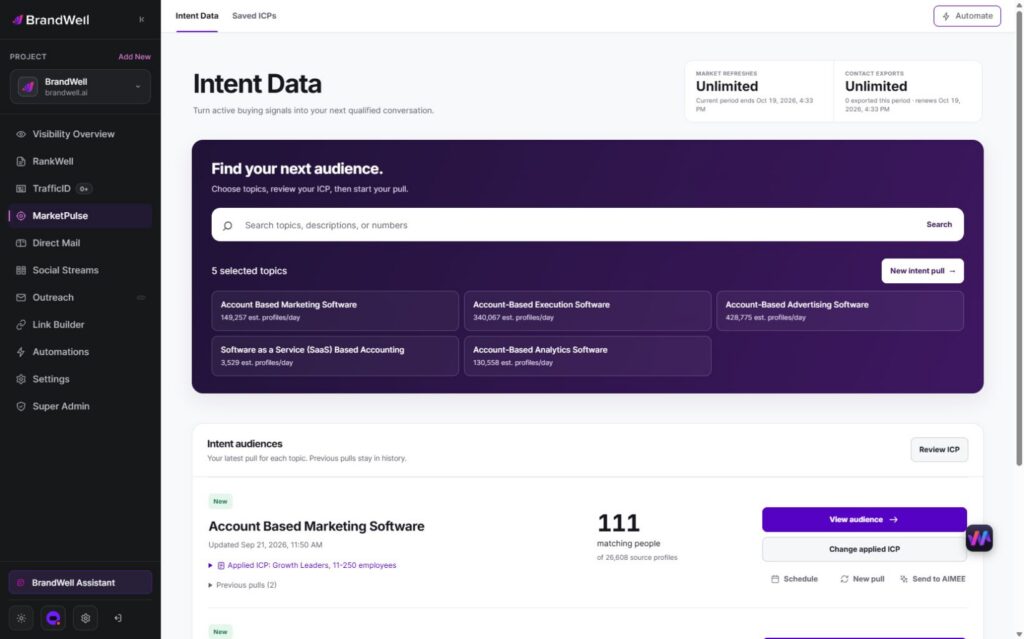
BrandWell MarketPulse: intent data starting at $500/mo. Find people researching topics relevant to what you sell, apply saved ICP filters, and review available contact details before taking action.
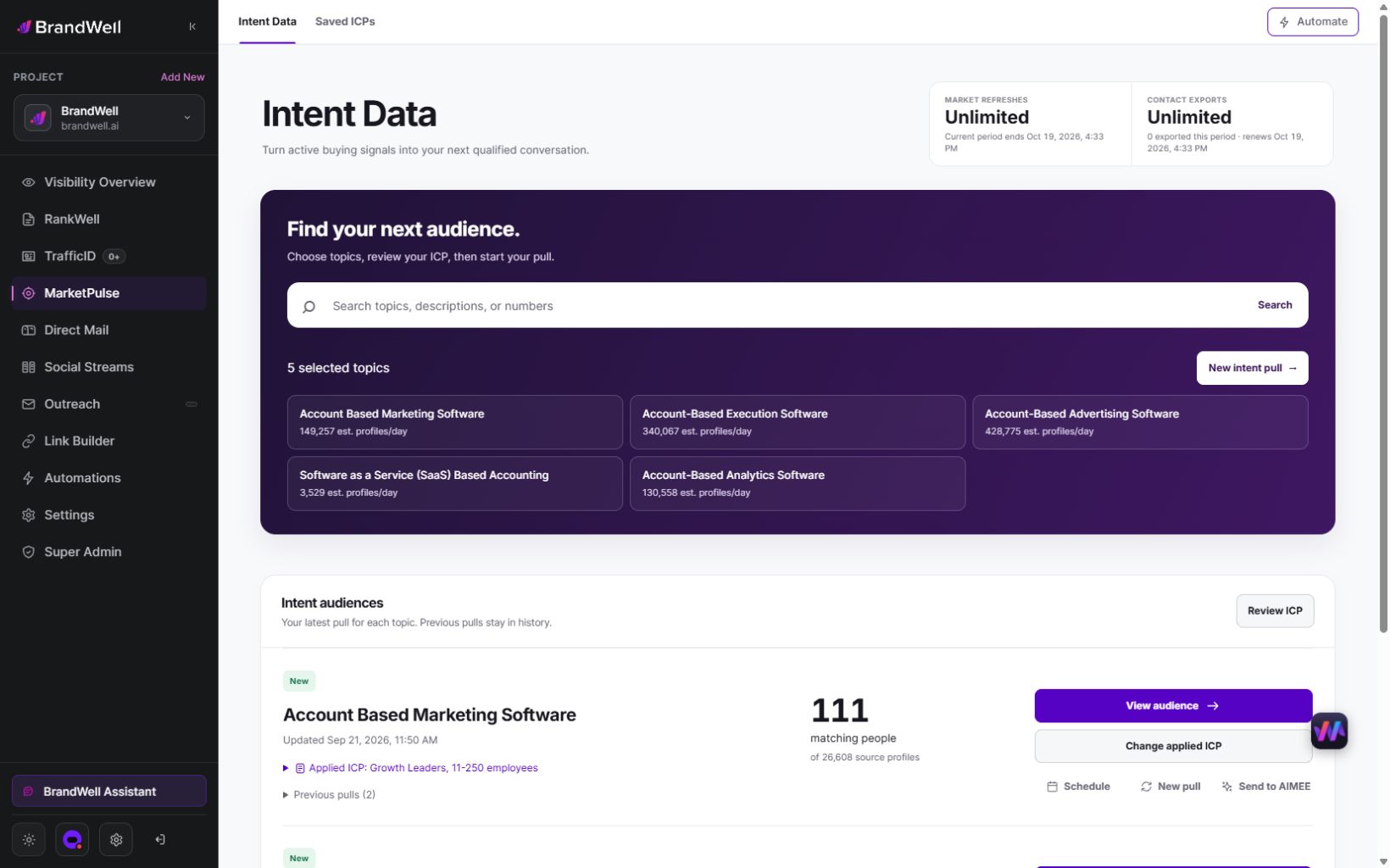
MarketPulse plans are starting at $500/mo. Verify current package scope and offers on the product page.
| Plan | Topics and refreshes | Monthly exports |
|---|---|---|
| Starter | 1 topic, weekly | 25,000 contacts |
| Growth | 3 topics, daily | 100,000 contacts |
| Scale | 10 topics, daily | Unlimited contacts |
Swipe the table to see all columns.
A pull retrieves available data from the previous 24 hours for one topic. Daily use across all included topics provides 90 Growth pulls or 300 Scale pulls in a 30-day month. Weekly Starter pulls vary by calendar month. Available audience size and contact fields vary, and audiences may overlap. Refreshes stop at the plan limit without overage charges.
- Find and qualify: search the topic catalog, save your ICP, and review the people and companies that match.
- Act on the research: export qualified contacts or prepare an Outreach or Direct Mail workflow. Connected products, channel usage, and fulfillment may cost extra.
- Get help from AIMEE: Growth and Scale include AIMEE for the initial user to research accounts and prepare the next step through connected tools.
Agencies and other service businesses can build client deliverables around their available Intent Scans and exports. Keep each client’s scope, permissions, and service fees clear. A subscription is not a promise of a white-label platform or exclusive access to a market.
Explore MarketPulse and watch the demo or compare plans starting at $500/mo. Any early-access discount is a separate, time-limited offer shown to an eligible recipient.
Define the commercial research decision
Start with a narrow commercial decision. An office tenant-representation team may want to prioritize approved accounts for research. An industrial broker may want to layer company research signals onto a defined company list before a market review. A building-services client may want to identify relevant businesses and properties for a permitted campaign. In each case, define what the service may conclude and what must be verified.
Build recurring value from a maintained workflow: topic review, company resolution, property and tenancy validation, qualification, activation, client disposition, and learning. The service can improve prioritization and consistency, but whether it produces pipeline or revenue depends on the client’s market, offer, data, timing, execution, and attribution.
Write the client-facing output as a research queue, not a relocation list. Each opportunity sheet should explain which company-level signal caused review, which property or tenancy facts were verified separately, what remains unknown, and what action is permitted. This language helps the client use urgency without confusing it with certainty.
Use topics that correspond to a business question without pretending they reveal a transaction. BrandWell’s intent-topic selection and maintenance guide can help the agency test relevance, exclusions, and drift.
Assign entity and property reviewers
The agency needs a delivery lead, signal or data analyst, CRE subject-matter reviewer, client owner, activation owner, and an authorized privacy, security, or legal reviewer when the use requires it. The subject-matter reviewer should understand whether a record refers to a property owner, operator, tenant, parent company, broker, investor, or service provider. Those roles are not interchangeable.
- Scope: define property type, geography, entity type, approved topics, excluded uses, and client decision.
- Resolve: match the company and preserve parent, subsidiary, location, and ambiguity.
- Verify: check property and tenancy facts in approved sources rather than inferring them from the signal.
- Qualify: apply commercial fit, relationship, suppression, confidence, and timing rules.
- Activate: route a proportionate action to an owner and approved destination.
- Reconcile: capture disposition, corrections, contact state, and destination receipt.
- Review: update topics, definitions, sources, cost, and client learning.
The cadence should match decision velocity. A fast-moving leasing program and a long-cycle owner strategy should not share an arbitrary refresh. Put the service level, source refresh, client response obligation, and exception clock in writing.
Evaluate each evidence layer separately
The best-fit stack connects distinct capability layers: intent or first-party signal collection, business-entity resolution, contact validation where permitted, commercial property and tenancy sources, relationship and CRM records, qualification workflow, secure client reporting, activation destinations, and an evidence ledger. Do not choose one system and assume it proves every layer.
Test whether a tool distinguishes property owner, tenant, location, parent company, and individual contact. Confirm geography, update method, source rights, permitted uses, corrections, exports, access roles, retention, and contractual disclosure. Run known examples, ambiguous entities, multitenant buildings, virtual locations, subsidiaries, and recently changed occupancy through the workflow.
Useful templates include an entity worksheet, property-fact checklist, relationship and suppression register, opportunity sheet, source-rights register, claim-evidence ledger, client disposition form, and exception note. A vendor comparison should score these operating requirements and actual contract terms, not rely on a broad “top platforms” label.
Compare market coverage and prioritization
| Approach | What it does well | Limitation | Appropriate use |
|---|---|---|---|
| Static property or tenant list | Defines a known market and supports systematic coverage | May not reflect current research or priority | Market mapping, relationship coverage, and baseline prospecting |
| Manual research | Adds context and handles ambiguous properties or entities | Slow, inconsistent, and hard to refresh at scale | High-value accounts, exception review, and validation |
| Intent-led prioritization | Helps order which approved companies to examine first | Does not prove a move, lease, expansion, or authority | Adding timely research context to a defined commercial universe |
| Hybrid evidence ladder | Combines timely prioritization with property and human verification | Requires owners, controls, and documented handoffs | A scoped program that can maintain each required verification layer |
Swipe the table to see all columns.
Use intent as an additional prioritization layer, not a replacement for market knowledge, property records, tenant facts, relationships, or human judgment. A static list can be the right answer when the client needs complete market coverage. Manual research can be the right answer when the universe is small or each property is unusually complex.
Model entity ambiguity and validation cost
Model the cost of the full evidence ladder. Include wholesale modules and usage, topic design, entity resolution, property or tenancy data access, analyst validation, contact checks, account service, client reporting, activation support, corrections, governance review, and allocated overhead. Complexity rises with property types, geographies, legal entities, data sources, custom destinations, and review frequency.
Copyable CRE service economics sheet
Setup cost = discovery + topic and entity design + source review + workflow configuration + testing + training
Recurring cost = platform and usage + property validation + analyst review + client service + support + allocated overhead
Client price floor = recurring cost / (1 - chosen contribution rate)
Scope unit = contracted topics + entity and property universe + refresh + review + destinations + support boundary
No universal price or ROI benchmark applies. Use actual vendor terms, analyst capacity, client retail price, collection risk, and a chosen contribution target. Model a downside case with extra entity ambiguity, corrections, or source changes.
Measure reviewed sheets and actual actions
Begin with service metrics: contracted work delivered, entities resolved, property facts verified, exceptions closed, destination receipts, and client review completion. Measure quality through duplicate rate, unresolved-entity rate, source freshness, correction rate, identity-confidence distribution, and sampled relevance. Adoption includes accepted opportunity sheets, assigned accounts, completed research, and recorded dispositions.
Agency economics include recurring fee, cost to serve, analyst hours, support load, scope changes, contribution, collection status, renewal, contraction, and expansion. Client outcomes may include responses, meetings, opportunities, or transactions, but report them only from an agreed record and with an appropriate sourced, influenced, associated, or unknown label.
Do not present a lease or sale as caused by one signal. Commercial real-estate outcomes involve multiple people, relationships, market conditions, property constraints, and long time horizons. The service should improve the quality of the next decision and the record used to learn.
Choose clients with a verifiable commercial scope
The clearest fit is an agency serving a defined B2B commercial market with clients that have account owners, a usable CRM or review process, and capacity to verify and act. Examples may include office or industrial brokerage, commercial owner-operator marketing, B2B location strategy, and property-service businesses. Each needs a different entity, property, and action definition.
A client testing a new market may start with a curated manual service. A mature client with consistent definitions may support controlled automation. A client with fragmented systems may need a shared opportunity sheet before integration. Do not sell a high-frequency feed to a team that cannot review it.
Exclude or pause use cases that depend on individual profiling without a permitted purpose, blur commercial and residential activities, require unverified claims about occupancy or authority, or cannot satisfy source rights and security. Client stage does not override those controls.
Build a sourced opportunity sheet
Use company-level research, approved website behavior, client first-party engagement, and other contracted signals as inputs. Record topic, source, recency, geography where supportable, and confidence. Then resolve the business entity and separately validate property, tenancy, ownership, occupancy, and relationship facts from permitted sources. The exact sources vary by jurisdiction and contract.
Example opportunity-sheet fields
A practical sheet can contain company name and domain, entity relationship, signal topic and recency, company-match confidence, target-market fit, relevant property or tenancy fact with source, relationship owner, suppression state, contact-validation state, recommended research step, reviewer, destination, and final disposition. Use structured states rather than an unbounded notes field for the most important controls.
Include an explicit “not established” field for relocation, expansion, lease timing, authority, and budget. That may feel repetitive, but it protects the operational meaning of the sheet and gives account teams language they can repeat accurately.
Person identity is a separate layer. Where permitted, validate contact information and role relevance. Do not state that a contact created a company-level signal or can authorize a real-estate decision unless verified independently. Apply suppression and existing-relationship rules before activation.
Approved actions can include account research, broker review, relationship-owner assignment, a tailored commercial campaign, or outreach under the client’s policy. Preserve the source event, verification record, action, response, and outcome association. Missing outcome data should remain marked unavailable.
Control transaction claims and housing boundaries
The largest strategic risk is selling a relocation or expansion prediction when the evidence only supports prioritization. Operational risks include confusing property owner with tenant, matching a location to the wrong parent, using stale occupancy, losing relationship exclusions, or letting unreviewed records trigger outreach. Trust erodes when uncertainty is hidden.
Document the purpose, permitted fields, source rights, access, retention, correction and incident owner for the actual service. An agency worksheet does not certify regulatory compliance or approve a data source.
The HUD overview addresses home, mortgage and related housing discrimination. If a campaign touches housing or an uncertain commercial/residential boundary, stop for qualified review. A “commercial” label alone does not establish permitted use or remove other obligations.
Use BrandWell’s intent-data compliance program guide as an operational checklist, then adapt it to the actual jurisdiction and use with authorized reviewers.
Maintain the recurring research service
A recurring package can include contracted topic monitoring, company resolution, property and tenancy validation at the agreed level, qualification, opportunity sheets, activation support, evidence reporting, and a review. Charge separately for custom markets, data sources, destinations, higher-touch validation, or advisory work. Renew only if the client uses the output and the delivery is sustainable.
AIMEE can help prepare an approved business opportunity sheet through configured connected tools. Preserve source references, unresolved entity relationships and required human approvals. A research signal does not verify tenancy, occupancy, a lease event or relocation.
Start with supported MarketPulse topic research from $250/month. Check the actual topic and permitted fields, then prepare the approved next research action. Property, tenancy and ownership validation are separate agency tasks using separately permitted sources; do not assume a subscription supplies those databases.
Before presenting the service, use BrandWell’s agency discovery questions for buying intent to confirm the client decision, systems, capacity, and risk boundaries.
Copyable CRE opportunity-sheet review
ROLE: Act as a commercial real-estate research operations assistant. Do not act as a broker, lawyer, decision maker, or autonomous outreach agent.

INPUTS:
- approved commercial use and geography
- contracted company-level signals and topics
- entity, property, tenancy, and relationship sources
- fit, confidence, suppression, and retention rules
- client action options and destination

TASK:
1. Keep company signals, entity resolution, property facts, tenancy facts, and contacts in separate fields.
2. Mark each field verified, inferred, conflicting, stale, unresolved, or unavailable.
3. Apply fit and suppression rules without filling gaps.
4. Draft a review-only opportunity sheet with source references.
5. Recommend the lowest-risk next action and list required approvals.

STOP CONDITIONS:
- Do not infer relocation, expansion, lease timing, authority, budget, protected traits, or individual intent.
- Do not invent addresses, ownership, occupancy, contacts, prices, or outcomes.
- Do not publish, export, contact, route, or change a client system.

HUMAN APPROVAL REQUIRED:
A CRE subject-matter reviewer verifies property and tenancy context. The client approves fit and action. Authorized privacy, security, legal, and sector reviewers approve applicable use. A human approves every outreach or system change.
Claude, ChatGPT, or AIMEE can organize evidence and identify gaps. Human reviewers own facts, permissions, decisions, and activation.
Test one property-market workflow
Select a narrow commercial use case and a small approved company universe. Run every record through all six evidence rungs. If reviewers repeatedly jump from a signal to a transaction claim, tighten the workflow before adding volume.
Worked example: count companies and property sheets separately
A fictional month’s intake contains 150 distinct company accounts. Sixty meet the client’s commercial fit rule, and 40 have enough independently reviewed entity and property context for an opportunity sheet. Sheet yield is 40 / 60 = 66.7% of fit accounts or 40 / 150 = 26.7% of intake. If 25 sheets receive a recorded client action, activation is 62.5% of complete sheets or 16.7% of intake. These states do not establish a move, lease expiry, authority or transaction.
Suppose tools and permitted source access cost $600, entity review costs $500, property validation costs $700 and client reporting costs $200. Defined recurring cost is $2,000, or $50 per complete sheet and $80 per acted-on sheet. At a $3,000 fee, the $1,000 remainder is 33.3% before acquisition, setup recovery, general overhead, tax and financing. Six extra ambiguity-review hours at $100 add $600 and reduce the remainder to $400, or 13.3%. These are invented planning inputs, not typical results or BrandWell property-data terms.
A company with three locations remains one company and three separately verified location records. Do not count the locations as three independent buyers. Record the unit for every rate and retain unknown lease, occupancy and relationship fields rather than filling them from topic activity.
Prepare the review sheet in BrandWell
Review a relevant available MarketPulse business topic against the saved client ICP and preserve the actual preceding-24-hour pull window. AIMEE can help organize an approved account brief through configured tools. Add separately permitted entity, property and tenancy references to the agency’s review record; label missing facts. A qualified reviewer approves context, relationship exclusions and the actual next action before outreach.
Frequently asked questions
Does a topic signal mean a tenant is moving?
No. It can prioritize research; relocation and tenancy facts require separate verification.
Does MarketPulse supply a property or lease database?
Do not assume that. Verify supported fields and separately source property context.
Are three locations three independent buyers?
Not automatically. Keep company and location units distinct.
Can we infer permitted use from a commercial label?
No. Review the actual purpose, source terms and commercial/residential boundary.
Review supported business research: explore MarketPulse and current plans.
Reviewed and updated October 3, 2026.

Written by