On this page
- Current MarketPulse workflow
- Map application relevance before prioritizing accounts
- Assign technical and channel owners
- Evaluate the supported research stack
- Combine topic context with manual discovery
- Model technical review and exception work
- Measure briefs and long-cycle feedback
- Choose clients with clear applications
- Keep plant, account and stakeholder states separate
- Control false-project and channel risks
- Maintain the recurring technical brief
- Industry classification is context, not project evidence
- Worked example: technical briefs and channel clearance
- Frequently asked questions
Direct answer: For industrial and manufacturing clients, use intent data to prioritize application and account research across long buying cycles, not to declare that a plant has a funded project. Model parent, plant, site, distributor, supplier, and committee roles separately. Combine technical-topic relevance with account fit, human validation, channel rules, and evidence from sales follow-up.
Current MarketPulse offer: intent-data plans start at $500/mo. See the product, demo, and current plans. Updated October 3, 2026.
Who this is for: Industrial marketing agency owners serving manufacturers, equipment suppliers, industrial software firms, engineering services, distributors, or other technical B2B sellers with named accounts and consultative sales processes.
Industrial buying decisions often involve an application, a facility, a corporate owner, a channel relationship, and several technical and commercial stakeholders. A single company row cannot represent all of those relationships. The service should organize hypotheses for research and discovery while keeping uncertainty attached.
Start by translating the client’s product into applications and business problems, then choose and maintain application-relevant intent topics. Broad industry codes remain useful context, but they cannot establish a project, budget, outage, procurement event, or buying authority.
Current MarketPulse workflow
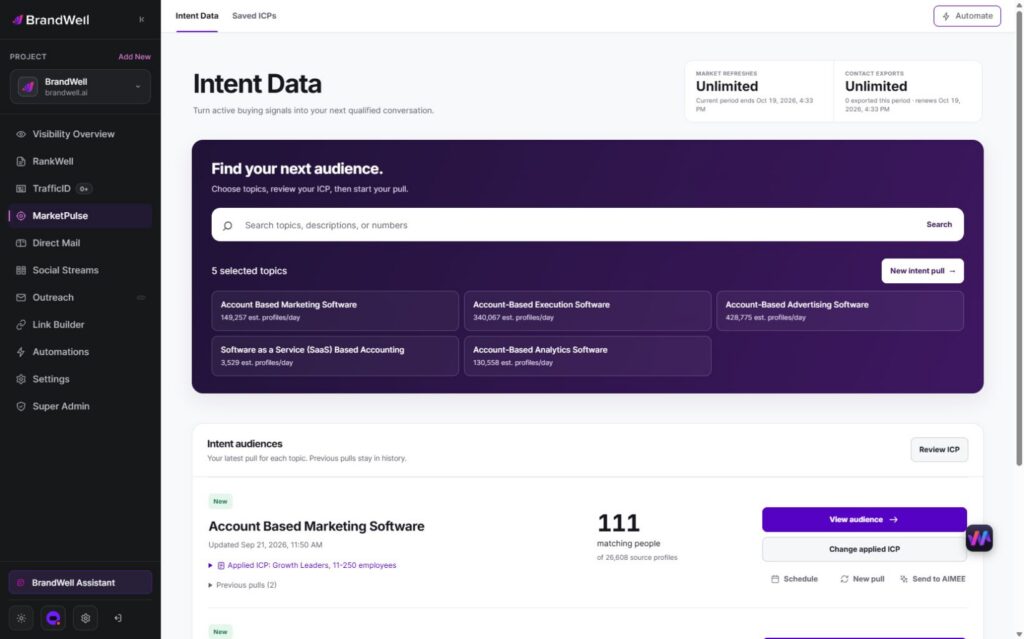
BrandWell MarketPulse: intent data starting at $500/mo. Find people researching topics relevant to what you sell, apply saved ICP filters, and review available contact details before taking action.
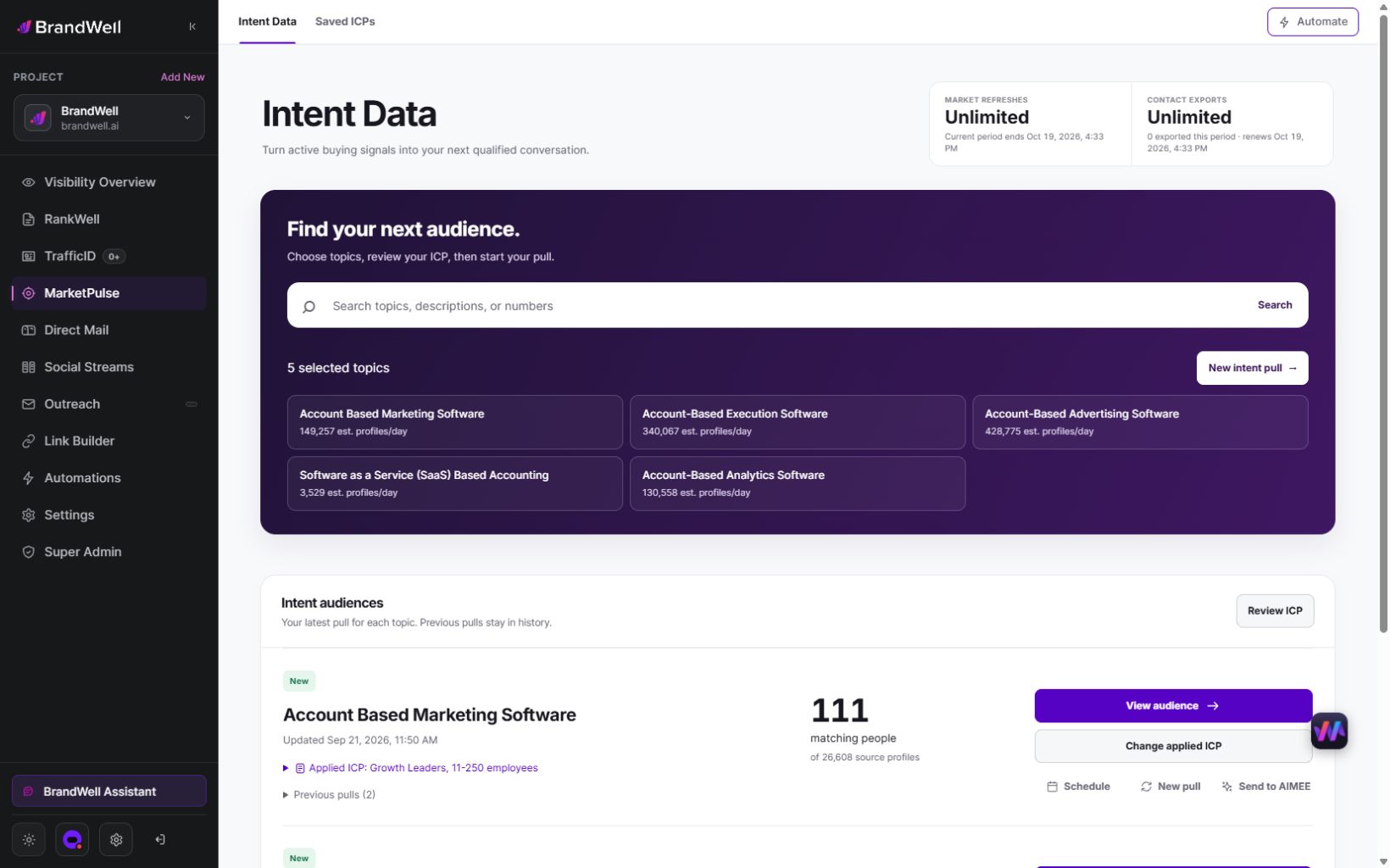
MarketPulse plans are starting at $500/mo. Verify current package scope and offers on the product page.
| Plan | Topics and refreshes | Monthly exports |
|---|---|---|
| Starter | 1 topic, weekly | 25,000 contacts |
| Growth | 3 topics, daily | 100,000 contacts |
| Scale | 10 topics, daily | Unlimited contacts |
Swipe the table to see all columns.
A pull retrieves available data from the previous 24 hours for one topic. Daily use across all included topics provides 90 Growth pulls or 300 Scale pulls in a 30-day month. Weekly Starter pulls vary by calendar month. Available audience size and contact fields vary, and audiences may overlap. Refreshes stop at the plan limit without overage charges.
- Find and qualify: search the topic catalog, save your ICP, and review the people and companies that match.
- Act on the research: export qualified contacts or prepare an Outreach or Direct Mail workflow. Connected products, channel usage, and fulfillment may cost extra.
- Get help from AIMEE: Growth and Scale include AIMEE for the initial user to research accounts and prepare the next step through connected tools.
Agencies and other service businesses can build client deliverables around their available Intent Scans and exports. Keep each client’s scope, permissions, and service fees clear. A subscription is not a promise of a white-label platform or exclusive access to a market.
Explore MarketPulse and watch the demo or compare plans starting at $500/mo. Any early-access discount is a separate, time-limited offer shown to an eligible recipient.
Map application relevance before prioritizing accounts
Lead with application relevance. Define the equipment, process, material, standard, operating problem, or use case the client can actually support. Translate it into approved topics with explicit exclusions. Then test accounts against industry, geography, account tier, installed-base evidence where legitimately available, channel ownership, existing relationships, and technical sales capacity.
The resulting account brief should state the observed topic, entity evidence, application hypothesis, fit factors, channel or relationship constraints, plausible stakeholder roles, missing evidence, and approved discovery action. It must not say the plant has a capital project, approved budget, RFQ, failure, or purchase date unless the client supplies direct evidence of that event.
Recurring revenue comes from ongoing topic tuning, entity maintenance, technical validation, account briefs, committee hypotheses, channel suppressions, sales feedback, and long-cycle reporting. This helps a client maintain focus, but it does not promise a qualified pipeline or a sale within a particular period.
Assign technical and channel owners
Assign a technical topic owner, account and plant data steward, analyst, channel owner, client sales liaison, delivery lead, privacy reviewer, and client approver. The topic owner decides whether research language actually maps to an application. The channel owner catches distributor, rep, territory, and existing-account conflicts before outreach.
At intake, capture product and application maps, approved topics, account tiers, parent and site hierarchy, industries, territories, installed-base inputs, channel rules, customers, open opportunities, relationship suppressions, plausible committee roles, and feedback fields. Weekly operations review observations, resolve entities, apply fit, identify conflicts, build briefs, and route only accepted accounts.
Technical and sales feedback may arrive slowly, so use a cadence that reflects the cycle. Review operational exceptions weekly, topic precision monthly, and long-cycle evidence by account cohort. Do not retire a technically sound topic solely because no deal appeared quickly. Do retire or revise a topic when experts repeatedly find that it describes the wrong application.
Evaluate the supported research stack
Select capabilities that represent the industrial buying network:
- Application-topic map: product, process, problem, topic, exclusion, expert, and version.
- Entity hierarchy: corporate parent, legal entity, plant, site, domain, supplier, distributor, and territory.
- Account and contact validation: match confidence, role evidence, contactability, and ambiguity kept separate.
- Relationship suppression: customers, active opportunities, channel partners, protected accounts, and conflicts.
- CRM routing: direct seller, distributor, rep, named-account owner, exception, and feedback codes.
- Technical account brief: application hypothesis, source evidence, uncertainty, stakeholders, discovery questions, and action.
- Evidence ledger: acceptance, technical discovery, stakeholder expansion, observed opportunity events, rejection, and maintenance.
Templates should include an application decomposition sheet, plant-parent reconciliation, channel-clearance form, buying-committee hypothesis, discovery brief, long-cycle outcome log, and topic review memo. A generic lead tool is insufficient if it cannot preserve multiple entity types, relationships, and technical evidence.
Combine topic context with manual discovery
Application and account intent adds timing context to a defined account market, but its best use is prioritizing research. Industry-code segmentation is efficient for building a broad fit universe, although a code does not reveal an application or project. Manual account research is stronger for strategic plants, complex process context, and publicly visible projects. Distributor intelligence can carry relationship and territory knowledge that a third-party observation lacks.
Installed-base data may be valuable when its source, accuracy, rights, and update cycle are known. Client first-party engagement can show direct interaction with technical content. Each input answers a different question, so combine them as labeled evidence rather than blending them into an unexplained score.
Use a hybrid workflow: industry and account rules define the market, topic evidence orders research, technical reviewers test application fit, channel owners clear relationships, and sellers conduct discovery. Use manual research alone when the account set is small, the application is highly specialized, or entity resolution is uncertain.
Model technical review and exception work
Budget for technical work, not just data. Include application and topic design, subject-matter review, platform and source cost, account and plant resolution, contact validation, channel clearance, brief preparation, sales handoff, reporting, client meetings, and a learning period. Add exception time for complex ownership and distributor conflicts.
Long-cycle service economics worksheet
- Foundation: application map, topic set, entity hierarchy, systems, governance, and base reporting.
- Per-account work: evidence review, technical validation, relationship checks, committee hypothesis, and brief.
- Sales dependency: time for seller acceptance, discovery, feedback, and stakeholder mapping.
- Rework: wrong plant, stale relationship, topic mismatch, channel conflict, or unverified contact.
- Scenario contribution: retail fee minus direct delivery cost under conservative, expected, and high-effort cases.
Avoid short-cycle ROI promises. An accepted account brief may be useful well before a measurable opportunity exists. Agree on leading service evidence and longer-term client observations, then replace labor assumptions with actual delivery data. If economics require a fixed project count, the model is built on a claim the signal cannot support.
Build capacity around briefs, not raw observations. Estimate how many technically reviewed accounts the agency and client can handle in a cycle, then cap the queue. A smaller accepted set makes it possible to resolve plant ownership, clear channels, and record feedback. Overflow can remain in research rather than becoming low-quality outreach.
Measure briefs and long-cycle feedback
Start with application-topic precision, accepted-account rate, parent or plant resolution, relationship conflicts found, committee-role coverage, contact validation, channel clearance, sales acceptance, and time to feedback. These show whether briefs are technically and operationally useful.
Track technical discovery, stakeholder expansion, observed qualification, RFQ or opportunity events only when the client records them, progression by account cohort, delivery effort, cost per accepted brief, contribution under the declared cost model, renewal, and expansion. An RFQ should never be inferred from research activity. It enters the ledger only when an authorized source reports it.
Document attribution limits. Industrial outcomes may reflect existing relationships, distributor work, engineering cycles, budgets, and sales activity that predate the service. Use the evidence ledger to show sequence and contribution without claiming sole causation. Review topic and account cohorts over a time horizon appropriate to the client’s cycle.
Choose clients with clear applications
Best-fit clients have defined applications, named-account economics, technical sales capacity, patience for long cycles, usable entity data, clear territories, and channel rules. Manufacturers, industrial technology providers, equipment suppliers, engineering services, and distributors may fit when they can explain which problem and account matter.
Exclude commodity or consumer demand, clients seeking anonymous project detection, teams with no technical reviewer, unclear direct-versus-channel ownership, no sales feedback, and guaranteed-project expectations. A broad market with vague applications will usually create noisy topics and generic outreach.
Use agency discovery questions to qualify buying-intent fit. Ask what application triggers research, which entity buys, how plants and headquarters share decisions, who owns each channel, what relationships must be suppressed, what the seller can do next, and how long credible feedback takes.
Keep plant, account and stakeholder states separate
Maintain distinct states for research activity, company identity, plant or site relationship, application fit, stakeholder hypothesis, validated contact, channel ownership, human approval, and observed outcome. A domain match might establish a corporate account while leaving the relevant plant unresolved. A job title may suggest a role while leaving buying involvement unknown.
The 8-stage Application-to-Account Evidence Chain
- Application map: define the process, equipment, material, standard, problem, or use case the client solves.
- Topic set: translate the application into approved research topics and exclusions; industry codes stay contextual.
- Entity resolution: separate parent, legal entity, plant, site, distributor, supplier, and domain evidence.
- Fit screen: apply industry, geography, capacity, channel, account, and relationship rules without inferring a project.
- Committee hypothesis: map plausible engineering, operations, quality, procurement, finance, and executive roles as hypotheses.
- Human validation: review technical relevance, conflicts, relationships, suppressions, and ownership.
- Approved handoff: send evidence, uncertainty, discovery questions, and next-action options to the correct seller.
- Long-cycle evidence: log acceptance, technical discovery, stakeholder expansion, qualification, observed events, and limitations.
Run a lead and intent data QA checklist before handoff. Activation can be analyst research, technical content, seller discovery, account advertising, distributor review, or suppression. The evidence state, relationship rules, and human owner determine the route.
Control false-project and channel risks
The defining risk is false project inference. Topic research does not prove a capital program, budget, outage, RFQ, specification, authority, or purchase date. Other risks include routing to the wrong plant, confusing parent and site, stale application data, distributor conflict, contacting an existing customer, technical misinterpretation, overconfident committee mapping, long-cycle attribution, excessive retention, weak suppression, and poor expectation setting.
Make each hypothesis revisable. Require technical approval for application relevance, reviewed entity evidence, channel clearance for ownership and sales approval for the next action. Define allowed fields, access, retention and correction with qualified client reviewers; this operating checklist is not a compliance finding.
When an account changes owner or a distributor relationship appears, preserve the previous evidence and route. Do not overwrite history to make reporting look cleaner. The change record explains why the next action changed and helps the agency distinguish a data correction from a true market event.
Technical validation should be concise enough to repeat. Give the subject-matter reviewer the topic definition, application map, account and site evidence, source context, and a binary accept, reject, or investigate decision with a reason. Do not ask an engineer to inspect an unexplained spreadsheet. Structured feedback makes topic maintenance faster and preserves why a record was held.
Build a distribution plan for the account brief. A direct seller may need the full evidence and discovery questions. A distributor may receive only the approved account and application context. An advertising system may receive a permitted account audience but not committee hypotheses. The destination, role, and client contract decide which fields move. Convenience does not justify sharing the whole record.
Use cohort reviews to accommodate long cycles. Group accepted briefs by application, account tier, channel, and handoff period, then examine actual discovery and stakeholder events over time. Keep the cohort definition stable enough to learn. If a topic or route changes, start a new version instead of blending unlike records into a favorable trend.
Give the client a clear definition of a complete brief. At minimum, require a resolved account, stated entity uncertainty, application rationale, source context, channel status, relationship check, approved discovery path, and named reviewer. If any required element is absent, classify the brief as research pending rather than forcing it into a seller queue.
Maintain the recurring technical brief
Package application and topic maintenance, target-account and plant hierarchy, prioritized technical briefs, committee hypotheses, relationship and channel suppressions, approved sales handoff, outcome review, and a long-cycle report. Price the recurring expertise and evidence work, not a promised project count.
AIMEE can help organize an internal account brief through configured connected tools. Preserve the observed research, entity uncertainty, application hypothesis and channel owner. Technical, identity, channel and sales decisions stay with their authorized reviewers.
Copyable agent-ready workflow: application-to-account brief builder
Use Claude, ChatGPT, or AIMEE to organize evidence. Human experts retain technical, channel, identity, and sales decisions.
Goal: Build an evidence-labeled industrial account brief.
Inputs: client product and application map; approved topics and exclusions; target account and plant hierarchy; industry, installed-base, channel, and territory rules; contact evidence; customer, distributor, relationship, and suppression lists; sales feedback.
Construct: the eight evidence stages. Show missing entity and technical evidence, channel conflicts, plausible committee roles labeled as hypotheses, discovery questions, uncertainty, and approved next-action options.
Stop if: a signal is presented as proof of project, budget, outage, RFQ, authority, or purchase date; plant or sales ownership is unresolved; the topic does not map to an approved application; a relationship conflict remains; or contact evidence is missing or suppressed.
Output only: a sourced account brief for human review. Do not send outreach, create an opportunity, assign an account, or assert a project.
Approvals: technical subject-matter owner, data owner, channel or account owner, and sales owner.
Test the evidence chain before scaling delivery
MarketPulse supplies topic research audiences and saved ICP filtering starting at $500/mo. Review available topic and account evidence, then prepare an approved next step through configured connected tools. Plant hierarchies, installed-base research, channel rules and custom integrations need their own verified agency implementation.
MarketPulse plans are starting at $500/mo. Starter includes 1 topic, weekly refreshes, and 25,000 exportable contacts per month. Growth includes 3 topics, daily refreshes, and 100,000 exportable contacts. Scale includes 10 topics, daily refreshes, and unlimited contact exports. AIMEE for the initial user is included with Growth and Scale. Compare MarketPulse plans and current offers.
Industry classification is context, not project evidence
The Census Bureau’s NAICS overview describes classification of business establishments for statistical purposes. Use a documented code as market context, not evidence that a specific plant has an approved purchase, RFQ or capital project.
Keep the classification version, establishment or parent level, source and observation date. Then add separately reviewed application relevance, plant relationship and channel ownership. A parent-domain match can leave the correct facility unresolved. Label the uncertainty instead of converting it into an outreach-ready plant record.
Worked example: technical briefs and channel clearance
Suppose a fictional month begins with 120 account observations representing 80 distinct parent accounts. Forty parents pass the written application-fit review, and 25 receive sufficient entity and channel clearance for a complete brief. Complete-brief yield is 25 / 40 = 62.5% of fit parents or 25 / 80 = 31.25% of distinct parent accounts. Do not use 120 observations as a count of unique plants or potential projects.
If a seller accepts 20 of the 25 briefs, seller acceptance is 80% of complete briefs. Ten subsequently have recorded technical discovery, or 50% of accepted briefs and 12.5% of the original 80 parents. Three RFQs can be reported only if directly recorded by the client or another authorized source. Their association with the cohort does not establish that topic research caused them.
Suppose research tools cost $500, technical review costs $900, entity and channel review costs $450 and reporting costs $150. Defined recurring cost is $2,000, or $80 per complete brief and $100 per seller-accepted brief. A $3,000 fee leaves $1,000, or 33.3%, before acquisition, setup recovery, general overhead, tax and financing. Ten extra technical hours at $100 consume that remainder. Counts, fees and labor are invented planning inputs, not market benchmarks or BrandWell delivery terms.
Prepare an evidence-labeled account in BrandWell
Search relevant available topics in MarketPulse and apply the saved client ICP. Preserve each pull’s actual preceding-24-hour window and the available source and identity fields. Add separately verified application, facility and relationship evidence to an internal brief; do not imply those custom layers are included automatically. AIMEE can help organize a draft through configured tools. Route the final approved discovery question to the correct seller or channel owner rather than asserting a funded project.
Frequently asked questions
Does a topic signal prove an industrial project?
No. Project, budget and RFQ claims require separately recorded evidence.
Does a company domain identify the correct plant?
Not necessarily. Preserve the parent-to-site uncertainty and review it.
Are committee roles verified buyers?
No. Treat plausible roles as hypotheses until the actual buying involvement is established.
Does MarketPulse include custom installed-base research?
Do not assume it. Verify any additional research and implementation scope separately.
Review the research input: explore current MarketPulse plans starting at $500/mo.
Reviewed and updated October 3, 2026.

Written by