On this page
- Define the lifecycle and decision horizon
- Use an eight-layer cost register
- Build the estimate in seven steps
- Choose evidence for the actual cost question
- Verify supported research and operating scope
- Check omitted and duplicated costs
- Keep return evidence separate from costs
- Check operating readiness
- Verify rights and actual risk controls
- Scope a separate cost-review service
- Use the acceptance checklist
- Record the cost decision
- Copyable lifecycle-cost evidence card
- Frequently asked intent-data TCO questions
Intent data total cost of ownership is the full cost of turning market signals into governed, measurable action – not merely the vendor subscription. A useful TCO model includes software and data, setup, integrations, identity and enrichment, operations, activation, measurement, governance, change management, renewal exposure, and exit costs. It also separates unavoidable program costs from vendor-specific costs so buyers can compare operating models fairly.
Who this is for: agency owners, marketing and revenue leaders, RevOps, finance and procurement teams comparing an intent-research program. Treat MarketPulse as a research input and verify the implementation, rights and fees of the wider operating workflow separately.
Current MarketPulse offer: intent-data plans start at $500/mo. See the product, demo, and current plans. Updated October 3, 2026.
Define the lifecycle and decision horizon
A practical three-year intent data TCO formula is:
TCO = contracted platform and data fees + implementation + integrations + internal labor + activation costs + measurement and governance + expected overages and change costs + exit costs − credits or avoided costs you can defend.
Choose a horizon long enough to include setup, adoption, at least one renewal decision, and a possible migration. Then model three cases:
- Expected case: the workload, usage, adoption, and data quality the team genuinely anticipates.
- High-cost case: slower implementation, more services, higher usage, weak match rates, extra data, or renewal uplift.
- Low-cost case: strong internal readiness, limited scope, high acceptance, and reusable infrastructure.
Do not subtract speculative pipeline from TCO. Pipeline and revenue belong in the return model. TCO answers, “What will this operating capability cost?” ROI asks whether the incremental value exceeds that cost. Payback period asks how long recovery takes. Keeping those questions separate prevents favorable attribution assumptions from disguising an expensive program.
Use an eight-layer cost register
| Cost layer | Include | Common omission | Evidence to request |
|---|---|---|---|
| Acquisition | Subscription, data modules, seats, topics, accounts, credits, minimum commitments | Add-ons needed for the promised use case | Itemized written quote and unit definitions |
| Implementation | Discovery, configuration, data mapping, validation, enablement, professional services | Internal stakeholder time and rework | Implementation plan, owners, acceptance criteria |
| Integration | CRM, MAP, warehouse, ads, API, web tag, identity and enrichment connections | Middleware, engineering maintenance, failed-sync handling | Architecture, supported destinations, rate limits, error behavior |
| Operation | Signal review, qualification, suppression, routing, reporting, client delivery | Human QA and rejected-record handling | RACI, weekly workload, disposition workflow |
| Activation | Audience sync, paid media, research, sequencing, sales follow-up | Media spend and channel-tool cost | Destination-level workflow and approval map |
| Governance | Privacy, security, permissions, retention, consent, vendor management | Legal review, data-subject handling, client separation | DPA, security packet, data flow, retention and deletion rules |
| Measurement | Baseline design, instrumentation, experiment analysis, attribution and reporting | Analyst time and comparison-cohort maintenance | Metric dictionary and measurement plan |
| Change and exit | Renewal, price changes, additional scope, export, deletion, migration and retraining | Lost history, unusable derived data, notice windows | Order form, renewal language, export format, termination assistance |
Swipe the table to see all columns.
For each line, record the amount, billing unit, owner, timing, confidence level, source document, and whether the cost changes by vendor. That last field is important. Your CRM administrator’s baseline salary may be unavoidable in every option, while a proprietary connector fee may be vendor-specific. Comparing all costs for one option with only subscription fees for another produces a misleading winner.
Build the estimate in seven steps
1. Freeze the decision and use cases
Write the actual decision before requesting prices. Examples include choosing a white-label agency service, adding off-site topic signals to an existing stack, identifying eligible website visitors, prioritizing accounts for SDR research, or activating audiences. List the required geographies, clients, users, topics, accounts, destinations, cadence, retention, and identity level.
A buyer comparing a narrow branded topic-report service with a full enterprise ABM platform is not conducting a matched comparison. Both may be valid options, but the excess modules, internal headcount, and media operations required by one model need to be explicit.
2. Normalize every commercial quote
Ask each provider to quote the same scope and disclose:
- included products, data sources, topics, accounts, records, users, workspaces, and clients;
- usage units, resets, overages, credit expiration, and throttles;
- implementation, training, support, and professional-services charges;
- integration and API entitlements;
- term, billing cadence, renewal, notice, uplift, and cancellation rules;
- export, deletion, derived-data, and transition rights;
- any media commitment or pass-through spend;
- reseller, white-label, tenant, and end-client permissions when relevant.
An annual equivalent is not evidence of monthly billing. A procurement benchmark is not list pricing. A “starting at” number is not a complete quote. Normalize the cash schedule and the recognized lifecycle cost separately so finance can see both liquidity and economics.
3. Map the operating workflow
Draw the full path: signal source → eligibility → identity → enrichment → qualification → approval → destination → action → disposition → outcome. Assign an owner and estimated minutes per unit at every step. Multiply the expected volume by handling time, then add exception and management time.
This exposes an important pattern: inexpensive data can become costly when it requires manual cleaning, while a higher subscription can reduce labor if its automation genuinely works in the buyer’s stack. The reverse is also possible. Automation that routes noisy records faster can increase waste. Test the workflow rather than assuming either outcome.
4. Price data quality, not just data volume
Record denominators for coverage, match rate, field completeness, acceptance, duplication, staleness, false positives, and activation. Calculate the cost per accepted, usable signal, not only cost per delivered record:
Cost per accepted signal = relevant program cost ÷ signals that pass the agreed qualification and governance rules.
For example, two providers can deliver the same record volume while one requires much more enrichment, review, suppression, or correction. The accepted-unit denominator makes that burden visible. It still does not prove business impact; it is an operating-efficiency measure.
5. Add adoption and change costs
Include enablement, playbook design, sales-management time, client training, reporting changes, and the opportunity cost of delayed or displaced work. Use ramp assumptions rather than pretending the team reaches steady-state utilization immediately. Model unused seats and credits if historical adoption suggests they are likely.
6. Add risk-adjusted ranges
Mark uncertain cells and give them low, expected, and high values. High-variance items typically include professional services, custom integrations, usage overages, media, match quality, internal review, implementation delay, and renewal pricing. Multiply probability by cost only when the probability has a defensible basis; otherwise show a range and sensitivity table.
7. Define acceptance and stop rules
A purchase should have commercial acceptance criteria before signature. Examples: required destinations work, output fields meet the agreed schema, latency stays within the operating window, accepted-signal cost remains below a threshold, permissions support the intended client model, and the team can reconcile records to outcomes. State what triggers remediation, scope reduction, renegotiation, or rejection.
Choose evidence for the actual cost question
The core tool can be a controlled spreadsheet with separate quote, labor, usage, risk, and cash-flow tabs. A warehouse or clean CRM export supplies denominators; a BI layer monitors adoption and accepted-signal cost; finance validates capitalization, cash timing, and discount assumptions; and a contract repository preserves the quote and renewal rules. Experiment platforms can help with incremental value, but they should not be used to invent TCO inputs.
Choose the measurement method by the decision. Descriptive analysis is enough to reconcile invoices, usage, labor, and accepted signals. Attribution allocates observed outcomes but is vulnerable to selection and model choices. Matched observational analysis can improve comparability when randomization is impractical, while leaving residual confounding. Randomized or phased experiments provide stronger incremental evidence when sample size and operating controls are adequate. None changes the cost ledger; each changes how confidently the buyer can compare cost with value.
Verify supported research and operating scope
Evaluate current MarketPulse research against the full workflow you actually need. Keep licensed inputs, actual implementation, human work, client rights, destination requirements and costs visible. The research subscription does not establish a native agency operating system or branded client portal.
MarketPulse research is starting at $500/mo. Verify current topics, refreshes, exports and included tools on the product page. Managed delivery, custom integrations, client interfaces and reporting require separately verified implementation, rights and fees.
Current MarketPulse research input
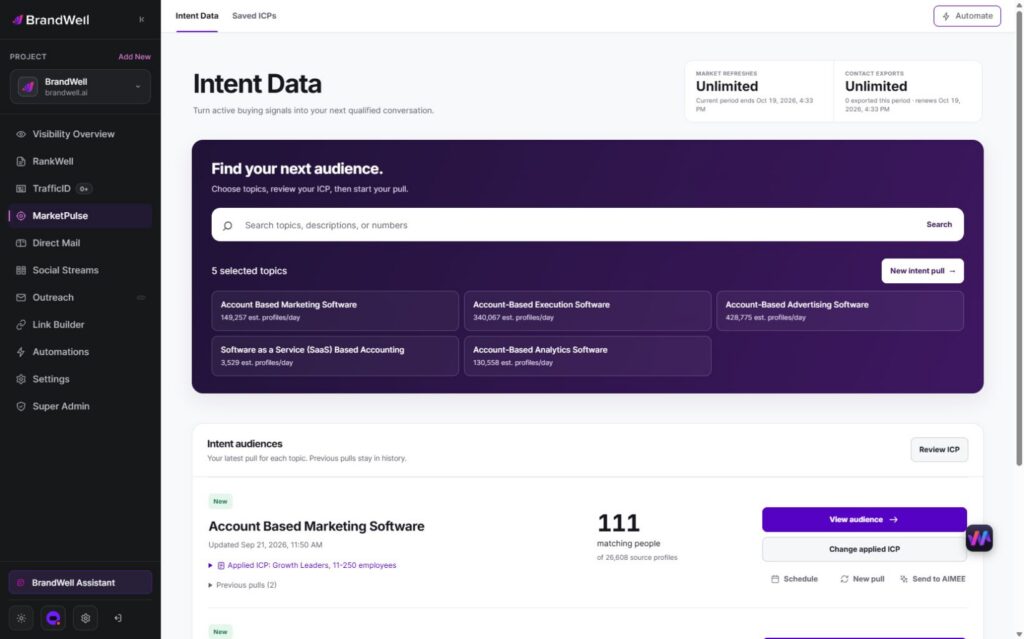
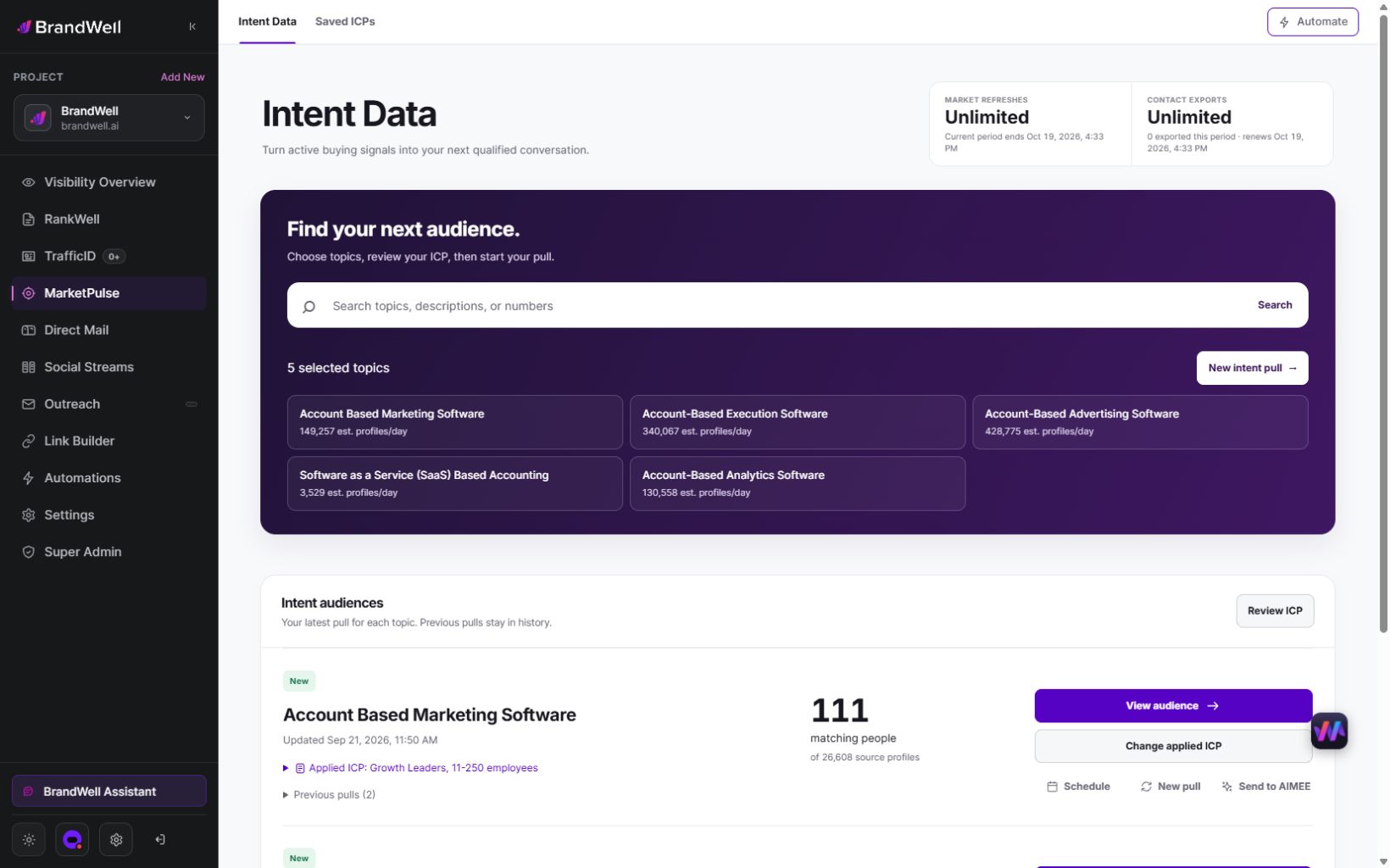
BrandWell MarketPulse: intent data starting at $500/mo. Find people researching topics relevant to what you sell, apply saved ICP filters, and review available contact details before taking action.
| Plan | Topics and refreshes | Monthly exports |
|---|---|---|
| Starter | 1 topic, weekly | 25,000 contacts |
| Growth | 3 topics, daily | 100,000 contacts |
| Scale | 10 topics, daily | Unlimited contacts |
Swipe the table to see all columns.
A pull retrieves available data from the previous 24 hours for one topic. Daily use across all included topics provides 90 Growth pulls or 300 Scale pulls in a 30-day month. Weekly Starter pulls vary by calendar month. Available audience size and contact fields vary, and audiences may overlap. Refreshes stop at the plan limit without overage charges.
- Find and qualify: search the topic catalog, save your ICP, and review the people and companies that match.
- Act on the research: export qualified contacts or prepare an Outreach or Direct Mail workflow. Connected products, channel usage, and fulfillment may cost extra.
- Get help from AIMEE: Growth and Scale include AIMEE for the initial user to research accounts and prepare the next step through connected tools.
Agencies and other service businesses can build client deliverables around their available Intent Scans and exports. Keep each client’s scope, permissions, and service fees clear. A subscription is not a promise of a white-label platform or exclusive access to a market.
Explore MarketPulse and watch the demo or compare plans starting at $500/mo. Any early-access discount is a separate, time-limited offer shown to an eligible recipient.
Check omitted and duplicated costs
The most consequential hidden costs are often not hidden by a vendor; they are omitted by the buyer’s spreadsheet. Test these categories explicitly:
- Unusable or rejected data. Wrong geography, stale role, ambiguous identity, irrelevant topic, duplicates, and unmatchable accounts consume review and activation capacity.
- Missing workflow components. A topic signal may still require identity, enrichment, CRM, audience sync, sequencing, reporting, and a client portal.
- Integration fragility. Authentication changes, schema drift, API limits, retries, duplicate writes, and ownership gaps create recurring engineering work.
- Manual approval. Human review is valuable where consequences are material, but it must be staffed and measured rather than called “automation.”
- Media and channel spend. Advertising costs and outbound tooling should not disappear inside a platform comparison.
- Adoption drag. Unused seats, credits, dashboards, and integrations are costs even when the invoice is unchanged.
- Governance work. Privacy assessment, security review, retention, deletion, data-subject handling, client permissions, and incident response require real owners.
- Measurement overhead. Cohort design, attribution, instrumentation, analyst time, and source-of-truth reconciliation are program costs.
- Commercial change. Renewal uplift, extra topics, new geographies, additional clients, higher usage, professional services, and overages can alter the expected case.
- Exit friction. Export limits, non-portable configuration, lost history, deletion verification, migration, and retraining can make switching expensive.
Keep return evidence separate from costs
TCO should feed – but not predetermine – the investment decision. Create a separate measurement plan with a baseline, eligible population, comparison design, definitions, and observation window. Useful operating metrics include usable coverage, accepted-signal cost, time to action, activation rate, rejected-record rate, and team adoption. Business outcomes may include qualified meetings, opportunity creation, stage progression, cycle time, win rate, gross profit, and retained agency revenue.
Intent, identity, and activation records explain who entered a workflow and what happened next. They do not establish causality by themselves. Last-touch or influenced-pipeline reports are vulnerable to selection bias: high-fit accounts may both show intent and convert for reasons unrelated to the signal. Where feasible, use randomized holdouts, phased rollouts, matched cohorts, or difference-in-differences analysis. When scale is insufficient, report descriptive evidence and uncertainty instead of manufacturing precision.
The decision becomes useful when the high-cost scenario remains acceptable or when the expected incremental value clearly exceeds a risk-adjusted cost range. If the result changes with one fragile assumption – such as 100% adoption or perfect attribution – the buyer does not yet have a decision-grade model.
Check operating readiness
An intent-data program is more likely to justify its TCO when the buyer has a defined market, enough addressable accounts or site activity, a valuable sales motion, agreed qualification rules, responsive activation channels, CRM discipline, and outcome feedback. It can also fit agencies that have repeatable client packaging and can spread a delivery system across multiple retained clients.
It is a poor fit when the offer is unproven, the market is too small for reliable measurement, sales cannot follow up, privacy and data rights are unresolved, identity requirements exceed realistic coverage, or the team expects a signal vendor to fix positioning and process failures. A simpler first-party analytics, CRM cleanup, customer-research, or conversion program may be the better investment.
Verify rights and actual risk controls
Map actual source, purpose, identity method, permitted use, geography, sharing, retention, access, correction, deletion and downstream destinations. Verify unresolved requirements for the actual jurisdiction and implementation before activation. A lower cost cannot substitute for required rights or security controls.
Do not equate an identification match with consent, an account signal with a named individual’s research, or a delivered record with a sales-ready buyer. Preserve confidence and provenance. Create suppression and deletion paths. Require human approval for sensitive or high-impact actions. Keep public claims narrower than internal hypotheses.
Scope a separate cost-review service
An agency can make cost governance part of a broader intent-data retainer rather than a one-time spreadsheet. A practical service includes:
- an initial scope and lifecycle-cost baseline;
- a branded signal and topic report;
- accepted/rejected record reconciliation;
- workflow and activation review;
- usage, overage, and adoption tracking;
- client outcome and comparison-cohort reporting;
- a quarterly scenario refresh and renewal recommendation;
- documented changes to topics, thresholds, routing, and permissions.
Review an available MarketPulse topic, saved ICP and actual preceding-24-hour matches for the approved research purpose. Keep uncertain company context visible. AIMEE can organize supplied context through configured tools; named owners approve actual exports, messages, audience uploads and CRM writes.
A recurring report should preserve actual costs, accepted units, completed actions, returned outcomes, uncertainty and decisions. These records support review; they do not establish that the service caused an opportunity or improved trust.
Use the acceptance checklist
Before choosing an option, require affirmative answers to these questions:
- Are all compared quotes scoped to the same use cases, accounts, topics, users, clients, destinations, service levels, and term?
- Are subscription, data, identity, integrations, services, internal labor, media, governance, measurement, change, and exit included?
- Are billing cadence and lifecycle expense shown separately?
- Are usage units, overages, resets, credits, and expected volumes explicit?
- Is cost per accepted signal based on prospective denominators?
- Does the workflow have owners, approvals, exceptions, and disposition feedback?
- Are privacy, security, tenant, end-client, retention, and deletion requirements satisfied?
- Is incremental value measured separately from influenced-pipeline reporting?
- Does the high-cost scenario remain tolerable?
- Are renewal and exit rights acceptable?
Record failed or unresolved criteria and their effect on the decision. Ask for matched written quotes and test the workflow before selecting the apparent lowest price.
Record the cost decision
Intent data TCO is a lifecycle operating model. Subscription price matters, but its meaning depends on accepted data, required stack, human work, activation, governance, measurement, commercial terms, and exit rights. Normalize scope, retain denominators, model ranges, and keep cost separate from speculative return.
MarketPulse research is starting at $500/mo. Verify current topics, refreshes, exports and included tools on the product page. Managed delivery, custom integrations, client interfaces and reporting require separately verified implementation, rights and fees.
Copyable lifecycle-cost evidence card
Decision: [Actual use case, equivalent scope and horizon.] Cost line: [Unit, quantity, source, timing and responsible owner.] Boundary: [Cash, accounting expense, allocated labor or opportunity cost.] Change: [Vendor-specific, avoidable, shared or already committed.] Uncertainty: [Range, supported assumptions and sensitivity.] Value: [Separate accepted units and mature outcomes.] Review: [Actual versus estimate, corrections, renewal and exit decision.]
Update the model with actual costs
The GAO cost-estimating guide includes documented assumptions, sensitivity and risk analysis, and updating estimates with actual costs. Apply those disciplines to the stated scope and horizon; the guide is not a BrandWell price benchmark.
A lower subscription can have a higher operating cost
In fictional arrangement A, a $500 monthly input and $1,000 monthly operating effort plus $2,000 setup produce a $20,000 first-year total. Arrangement B has an $800 input and $600 operating effort plus $1,000 setup: $17,800. Compare the same rights and deliverables before choosing either. These invented values exclude media, tax, financing and any unlisted costs; they are not BrandWell service prices.
Do not add unused entitlement value twice
A fictional annual license costs $6,000. An internal review allocates $2,000 of that fee to unused entitlements. Total license cost remains $6,000, not $8,000. Show the utilization issue within the existing fee, and verify which future amount can actually be avoided under the agreement.
Committed cost and avoidable cost answer different questions
A fictional program has paid $3,000 for completed implementation. That historical spend belongs in a retrospective full-cost account, but is not a new cost caused by continuing tomorrow. A future noncancellable obligation can still affect cash and switching even if an option is retired. Keep historical, committed and avoidable lines distinct.
Show renewal assumptions as scenarios
A fictional $500 monthly fee increasing 10% at each annual renewal costs $6,000, $6,600 and $7,260 over three years: $19,860 before other costs. A constant fee would cost $18,000. The $1,860 difference is a sensitivity result based on an invented assumption, not a forecast or BrandWell renewal policy.
A risk range is not an expected value
A fictional base estimate is $20,000 and a possible correction adds $4,000. Without a defensible probability, show the $20,000-$24,000 scenario range. Do not select an unsupported percentage and label the resulting figure an expected cost.
Keep accepted-unit cost separate from business value
A fictional $2,000 cycle has 100 delivered unique records and 40 accepted under the agreed rules. Cost is $20 per delivered record or $50 per accepted record. Neither establishes qualified opportunities or incremental revenue. A zero accepted count makes accepted-unit cost undefined.
Use supported research within the actual implementation
MarketPulse research is starting at $500/mo. Search a relevant topic, save the approved ICP and review actual available matches. AIMEE can organize supplied context through configured tools. Owners approve exports, messages, audience uploads and CRM writes; client interfaces, custom integrations and managed delivery require separately verified implementation, rights and fees.
Frequently asked intent-data TCO questions
Can expected pipeline be subtracted from TCO?
Keep costs and speculative return in separate models.
Should unused seats be added on top of the license fee?
Disclose unused allocation within the existing fee instead of counting it twice.
Does a lower monthly input mean a cheaper program?
Compare equivalent scope, actual labor, setup, activation and exit costs.
Is a risk range a probability-weighted estimate?
No. Use probabilities only when their basis is defensible and disclosed.
Review current research: explore MarketPulse and current plans.
Reviewed and updated October 3, 2026.

Written by