On this page
- Define the actual approval decision
- Collect evidence across six diligence gates
- Run a staged review with named owners
- Verify research and separate implementation
- Compare complete operating models
- Normalize cost and contract exposure
- Measure a bounded validation
- Control mistakes and data-use risks
- Scope a separate agency diligence service
- Record the purchasing decision
- Copyable intent-data diligence record
- Frequently asked diligence questions
Direct answer: Approve an intent-data supplier only after the actual use case passes commercial, data, operational, rights, security and exit review. Require traceable evidence, a representative sample, tested delivery and complete costs. A weighted feature score cannot resolve a failed mandatory gate; research signals do not establish consent, identity certainty or incremental revenue.
Who this is for: Procurement, RevOps, data, privacy, security, and agency leaders choosing an intent-data platform or agency infrastructure. This is an integrated approval framework, not a white-label-only checklist, an API review, or a generic privacy or security questionnaire.
Current MarketPulse offer: intent-data plans start at $500/mo. See the product, demo, and current plans. Updated October 3, 2026.
Define the actual approval decision
Intent data vendor due diligence should answer one practical question: can this supplier produce signals your team may lawfully and reliably turn into a better action at an acceptable total cost? Write the use case before opening a demo. Name the audience, signal type, decision owner, activation channel, expected response time, excluded uses, and business outcome. Then ask each vendor to demonstrate that exact path.
Separate five assertions that are often blended together. Coverage asks whether the vendor observes the market you care about. Accuracy asks whether records and classifications are correct. Freshness asks whether the evidence is still actionable. Activation asks whether the signal reaches a trained owner in usable form. Incrementality asks whether acting on it changes outcomes versus business as usual. A vendor can be strong on one and weak on another.
Set non-negotiable gates before weighted preferences. An unresolved right-to-use issue, unsupported security claim, missing deletion process, or unusable integration should stop approval regardless of feature score. Within the vendors that pass, score fit, signal quality, operating effort, contract risk, and expected value using the same definitions.
Collect evidence across six diligence gates
The useful artifact is an evidence room tied to owners and decisions, not a spreadsheet of yes/no answers. Every material response should link to a current document, contract clause, test output, or named accountable person. Mark vendor-reported claims separately from buyer-observed results.
- Commercial gate. Capture the quoted modules, units, users, topics, accounts, credits, client capacity, services, support, implementation, billing cadence, initial term, renewal mechanics, overages, price adjustments, termination help, and data-export rights. Compare annual commitments as annual commitments; do not silently convert them into monthly prices.
- Data gate. Document first-, second-, and third-party sources; account- versus person-level granularity; identity method; topic taxonomy; geography; refresh process; validation; suppression; and error correction. Request a sample drawn from the intended market rather than a hand-picked showcase.
- Operational gate. Prove ingestion, mapping, deduplication, enrichment, scoring, routing, alerts, CRM writeback, advertising destinations, reporting, failure handling, and ownership. A CSV export may be enough for a pilot but inadequate for a recurring multi-client service.
- Legal and privacy gate. Map controller, processor, service-provider, and independent-party roles for each flow. Record collection basis, notices, contractual purpose limits, downstream sharing, retention, deletion, access requests, opt-outs, sensitive-data exclusions, cross-border transfers, and subprocessor changes. Intent does not itself create permission to contact someone.
- Security gate. Ask for controls and evidence proportionate to the data and access involved: authentication, least privilege, encryption, logging, incident response, vulnerability management, business recovery, employee access, subprocessors, and notification duties. A control framework can organize the review; it is not vendor certification.
- Continuity gate. Establish export formats, data portability, deletion at exit, transition assistance, service dependencies, material-change notice, backup and recovery objectives, support escalation, and what happens to client workspaces if the relationship ends. A signal program that cannot be unwound is an operating risk.
Document applicable roles, purposes, recipients, retention, correction, suppression and exit responsibilities for the actual data flows and jurisdictions. Obtain qualified review where requirements are unresolved; a framework reference does not establish lawful use.
A weighted scorecard that cannot hide a failed gate
Keep pass/fail gates separate from scored preferences. Once a supplier clears the gates, assign weights that reflect the operating decision rather than a generic template. One practical model gives signal fitness and data quality 25 points, activation and implementation 20, rights and privacy 15, security and resilience 15, commercial and contract fit 15, and proof and measurement 10. Change the weights before reviewing vendors, not after seeing the winner.
For every score, require a short explanation and evidence pointer. “Strong coverage” is not a score rationale; “82 of 100 sampled target accounts appeared, 67 remained after geography and policy filters, and 54 reached the CRM with required fields” is reviewable. Apply confidence grades where a vendor assertion has not yet been tested. Do not average away a missing subprocessor list or an unaccepted use restriction. Record those as blocking exceptions.
Add a sensitivity check. Recalculate the outcome if match quality is lower, internal labor is higher, or the term extends beyond the initial validation horizon. A choice that wins only under optimistic assumptions needs a narrower pilot or stronger contractual protection. The final decision memo should name the recommended operating model, runner-up, rejection reasons, open exceptions, compensating controls, accountable owners, and the evidence expiration trigger.
Run a staged review with named owners
First, procurement and the business sponsor freeze the use case and scope. Second, data and RevOps map the proposed signal from source through identity, qualification, routing, action, and outcome writeback. Third, privacy, security, and counsel review rights and controls. Fourth, finance normalizes the quote and internal labor into a total-cost model. Fifth, operators run a bounded validation. Finally, the decision group records passes, exceptions, compensating controls, owners, and expiration dates for every unresolved item.
The validation sample should include true target accounts, known non-targets, stale records, duplicate companies, difficult geographies, and existing customers. Inspect false positives as closely as successful matches. Measure usable records after policy and fit filters, not the vendor’s delivered volume. Test API or file reliability, field definitions, retry behavior, rate limits, latency, and the audit trail. Ask who repairs a bad record and how the correction propagates.
Require an activation rehearsal. A signal should arrive with source, granularity, observed time, confidence, fit rationale, identity status, permitted action, suppression result, owner, and next step. If an SDR, media buyer, lifecycle manager, or agency analyst cannot explain why a record entered the queue, the implementation is not ready.
Rehearse failure and exit before signing
Ask the vendor to demonstrate a late file, API error, duplicate record, incorrect identity, revoked access, deletion request, and expired credential. Confirm who receives the alert, which records are quarantined, what is retried, and how downstream systems are corrected. Review service credits separately from business recovery; a credit does not restore a contaminated audience or repair an inappropriate contact.
Then run an exit tabletop. List every dataset, derived score, audience, report, client workspace, integration credential, and model dependency that must be exported, disabled, returned, or deleted. Define verification evidence and deadlines. If the vendor is a subcomponent of an agency service, decide who communicates with each client and how the agency continues minimum delivery during transition. Continuity diligence turns an abstract termination clause into an executable plan.
Verify research and separate implementation
BrandWell publishes this guide. Evaluate current MarketPulse research against your actual requirements, separately from custom connectors, agency services and client interfaces. This is a buyer checklist rather than an independent vendor ranking.
Current MarketPulse research input
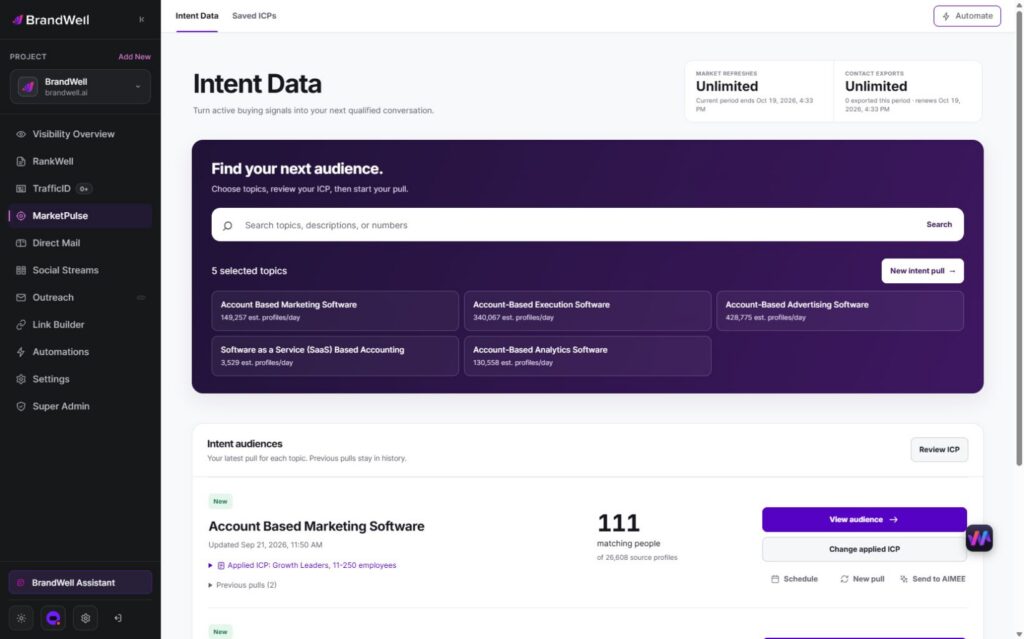
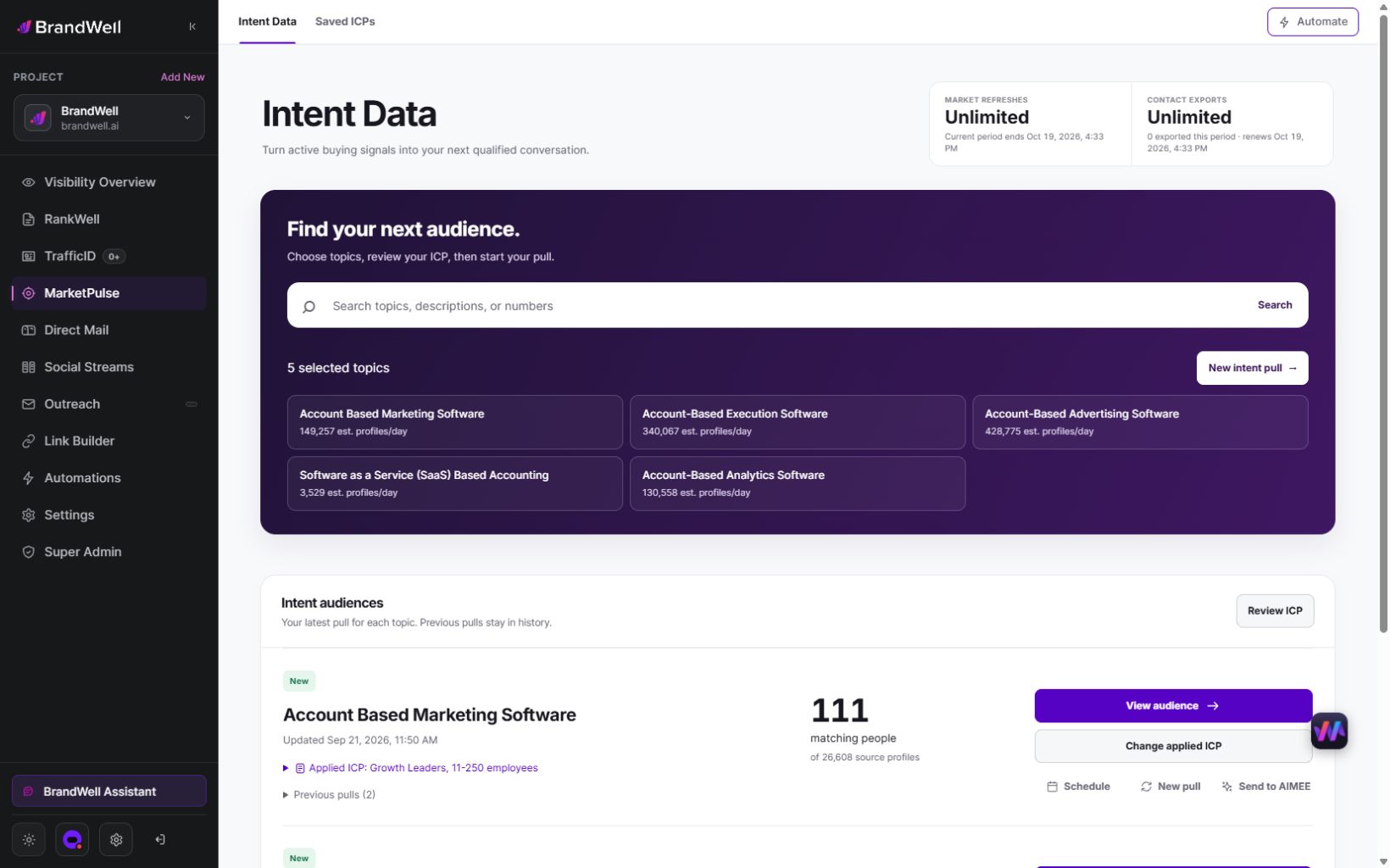
BrandWell MarketPulse: intent data starting at $500/mo. Find people researching topics relevant to what you sell, apply saved ICP filters, and review available contact details before taking action.
| Plan | Topics and refreshes | Monthly exports |
|---|---|---|
| Starter | 1 topic, weekly | 25,000 contacts |
| Growth | 3 topics, daily | 100,000 contacts |
| Scale | 10 topics, daily | Unlimited contacts |
Swipe the table to see all columns.
A pull retrieves available data from the previous 24 hours for one topic. Daily use across all included topics provides 90 Growth pulls or 300 Scale pulls in a 30-day month. Weekly Starter pulls vary by calendar month. Available audience size and contact fields vary, and audiences may overlap. Refreshes stop at the plan limit without overage charges.
- Find and qualify: search the topic catalog, save your ICP, and review the people and companies that match.
- Act on the research: export qualified contacts or prepare an Outreach or Direct Mail workflow. Connected products, channel usage, and fulfillment may cost extra.
- Get help from AIMEE: Growth and Scale include AIMEE for the initial user to research accounts and prepare the next step through connected tools.
Agencies and other service businesses can build client deliverables around their available Intent Scans and exports. Keep each client’s scope, permissions, and service fees clear. A subscription is not a promise of a white-label platform or exclusive access to a market.
Explore MarketPulse and watch the demo or compare plans starting at $500/mo. Any early-access discount is a separate, time-limited offer shown to an eligible recipient.
Compare complete operating models
An enterprise ABM suite is appropriate when one platform must coordinate account modeling, media, orchestration, and measurement across a mature team. A point intent source fits buyers that already own identity, routing, analytics, and governance. A data broker may help with records but not research timing. Building in-house can fit a large team with unique data and engineering capacity, but it transfers collection, identity, compliance, maintenance, and continuity obligations to the buyer.
For an agency service, separately verify client separation, deliverables, branding, access, reporting, fees, support, changes and offboarding. A research subscription does not establish a native multi-client platform or a resale contract. Apply the six gates to each actual implementation.
Normalize cost and contract exposure
Calculate software or data fees, implementation, identity and validation, connectors, media, services, internal administration, client operations, security and legal review, training, measurement, and exit work. Model base, expected, and high-usage cases. Record annual contract value separately from cash timing, and do not assume every supplier requires the same term.
MarketPulse research is starting at $500/mo. Verify current topics, refreshes, exports and included tools on the product page. Custom connectors, client interfaces and managed agency delivery need separately verified implementation, rights and fees.
Use a contract worksheet that shows unit definitions, minimums, included capacity, overages, unused-credit treatment, renewal notice, price-change rules, audit rights, service levels, data return, deletion, and transition help. An apparently low fee can be expensive when operators must manually repair identity, move files, or rebuild reports.
Measure a bounded validation
Define acceptance before the sample arrives: eligible-market coverage, correct-company rate, usable-identity rate, topic relevance, freshness, policy-pass rate, delivery reliability, and operator acceptance. Then track actions, meetings, accepted opportunities, gross profit, complaints, corrections, and suppressions. Report denominators and rejection reasons.
Use a holdout or matched baseline where practical. Compare vendor-assisted records with otherwise eligible accounts receiving business-as-usual treatment. Exclude pre-existing opportunities and duplicated touches. “Influenced pipeline” is descriptive; incremental value requires a credible counterfactual. A short validation proves only what was observed in its scope and window.
A possible fit is a buyer with a defined ICP, enough volume to prioritize, an owner for every signal, measurable downstream outcomes, and willingness to inspect mistakes. Poor fits include tiny markets already reviewed manually, teams without reliable CRM outcomes, buyers demanding certainty about every lead, or organizations unable to document permitted use.
Control mistakes and data-use risks
Common failures include accepting vendor-reported coverage as accuracy, testing only known winners, mixing account and person claims, ignoring signal age, using delivery volume as ROI, linking a score to outreach without suppression checks, and signing before export and deletion are defined. Another is letting the business sponsor approve exceptions that privacy, security, or legal owners have not accepted.
Maintain actual source and purpose records, role assignments, retention, access, correction, suppression, deletion, supplier-change review and incident ownership. Resolve applicable sector, jurisdiction and channel requirements before action. Intent research is not permission for outreach.
Scope a separate agency diligence service
An agency can sell a recurring governance layer: initial evidence-room setup, quarterly vendor and data-flow review, topic and ICP calibration, sample audits, branded topic reports, exception tracking, rights and security document refreshes, TCO monitoring, and client offboarding readiness. The agency sets retail pricing and bills its client; it should promise defined reviews and deliverables, not a certain pipeline outcome.
Review an available MarketPulse topic, saved ICP and actual preceding-24-hour matches for the approved research purpose. Keep uncertain company context visible. AIMEE can organize supplied context through configured tools; named owners approve actual exports, messages, audience uploads and CRM writes.
Agent-ready diligence instructions
AIMEE can prepare a review brief through configured connected tools. Keep proposed actions separate from actual approvals and destination acknowledgements. Confirm the implementation and permissions before execution.
Record the purchasing decision
Review current MarketPulse research and plans, starting at $500/mo. Evaluate a relevant topic, approved ICP, available fields and operating effort. Verify current guarantee conditions before testing. A bounded test cannot establish future pipeline or revenue.
Copyable intent-data diligence record
Use case: [Actual market, observation unit and decision.] Evidence: [Source, sample, rights and unresolved claims.] Gates: [Commercial, data, operations, rights, security and exit status.] Delivery: [Owner, tested destination, acknowledgement and recovery.] Costs: [Commitment, labor, usage and transition.] Outcome: [Eligible cohort, exclusions, mature feedback and comparator.] Decision: [Approve, hold or reject; owner and review trigger.]
Make supplier responsibilities explicit
NIST’s supply-chain quick-start guide addresses supplier cybersecurity roles and requirements. It does not certify a vendor or settle data-use rights.
A high weighted score cannot clear a failed gate
A fictional supplier scores 82 out of 100 on preferences but cannot provide required deletion evidence. Record the score and the unresolved gate separately. Hold approval until the responsible owner accepts verified remediation. Do not lower the gate after seeing an attractive score.
Coverage, eligibility and delivery have different denominators
A fictional sample contains 100 target accounts: 82 appear in the source, 67 pass geography and policy review, and 54 reach the CRM with required fields. Report source appearance as 82%, eligibility as 67% of sampled accounts or 81.7% of observed accounts, and completed delivery as 54% of sampled accounts or 80.6% of eligible accounts. Twenty-seven observed accounts have not reached that delivery state. None of these rates establishes correct identity or incremental sales.
Separate a service credit from operational recovery
A fictional late file earns a contractual credit while a downstream audience still contains withdrawn records. Keep the financial remedy separate from correction, suppression propagation and acknowledgement. A paid credit does not show that the affected records were removed.
Rehearse the actual exit
A fictional offboarding job reports success but one destination has not acknowledged deletion. Record the completed steps, unresolved destination, owner and deadline. A supplier status flag alone does not establish that every copy, credential or approved dependent workflow has been resolved.
Use supported research within scope
MarketPulse research is starting at $500/mo. Search a relevant topic, save the approved ICP and inspect available matches. Keep account context and person-level claims distinct. AIMEE can organize supplied context through configured tools; owners approve actual exports, messages, audience uploads and CRM writes. Custom integrations, reports and managed client delivery require separately verified implementation, rights and fees.
Frequently asked diligence questions
Can a feature score resolve a rights failure?
No. Resolve mandatory gates separately from preferences.
Is source coverage the same as correct identity?
No. Validate the actual record and association separately.
Does a service credit show operational recovery?
No. Verify correction and downstream acknowledgements.
Does an export establish a complete exit?
No. Verify remaining copies, credentials and responsibilities.
Review current research: explore MarketPulse and current plans.
Reviewed and updated October 3, 2026.

Written by