On this page
- Current MarketPulse research workflow
- Keep a dated evidence timeline
- Use six timing and review steps
- Separate four action lanes
- Define cooling and re-engagement rules
- Compare continuity and operating scope
- Budget the full learning horizon
- Compare equal-age outcome cohorts
- Verify purpose and action boundaries
- Scope a separate timeline service
- Keep assistant updates within approval
- Long-cycle buyer questions
- Copyable equal-age cohort record
- Frequently asked timing questions
For a bounded long-cycle intent-data test, signals are treated as a time series, not a moment of truth. Preserve recency, repetition, topic progression, first-party behavior, relationship context, and buying-group evidence. Choose a proportionate next action at each stage, then measure cohorts over the real evaluation period without claiming that research behavior proves stage or purchase intent.
Who this is for: B2B revenue teams and agencies selling high-consideration products or services where evaluation can span months, multiple stakeholders, security or procurement review, and periods of apparent inactivity.
Current MarketPulse offer: intent-data plans start at $500/mo. See the product, demo, and current plans. Updated October 3, 2026.
Current MarketPulse research workflow
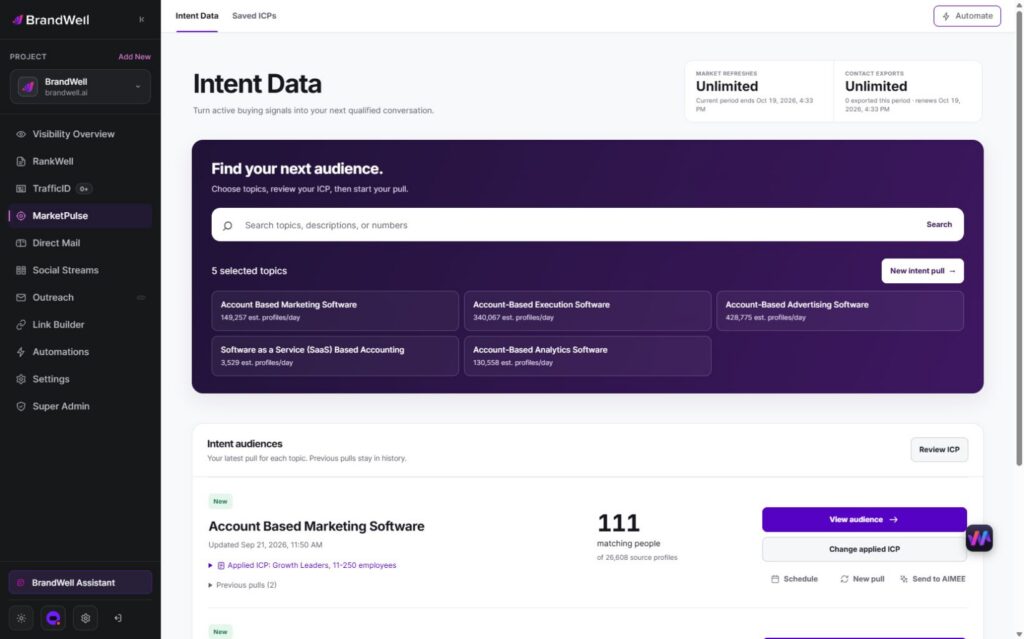
BrandWell MarketPulse: intent data starting at $500/mo. Find people researching topics relevant to what you sell, apply saved ICP filters, and review available contact details before taking action.
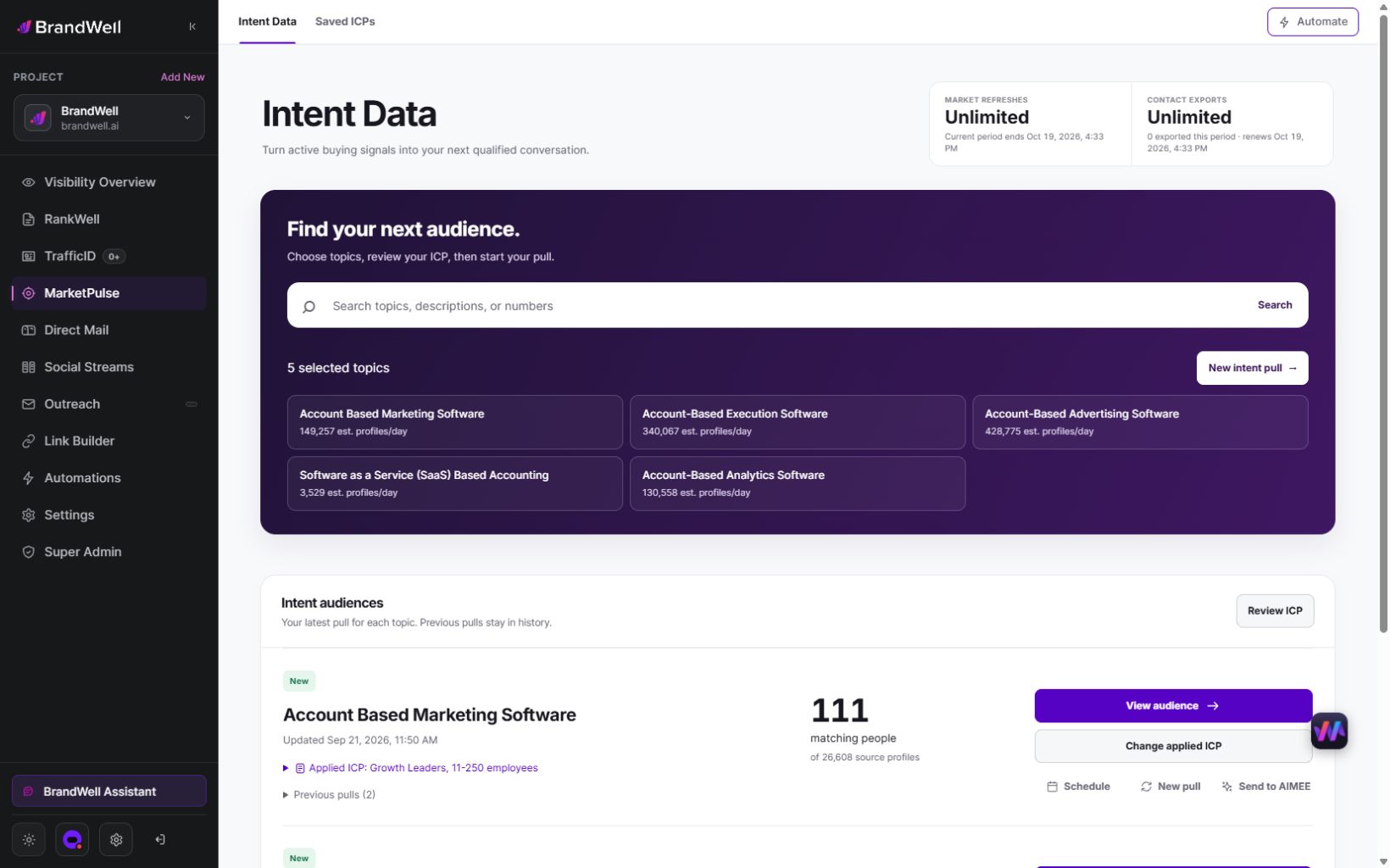
MarketPulse plans are starting at $500/mo. Verify current package scope and offers on the product page.
| Plan | Topics and refreshes | Monthly exports |
|---|---|---|
| Starter | 1 topic, weekly | 25,000 contacts |
| Growth | 3 topics, daily | 100,000 contacts |
| Scale | 10 topics, daily | Unlimited contacts |
Swipe the table to see all columns.
A pull retrieves available data from the previous 24 hours for one topic. Daily use across all included topics provides 90 Growth pulls or 300 Scale pulls in a 30-day month. Weekly Starter pulls vary by calendar month. Available audience size and contact fields vary, and audiences may overlap. Refreshes stop at the plan limit without overage charges.
- Find and qualify: search the topic catalog, save your ICP, and review the people and companies that match.
- Act on the research: export qualified contacts or prepare an Outreach or Direct Mail workflow. Connected products, channel usage, and fulfillment may cost extra.
- Get help from AIMEE: Growth and Scale include AIMEE for the initial user to research accounts and prepare the next step through connected tools.
Agencies and other service businesses can build client deliverables around their available Intent Scans and exports. Keep each client’s scope, permissions, and service fees clear. A subscription is not a promise of a white-label platform or exclusive access to a market.
Explore MarketPulse and watch the demo or compare plans starting at $500/mo. Any early-access discount is a separate, time-limited offer shown to an eligible recipient.
Keep a dated evidence timeline
A long-cycle team should not ask, “Is this account hot?” It should ask, “What evidence exists, how has it changed, what remains unknown, and what action is appropriate now?” One fresh research event may justify account research. Repeated evidence across related topics and known engagement may justify a seller review. Only direct buyer conversations establish opportunity facts.
Intent data is a fit when the team has defined target accounts, a sales process that records stages and participants, enough deal value for patient account work, and capacity to maintain context. It is premature when the company expects immediate attribution, cannot keep CRM history, or plans to expose inferred behavior in outreach.
Use six timing and review steps
1. Define a decay policy by signal type
Every event needs an observed time, source, unit, and expiry rule. A known demo request, return visit, company-level topic surge, candidate identity, and old webinar attendance should not share one decay window. Keep the raw event even after its action weight expires so operators can audit what happened; restrict retention according to policy and law.
2. Track repetition and progression separately
Keep repetition separate from topic progression. Use a versioned dictionary of topic labels, synonyms, exclusions and broader or narrower concepts. Neither recurring research nor a changed topic proves a buying stage.
3. Add a buying-group evidence ladder
Separate account-level evidence from known-person evidence. A practical ladder is:
- target account fit only;
- fresh account-level research evidence;
- repeated or progressive account evidence;
- multiple role candidates associated with the account;
- known first-party engagement from one contact;
- seller-confirmed participants, problem, process, or timing.
Do not fill missing committee roles by pretending candidate contacts are active buyers. Use enrichment to form research hypotheses, then let sellers validate roles.
4. Choose stage-proportionate actions
For weak account-level evidence, update the account brief or test low-frequency media where eligible. For repeated evidence, alert the account owner with context. For known first-party engagement, review whether an existing relationship permits a useful response. For an open opportunity, compare new evidence with the opportunity plan and ask the seller – not the score – whether action is warranted.
5. Re-engage without surveillance language
Use the business problem, prior conversation, published resource, or known relationship as the message context. Do not say or imply that you observed a named person’s research unless the interaction was directly disclosed and the use is appropriate. Test whether the cue changes useful preparation or timing; do not expose inferred behavior in the subject line.
6. Return outcomes over the full cycle
Record acceptance, action, meeting qualification, participant validation, opportunity creation, stage progression, no decision, loss reason, expansion, and revenue. Keep cohort entry time so delayed outcomes do not bias newer accounts downward. This is the core intent-led growth for companies with long sales cycles implementation guide.
Separate four action lanes
Use these four action lanes:
- Observe: store the event, provenance, time, and unit; no seller interruption.
- Research: apply fit, identity state, history, and suppressions; update the account brief.
- Review: notify the owner only when the evidence meets a documented combination or recurrence rule.
- Act: a human selects an approved action based on relationship and opportunity context; the result returns to the model.
Examples include a target account researching a broad problem twice over six weeks, a known customer visiting implementation content, or several role candidates appearing at a company with an open opportunity. Each is an input to review, not proof of a committee decision.
Preserve the actual vendor label, underlying construction, observed recurrence and downstream validation as distinct fields. A segment name is not buyer-confirmed intent or a stage.
Define cooling and re-engagement rules
Preserve actual quiet periods during an evaluation. Do not keep an account permanently urgent because it once crossed a threshold. Define a cooling state when action-weighted evidence expires, and distinguish “no new evidence” from a seller-confirmed no decision, closed loss, procurement delay, or future renewal window.
A re-engagement rule should name the minimum new evidence, relationship owner, approved context, frequency cap, and next eligible date. For example, a dormant account may return to research review only after a new first-party event, a materially different topic, repeated fresh account evidence, or a seller-requested check. An old candidate identity alone should not restart outreach.
Measure whether reactivated accounts produce new qualified conversations rather than simply adding activity. Preserve the quiet interval in the timeline; deleting it creates survivorship bias and makes the cadence look more responsive than it was.
Compare continuity and operating scope
Compare tools against the actual evidence-loop gap: necessary input, verifiable output, operator labor, policy fit, integration burden, exportability and total cost. Verify a representative sample before assuming a subscription will solve an operating constraint.
- CRM and first-party timeline: Consider for teams with strong known engagement but limited off-site visibility. Low incremental software burden; dependent on disciplined event and contact history.
- Modular intent, visitor, enrichment, and validation tools: Consider when a specific evidence gap is known. The team owns identity reconciliation, decay, routing, and exception handling.
- Managed agency or reseller service: Consider when sellers need curated account briefs and cadence reporting more than another dashboard. Check multi-month continuity and data export.
- Enterprise orchestration suite: Consider for coordinated multi-channel programs and several business functions. Greater cost and governance burden can be justified only by the operating scope.
- Custom pipeline: Consider when the signal-timing model is proprietary and data engineering, security, and maintenance ownership exist.
Buy software when RevOps can operate the timeline. Hire an agency when curation, reporting, and continuity are the gap. Build when the company has a stable, high-volume proprietary process. Do not buy an enterprise suite merely because the sales cycle is long.
Budget the full learning horizon
Intent-led growth for companies with long sales cycles pricing must cover the full learning window: data or platform, historical retention, matching and enrichment, integration, operator review, seller research, enablement, media, creative, privacy and security review, reporting, and renewal overlap. A cheap monthly feed can become expensive if six months of records cannot be reconciled to opportunities.
Build scenarios for the existing process, a narrow managed pilot, and a broader platform. State commitment length and billing separately. Account for implementation before the first usable cohort and the lag between cohort entry and revenue.
Compare equal-age outcome cohorts
Intent-led growth for companies with long sales cycles ROI needs leading, process, and business measures:
- signal coverage, recency at review, and repeated-evidence rate;
- identity-state distribution and correction rate;
- owner acceptance, research completion, and SLA;
- validated buying-group participants and problem hypotheses;
- qualified meetings and opportunity creation by cohort;
- stage progression, reactivation, no-decision, win, and loss over the full cycle;
- cost by reviewed and accepted account;
- complaints, opt-outs, and governance exceptions.
Use vintage cohorts: group accounts by the date they first met the program rule, then compare equal follow-up windows. Where feasible, maintain a matched baseline or holdout. Attribution is still limited because sales execution, brand, market conditions, product fit, and existing relationships affect the outcome.
Stop or redesign when evidence stays stale, seller acceptance is low, committee hypotheses are mostly wrong, or the sales team cannot use the context. Expand only a proven topic, role pattern, stage action, business unit, or automation rule.
Verify purpose and action boundaries
Verify actual source rights, necessary fields, permitted purpose, access, retention, suppression, correction, deletion and incident ownership. A vendor label does not establish coverage, accuracy or permission.
Verify recipient, jurisdiction, purpose, channel and opt-out obligations before contact. Resolve missing approval before activation. A business contact or research event does not establish permission for every proposed action.
Scope a separate timeline service
A right-sized agency service maintains continuity. It should include a versioned topic map, account timeline, recurrence and progression review, buying-group hypotheses, seller-ready briefs, monthly opportunity reconciliation, quarterly rule changes, and governance reporting. The agency should not promise immediate meetings from a long-cycle signal program.
Here, BrandWell means the MarketPulse intent-data and growth automation platform, connected with the broader BrandWell content and growth tools.
BrandWell MarketPulse is topic-based intent-data software for businesses and agencies. Choose relevant research topics, apply saved ideal-customer-profile filters, review available names, roles, companies and contact details, and export the audience or prepare a connected workflow. Plans start at $500/mo. TrafficID identifies visitors to your own website and is a separate product. A MarketPulse subscription does not by itself promise a white-label portal, custom API implementation, exclusive topics, or managed client delivery.
Review an available MarketPulse topic, saved ICP and actual preceding-24-hour matches for the approved research purpose. Keep uncertain company context visible. AIMEE can organize supplied context through configured tools; named owners approve actual exports, messages, audience uploads and CRM writes.
Keep assistant updates within approval
AIMEE can prepare a review brief through configured connected tools. Keep proposed actions separate from actual approvals and destination acknowledgements. Confirm the implementation and permissions before execution.
Objective: update the long-cycle account evidence timeline; no outreach.
Inputs: account events with source/time/unit, topic dictionary and versions,
identity states, CRM history, opportunity state, known relationships,
suppression rules, permitted actions, and decay policy.
Tasks: preserve raw evidence; expire action weight by signal type; identify
repetition and progression; distinguish account evidence from known-person
evidence; list possible buying-group gaps; propose observe, research, review,
or human-approved action. State uncertainties and conflicting evidence.
Stop before CRM writes, audience changes, or external communication.
A written assistant prompt does not establish that expiry, permissions, approvals or reconciliation are implemented. Verify actual behavior and preserve uncertainty before using its proposed update.
Long-cycle buyer questions
How should long-cycle companies use intent data?
Use it to maintain dated evidence and test actual research, review and re-engagement decisions without inferring a stage.
What is the simplest workflow?
Observe, research, review, and act: preserve each event, apply decay and fit, add relationship context, route only qualified combinations, and return outcomes.
What are the best affordable tools?
Compare actual history, outcome return, labor and exit across: CRM timeline, modular tools, managed service, enterprise suite, or custom pipeline.
Software, agency, or in-house?
Software fits an operating RevOps team; an agency supplies ongoing curation; a build fits a proprietary repeated model. Compare continuity and exit, not features alone.
What should the company budget?
Budget for the full cohort horizon, including implementation, data history, matching, labor, seller research, media, governance, and measurement lag.
How should pipeline impact be measured?
Use equal-age cohorts, acceptance, validated participants, qualified meetings, opportunities, progression, and cost. Retain a baseline or holdout when feasible.
When is intent data a fit?
It fits defined target accounts, high deal value, durable CRM history, and patient operators. It is premature when leaders demand immediate attribution or expose inferences in outreach.
Which signals matter most?
Use recency, repetition, topic progression, known first-party engagement, relationship history, and seller-confirmed buying-group evidence together.
Which risks matter most?
Watch stale evidence, incorrect identity, interest labeled as purchase intent, lost history, over-alerting, missing suppressions, and stage automation without human validation.
What agency service fits?
A persistent account-timeline service with topic governance, buying-group hypotheses, seller briefs, opportunity reconciliation, and documented rule changes.
A bounded next step is to take one current opportunity and reconstruct its evidence timeline without scores. If the team cannot explain what changed, when, and why an action followed, it is not ready to automate the pattern.
Copyable equal-age cohort record
Entry: [Actual eligibility rule, date and unique account unit.] Evidence: [Source, event date, uncertainty and permitted purpose.] Window: [Same follow-up length and outcome definition.] Action: [Named approver, implemented route and acknowledgement.] Outcome: [Buyer-confirmed stage, opportunity, loss or unresolved state.] Comparison: [Actual assignment, baseline, contamination and assumptions.] Cost: [Setup, full period, labor, activation and exit.]
The UK Magenta Book separates monitoring from impact evaluation. A causal estimate requires an appropriate comparison and assumptions; this government guidance does not validate a BrandWell workflow or predict a sales cycle.
Worked example: unequal age changes the apparent result
Assume a fictional January cohort of 100 eligible accounts has 90 days of follow-up and 20 verified opportunities, a 20% rate. A March cohort of 100 accounts has only 30 days and five verified opportunities, a 5% rate. The 15-percentage-point gap is not a fair equal-age comparison. After 90 days, March has 18 verified opportunities, or 18%. The equal-age descriptive gap is now two percentage points. This still is not causal lift: assignment, market, seller behavior, exclusions and missing outcomes may differ.
Keep the same opportunity definition and unique identifiers. Research recurrence does not fill an unknown buyer stage. Preserve no-decision, open, lost and unresolved outcomes instead of reporting only accounts with completed feedback.
Count cost over the actual follow-up horizon
Using the current standard $250/month MarketPulse Starter price, three months of subscription cost $750. Add a fictional $900 in review work and $300 in setup for $1,950 in defined costs. At 20 verified opportunities, descriptive cost is $97.50 per opportunity. If three more months of subscription and the same review work add $1,650 without additional opportunities, total cost becomes $3,600, or $180 per opportunity. This is a scenario, not a recommended duration, causal cost estimate or guaranteed outcome.
A fictional $4,000 agency fee against $3,600 in defined costs leaves $400, or 10%. An extra $500 in reconciliation makes the remainder negative $100. Acquisition, general overhead, tax and financing are excluded and can further change the result. Agency inputs are invented and are not BrandWell service prices or typical margins.
Prepare the supported research input
Review an available MarketPulse topic, saved ICP and actual preceding-24-hour matches for the approved purpose. Verify company context and preserve uncertainty. TrafficID is separately scoped own-site visitor work. AIMEE can organize supplied context through configured tools. Owners approve exports, messages, Outreach enrollment, audience uploads and CRM writes. A custom persistent timeline, retention arrangement, agency reporting service or synchronization requires separately verified implementation, rights, scope and fees.
Frequently asked timing questions
Can 30-day and 90-day cohorts be compared as equal?
No. Preserve the actual follow-up windows.
Does an equal-age gap prove causal lift?
No. Verify comparison design and assumptions.
Does repeated research establish a buying stage?
No. Keep actual buyer evidence separate.
Should cost stop at the initial pilot period?
No. Count the actual follow-up and delivery horizon.
Review the research product: explore MarketPulse and current plans.
Reviewed and updated October 3, 2026.

Written by