On this page
- Current MarketPulse research workflow
- Check actual team readiness
- Use five readiness gates
- Define four operating levels
- Test nine review and action steps
- Keep signal types distinct
- Choose tools for the actual gap
- Compare operating responsibilities
- Count full operating costs
- Separate quality, adoption and outcomes
- Verify purpose and action boundaries
- Scope a separate agency operating service
- Copyable growth-stage operating test
- Frequently asked questions
Intent-led growth for a growth-stage company starts with a bounded test: define fit, evidence, eligibility, owners and follow-up capacity before increasing research volume. Keep signals separate from buyer-confirmed outcomes. Expand only against a written decision rule and measured operating constraints.
Current MarketPulse offer: intent-data plans start at $500/mo. See the product, demo, and current plans. Updated October 3, 2026.
Current MarketPulse research workflow
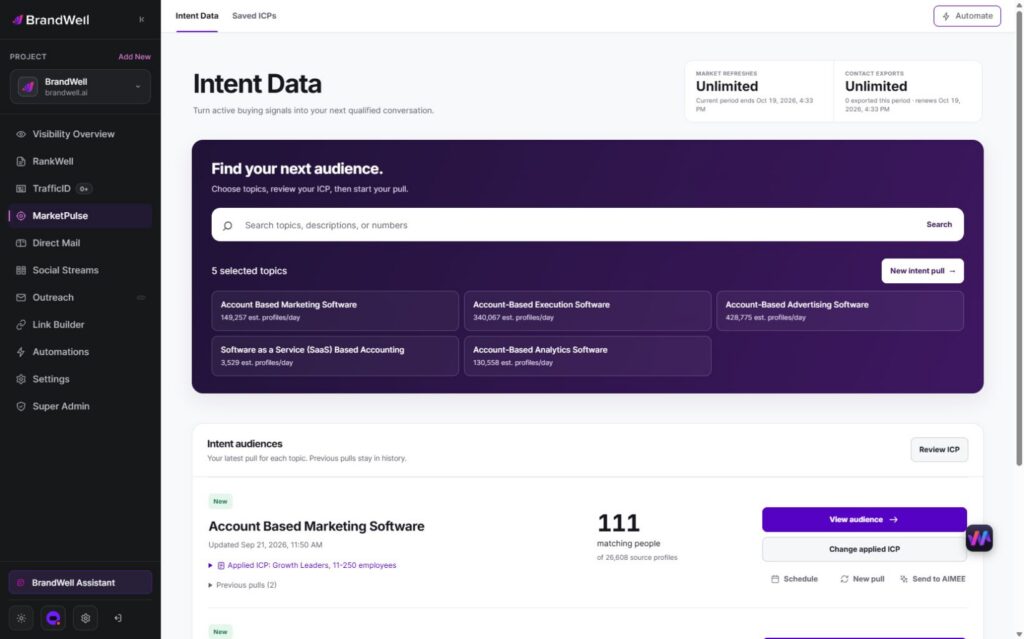
BrandWell MarketPulse: intent data starting at $500/mo. Find people researching topics relevant to what you sell, apply saved ICP filters, and review available contact details before taking action.
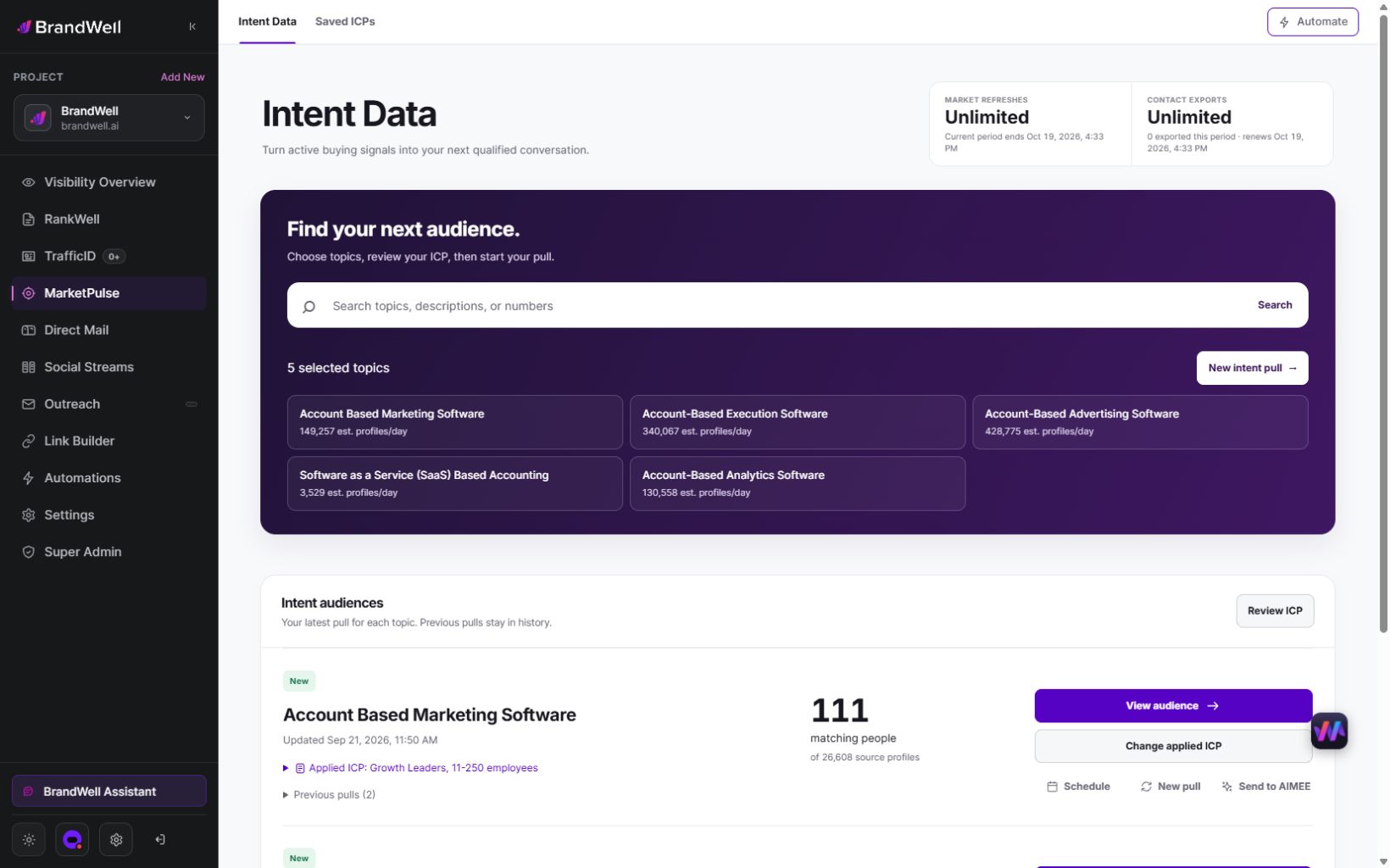
MarketPulse plans are starting at $500/mo. Verify current package scope and offers on the product page.
| Plan | Topics and refreshes | Monthly exports |
|---|---|---|
| Starter | 1 topic, weekly | 25,000 contacts |
| Growth | 3 topics, daily | 100,000 contacts |
| Scale | 10 topics, daily | Unlimited contacts |
Swipe the table to see all columns.
A pull retrieves available data from the previous 24 hours for one topic. Daily use across all included topics provides 90 Growth pulls or 300 Scale pulls in a 30-day month. Weekly Starter pulls vary by calendar month. Available audience size and contact fields vary, and audiences may overlap. Refreshes stop at the plan limit without overage charges.
- Find and qualify: search the topic catalog, save your ICP, and review the people and companies that match.
- Act on the research: export qualified contacts or prepare an Outreach or Direct Mail workflow. Connected products, channel usage, and fulfillment may cost extra.
- Get help from AIMEE: Growth and Scale include AIMEE for the initial user to research accounts and prepare the next step through connected tools.
Agencies and other service businesses can build client deliverables around their available Intent Scans and exports. Keep each client’s scope, permissions, and service fees clear. A subscription is not a promise of a white-label platform or exclusive access to a market.
Explore MarketPulse and watch the demo or compare plans starting at $500/mo. Any early-access discount is a separate, time-limited offer shown to an eligible recipient.
Check actual team readiness
This guide is for founders, CMOs, CROs, RevOps leaders, sales leaders, and agencies working with a B2B company that has moved beyond founder-only selling but has not yet built an enterprise revenue-operations machine. “Growth stage” is an operating condition, not a funding label: more people touch the buyer journey, handoffs multiply, campaign volume rises, and inconsistent definitions can leave outcomes or ownership unresolved.
A growth-stage company is ready for intent data when it knows which accounts fit, has sales capacity to review priorities, can distinguish a qualified opportunity from a meeting, and can return dispositions to the system. It is premature when the ICP changes every week, every signal becomes an alert, or nobody owns the action after a record is delivered.
The sections below move from readiness and maturity to the operating workflow, tool choices, budget, measurement, safeguards, and a recurring agency service. Each example and checklist supports a real decision instead of treating every activity signal as pipeline.
Use five readiness gates
Pass five gates before buying another data source:
- Fit gate: The team can state the account, industry, size, geography, role, problem, and disqualifiers that define a plausible buyer.
- Capacity gate: A named owner can review and act on qualified records within an agreed service level.
- Outcome gate: Sales acceptance, qualified opportunity, stage movement, closed revenue, and rejection reasons have stable definitions.
- Permission gate: The company can explain the source, purpose, permitted use, retention, suppression, and destination for each data class.
- Learning gate: A baseline or comparison cohort exists, and the team agrees in advance what will cause it to stop, repair, or scale the pilot.
Failing a gate does not mean the company can never use intent. It means the next investment should repair the missing operating capability. A sharper ICP, cleaner opportunity stages, or a weekly review meeting may produce more value than a larger vendor contract.
A useful growth-stage benchmark is internal consistency, not an anonymous industry average. Record the current acceptance rate, review latency, qualified-opportunity rate, and data correction rate before the pilot. Those become the baseline the new workflow must beat.
Define four operating levels
Choose the next operating level from the current gap rather than the hoped-for organization. Test these four levels:
Level 1: Visible evidence
Create one account view that shows fit facts, first-party activity, off-site topic or category activity, identity confidence, recency, source, and exclusions. The goal is not automation. It is making disagreements visible.
Level 2: Governed review
Add reason codes, a review owner, suppression checks, permitted-use status, and accept/reject/defer decisions. A score without its evidence is not reviewable. A record without a “no action” option pressures operators to manufacture activity.
Level 3: Controlled activation
Route only approved actions into CRM, seller tasks, content recommendations, or eligible paid-audience tests. Require destination acknowledgement and retain the external record or campaign ID. Automate preparation and QA before automating outreach or spend.
Level 4: Outcome feedback
Join seller disposition, qualified opportunity, stage movement, revenue status, and time to outcome back to the original evidence. Change thresholds from observed results, not from vendor labels. Expand topics or channels only when the base process remains trustworthy under added volume.
This maturity framework keeps the stack reversible. Each level has a useful output even if the company chooses not to proceed.
Test nine review and action steps
Use these nine steps as a bounded workflow template:
- Freeze the ICP, exclusions, territory rules, and account keys for the pilot.
- Select a small topic set and a small set of owned behaviors tied to real buyer questions.
- Ingest the raw event with source, observation unit, timestamp, topic, and provenance intact.
- Resolve or enrich only the fields needed for the proposed action; label match confidence.
- Score fit, timing, engagement, and identity separately so reviewers can see conflicts.
- Suppress customers, partners, competitors, opt-outs, restricted categories, and ineligible destinations before activation.
- Route eligible records to a named human with reason codes, evidence, recommended action, and a no-action path.
- Write only the approved payload to the destination and confirm the destination accepted it.
- Return dispositions and opportunity outcomes on a fixed cadence.
A worksheet or CRM view can run the first pilot. Add orchestration only when stable volume, repeated manual work, or error risk justifies it. Verify the operating design and actual connector behavior separately.
Use a service-level template with four fields: who reviews, how quickly, what evidence is required, and which actions that person may approve. If sales cannot meet the review SLA, lower the feed volume rather than increasing alerts.
Keep signal types distinct
First-party observations include the company’s own forms, product events, authenticated visits, CRM activity and customer conversations. Verify the actual context and permitted purpose. These observations do not establish budget, authority or purchase timing.
Third-party intent can reveal off-site category, competitor, or topic research outside the company’s properties. Treat it as probabilistic timing evidence. Preserve whether the observation is person-, device-, household-, account-, or aggregate-level; never silently promote an account event into a named person’s action.
Test whether corroboration changes actual review decisions:
- strong fit plus recent owned high-intent activity can justify fast human review;
- strong fit plus fresh off-site topic activity can justify account research or a content recommendation;
- weak fit plus high activity should usually be rejected;
- unresolved identity should remain unresolved until an approved match process produces evidence;
- stale activity should decay rather than remain permanently “hot.”
The signal taxonomy is a template, not a truth machine. Review false-positive categories every week and update exclusions before increasing volume.
Choose tools for the actual gap
Compare tools against the actual evidence-loop gap: necessary input, verifiable output, operator labor, policy fit, integration burden, exportability and total cost. Verify a representative sample before assuming a subscription will solve an operating constraint.
- Account and contact system of record: Holds stable keys, ownership, stages, suppression, and outcomes.
- First-party measurement: Captures consented forms, product or site events, and campaign context with documented definitions.
- Intent and visitor evidence: Supplies off-site topics or owned-site visitor signals with source, recency, observation unit, and coverage boundaries.
- Enrichment and validation: Adds only the business facts and contactability fields needed after a fit gate; it should expose confidence and correction paths.
- Review and orchestration: Presents evidence, reason codes, approvals, retries, and destination acknowledgement.
- Activation and reporting: Supports approved CRM, outreach, content, or paid-media actions and returns business outcomes.
Do not award “best” status from feature count. A nominally cheap subscription can be expensive if analysts reconcile duplicates, sellers reject records, or the destination cannot legally or technically use the data. Ask for representative samples, data lineage, refresh logic, policy limitations, export, deletion, and an exit plan.
Check the current destination requirements for the actual source, recipient, region, account and campaign before upload. Third-party research is not automatically first-party customer information or permission for an audience, message or other activation. Hold unresolved eligibility checks rather than uploading speculatively.
Compare operating responsibilities
Buy software when the company already owns ICP definitions, data governance, routing, seller adoption, and measurement. Software can reduce repetitive collection and delivery; it cannot create those decisions.
Hire an agency when the missing resource is operating capacity: topic design, client-safe review, data QA, reporting, coordination, or campaign execution. Require client isolation, transparent sources, explicit approval boundaries, export rights, and a measurable acceptance definition.
Build in-house when unique decision logic, integrations, or proprietary first-party data creates durable advantage and the team can maintain security, monitoring, documentation, and policy changes.
A hybrid arrangement can keep data supply separate from internal approval and agency operating work. Verify actual reversibility, implementation, rights, handoff cost and responsibility. Compare the arrangement against the company’s specific constraints rather than assuming a best model.
The wrong choice is any model with unclear ownership. Put one name beside data approval, privacy review, routing, sales action, campaign action, and measurement before signing a contract.
Count full operating costs
Intent-led growth pricing should be evaluated as total operating cost:
- data, identity, enrichment, and validation;
- setup, integration, CRM changes, and QA;
- analyst, RevOps, seller, and agency labor;
- paid media or outreach execution;
- security, privacy, legal, and platform-policy review;
- reporting, experiments, and opportunity reconciliation;
- overages, contract term, offboarding, and replacement cost.
Use reader-supplied economics:
- All-in pilot cost = external spend + internal labor + activation + governance + measurement.
- Gross profit per incremental customer = expected first-period revenue × gross margin, adjusted for delivery risk.
- Breakeven incremental wins = all-in pilot cost ÷ gross profit per incremental customer.
- Maximum acceptable cost per qualified opportunity depends on opportunity-to-win probability, time to outcome, and a safety margin.
Do not use attributed pipeline as cash. State whether a result is sourced, influenced, or incremental, and show the denominator and lag window. A budget is credible only when it includes a stop rule.
Separate quality, adoption and outcomes
Track four layers of KPIs:
Signal quality: ICP pass rate, freshness, provenance completeness, match confidence, duplicate rate, corrections, and false-positive reason codes.
Workflow quality: review latency, acceptance, deferred records, suppression conflicts, routing success, retries, and destination acknowledgement.
Seller and channel adoption: actions completed, useful-content selections, positive replies, audience delivery, qualified meetings, and seller rejection reasons.
Pipeline and economics: qualified opportunities per eligible account, stage progression, win/loss, gross profit, time to outcome, and cost per incremental qualified opportunity.
The pilot scorecard should show baseline, pilot cohort, comparison cohort or phased rollout, sample size, exclusions, and uncertainty. Set stop-or-scale rules before the first record arrives. Examples: stop if provenance is missing; repair if sellers reject a defined share for the same preventable reason; scale only if adoption holds while qualified outcomes improve.
Keep actual campaign, account, action and unique outcome identifiers. A tracking parameter can associate traffic with a campaign; it cannot by itself establish incremental pipeline or revenue. Preserve a suitable comparator and the assumptions behind any causal claim.
Verify purpose and action boundaries
Keep the actual source, observation unit, necessary fields, permitted purpose, access, recipients, retention, correction, deletion and suppression route. Resolve missing rights or approvals before activation. A signal does not establish identity, consent, qualification or a purchase.
Verify actual access, retention, security responsibilities and incident ownership for each implementation. A connected tool is not evidence that all fields or actions are permitted.
Verify applicable jurisdiction, recipient type, purpose, channel and opt-out requirements before action. A vendor contract or a data label does not establish permission. Obtain qualified advice for unresolved requirements.
Human approval should precede outreach, audience upload, campaign spend, CRM writes, deletion, and client-facing claims. Agents may prepare evidence and recommendations, but people own consequential decisions.
Scope a separate agency operating service
A growth-stage agency service should include an ICP and topic workshop, source and permission register, branded weekly evidence report, review queue, routing SLA, activation register, data-quality log, opportunity feedback, and a monthly stop-repair-scale decision. Sell operating reliability, not a pile of leads.
Where BrandWell fits
MarketPulse supplies topic research and available match details. AIMEE can organize supplied context through configured tools. An agency operating service, branded weekly report, CRM synchronization or custom client interface needs separately verified implementation, rights, scope and fees. The research subscription does not establish those delivery capabilities.
Review an available MarketPulse topic, saved ICP and actual preceding-24-hour matches for the approved research purpose. Keep uncertain company context visible. AIMEE can organize supplied context through configured tools; named owners approve actual exports, messages, audience uploads and CRM writes.
AIMEE can prepare a review brief through configured connected tools. Keep proposed actions separate from actual approvals and destination acknowledgements. Confirm the implementation and permissions before execution.
Keep the CRM, ICP, seller judgment, destination eligibility and measurement design under named ownership. Test whether the separately scoped agency service produces useful review work and feedback before expanding it.
Next step: If the readiness gates pass, scope one topic set, one action route, and a current written BrandWell quote before expanding the program.
Copyable growth-stage operating test
Question: [Actual operating constraint and decision.] Scope: [Topic, unique account unit, cohort, period and exclusions.] Evidence: [Source, uncertainty, fit and permitted purpose.] Capacity: [Review, specialist, action and feedback hours.] Ownership: [Approver, destination, acknowledgement and error recovery.] Outcome: [Actual disposition, unique opportunity and unresolved cases.] Decision rule: [Full costs, comparator, stop or repair criteria and expansion condition.]
Check specialist capacity before adding volume
Google’s SRE overload guidance measures actual resource constraints. It concerns computing, not staffing benchmarks. As an operating analogy, check each constrained resource separately rather than treating a record count as workload capacity.
Assume a fictional weekly cohort of 200 appearances deduplicated to 100 accounts. Fifty meet the review policy. At 12 minutes per eligible account, routine review requires 10 hours. Fifteen exceptions at 20 minutes each require five additional specialist hours. With 12 routine hours but four specialist hours available, the specialist gap is one hour even though total nominal capacity is 16 hours against 15 hours of work. The roles are not assumed interchangeable. Defer work, repair the workflow or secure the actual skill before expanding.
Keep acceptance separate from sales outcomes
Suppose 30 of the 50 eligible accounts receive seller acceptance. Acceptance is 60% of eligible accounts or 30% of the 100 unique accounts. If feedback is available for 24 accepted accounts, coverage is 80%; six are unresolved. Four actual qualified opportunities are 16.7% of the 24 reported accounts, 13.3% of the 30 accepted accounts or 4% of all unique accounts. Name the denominator and missing feedback. Neither seller acceptance nor a research appearance is a buyer commitment.
Test the full operating remainder
A fictional $2,500 agency pilot fee against $1,800 in defined costs leaves $700, or 28%. An extra $800 in correction work makes the remainder negative $100. Acquisition, setup, general overhead, tax and financing are excluded and can further change the result. These invented inputs are not BrandWell agency-service prices, typical margins or evidence of incremental revenue.
Use the supported research input
Review an available MarketPulse topic, saved ICP and actual preceding-24-hour matches against the approved research purpose. Verify public company context and preserve uncertainty. TrafficID is separately scoped own-site visitor work. AIMEE can organize supplied context through configured tools. Named owners approve exports, messages, Outreach enrollment, audience uploads and CRM writes. Custom reports, client interfaces and synchronization require separately verified implementation and rights.
Frequently asked questions
Does total spare time prove capacity?
No. Check the actual specialist and destination constraints.
Is seller acceptance a qualified opportunity?
No. Preserve actual buyer evidence and distinct stages.
Should missing feedback be excluded silently?
No. Report unresolved cases and the denominator.
Does MarketPulse include every agency workflow?
Do not assume that. Verify implementation, rights and scope.
Review the research product: explore MarketPulse and current plans.
Reviewed and updated October 3, 2026.

Written by