On this page
- Current MarketPulse research workflow
- Check team ownership and fit
- Define five evidence and action layers
- Test usable coverage
- Use seven review and action steps
- Set action-specific gates
- Choose tools for the actual gap
- Compare internal, agency and software roles
- Count full operating costs
- Run a bounded comparison pilot
- Verify purpose and action boundaries
- Scope a separate agency operating service
- Copyable cross-team pilot contract
- Frequently asked questions
Direct answer: Intent-led growth for mid-market companies works when one governed account model connects first-party behavior, off-site research, identity confidence, sales ownership, paid-media eligibility, and opportunity outcomes. Build the minimum shared architecture first; pilot a few signal-to-action routes; and refuse enterprise-suite complexity until coverage, adoption, and incremental pipeline justify it.
Current MarketPulse offer: intent-data plans start at $500/mo. See the product, demo, and current plans. Updated October 3, 2026.
Current MarketPulse research workflow
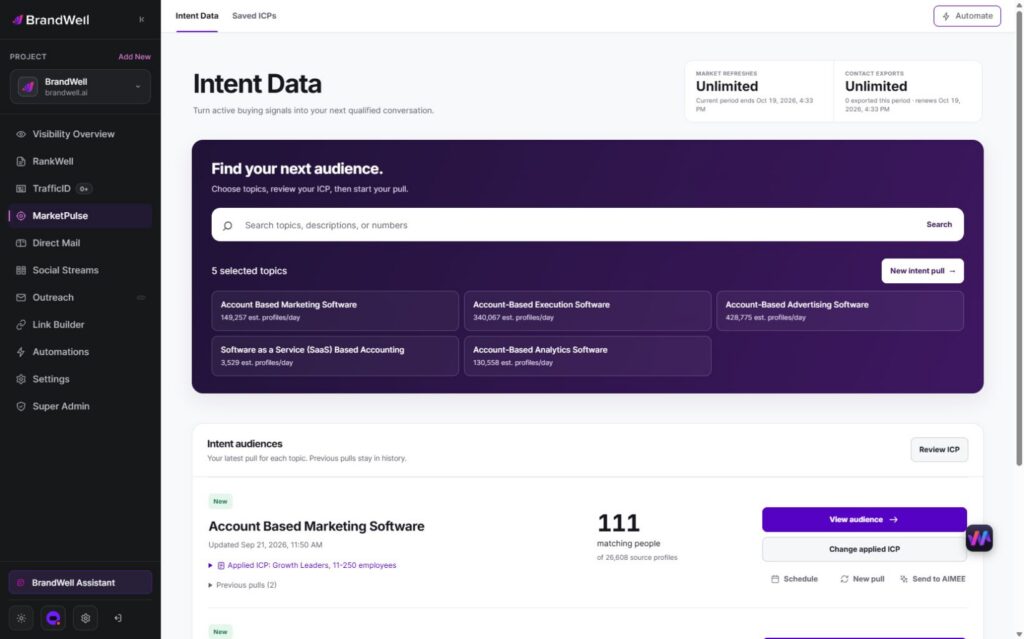
BrandWell MarketPulse: intent data starting at $500/mo. Find people researching topics relevant to what you sell, apply saved ICP filters, and review available contact details before taking action.
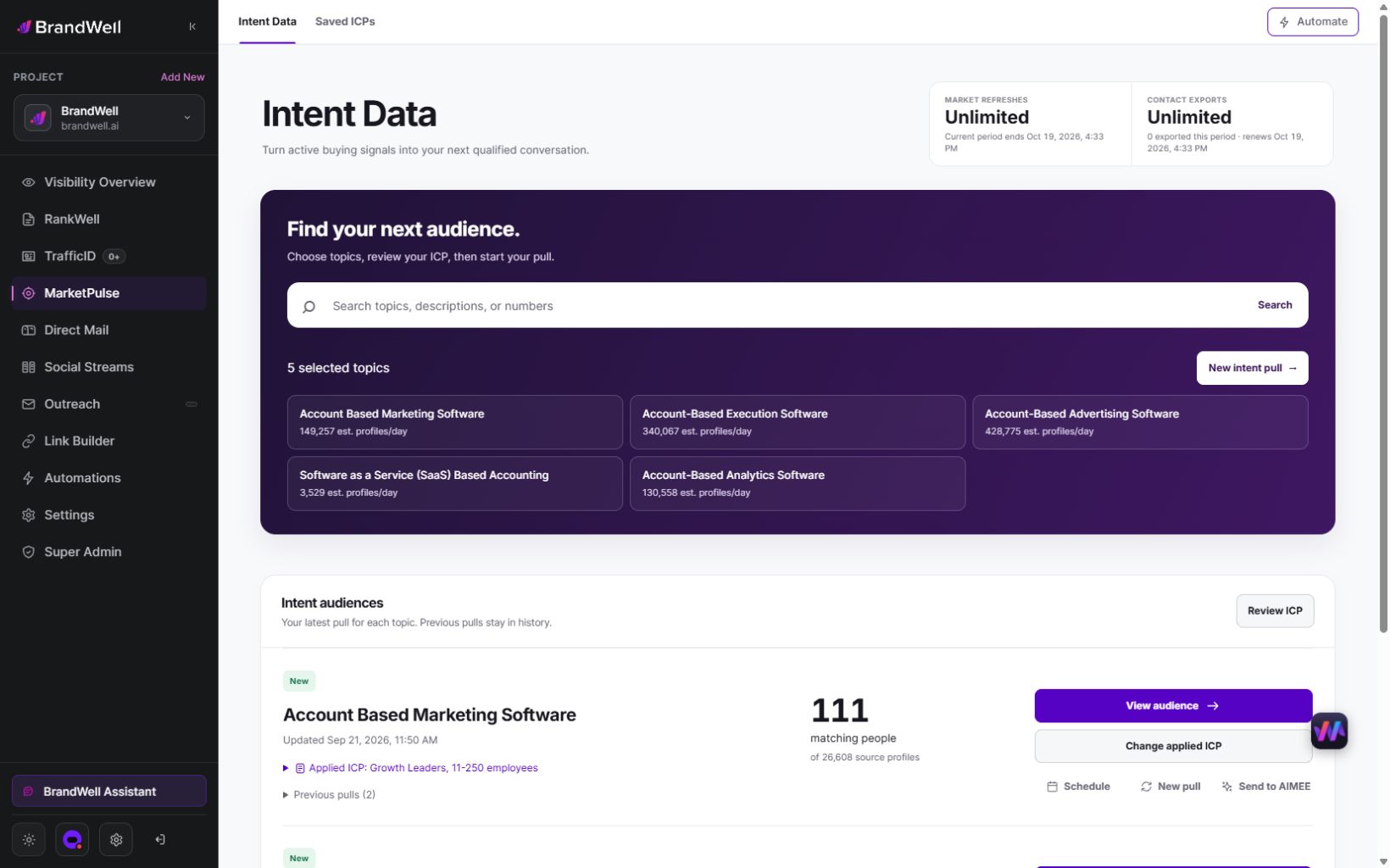
MarketPulse plans are starting at $500/mo. Verify current package scope and offers on the product page.
| Plan | Topics and refreshes | Monthly exports |
|---|---|---|
| Starter | 1 topic, weekly | 25,000 contacts |
| Growth | 3 topics, daily | 100,000 contacts |
| Scale | 10 topics, daily | Unlimited contacts |
Swipe the table to see all columns.
A pull retrieves available data from the previous 24 hours for one topic. Daily use across all included topics provides 90 Growth pulls or 300 Scale pulls in a 30-day month. Weekly Starter pulls vary by calendar month. Available audience size and contact fields vary, and audiences may overlap. Refreshes stop at the plan limit without overage charges.
- Find and qualify: search the topic catalog, save your ICP, and review the people and companies that match.
- Act on the research: export qualified contacts or prepare an Outreach or Direct Mail workflow. Connected products, channel usage, and fulfillment may cost extra.
- Get help from AIMEE: Growth and Scale include AIMEE for the initial user to research accounts and prepare the next step through connected tools.
Agencies and other service businesses can build client deliverables around their available Intent Scans and exports. Keep each client’s scope, permissions, and service fees clear. A subscription is not a promise of a white-label platform or exclusive access to a market.
Explore MarketPulse and watch the demo or compare plans starting at $500/mo. Any early-access discount is a separate, time-limited offer shown to an eligible recipient.
Check team ownership and fit
This playbook is for CMOs, CROs, RevOps, demand generation, sales operations, data leaders, and agencies serving B2B companies with multiple teams, territories, campaigns, and systems – but without unlimited integration or governance capacity. “Mid-market” here describes operating complexity, not an employee-count threshold.
Intent data is a fit when the company has a stable market, named account owners, usable CRM stages, enough volume for a comparison, and a cross-functional owner who can resolve conflicts. It is premature when every department defines “qualified” differently, account keys cannot reconcile, or no team can act within the useful signal window.
The playbook starts with shared account architecture, tests usable coverage, and then moves through activation, operating-model choices, total cost, measurement, and safeguards. It is designed to help a mid-market team choose the smallest system that its people can govern.
Define five evidence and action layers
Check whether the actual constraint is tooling, shared definitions, ownership or follow-up capacity. Create five linked layers:
- Account layer: one stable account key, parent-child rules, territory, owner, customer status, and ICP facts.
- Evidence layer: immutable source event, observation unit, topic or behavior, timestamp, provenance, confidence, and permitted-use code.
- Decision layer: fit, timing, identity confidence, engagement, suppression, reviewer, reason code, and approved action.
- Activation layer: destination, payload, approver, campaign or record ID, acknowledgement, retry, and error status.
- Outcome layer: seller disposition, qualified stage, opportunity ID, revenue status, loss reason, and outcome time.
Do not let one vendor score overwrite these layers. A high account score can coexist with weak identity. An identified visitor can be a poor fit. A fresh topic can be ineligible for the proposed destination. Keeping dimensions visible lets teams disagree productively and repair the correct part.
Document which system is authoritative for each field. The CRM may own opportunity stage, a consent system may own marketing permission, and the signal provider may own event provenance. “Synced” is not the same as “authoritative.”
Test usable coverage
Coverage is not the number of records a provider can show in a demo. It is the share of the client’s real market that produces evidence the team is permitted and able to use.
Run a coverage test with a representative account sample:
- define the target market and exclusions before the supplier returns data;
- freeze the sample so weak accounts cannot be swapped out later;
- request the raw observation unit, source class, recency, topic definition, and match level;
- separate “record returned” from “correct account,” “usable contact,” and “action eligible”;
- review false positives, missing segments, stale records, duplicates, and parent-child errors;
- calculate coverage by meaningful segment, not only in aggregate;
- estimate operator work per usable record.
Use internal benchmarks. Record current coverage, seller acceptance, review latency, opportunity conversion, and correction rate. A pilot should improve those values without hiding new labor. Published market averages rarely share your ICP, stage definitions, or denominator.
Require the coverage test to preserve unavailable evidence. “No evidence” is a valid result; it is better than manufactured certainty.
Use seven review and action steps
AWS idempotent-API guidance explains retries without repeated side effects. Verify the actual destination contract and reconciliation behavior; this technical reference does not establish a native BrandWell CRM connector.
The minimum mid-market workflow is simple enough to audit and strong enough to scale:
- Select accounts and topics. Tie every topic to a buyer problem, decision stage, and plausible action.
- Collect evidence. Preserve first-party and third-party events separately with timestamps and source metadata.
- Normalize and deduplicate. Resolve domains and account relationships without deleting the original values.
- Apply fit, freshness, identity, and permission gates. Keep each score explainable and versioned.
- Assign a human review state. Accept, reject, defer, investigate, or suppress with a reason.
- Route one approved action. CRM task, content recommendation, eligible audience test, or opportunity support – with destination acknowledgement.
- Reconcile outcomes. Return sales disposition, campaign delivery, qualified opportunity, revenue, and policy exceptions.
Set service levels by action. A pricing-page form fill may deserve immediate attention; aggregate topic movement may belong in a weekly account plan. Treating every event as urgent creates alert fatigue and teaches sales to ignore the feed.
Use idempotency keys for destination writes. Suppression must run before enrichment and activation, not after a complaint. Failed writes need a bounded retry and an error owner.
Set action-specific gates
Mid-market companies need different evidence and controls for different actions.
Sales prioritization
Evidence gate: ICP fit, fresh corroborated signal, account ownership, contactability or account-level action, and suppression review.
Action: Give the seller the account, reason codes, useful context, and a recommended research or outreach step.
Limit: Activity does not prove purchase authority or timing. Measure seller acceptance, positive replies, qualified meetings, and rejection reasons.
Paid-media activation
Evidence gate: Destination-eligible data, adequate audience scale, approved purpose, consent or policy signals where required, exclusions, budget, and experiment design.
Action: Use observation, exclusions, or a controlled audience test before automating bids or budgets.
Verify the current policy of the actual destination before an audience test. A research or contact record does not itself establish eligibility for a first-party audience feature or permission for marketing.
Content and web experience
Evidence gate: A stable topic cluster, aggregate or appropriately minimized evidence, approved claims, and a non-invasive experience.
Action: Prioritize a comparison, proof asset, implementation guide, or landing-page path that answers the observed market question.
Limit: A topic signal cannot tell you exactly what one visitor believes. Measure useful engagement and downstream qualification, not clicks alone.
Opportunity support
Evidence gate: A real opportunity, known owner, verified stage, buying-group context, and an evidence-backed obstacle.
Action: Route security, integration, proof, or business-case material to the owner.
Limit: External research may relate to another initiative. Measure next-step completion and stage movement with honest attribution.
This matrix creates activation workflows that can be approved one by one instead of granting a feed blanket permission to act.
Choose tools for the actual gap
Compare tool costs and usable scope against the specific gap and existing systems.
- If account ownership and stages are unreliable, repair the CRM before adding intent.
- If first-party events lack definitions, fix measurement and consent before buying off-site signals.
- If sellers cannot interpret the feed, add a review surface and reason codes before orchestration.
- If identity coverage is weak, test enrichment on already eligible records rather than enriching everything.
- If paid audiences cannot meet platform or size rules, use account research or content prioritization instead.
- If outcomes cannot return, build the reconciliation before scaling activation.
Evaluate every tool or expert service on sample coverage, source transparency, observation unit, recency, correction, permission, export, integration, security, operator labor, and contract exit. An implementation example should show the full chain from event to outcome – not a dashboard screenshot alone.
Avoid unsupported company roundups. Vendor capabilities and terms change, and a “best” platform depends on current systems, volume, region, data rights, and operating ownership. Run the same representative test across candidates.
Compare internal, agency and software roles
Software fits when internal teams can own configuration, quality review, routing, governance, and adoption. Include implementation and operator labor in its cost.
Agency service fits when the company needs a managed operating layer across topic design, QA, activation, reporting, and cross-functional cadence. Require documented approval boundaries, client isolation, data export, and offboarding.
Internal build fits when proprietary first-party data or decision logic creates real advantage and engineering can maintain connectors, errors, access controls, policy changes, and documentation.
Hybrid is often right-sized: keep system-of-record and approval ownership internal; use providers for modular data and enrichment; and use an agency for implementation or recurring analysis. The company can replace a module without rebuilding the whole revenue process.
Compare options on time to first useful decision, three-year operating cost, customization, portability, governance burden, failure recovery, and the quality of the outcome loop. Buying a suite to avoid making ownership decisions only hides the problem.
Count full operating costs
Build the budget from components:
- signal, visitor, identity, enrichment, and validation data;
- users, records, topics, accounts, destinations, and overages;
- CRM, warehouse, integration, and reporting work;
- analyst, seller, RevOps, agency, privacy, security, and legal time;
- media and creative;
- QA, corrections, suppression, incident response, and offboarding.
Use a scenario model rather than a universal price benchmark:
- Total pilot cost = external spend + internal labor + activation + governance + measurement.
- Cost per usable reviewed account = total pilot cost ÷ accounts passing evidence and permission gates.
- Cost per accepted priority = total pilot cost ÷ priorities sales accepts.
- Cost per incremental qualified opportunity requires a defensible comparison, not attribution alone.
- Breakeven wins = total pilot cost ÷ expected gross profit per incremental customer.
A planning budget should reserve capacity to act. Funding the data while starving seller follow-up, creative, or measurement makes the pilot untestable.
Run a bounded comparison pilot
Freeze the pilot contract before launch:
- target account and topic scope;
- observation unit and source classes;
- baseline and comparison cohort or phased rollout;
- action routes and human approvers;
- data, platform, and legal exclusions;
- review SLA and destination acknowledgement;
- scorecard definitions and lag window;
- stop, repair, and scale thresholds;
- export and deletion process;
- final decision owner.
Track signal quality, workflow quality, activation, pipeline, and economics separately. Report sample size, missing data, corrections, and uncertainty. Attribution can show which records touched a campaign or opportunity; incrementality asks what changed because of the program.
Preserve actual campaign, account, action and outcome identifiers during the pilot. Tracking which opportunity received a signal or campaign exposure is association. A causal claim requires a suitable comparison and assumptions; a tracking field alone does not establish incremental revenue.
Scale one dimension at a time: more accounts, more topics, more routes, or more automation. If all four change together, the team cannot tell what improved or broke.
Verify purpose and action boundaries
Signals are probabilistic evidence, not proof of identity, consent, need, authority, buying stage, qualification, purchase, pipeline, or outcome; require human approval before consequential actions.
Verify actual source rights, necessary fields, permitted purpose, recipients, access, retention, suppression, correction, deletion and incident ownership. Resolve missing approvals or requirements before an export or activation. Keep technical access separate from marketing permission.
Verify the actual source rights, audience, purpose, jurisdiction, access, retention, suppression, destination and action approval. Startup stage does not establish an exemption. Resolve missing permissions or requirements before contact, export or upload.
Verify the actual source rights, audience, purpose, jurisdiction, access, retention, suppression, destination and action approval. Startup stage does not establish an exemption. Resolve missing permissions or requirements before contact, export or upload.
Avoid these mistakes: account-to-person inference, hidden score logic, stale signals, duplicate routing, unsupported destination uploads, missing suppression, broad staff access, silent enrichment corrections, and claims that attributed pipeline is incremental revenue.
Scope a separate agency operating service
A right-sized agency offer includes market and topic design, a coverage test, source and permission register, branded evidence report, cross-functional review, controlled activation, data-quality log, opportunity reconciliation, executive scorecard, and quarterly architecture review. Measure actual decision quality, use and outcomes separately from lead volume.
Where BrandWell fits
BrandWell MarketPulse is topic-based intent-data software for businesses and agencies. Choose relevant research topics, apply saved ideal-customer-profile filters, review available names, roles, companies and contact details, and export the audience or prepare a connected workflow. Plans start at $500/mo. TrafficID identifies visitors to your own website and is a separate product. A MarketPulse subscription does not by itself promise a white-label portal, custom API implementation, exclusive topics, or managed client delivery.
Review an available MarketPulse topic, saved ICP and actual preceding-24-hour matches against the bounded research purpose. AIMEE can organize supplied context through configured tools. Verify public company context and preserve uncertainty. Named owners approve exports, outreach, audience uploads and CRM writes; custom reports or services need separate scope.
MarketPulse supplies topic research and available match details. AIMEE can organize supplied context through configured tools. An agency operating service, branded report, custom interface, CRM join or warehouse synchronization needs separately verified implementation, rights, scope and fees. A research subscription does not establish those delivery capabilities or causal measurement.
Next step: Request a representative coverage review and written scope for one governed pilot before committing to broader data, channels, or automation.
Copyable cross-team pilot contract
Decision: [Actual team question and owner.] Scope: [Account sample, topic, unit, period and exclusions.] Evidence: [Actual source, match state, uncertainty and eligibility.] Action: [Named approver, implemented destination and acknowledgement.] Recovery: [Stable request key, reconciliation, bounded retry and error owner.] Feedback: [Seller disposition, unique opportunity and missing outcomes.] Economics: [Full cost, usable units, capacity and stop rule.]
Verify each implemented connector and permission boundary. A proposed workflow, API diagram or software subscription is not evidence that a destination write has been delivered.
Worked example: coverage and acceptance have different units
Assume a fictional sample of 1,000 research appearances, deduplicated to 800 accounts. Four hundred meet the written fit rule, 300 are eligible for the intended action and 120 are accepted by sellers. Seller acceptance is 40% of eligible accounts or 15% of the 800 unique accounts. Do not compare those rates to raw appearances without naming the changed unit.
With $3,000 in defined pilot costs, cost is $25 per accepted account or $3.75 per unique account. The cheaper-looking denominator does not establish a cheaper useful outcome. Acceptance is not contact permission, delivery, meeting, pipeline or revenue. Preserve rejection reasons and missing feedback.
Reconcile timeouts before counting destination writes
Suppose 120 approved records are sent to an implemented CRM destination. One hundred ten acknowledge success and ten time out. Reconciliation finds eight of the timed-out requests already written; only two still need a checked retry under the same action identifiers. The intended result is 120 unique writes, not 128 or 130. A timeout is an unknown response rather than proof that nothing happened.
Check actual destination behavior, unchanged payloads, expired request keys and action eligibility before replay. A successful write does not establish a seller disposition or buyer response. Reconcile those later states separately.
Check the full delivery remainder
A fictional $4,000 agency pilot fee against $3,000 in defined costs leaves $1,000, or 25%. An extra $1,200 in corrections makes the remainder negative $200. Setup, acquisition, general overhead, tax and financing are excluded and can further change the result. These invented inputs are not BrandWell agency-service prices or typical margins.
Prepare the supported BrandWell research input
Review an available MarketPulse topic, saved ICP and actual preceding-24-hour matches against the approved research purpose. Verify public company context and preserve uncertainty. TrafficID is separately scoped own-site visitor work. AIMEE can organize supplied context through configured tools. Owners approve exports, messages, Outreach enrollment, audience uploads and CRM writes. Agency reports, custom interfaces and cross-system synchronization require separately verified implementation and rights.
Frequently asked questions
Is a raw appearance the same as an accepted account?
No. Preserve units, deduplication and each eligibility stage.
Does a timeout prove a write failed?
No. Reconcile the actual destination before retry.
Is a successful CRM write a sales outcome?
No. Track seller and buyer outcomes separately.
Does MarketPulse include every custom connector?
Do not assume that. Verify implementation and scope.
Review the research product: explore MarketPulse and current plans.
Reviewed and updated October 3, 2026.

Written by