On this page
- Current MarketPulse research workflow
- Check the actual startup decision
- Set a readiness and budget gate
- Separate five evidence types
- Run a bounded learning loop
- Review buyer evidence before inference
- Choose tools for the actual question
- Compare founder, agency and software roles
- Count cash and founder-time costs
- Measure learning and actual commitments
- Verify purpose and action boundaries
- Scope a separate learning service
- Copyable pre-revenue experiment card
- Frequently asked questions
Before a pre-revenue startup buys intent data, define the buyer problem, learning decision, action owner, review capacity and affordable experiment. Use customer conversations, public company research and documented first-party evidence to test the hypothesis. External topic research can inform a review queue, but it does not establish product-market fit, budget or a future sale.
Current MarketPulse offer: intent-data plans start at $500/mo. See the product, demo, and current plans. Updated October 3, 2026.
Current MarketPulse research workflow
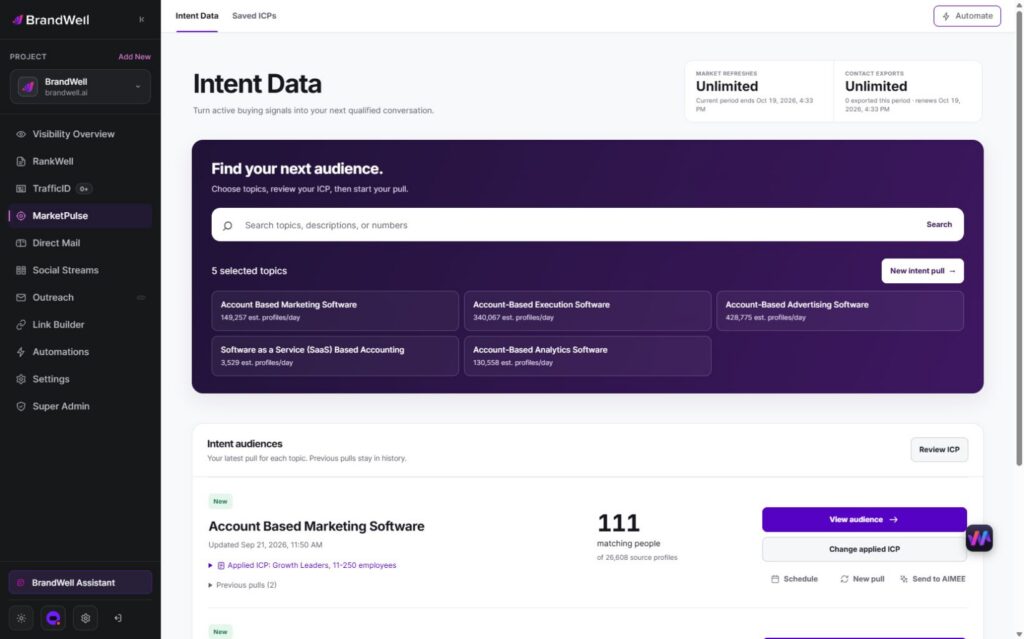
BrandWell MarketPulse: intent data starting at $500/mo. Find people researching topics relevant to what you sell, apply saved ICP filters, and review available contact details before taking action.
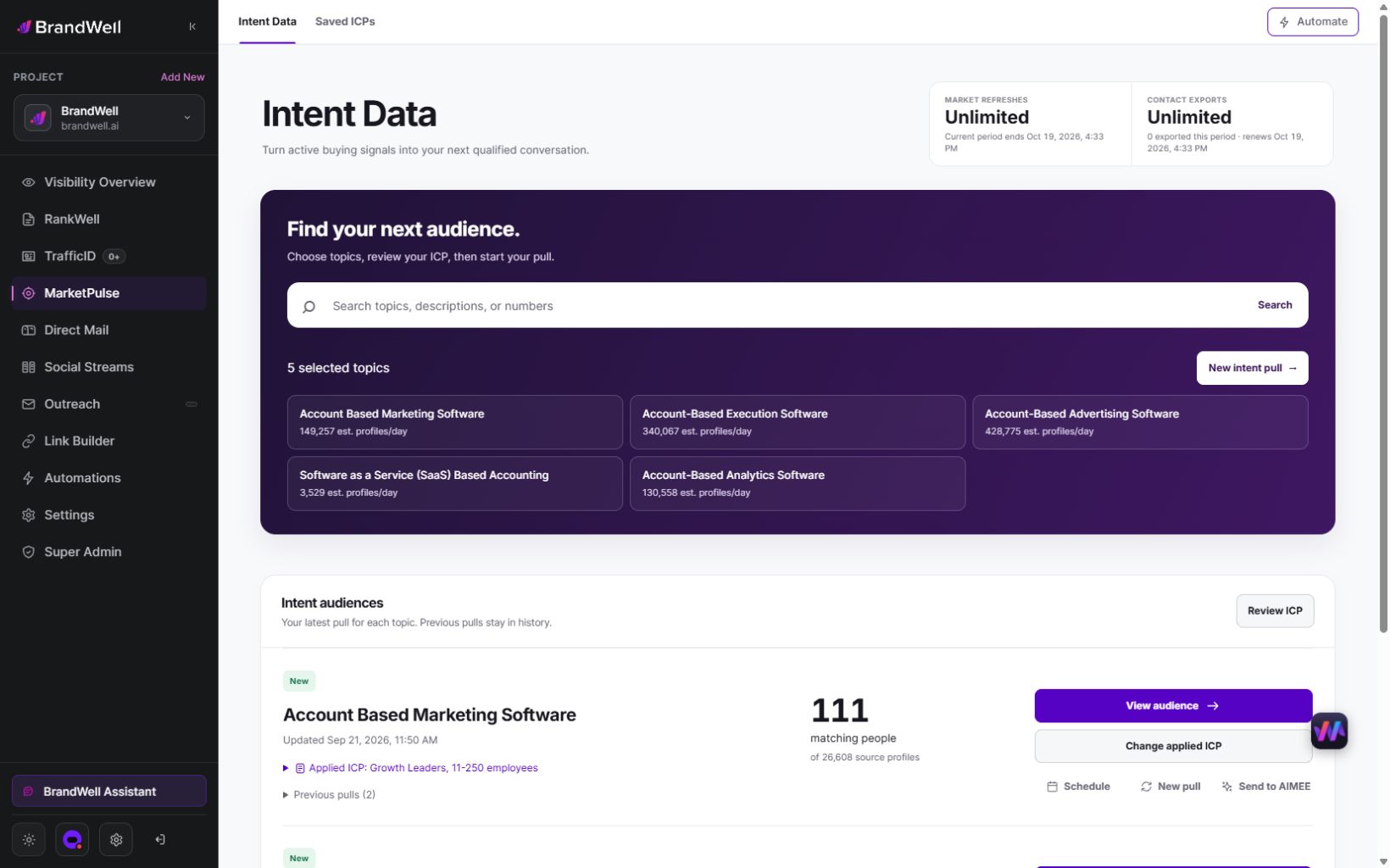
MarketPulse plans are starting at $500/mo. Verify current package scope and offers on the product page.
| Plan | Topics and refreshes | Monthly exports |
|---|---|---|
| Starter | 1 topic, weekly | 25,000 contacts |
| Growth | 3 topics, daily | 100,000 contacts |
| Scale | 10 topics, daily | Unlimited contacts |
Swipe the table to see all columns.
A pull retrieves available data from the previous 24 hours for one topic. Daily use across all included topics provides 90 Growth pulls or 300 Scale pulls in a 30-day month. Weekly Starter pulls vary by calendar month. Available audience size and contact fields vary, and audiences may overlap. Refreshes stop at the plan limit without overage charges.
- Find and qualify: search the topic catalog, save your ICP, and review the people and companies that match.
- Act on the research: export qualified contacts or prepare an Outreach or Direct Mail workflow. Connected products, channel usage, and fulfillment may cost extra.
- Get help from AIMEE: Growth and Scale include AIMEE for the initial user to research accounts and prepare the next step through connected tools.
Agencies and other service businesses can build client deliverables around their available Intent Scans and exports. Keep each client’s scope, permissions, and service fees clear. A subscription is not a promise of a white-label platform or exclusive access to a market.
Explore MarketPulse and watch the demo or compare plans starting at $500/mo. Any early-access discount is a separate, time-limited offer shown to an eligible recipient.
Check the actual startup decision
This guide is for pre-revenue B2B founders, early marketers, advisors, incubators, and agencies deciding whether buyer-intent or lead data can accelerate learning. It is not a shortcut around customer discovery, a substitute for a clear offer, or proof of product-market fit.
“Pre-revenue” covers different realities. A founder with design partners, a defined enterprise problem, and a financed sales experiment is different from a team with only an idea. The readiness decision should follow evidence and economics, not the stage label.
The plan begins with a do-not-buy gate, climbs an evidence ladder, and ends with a bounded learning loop and a clear service decision. The central rule is strict: do not manufacture certainty from a probabilistic signal.
Set a readiness and budget gate
A pre-revenue startup should postpone a paid intent program when any of these conditions is true:
- the buyer, problem, and trigger are still broad hypotheses;
- the founder cannot name a finite set of plausible accounts;
- there is no offer or next step a prospect can accept;
- conversations do not reveal a repeated problem or decision process;
- no one can review and act on records quickly;
- the expected deal economics cannot support the all-in program cost;
- success is defined as “more leads” rather than a specific learning or commercial event;
- data source, permission, or destination use cannot be explained;
- the team plans to automate outreach before it has learned what a helpful message sounds like.
Passing the gate does not prove that intent data will work. It means a small, reversible experiment may answer a useful question.
A good readiness sign is a repeated pattern: similar organizations describe the same costly problem, recognize a plausible solution, agree to a concrete next step, and use similar language. A signed design partnership, paid pilot, procurement step, or product commitment is stronger evidence than clicks or compliments.
Separate five evidence types
GOV.UK user-needs guidance distinguishes user research from assumptions. Keep actual interview evidence separate from founder hypotheses; this government service guidance does not validate a startup market or predict revenue.
Pre-revenue teams should spend from stronger learning evidence outward.
Rung 1: Direct problem evidence
Conduct structured interviews with defined roles. Record the current workflow, trigger, consequence, alternatives, decision participants, constraints, and what the buyer has already spent. Do not lead with the product.
Rung 2: Commitment evidence
Ask for a meaningful next step: access to a process owner, data sample, technical review, design partnership, trial, procurement conversation, or payment. Commitment shows more than stated interest.
Rung 3: Owned behavior
Track consented form submissions, replies, event participation, demo actions, product events, and repeat site behavior. Keep source and context. An anonymous page view is weaker than a known person agreeing to a next step.
Rung 4: Manual market evidence
Research public company facts, role changes, initiatives, technology, hiring, and credible trigger events. Use this to select whom to interview, not to declare that the account is buying.
Rung 5: External intent evidence
Use off-site topic, category, competitor, or visitor signals as probabilistic context. Preserve whether the observation is person-, device-, household-, account-, or aggregate-level. External evidence can prioritize research; it cannot replace the first four rungs.
Use this proposed ladder to keep a research input separate from a buyer commitment.
Run a bounded learning loop
A bounded learning workflow can use the following steps:
- Write one falsifiable ICP and problem hypothesis.
- Select 25–100 plausible accounts using defensible fit facts.
- Choose one buyer question and one narrow topic cluster.
- Collect owned and public evidence; optionally add a small, time-bounded external sample.
- Record source, date, observation unit, fit, confidence, and permitted use.
- Pick the next learning action: interview request, manual research, content test, landing-page test, or no action.
- Require founder or named human approval before contact, audience upload, spend, or CRM change.
- Record the result using fixed reason codes.
- Update the hypothesis only at the scheduled review, not after every anecdote.
- Stop, repair, or repeat based on the learning scorecard.
A spreadsheet is often sufficient. Suggested columns are account, fit reason, disqualifier, role hypothesis, problem hypothesis, evidence source, observation unit, recency, identity confidence, permitted action, next step, owner, result, and lesson.
Do not create a blended “intent score” yet. At this stage, explainability matters more than ranking precision.
Review buyer evidence before inference
Review direct first-party and qualitative evidence such as: a prospect describes the problem in their own words, introduces another stakeholder, shares a sample, returns to an implementation page, asks about security, or agrees to test the product. These signals have context, but they still require interpretation.
Third-party topic or category activity can help find additional accounts that resemble the early evidence. Keep the action proportionate:
- a broad topic can trigger market research;
- fresh account-level activity plus strong fit can trigger a human account review;
- resolved contact data can trigger a permission and relevance check, not automatic outreach;
- repeat owned high-intent behavior can trigger a founder follow-up;
- conflicting or stale evidence should trigger no action.
A person-level match is not proof that the person generated an account-level event. A company visiting the site is not proof of a buying project. These distinctions protect both learning quality and trust.
Choose tools for the actual question
Compare tool categories against the defined learning decision:
- Interview and note system: Stores questions, exact answers, commitments, objections, and follow-ups.
- Simple account worksheet or lightweight CRM: Holds stable account keys, fit reasons, owners, contact history, and outcomes.
- Owned analytics and form capture: Records consented behavior and campaign context with clear definitions.
- Public research workflow: Documents source URLs and separates facts from hypotheses.
- Selective validation or enrichment: Used only after an account passes the fit and action-value gate.
- Optional bounded intent sample: Evaluated for source, coverage, observation unit, recency, correction, permitted use, and cost per useful learning action.
“Free” is not affordable when it creates inaccurate records, privacy exposure, or founder distraction. “Expensive” can be rational only if the startup has high-value deals, a finite market, credible evidence, sufficient runway, and a test that can change a real decision.
Avoid a vendor listicle before those constraints are known. The right setup for an early enterprise design-partner motion differs from a self-serve product. Ask every provider for a representative sample and a written statement of what the data does not prove.
Compare founder, agency and software roles
Keep founder access to actual buyer evidence explicit. Founders need direct exposure to buyer language and objections. Outsourcing all conversations creates a filtered view of the market.
A bounded agency research sprint can help with account mapping, interview recruitment, topic taxonomy, evidence QA, or experiment design. The deliverable should be a reusable learning system and documented findings – not a recurring pile of leads.
Software is justified when manual evidence is already repetitive, stable, and expensive to manage. A tool should reduce a proven bottleneck rather than create a new activity queue.
A hybrid may fit a financed, high-ACV startup: the founder owns interviews and offer decisions; an agency prepares research and reports; a modular provider supplies a limited signal sample; and humans approve every activation.
Compare alternatives on learning speed, founder access to raw evidence, total cost, data rights, operator work, reversibility, and the next decision the output can change. If the team cannot name that decision, do not buy.
Count cash and founder-time costs
Pre-revenue pricing should be constrained by runway and decision value. Include data, setup, founder and staff time, agency work, paid media, creative, legal or privacy review, and measurement.
Use three caps:
- Runway cap: the experiment cannot threaten the next critical product or customer milestone.
- Decision-value cap: spend no more than the expected value of reducing uncertainty around a specific decision.
- Action-capacity cap: do not purchase more records than the team can review and use well.
Calculate:
- All-in learning cost = cash spend + valued founder/staff time + activation + governance.
- Cost per completed learning action = all-in cost ÷ useful interviews, samples, tests, or verified commercial steps.
- Cost per validated or invalidated hypothesis = all-in cost ÷ decisions changed with documented evidence.
- Future breakeven wins can be modeled from expected gross profit, but it is a scenario – not pre-revenue ROI proof.
Do not book projected pipeline from inferred intent. At this stage, the return is a better decision, a credible commitment, or a shorter path to “no.”
Measure learning and actual commitments
A pre-revenue scorecard should emphasize:
Evidence quality: target-account fit, source completeness, freshness, observation unit, correction rate, and contradictory evidence.
Learning behavior: interviews completed, decision participants reached, repeated problems, objection patterns, commitments, and hypotheses changed.
Workflow quality: review latency, records with a documented decision, suppression checks, manual corrections, and time per useful record.
Commercial progress: design partners, paid pilots, procurement steps, product activation, and eventually qualified opportunities and revenue – using strict definitions.
Use your first cycle as the baseline. “Benchmark” means the startup’s own starting point unless a third-party comparison uses the same definitions and denominator. Publish sample size and missing data in internal reports.
A stop rule might be: pause external signals if they do not produce better-fit interviews than manual selection; stop outreach if objection or complaint patterns show poor relevance; proceed only when repeated buyer evidence and commitments remain coherent.
Verify purpose and action boundaries
Signals are probabilistic evidence, not proof of identity, consent, need, authority, buying stage, qualification, purchase, pipeline, or outcome; require human approval before consequential actions.
Pre-revenue status does not remove privacy, security, marketing, or platform obligations. Maintain a compact data register with source, purpose, observation unit, owner, access, retention, correction, deletion, and suppression.
Verify the actual source rights, audience, purpose, jurisdiction, access, retention, suppression, destination and action approval. Startup stage does not establish an exemption. Resolve missing permissions or requirements before contact, export or upload.
Verify the actual source rights, audience, purpose, jurisdiction, access, retention, suppression, destination and action approval. Startup stage does not establish an exemption. Resolve missing permissions or requirements before contact, export or upload.
Verify the current policy of the actual destination before an audience test. A research or contact record does not itself establish eligibility for a first-party audience feature or permission for marketing.
Scope a separate learning service
A startup can separately scope an agency discovery and signal-validation sprint covering: ICP hypothesis, account sample, interview plan, topic map, source register, evidence report, weekly learning review, experiment backlog, and stop-or-proceed recommendation. The agency should transfer the method and raw evidence back to the founder.
Where BrandWell fits – and where it does not
Consider MarketPulse only for a defined research decision, relevant topic coverage, actual review capacity and affordable scope. Use a bounded test to assess whether research adds useful evidence. A financed startup or a high-value offer does not itself establish fit or expected returns.
BrandWell MarketPulse is topic-based intent-data software for businesses and agencies. Choose relevant research topics, apply saved ideal-customer-profile filters, review available names, roles, companies and contact details, and export the audience or prepare a connected workflow. Plans start at $500/mo. TrafficID identifies visitors to your own website and is a separate product. A MarketPulse subscription does not by itself promise a white-label portal, custom API implementation, exclusive topics, or managed client delivery.
Review an available MarketPulse topic, saved ICP and actual preceding-24-hour matches against the bounded research purpose. AIMEE can organize supplied context through configured tools. Verify public company context and preserve uncertainty. Named owners approve exports, outreach, audience uploads and CRM writes; custom reports or services need separate scope.
Defer the purchase when the actual bottleneck is an unknown customer problem, insufficient follow-up capacity or unclear permitted use. A pause can preserve budget without declaring that a product can never be useful later.
Next step: Run the do-not-buy gate first. Request a coverage review or written quote only after repeated buyer evidence, action capacity, and economics pass.
Copyable pre-revenue experiment card
Decision: [Specific uncertainty the founder will resolve.] Hypothesis: [Buyer, problem and existing process.] Sample: [Actual selection, unit, period and exclusions.] Evidence: [Questions, answers, contradictions and missing responses.] Budget: [Cash cap, valued founder time and action capacity.] Outcome: [Interview, test, signed commitment, collected payment or unknown.] Rule: [Continue, revise or stop with evidence and owner.]
A topic count or complimentary conversation does not establish willingness to pay. Keep design partnerships, nonbinding interest, procurement steps, signed agreements and collected money distinct. A changed hypothesis is learning, not booked revenue.
Worked example: cash cost and learning cost are different
Assume a fictional experiment spends $250 on a research allowance and $400 on recruitment and test materials. Cash cost is $650. Twelve founder hours valued at $75 add $900 in opportunity cost, giving an all-in learning cost of $1,550. With eight completed interviews, cost is $81.25 per interview in cash or $193.75 including valued founder time. Name which measure you report.
If those interviews change one documented hypothesis, cost per documented decision change is $1,550 under this model. That is not revenue ROI. Two nonbinding expressions of interest are not paid customers. Missing interview answers and the selection method also affect what the evidence can establish.
Keep the runway calculation cash-based
Suppose the startup has $12,000 cash and a stable $4,000 monthly cash burn: three months of modeled runway. Spending the $650 leaves $11,350, or about 2.84 months at the same burn. The $900 founder-time valuation is not deducted from cash again unless it creates an actual additional payment.
This arithmetic assumes no receipts, financing, changed burn or other experiment expenses. It is a fictional budgeting example, not a forecast, funding recommendation or a claim that any startup should spend these amounts.
Use a bounded BrandWell research workflow
Review an available MarketPulse topic, saved ICP and actual preceding-24-hour matches only when that research can inform the written decision. Verify public company context and preserve uncertainty. TrafficID is separately scoped own-site visitor work and needs actual relevant traffic. AIMEE can organize supplied context through configured tools. Owners approve exports, messages, Outreach enrollment, audience uploads and CRM writes. Agency research, reports and custom interfaces require separate implementation and rights.
Frequently asked questions
Does topic activity prove product-market fit?
No. Test the buyer problem and actual commitments.
Are compliments or nonbinding interest paid demand?
No. Track actual agreements and collected payments separately.
Should valued founder time reduce cash runway twice?
No. Separate opportunity cost from actual cash payments.
Must every startup buy external intent research?
No. Buy only a defined, affordable test that addresses the actual decision.
Review the research product: explore MarketPulse and current plans.
Reviewed and updated October 3, 2026.

Written by