On this page
- Current MarketPulse research workflow
- Check five readiness requirements
- Use seven bounded workflow steps
- Keep four evidence states distinct
- Compare actual operating constraints
- Count full workflow costs
- Measure cohorts and stop rules
- Verify purpose and action boundaries
- Scope a separate agency operating service
- Keep assistant work within approval
- Series A buyer questions
- Copyable readiness decision record
- Frequently asked readiness questions
Intent-led growth for Series A companies should begin as a bounded operating experiment, not a platform rollout. The company needs a defined ideal customer profile, enough target-account concentration to prioritize, a sales team able to act, and a way to return opportunity outcomes. Start with one signal-to-action path, keep uncertain matches visible, and expand only against a written rule supported by actual outcomes and operating capacity.
Who this is for: Series A founders, CMOs, CROs, RevOps leaders, and the agencies supporting them. This playbook assumes the company is trying to turn a newly funded growth plan into qualified pipeline without mistaking funding for product-market fit.
Intent signals are probabilistic evidence, not proof of identity, consent, need, authority, stage, qualification, purchase, pipeline, or outcome.
Current MarketPulse offer: intent-data plans start at $500/mo. See the product, demo, and current plans. Updated October 3, 2026.
Current MarketPulse research workflow
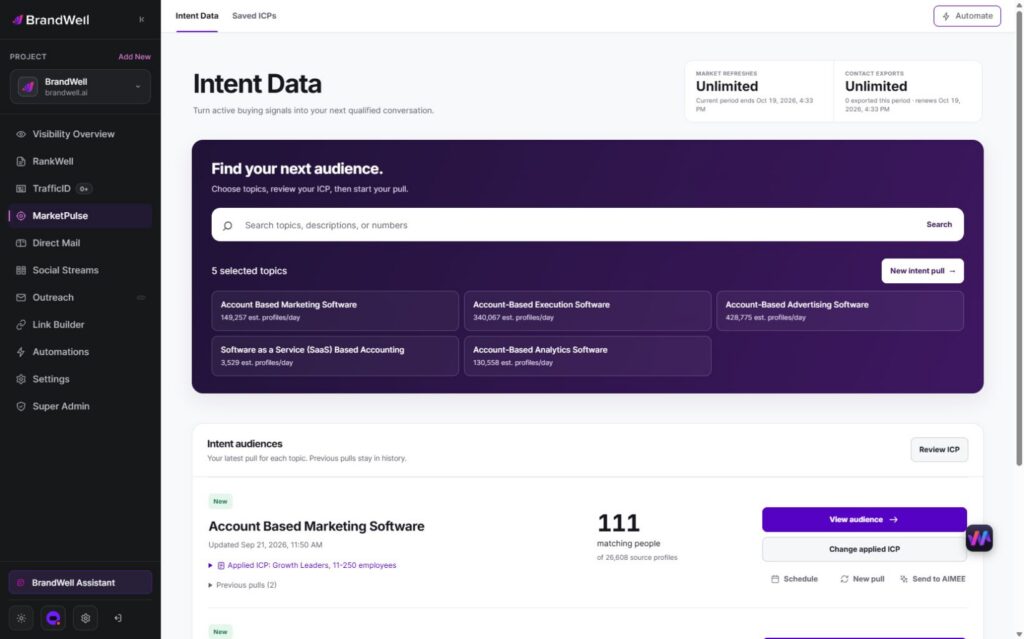
BrandWell MarketPulse: intent data starting at $500/mo. Find people researching topics relevant to what you sell, apply saved ICP filters, and review available contact details before taking action.
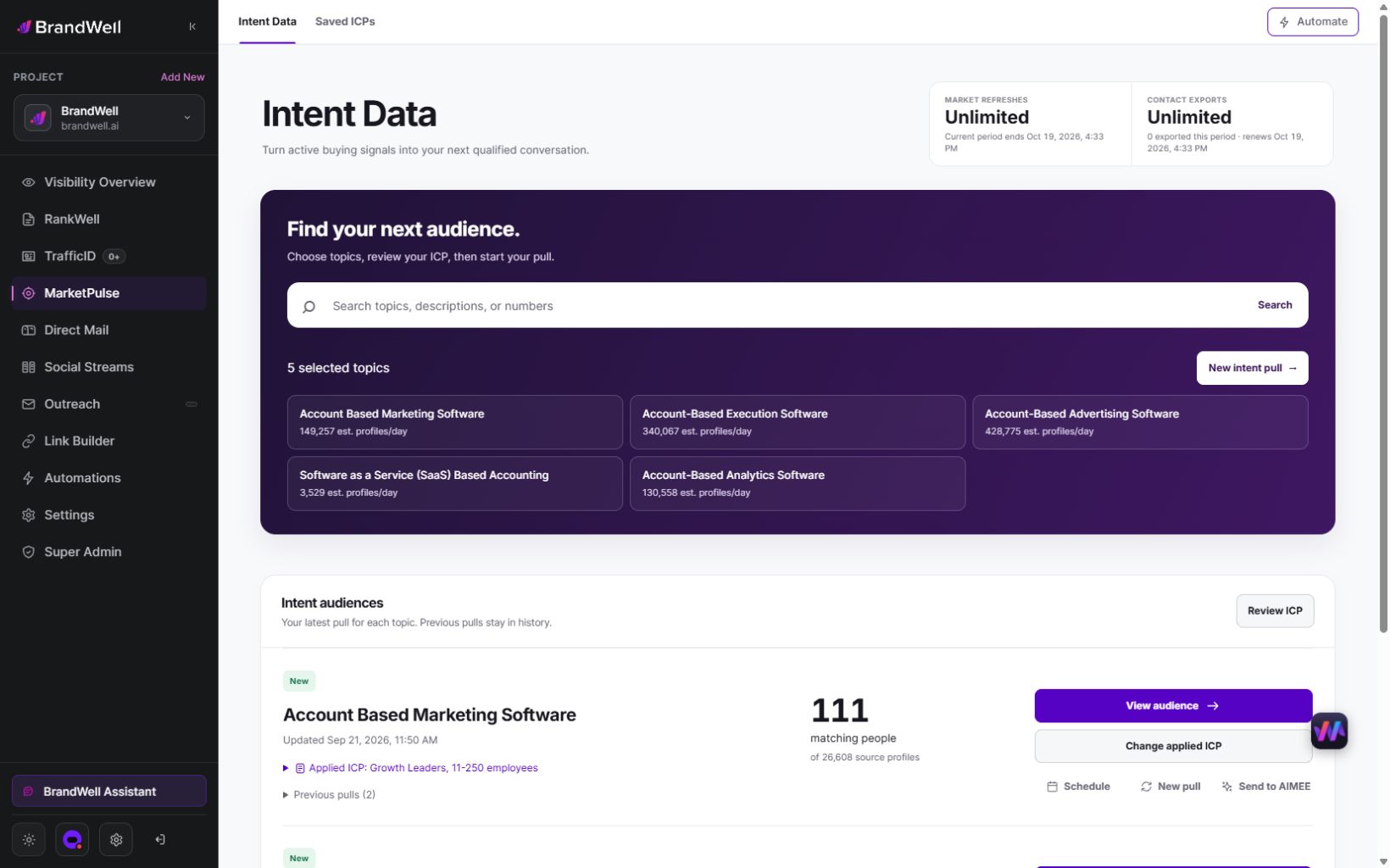
MarketPulse plans are starting at $500/mo. Verify current package scope and offers on the product page.
| Plan | Topics and refreshes | Monthly exports |
|---|---|---|
| Starter | 1 topic, weekly | 25,000 contacts |
| Growth | 3 topics, daily | 100,000 contacts |
| Scale | 10 topics, daily | Unlimited contacts |
Swipe the table to see all columns.
A pull retrieves available data from the previous 24 hours for one topic. Daily use across all included topics provides 90 Growth pulls or 300 Scale pulls in a 30-day month. Weekly Starter pulls vary by calendar month. Available audience size and contact fields vary, and audiences may overlap. Refreshes stop at the plan limit without overage charges.
- Find and qualify: search the topic catalog, save your ICP, and review the people and companies that match.
- Act on the research: export qualified contacts or prepare an Outreach or Direct Mail workflow. Connected products, channel usage, and fulfillment may cost extra.
- Get help from AIMEE: Growth and Scale include AIMEE for the initial user to research accounts and prepare the next step through connected tools.
Agencies and other service businesses can build client deliverables around their available Intent Scans and exports. Keep each client’s scope, permissions, and service fees clear. A subscription is not a promise of a white-label platform or exclusive access to a market.
Explore MarketPulse and watch the demo or compare plans starting at $500/mo. Any early-access discount is a separate, time-limited offer shown to an eligible recipient.
Check five readiness requirements
Intent data is a good fit when it helps a team choose among more plausible accounts than it can work. It is premature when the team cannot define a market, does not know which customer problem it solves, has no owner for follow-up, or cannot distinguish a qualified conversation from a lead. No signal feed can repair those gaps.
Use five readiness tests:
- ICP evidence: The team can describe successful and unsuccessful customers using observable company, role, problem, and buying-context attributes.
- Market concentration: There is a meaningful pool of accounts worth prioritizing, rather than a handful of named companies every seller already knows.
- Sales capacity: Someone can review and act on a small queue within an agreed service level.
- Signal relevance: The team can define topics, site behaviors, and first-party events tied to a real problem – not merely broad industry interest.
- Outcome return: CRM stages and opportunity outcomes can flow back to the operator so thresholds can change.
Failing one test does not end the project. It changes the next action. Fix ICP evidence, instrument a high-value website path, clean account ownership, or define outcome fields before buying a larger stack. That is the central decision in an intent-led growth for Series A companies strategy.
Use seven bounded workflow steps
This intent-led growth for Series A companies implementation guide is intentionally small enough to audit.
1. Freeze one commercial decision
Choose a decision such as “which 20 accounts should the team research this week?” or “which known website visitors deserve a human follow-up review?” Do not start with “score every account.” Write the eligible market, excluded accounts, action owner, response window, and prohibited actions.
2. Create a versioned topic and signal dictionary
Keep a versioned topic label, meaning, included and excluded concepts, source, observation unit, recency and uncertainty. A topic dictionary does not establish useful coverage, accuracy or a native implementation of a vocabulary standard.
3. Combine fit with first-party and third-party evidence
Keep first-party observations, third-party topics and firmographic or role evidence separate. Verify actual context and uncertainty. A form, page event or topic does not establish budget, authority, purchase readiness or permission for every action.
4. Resolve identity without erasing uncertainty
Store whether the observation is a known person, candidate person, company match, domain match, or unresolved visitor. Retain source, match time, confidence, and validation status. A company match does not establish which employee acted, and enrichment does not turn an inference into a fact.
5. Apply fit, freshness, suppression, and human review
Require the account to pass ICP rules, the evidence to fall inside a declared time window, and the record to pass customer, competitor, employee, duplicate, geography, consent, and opt-out suppressions. A reviewer should accept, reject, defer, or investigate with a reason. Do not auto-enroll a person from a single inferred event.
6. Route context, not a “hot lead” label
Give the seller an evidence card: account, role candidate, source, topic or page, timing, prior relationship, uncertainty, permitted next steps, and message constraints. The action could be research, account-plan enrichment, ad-audience review, a contextual email to an existing contact, or no action.
7. Return the downstream result and decide whether to expand
Capture queue acceptance, action, response, meeting qualification, opportunity creation, stage movement, disqualification reason, opt-out, and cost. Expand topics, account volume, or automation only after the team can explain why accepted records outperform the appropriate baseline. This is an operating framework, not a benchmark promise.
Keep four evidence states distinct
The simplest signal-to-action workflow for a Series A company is a four-state ladder:
- Research-only: A relevant account shows a fresh topic signal. Action: enrich the account and add it to a review queue.
- Fit plus repeated evidence: A target account shows recurring or multiple relevant signals. Action: prepare an account brief and check ownership or open opportunities.
- First-party corroboration: A known contact or confidently matched account engages with a decision asset. Action: human review for a contextual next step.
- Sales-confirmed state: A seller validates problem, role, timing, or process. Action: use normal opportunity stages; never let the intent score override seller evidence.
These are intent-led growth for Series A companies implementation examples, not claims that any signal proves a buying stage. Use these states to flag an actual risk: exposing a probabilistic inference in outreach as though the seller watched a named person research.
Compare actual operating constraints
Compare tools against the actual evidence-loop gap: necessary input, verifiable output, operator labor, policy fit, integration burden, exportability and total cost. Verify a representative sample before assuming a subscription will solve an operating constraint.
- Existing CRM, analytics, and a manual worksheet: Consider while proving the decision and vocabulary. Lowest software burden; highest operator discipline. Limited off-site visibility.
- Modular point tools or APIs: Consider when the team needs one capability such as enrichment, validation, visitor qualification, or a narrow topic feed. Integration and exception handling remain internal.
- A managed agency or reseller service: Consider when internal RevOps capacity is constrained but the economics support a recurring operator. Require data separation, a named SLA, decision-ready reporting, and an export path.
- A broader enterprise platform: Consider when multiple teams need coordinated advertising, orchestration, analytics, and governance. It can be premature for a Series A company that has not proven one workflow.
For build versus buy, software fits a team with a clear process and operator; an agency fits a team that needs process, reporting, and execution capacity; in-house development fits a repeated proprietary decision with engineering ownership. The status quo is also a legitimate alternative when the readiness gate fails.
Count full workflow costs
Intent-led growth for Series A companies pricing should separate data, platform, implementation, integration, enrichment and validation, operator labor, seller research, creative or media, privacy review, and measurement. Use a pilot cost ceiling before requesting quotes. Compare cost per reviewed account, accepted signal, qualified meeting, and opportunity – not cost per raw record.
Measure cohorts and stop rules
Intent-led growth for Series A companies ROI should be evaluated as a decision-improvement experiment. Freeze an eligible-account cohort and, where feasible, compare it with a matched baseline or randomized holdout that receives normal treatment. Track:
- coverage and no-match rate;
- freshness at review and median queue age;
- reviewer acceptance and rejection reasons;
- action within SLA;
- positive response and qualified meeting rate;
- opportunity creation and qualified pipeline;
- sales-cycle progression by cohort;
- opt-outs, complaints, and data corrections;
- fully loaded cost and contribution margin.
Do not claim deterministic attribution. Signals, seller skill, brand, timing, product fit, media, and market conditions interact. Stop when the queue is mostly off-ICP, stale, unexplainable, or unactioned; when governance cannot be satisfied; or when qualified outcomes do not justify cost. Expand only the dimension supported by evidence: a topic, segment, source, action, or integration.
Verify purpose and action boundaries
Verify actual source rights, necessary fields, permitted purpose, access, retention, suppression, correction, deletion and incident ownership. Resolve missing requirements before activation.
Verify actual recipient, jurisdiction, purpose, channel and opt-out obligations before contact. A vendor contract or business address does not establish permission. Resolve missing approval before action.
Scope a separate agency operating service
A useful agency offer has one outcome, one topic set, one market, a capped weekly queue, a signal dictionary, a review SLA, a CRM disposition loop, and a monthly evidence review. Charge for the maintained operating system – not a recurring dump of names. Give the client the right to see rejected cases and adjust rules.
Here, BrandWell means the MarketPulse intent-data and growth automation platform, connected with the broader BrandWell content and growth tools.
BrandWell MarketPulse is topic-based intent-data software for businesses and agencies. Choose relevant research topics, apply saved ideal-customer-profile filters, review available names, roles, companies and contact details, and export the audience or prepare a connected workflow. Plans start at $500/mo. TrafficID identifies visitors to your own website and is a separate product. A MarketPulse subscription does not by itself promise a white-label portal, custom API implementation, exclusive topics, or managed client delivery.
Evaluate MarketPulse with a representative topic and a defined ICP. Review the matching audience, prepare one useful action with BrandWell’s connected tools and AIMEE, and measure the operating effort. MarketPulse plans are starting at $500/mo; agree on the package, evaluation period, and success criteria before expanding.
Keep assistant work within approval
AIMEE can prepare a review brief through configured connected tools. Keep proposed actions separate from actual approvals and destination acknowledgements. Confirm the implementation and permissions before execution.
Objective: prepare the Series A account-review queue; do not contact anyone.
Inputs: approved ICP rules, topic dictionary, source and time, identity state,
CRM lifecycle, suppressions, and permitted-use policy.
For each record: preserve provenance; test fit and freshness; mark confidence;
check customer, employee, competitor, duplicate, geography, and opt-out rules;
produce an evidence card; recommend research, defer, reject, or human review.
Never infer budget, authority, or purchase readiness. Never expose private research
behavior in messaging. Stop before any external action and request named approval.
Output: decision, reason codes, missing evidence, suggested next step, audit log.
A written assistant prompt does not establish implemented rules, permission checks or stop behavior. Test actual output and preserve uncertainty before using a proposed action.
Series A buyer questions
How should Series A companies use intent data without overbuilding?
Prove one prioritization decision with a manual review queue before buying broad orchestration. Require ICP evidence, sales capacity, signal relevance, and outcome return.
What is the simplest signal-to-action workflow?
Ingest one signal, preserve provenance, add fit and identity state, apply freshness and suppressions, route an evidence card to a human, and return the result.
What are the best affordable tool choices?
Start with existing CRM and analytics, then compare modular tools, a managed service, and a broader suite by total operating cost and decision fit. No class wins universally.
Software, agency, or in-house?
Buy software when the process and owner exist; hire an agency when operations are the gap; build when the workflow is proprietary, repeated, and engineering-owned. Wait when readiness is missing.
What should a Series A company budget?
Set a pilot ceiling using conservative deal economics and include data, platform, integration, labor, media, governance, and measurement. A quote is only one cost line.
Which measures describe pipeline and operating use?
Use coverage, acceptance, SLA, qualified meetings, opportunities, cohort pipeline, cost, corrections, and opt-outs. Treat attribution honestly.
When is intent data a fit or premature?
It fits a defined ICP with excess plausible accounts, available sellers, and measurable outcomes. It is premature before product-market-fit evidence or when every account is already known.
Which signals matter most?
Verify context, recency, identity state, fit and seller evidence for each proposed action. First-party status alone does not establish buyer readiness or permission.
Which risks matter most?
Watch weak provenance, interest mislabeled as purchase intent, false identity, stale records, missing suppression, insecure access, unclear permitted use, and automated outreach without review.
What should an agency offer?
Scope a capped agency account-review service with actual signal definitions, human approval, feedback and a stop rule. A white-label interface, custom connector or managed client delivery requires separately verified implementation, rights and fees. A MarketPulse subscription does not establish these service capabilities.
The next step is not “buy more data.” It is to write the one decision, the readiness evidence, the cost ceiling, and the stop rule. Then request a scoped coverage review only if those four items survive scrutiny.
Copyable readiness decision record
Decision: [Actual operating question and named owner.] Customer evidence: [Observed problem, source, date and unresolved hypotheses.] Scope: [Topic, unique account unit, period and exclusions.] Readiness: [Each required gate, actual evidence and missing cases.] Action: [Eligibility, approver, implemented destination and acknowledgement.] Measurement: [Buyer outcomes, missing feedback and suitable comparator.] Budget: [Full cost, capacity, stop date and exit.]
GOV.UK user-needs guidance separates research from assumptions. Keep actual customer evidence distinct from internal hypotheses; this government service guidance does not validate a startup market or predict revenue.
Worked example: four passed gates do not fill the fifth
Assume a fictional team defines five required readiness gates. Four have documented evidence, but outcome-return ownership remains unresolved. Four of five is 80% documentation coverage, not 80% readiness or permission to launch. Resolve the missing required gate before relying on downstream outcome measurement. Funding does not fill it.
Suppose ten customer interviews include six confirmations of a defined problem and four disconfirmations. The descriptive confirmation rate is 60% of those interviews. Selection, question wording and missing perspectives limit interpretation; it does not establish market-wide demand, willingness to pay or product-market fit. Preserve the disconfirming evidence rather than editing it out of the ICP.
Measure each actual funnel denominator
A fictional pilot has 100 unique accounts, 60 eligible for review and 30 accepted by sellers. Acceptance is 50% of eligible accounts or 30% of the full cohort. Twenty-four accepted accounts have feedback; six remain unresolved. Eight verified opportunities are 33.3% of the 24 reported accounts, 26.7% of accepted accounts or 8% of the full cohort. Name the denominator and missing feedback. Seller acceptance is not a buyer outcome, and associated opportunities are not incremental revenue.
Check the full delivery remainder
At $2,400 in defined pilot costs, descriptive cost is $80 per accepted account or $300 per verified opportunity. A fictional $3,200 agency fee leaves $800, or 25%. Another $900 in correction work makes the remainder negative $100. Setup, acquisition, general overhead, tax and financing are excluded and can further change the result. These invented inputs are not BrandWell agency-service prices, typical margins or proof of causal returns.
Prepare the supported research input
Review an available MarketPulse topic, saved ICP and actual preceding-24-hour matches for the approved purpose. Verify company context and preserve uncertainty. TrafficID is separately scoped own-site visitor work. AIMEE can organize supplied context through configured tools. Owners approve exports, messages, Outreach enrollment, audience uploads and CRM writes. Custom reports, client interfaces and synchronization require separately verified implementation, rights, scope and fees.
Frequently asked readiness questions
Can funding substitute for customer evidence?
No. Keep the actual problem and demand evidence separate.
Can an aggregate score fill a missing required gate?
No. Resolve each actual blocking requirement.
Does interview confirmation prove market demand?
No. Preserve the sample and research limits.
Does MarketPulse include a white-label service?
Do not assume that. Verify and scope any custom service separately.
Review the research product: explore MarketPulse and current plans.
Reviewed and updated October 3, 2026.

Written by