On this page
- Current MarketPulse research workflow
- Check actual market-test readiness
- Use seven readiness questions
- Run seven bounded test steps
- Compare three operating approaches
- Choose capabilities for the actual gap
- Separate discovery, pilot and scale budgets
- Measure actual qualified outcomes
- Verify source and action boundaries
- Scope a separate market-entry service
- Copyable market-entry test record
- Frequently asked market-entry questions
Intent-led growth for a growth-stage company starts with a bounded test: define fit, evidence, eligibility, owners and follow-up capacity before increasing research volume. Keep signals separate from buyer-confirmed outcomes. Expand only against a written decision rule and measured operating constraints.
Current MarketPulse offer: intent-data plans start at $500/mo. See the product, demo, and current plans. Updated October 3, 2026.
Current MarketPulse research workflow
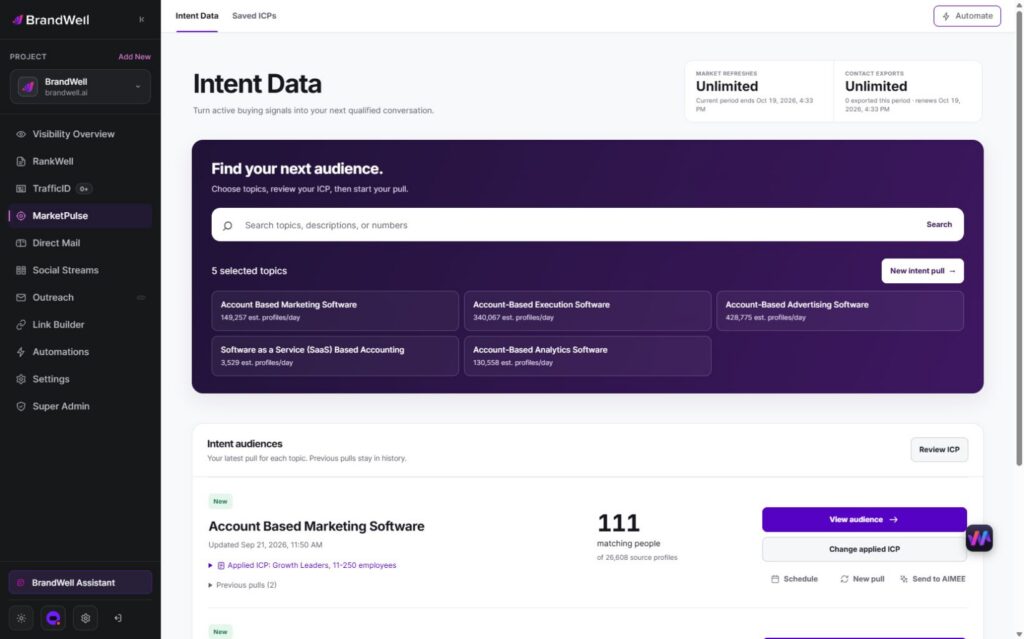
BrandWell MarketPulse: intent data starting at $500/mo. Find people researching topics relevant to what you sell, apply saved ICP filters, and review available contact details before taking action.
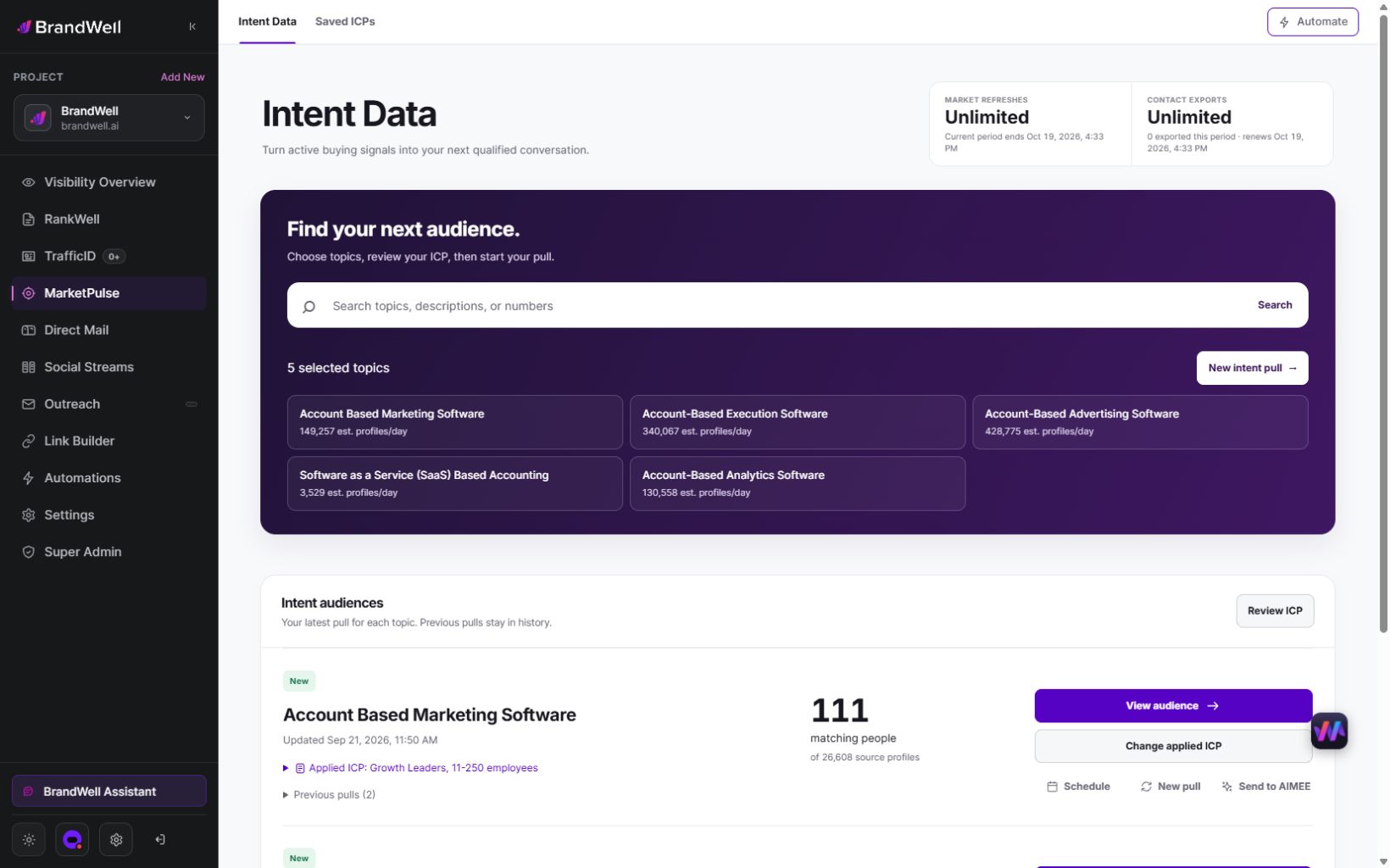
MarketPulse plans are starting at $500/mo. Verify current package scope and offers on the product page.
| Plan | Topics and refreshes | Monthly exports |
|---|---|---|
| Starter | 1 topic, weekly | 25,000 contacts |
| Growth | 3 topics, daily | 100,000 contacts |
| Scale | 10 topics, daily | Unlimited contacts |
Swipe the table to see all columns.
A pull retrieves available data from the previous 24 hours for one topic. Daily use across all included topics provides 90 Growth pulls or 300 Scale pulls in a 30-day month. Weekly Starter pulls vary by calendar month. Available audience size and contact fields vary, and audiences may overlap. Refreshes stop at the plan limit without overage charges.
- Find and qualify: search the topic catalog, save your ICP, and review the people and companies that match.
- Act on the research: export qualified contacts or prepare an Outreach or Direct Mail workflow. Connected products, channel usage, and fulfillment may cost extra.
- Get help from AIMEE: Growth and Scale include AIMEE for the initial user to research accounts and prepare the next step through connected tools.
Agencies and other service businesses can build client deliverables around their available Intent Scans and exports. Keep each client’s scope, permissions, and service fees clear. A subscription is not a promise of a white-label platform or exclusive access to a market.
Explore MarketPulse and watch the demo or compare plans starting at $500/mo. Any early-access discount is a separate, time-limited offer shown to an eligible recipient.
Check actual market-test readiness
This guide is for B2B companies entering a new geography, vertical, segment, or use-case category, plus the agencies helping them. It assumes the company has a specific offer, an accountable GTM owner, enough deal value to justify research, and a CRM or other outcome system. It is not a generic market-research guide, a list of geo-targeting tricks, or a claim that a topic signal proves market fit.
Use seven readiness questions
SBA market-research guidance covers demand, size, location, saturation, pricing and barriers. Define the actual market hypothesis before buying more research or automation.
Before buying another platform, answer these questions:
- What market thesis are we testing, and what evidence would disprove it?
- Which companies and buying roles fit the offer?
- Which alternatives, barriers, regulations, and buying constraints shape demand?
- What deal value, margin, cycle length, and sales capacity make the test viable?
- Which research topics or owned interactions would be relevant – but not conclusive?
- What action can the team lawfully and operationally take?
- Which CRM outcome will determine stop, revise, or expand?
Intent data is a good fit when the market has an identifiable account universe, meaningful consideration, observable research activity, and a team able to follow up. It is premature when the ICP is vague, the offer is untested, signal volume is tiny, the sales team has no capacity, no outcome is recorded, or there is no compliant activation route.
Use the readiness gate to check two potential mistakes: overbuilding a GTM stack before learning whether the market responds, and mistaking research volume for willingness to buy.
Run seven bounded test steps
Use a bounded test with an inspectable evidence chain.
Step 1: Write the market thesis and stop condition
Define the ICP, geography or segment, buying roles, exclusions, offer, value hypothesis, expected sales path, and minimum useful outcome. Write the conditions that would cause the team to stop before seeing results. Failure mode: changing the target or success definition after the test starts.
Step 2: Create a signal map
Separate first-party signals such as site visits, content interactions, forms, product activity, and event engagement from third-party topic, category, competitor, review, or research signals. Record the observation unit, source, specificity, timestamp, and permitted use. Failure mode: blending unlike events into an unexplained score.
Step 3: Review coverage and sample output
Ask for a market coverage review and inspect representative records before signing a broad commitment. Check relevant volume, account fit, geography, freshness, provenance, match basis, duplicates, and likely false positives. Failure mode: treating a vendor’s total database size as coverage of the chosen market.
Step 4: Prioritize with fit, intent, freshness, and confidence
Keep fit, topic evidence, freshness and match confidence as separate review fields. A qualitative score is not a calibrated probability. High topic activity from an out-of-market company may be less useful than moderate, recent research from a strong-fit account. Do not publish universal weights; calibrate the model against accepted and rejected outcomes. Failure mode: declaring a record “sales ready” because it crossed an arbitrary score.
Step 5: Resolve only eligible identities
Account-level evidence is often enough for planning or advertising. Resolve a person only when the approved action requires it and when provenance, purpose, notice, policy, suppression, and confidence allow. Failure mode: claiming a resolved contact was the person who generated an account-level signal.
Step 6: Activate one constrained channel
Choose one channel the market and team can support: aggregate planning, content nurture, eligible advertising, or human-reviewed outreach. Define messaging boundaries and a human approver. Failure mode: launching ads, sequences, and SDR tasks simultaneously, making it impossible to learn which path worked.
Step 7: Compare evidence with prewritten gates
Use a baseline, holdout, or control/treatment design where feasible. Record coverage, accepted records, activated records, qualified outcomes, cost, and exceptions. Stop, revise, or expand according to the rules written at the start. Failure mode: scaling because clicks rose while qualified pipeline did not.
Compare three operating approaches
Compare the three options using time to first test, required skills, fixed and variable cost, customization, data control, governance, measurement, portability, and limitations.
Build in-house
Build when RevOps, data, demand generation, sales, privacy, and measurement capabilities already exist and the workflow is strategically differentiating. It provides control and deep integration. Limitation: implementation and maintenance can delay learning, and internal labor is easy to omit from the cost model.
Buy software and data
Buy when the team understands the workflow and can operate a platform. This can accelerate signal access and automation. Limitation: software does not define the market thesis, approve data use, create sales capacity, or repair weak outcome tracking.
Hire an agency
Use an agency when speed, implementation help, managed review, or cross-functional coordination matters more than maximum internal control. Require client-isolated processing, transparent sources, documented handoffs, access controls, and export rights. Limitation: an opaque managed service can hide data problems and create dependency.
Manual research remains a valid alternative for a tiny account set or early interviews. Record the actual time and learning from the selected manual method. Move to automation only when volume, refresh needs, and stable acceptance rules justify it.
Choose capabilities for the actual gap
“Affordable” means the lowest total-cost system that can answer the market question responsibly, not the product with the lowest subscription price. Start with these capabilities:
- Market research and interview notes
- An account universe with fit and exclusion fields
- First-party instrumentation and one relevant external intent source
- Account matching and optional person-level enrichment
- A CRM, governed warehouse, or controlled sheet
- One activation destination
- Consent, suppression, retention, and deletion controls
- An experiment plan, outcome ledger, and decision memo
For every capability, document the least-complex viable manual method, the trigger for automation, the owner, and the limitation. A spreadsheet can support a pilot if access, provenance, and suppression are controlled. A sophisticated platform can still fail if no one reviews output or records sales dispositions.
Useful templates include a market-thesis canvas, coverage-sample rubric, signal dictionary, identity-confidence field, approved-action matrix, channel test brief, rejection-reason list, and stop/expand decision record. Use those resources to preserve the actual test question and owners.
Separate discovery, pilot and scale budgets
Separate three budgets so the team does not commit scale money before it has evidence.
Discovery includes market research, interviews, account-universe construction, topic design, coverage sampling, and privacy or platform review. Pilot includes scoped signal data, matching, enrichment, CRM setup, one channel, creative or outreach preparation, operator time, QA, and measurement. Scale adds markets, topics, volume, integrations, automation, media, ongoing operators, support, security reviews, and change management.
Calculate total cost as data + identity + implementation + internal labor + agency services + activation or media + governance + measurement + rework. Compare cost per eligible account, accepted account, reached account, qualified opportunity, and usable learning. Avoid “cost per lead” when the definition includes unmatched, ineligible, or unreviewed records.
Ask for a written quote specifying topics, geography, signal unit, coverage, match basis, modules, volume, destinations, users, service work, contract term, overages, onboarding, exclusions, deletion, and exit. A staged budget gives the company permission to stop without defending a large sunk investment.
Measure actual qualified outcomes
Use a funnel that keeps data quality, activation, and business outcomes separate:
- Coverage: relevant signal volume, eligible accounts, ICP coverage, and freshness
- Quality: sample acceptance, match confidence, duplicates, suppression, and rejection reasons
- Activation: eligible-to-approved-to-reached rate, latency, spend, and delivery errors
- Pipeline: sales acceptance, qualified meetings, accepted opportunities, stage progression, and cost per accepted opportunity
- Business: pipeline and revenue with a denominator, attribution rule, time window, and confidence note
Use a suitable comparison with documented assignment, population, overlap, equal-age observation window, exclusions and uncertainty. A small test can provide descriptive learning without proving that the program caused new revenue.
Stop for insufficient coverage, persistent ineligibility, unacceptable match quality, or poor economics. Revise when the market may be sound but the fit rule, message, offer, or channel is weak. Expand only after qualified outcomes repeat and the operating team can absorb more volume.
Verify source and action boundaries
Verify actual source, observation unit, match basis, recipients, purpose, notices, access, retention, correction, suppression, deletion and export. Resolve applicable jurisdiction, channel and rights requirements before activation. A vendor contract or research label is not permission.
Avoid these failures:
- Mentioning inferred research in “creepy” outreach
- Assuming account activity identifies an individual
- Buying data without validating source and permitted use
- Using sensitive topics for targeting
- Letting stale signals remain in a current-priority queue
- Ignoring opt-outs or suppression across destinations
- Allowing an agent to send outreach or change spend without approval
- Treating a vendor contract, hashing, or a consent banner as end-to-end compliance
Applicability depends on jurisdiction and channel. Obtain appropriate privacy and legal review and recheck current platform policies before activation.
Scope a separate market-entry service
An agency should begin with a coverage review and constrained pilot, not a promise of unlimited leads. Deliver a market and ICP brief, signal map, branded topic or account report, eligibility register, one approved activation plan, experiment readout, and stop/revise/expand memo. The recurring layer can add signal refresh, new-account review, suppression and quality QA, messaging recommendations, outcome reporting, and threshold recalibration.
MarketPulse supplies topic research and available match details. AIMEE can organize supplied context through configured tools. An agency operating service, branded weekly report, CRM synchronization or custom client interface needs separately verified implementation, rights, scope and fees. The research subscription does not establish those delivery capabilities.
MarketPulse supplies topic research and available match details. AIMEE can organize supplied context through configured tools. An agency operating service, branded weekly report, CRM synchronization or custom client interface needs separately verified implementation, rights, scope and fees. The research subscription does not establish those delivery capabilities.
AIMEE can prepare a review brief through configured connected tools. Keep proposed actions separate from actual approvals and destination acknowledgements. Confirm the implementation and permissions before execution.
Before operational use, complete product, pricing, privacy, security, compliance, legal, and platform-policy review. The purpose of an intent-led market-entry plan is not to create certainty from weak signals; it is to learn faster while limiting cost and risk.
Copyable market-entry test record
Thesis: [Actual buyer problem, market and disconfirming evidence.] Universe: [Unique account unit, geography, exclusions and sample limitations.] Research: [Topic definitions, source, period, uncertainty and interviews.] Action: [One approved channel, owner, eligibility and acknowledgement.] Outcome: [Qualified stage, observation window and missing feedback.] Economics: [Discovery, pilot, activation, labor and excluded costs.] Decision: [Comparator, uncertainty, stop, repair or expansion rule.]
Worked example: observed research is not the addressable market
Assume a fictional target universe has 200 unique accounts and the selected source observes research associated with 100. Observed coverage is 50% of that defined universe. It does not mean the unobserved 100 lack interest or that the observed 100 will buy. Check source coverage, topic definitions, observation unit and time window before interpreting a market opportunity. These invented counts are not typical MarketPulse output.
Suppose 60 observed accounts pass fit checks, 30 enter seller review and feedback exists for 20. Eight verified qualified opportunities are 40% of reported accounts, 26.7% of the 30 reviewed accounts or 4% of the full 200-account universe. Ten reviewed accounts lack feedback. A topic appearance is not buyer commitment, and excluding unresolved records can inflate the apparent rate.
Keep the test definition stable
If the original test targets one geography and later adds a different vertical, preserve separate cohorts and versions. Changing the audience, message and channel together prevents a simple interpretation of what changed. Report each actual population and equal-age outcome window. A descriptive improvement alone does not establish incremental demand or product-market fit.
Separate pilot costs from expansion promises
A fictional pilot uses the standard $500 Growth plan, $300 in setup and $700 in review, totaling $1,500 in defined costs. With eight qualified opportunities, descriptive cost is $187.50 each. A separate fictional $2,000 agency fee leaves $500, or 25%; another $600 in corrections makes the remainder negative $100. Discovery, acquisition, general overhead, tax and financing are excluded. Do not count earlier discovery costs twice or omit them from a whole-program calculation. These invented service inputs are not BrandWell agency-service prices or typical returns.
Use the actual research workflow
Review an available MarketPulse topic, saved ICP and actual preceding-24-hour matches for the approved purpose. Verify public company context and preserve unknown market fit. TrafficID is separately scoped own-site visitor work. AIMEE can prepare research through configured tools. Owners approve exports, messages, Outreach enrollment, audience uploads and CRM writes. Custom client reports, interfaces and integrations require separately verified implementation, rights, scope and fees.
Frequently asked market-entry questions
Does source coverage measure the whole market’s demand?
No. Preserve the actual source and universe limits.
Are unobserved accounts proven uninterested?
No. Absence from a source is not a buyer statement.
Can several simultaneous changes identify one winning cause?
No. Use a suitable design and disclose interpretation limits.
Does a qualified opportunity prove collected revenue?
No. Track actual closures, costs and receipts separately.
Review the research product: explore MarketPulse and current plans.
Reviewed and updated October 3, 2026.

Written by